Archival Inquiry & Philological Research

The Secret Histories of Human Speech

Every word we speak is an archival artifact. Letters & Letters investigates the forgotten origins of our vocabulary, the cultural traditions behind everyday sayings, and the genuine authorship of timeless quotations, cross-examined against primary manuscripts and historical lexicons.

The Editorial Desks

Word Origins

Classical Roots & Semantic Shifts

Tracking words across millennia from Proto-Indo-European reconstructions to Classical Latin, Norman French borrowings, and modern English usage.

Explore All Word Origins →
§

Idioms & Sayings

Maritime, Courtly & Street Lore

The historical circumstances, naval deck orders, guild secrets, and theater traditions that gave birth to our most colorful everyday figures of speech.

Explore All Idioms →
“

Verified Quotes

Primary Sources vs Folk Misattributions

Curated collections of timeless philosophical wisdom from Voltaire to Marcus Aurelius, with apocryphal and misattributed quotes systematically debunked.

Explore Verified Quotes →
¿?

Bilingual Philology

The Spanish and English Linguistic Bridge

Investigating the deep classical connections, false cognates, Andalusian Arabic loanwords, and phonetic evolutions linking Spanish and English speech.

Explore Bilingual Archive →
Archival Fact-Check Ledger

The Folk Etymology Register

Popular culture loves colorful origin stories. Most are complete fiction. Below are four pervasive linguistic myths disproved by primary historical manuscripts.

Gringo Folk Myth Disproved
Popular Myth: American soldiers in green coats during the 1846 Mexican War ("Green, go home!").
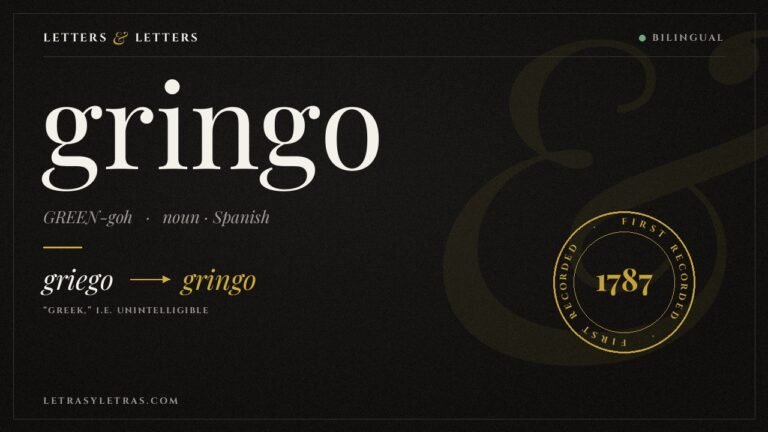
The Historical Record: Recorded in Madrid dictionaries in 1787 as an alteration of griego (Greek), meaning unintelligible foreign speech.
Primary Proof: Terreros y Pando, Diccionario Castellano (Madrid, 1787).
Examine Full Evidence →
Sincere Folk Myth Disproved
Popular Myth: Roman sculptors concealing cracks in cheap marble statues with wax ("sine cera").
The Historical Record: Classical Latin sincerus derives from PIE *sem- (one) and *ker- (to grow), meaning "of one growth", unadulterated, and whole.
Primary Proof: Classical Latin Corpus and Lewis & Short Latin Dictionary.
Examine Full Evidence →
Under the Weather Folk Myth Disproved
Popular Myth: Feeling ill as a direct result of cold rain or stormy weather.
The Historical Record: 19th-century seasick sailors were ordered below deck to the leeward side ("under the weather rail") where crashing spray was gentler.
Primary Proof: Naval logbooks and 1835 American print records.
Examine Full Evidence →
Boycott Folk Myth Disproved
Popular Myth: Captain Charles Boycott invented the social isolation tactic as an act of protest.
The Historical Record: Captain Boycott was the target, not the inventor. County Mayo tenants organized nonviolent ostracism against him in autumn 1880.
Primary Proof: Irish Land League records and London Times (November 1880).
Examine Full Evidence →

Recent Dispatches
Editorial Charter & Philological Methodology

The Letters & Letters Standard of Verification

We operate under a foundational conviction: a word or quotation is only as authentic as its earliest contemporary written record. We refuse hearsay, internet folklore, and unsourced attribution.

I

Primary Manuscripts First

Every etymology is traced to the Oxford English Dictionary (OED), Real Academia EspaƱola, and 18th-century print lexicons.

II

Zero Unverified Folklore

When an idiom origin cannot be verified in contemporary print records, we classify and debunk it as popular folk mythology.

III

Academic Citation Standards

Interactive quote and origin cards generate instant copyable APA 7th and MLA 9th edition academic citations for scholars and writers.

Scroll to Top