
English speakers use colorful vintage idioms every day without considering their historical origins. We tell restless children to hold their horses.
Colleagues describe exhausted workers as burning the candle at both ends. Others joke about the bee’s knees during friendly chatter.
These peculiar sayings feel familiar. Yet their literal meanings often sound bizarre to modern ears.
Why equate excellence with a bee’s knee joint? How did barking up an empty tree become a metaphor for errors?
Linguistic history reveals that old fashioned phrases are not random nonsense. Each expression preserves a snapshot of ancient sailing ships, Victorian factories, or 1920s jazz clubs.
Quick Answer: What Are Old Fashioned Phrases?
Old fashioned phrases are traditional idioms and colloquialisms that originated in earlier centuries. Most grew out of specialized trades, naval navigation, military life, or popular youth culture.
While the technologies that created them have vanished, their figurative meanings survive. They endure because they convey human feelings through memorable, sensory metaphors.
Key Takeaways
- Old fashioned phrases preserve obsolete historical technologies like rope beds and tallow candles.
- The 1920s jazz age produced an explosion of playful animal anatomy sayings for excellence.
- Naval warships and sailing vessels contributed dozens of our most common daily expressions.
- Victorian trade hazards gave rise to vivid psychological idioms like mad as a hatter.
- Folk etymologies frequently invent dramatic domestic myths that conflict with written records.
The Roaring Twenties: Jazz Age Slang and Flapper Wit
The 1920s witnessed an explosion of American youth slang. Young people in post-war cities rejected formal Victorian phrasing.
They favored witty, rhythmic expressions instead. Many of these phrases paired animals with absurd physical attributes.
Others grew out of vaudeville theater and fast-paced newspaper comic strips. They reflected an energetic generation inventing its own cultural shorthand.
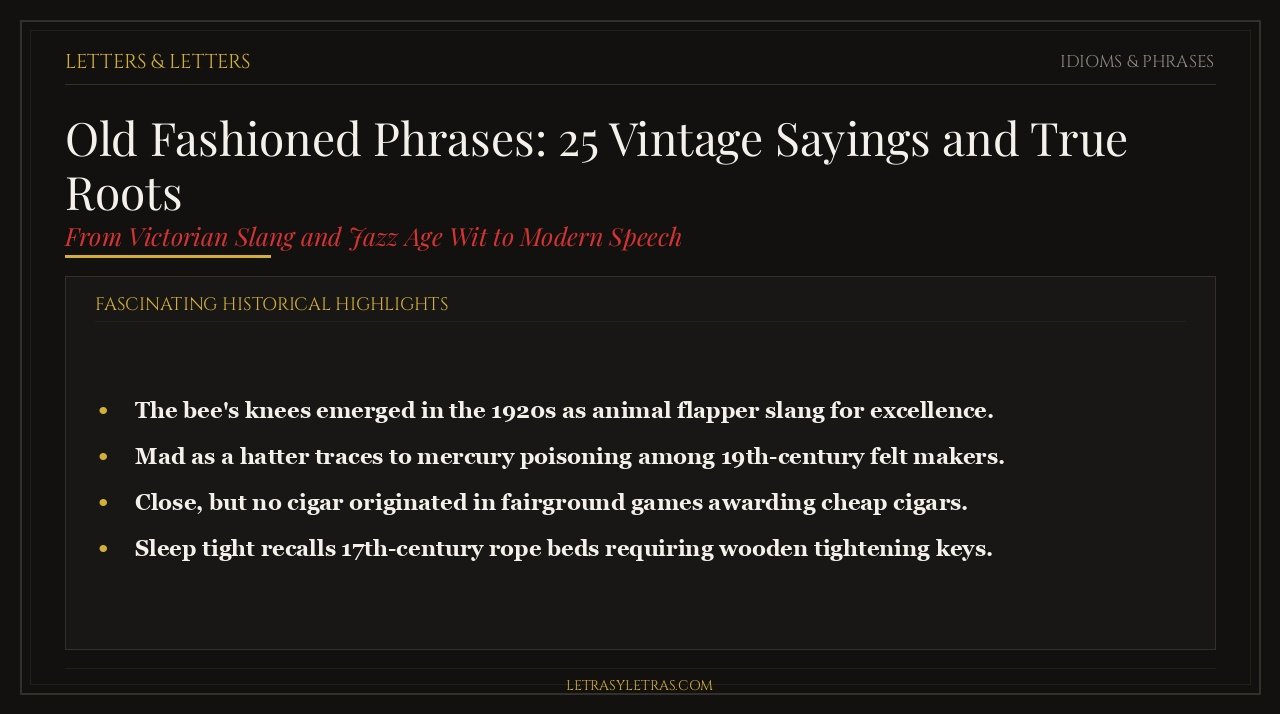
1. The Bee’s Knees
Today, calling something the bee’s knees means it represents peak quality. In the late eighteenth century, however, the phrase meant something that did not exist.
During the 1920s, American flappers repurposed the term into a badge of supreme approval. Etymologists document its sudden popularity alongside other playful phrases like the snake’s hips.
Historical citations cataloged by the Oxford Reference English Etymology archive trace its slang triumph to 1922 college campuses. The phonetic rhyme helped it outlast dozens of competing jazz era fads.
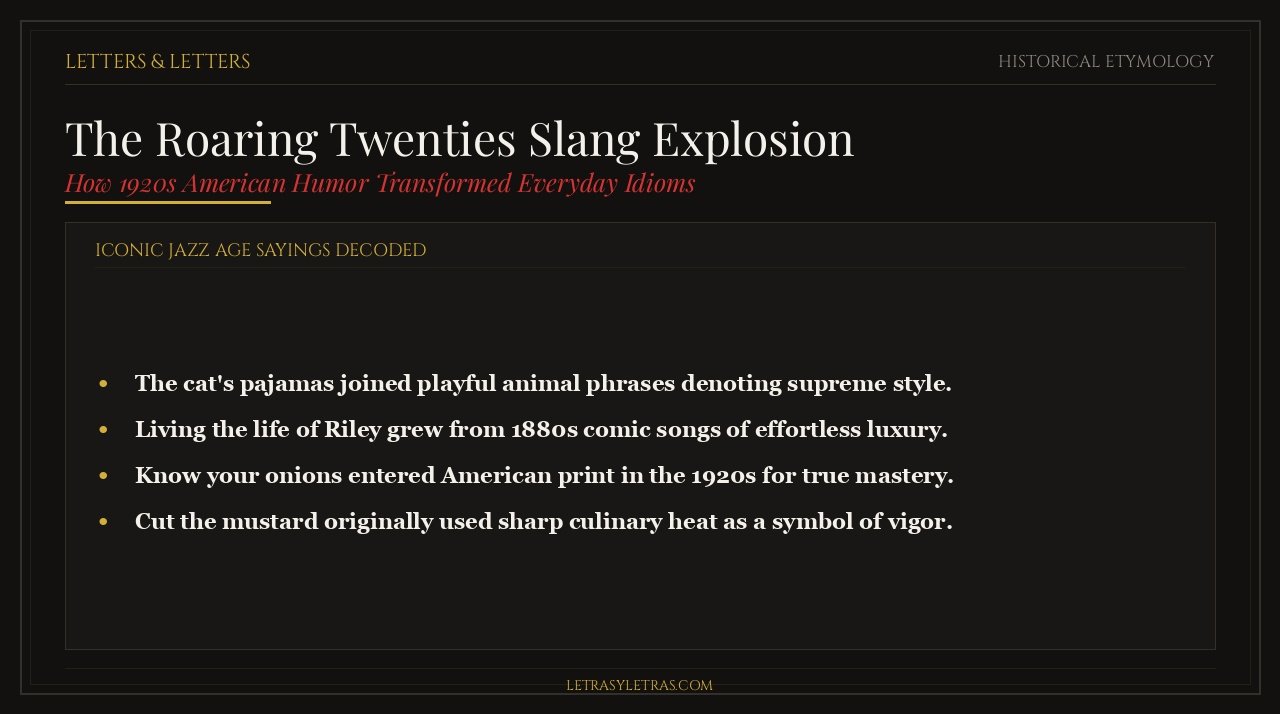
2. The Cat’s Pajamas
Cartoonist Thomas Dorgan popularized this expression in American newspapers during the early 1920s. He specialized in capturing urban slang in his syndicated comic strips.
Pajamas were considered modern loungewear for stylish women in that era. Giving fancy silk pajamas to a house cat created a comical image of luxury.
The phrase caught on immediately with city youth and college students. It became the ultimate compliment for a lively jazz record or a stylish dancer.
3. Know Your Onions
When someone knows their onions, they possess deep, practical competence. One popular folk story attributes the phrase to an English lexicographer named C.T. Onions.
Linguistic research disproves that clever tale. The term appeared in the American magazine Harper’s Bazaar in 1922. This date predated the famous Onions glossary.
Scholars believe onions served as rhyming slang or a humorous vegetable metaphor for layered skill. A similar linguistic path shaped the origin of the phrase cup of joe during that same era.
4. Living the Life of Riley
This nostalgic phrase describes a carefree existence filled with comfort and leisure. It originated in late nineteenth-century American music hall songs.
Songwriter Pat Rooney popularized the character of an ordinary Irishman who suddenly inherited wealth. The character spent his days dining on fine fare and avoiding hard labor.
Audiences loved the fantasy of effortless luxury. By the 1920s, living the life of Riley was standard American shorthand for enviable ease.
5. Cut the Mustard
To cut the mustard means to meet required standards or succeed under pressure. In nineteenth-century American slang, the word mustard represented genuine zest, heat, and vigor.
A spirited person or a gripping story was often described as being the genuine mustard. The verb cut implied selecting or harvesting the best portion of the crop.
Author O. Henry used the phrase in his 1902 story The Heart of the West. It quickly established itself as a staple of early twentieth-century conversation.
6. For Crying Out Loud
This vintage exclamation originated in American radio and theater in the early 1920s. It served as a gentle substitute for more profane oaths.
Writers needed expressions that sounded urgent without offending sensitive family listeners. Comic actor and cartoonist Thomas Dorgan helped cement its place in print.
The rhythmic cadence made it an instant favorite for expressing exasperation. It remains one of the few Roaring Twenties euphemisms still uttered today.
Victorian Quirks and Nineteenth-Century Street Slang
The Victorian era combined strict social etiquette with brutal industrial realities. Many enduring phrases reflect the harsh working conditions of that period.
Others grew out of frontier hunting customs and military medical crises before modern science emerged. They illustrate how ordinary people coped with difficulty through dark humor.
7. Mad as a Hatter
Lewis Carroll immortalized the eccentric Hatter in his 1865 masterpiece Alice’s Adventures in Wonderland. Yet the phrase existed in popular British speech decades earlier.
During the eighteenth and nineteenth centuries, felt hatmakers used mercurous nitrate to process animal fur. Prolonged exposure to toxic mercury fumes caused severe neurological damage.
Hatters developed tremors, slurred speech, paranoia, and memory loss. Tragic workplace poisoning gave society a dark, lasting idiom for erratic behavior.
8. Close, But No Cigar
This classic American phrase marks an effort that fell just short of victory. Its roots lie in late nineteenth-century fairgrounds and traveling carnivals.
Carnival booth games like ring toss and strength testers targeted adult male patrons. Rather than stuffed animals, operators awarded cheap tobacco cigars as top prizes.
When a player narrowly missed the winning target, the barker shouted that famous verdict. The phrase entered mainstream news reporting by the 1920s.
9. Barking Up the Wrong Tree
This vivid expression arose on the early nineteenth-century American frontier. Settlers hunted raccoons at night using trained hound packs.
Raccoons are agile climbers capable of leaping between interlocking tree canopies in the dark. A clever raccoon would escape while dogs barked at the base of an empty trunk.
Davy Crockett helped popularize the saying in his 1836 sketches. Today, it remains our go-to metaphor for pursuing mistaken leads or blaming innocent parties.
10. Bite the Bullet
To bite the bullet means to confront painful adversity with steady fortitude. The practice originated on military battlefields before surgical anesthesia became available.
Surgeons performing emergency operations needed a way to keep wounded soldiers from biting their own tongues in agony. Orderlies placed a soft lead musket ball between the patient’s teeth.
Rudyard Kipling recorded the phrase in his 1891 novel The Light That Failed. It reminds us of the raw physical grit demanded of historical soldiers.
11. Eat Humble Pie
Eating humble pie describes admitting an embarrassing mistake or suffering humiliation. The origin is a brilliant linguistic pun dating to fourteenth-century medieval England.
During royal hunts, lords and noble guests feasted on prime cuts of venison. Huntsmen and servants received the animal entrails, livers, and kidneys, known in Old French as numbles.
Cooks baked these organ meats into a pastry called umble pie. Over centuries, the pronunciation shifted from umble to humble, creating an accidental moral metaphor.
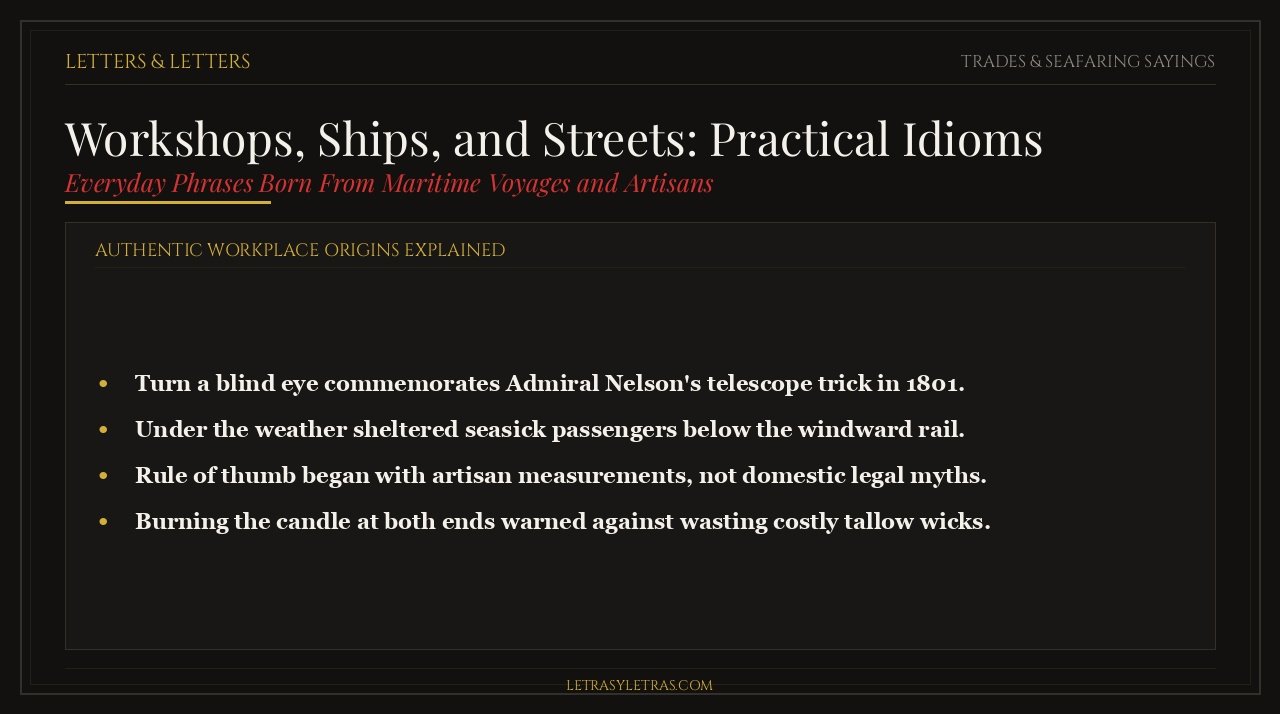
12. Turn a Blind Eye
This naval idiom means choosing deliberately to ignore an uncomfortable truth. It commemorates a historic act of military defiance by British naval hero Horatio Nelson.
At the 1801 Battle of Copenhagen, Nelson’s superior officer raised signal flags ordering an immediate withdrawal. Nelson had lost the sight in his right eye during an earlier Mediterranean campaign.
The admiral placed his telescope to his blind eye and remarked that he could see no signal. He continued the attack and secured a decisive British victory.
Seafaring and Military Sayings That Anchored Everyday Speech
The age of wooden sailing ships required immense discipline, physical coordination, and technical precision. Life at sea was dangerous, and sailors developed specialized vocabularies that gradually drifted ashore.
Our modern conversations regarding health, anger, and character remain deeply anchored in maritime tradition. Wooden vessels served as floating linguistic laboratories for the English tongue.
13. Under the Weather
When you feel unwell, you are drawing directly upon nineteenth-century naval architecture. During violent ocean storms, seasick sailors and passengers were ordered below deck.
They rested on the leeward side of the vessel, beneath the protective weather rail that faced into the wind. Resting under the weather sheltered them from crashing waves and spray.
American newspapers adopted the expression in the 1830s to describe mild illness. Explore our dedicated guide to the origin of the phrase under the weather for full shipboard blueprints.
14. Loose Cannons
In modern offices, a loose cannon is an unpredictable person who threatens collective safety. On eighteenth-century warships, a loose cannon was a literal disaster.
Heavy iron naval guns weighed several tons and were secured to wooden decks with thick hemp ropes. If a rope snapped during rough seas, the unsecured cannon became a deadly rolling battering ram.
The weapon could smash through hull timbers or crush sailors in seconds. Nineteenth-century writers quickly adopted the terrifying nautical hazard as a psychological metaphor.
15. Showing Your True Colors
Revealing your true colors means showing your genuine character after hiding your real motives. This phrase comes directly from maritime naval warfare and pirate deceptions.
Warships routinely hoisted the national flags, or colors, of neutral nations to approach enemies unsuspected. International maritime law, however, required vessels to hoist their authentic national colors before opening fire.
Raising your actual battle banner was showing your true colors. The practice passed into general English by the early eighteenth century. Similar maritime customs shaped the origin of the phrase passing with flying colors.
16. Three Sheets to the Wind
This colorful phrase describes profound drunkenness. In nautical terminology, a sheet is not a cloth sail, but rather a rope that controls the sail’s angle.
If three sheets slipped free from their cleats, the sails flapped wildly out of control in the wind. The ship wobbled and rolled through the water like an intoxicated sailor on cobblestones.
Novelist Pierce Egan used the idiom in his 1821 chronicle of London street life. It remains one of our oldest and most humorous drinking idioms.
17. In the Doldrums
To be in the doldrums means to feel sluggish, depressed, or lacking momentum. The word doldrums originally meant dullness or low spirits in late eighteenth-century speech.
In the nineteenth century, navigators applied the name to the Intertropical Convergence Zone near the equator. Across this latitude, prevailing trade winds collide and cancel out, creating dead calm seas.
Sailing vessels could remain trapped in stifling heat for weeks without moving an inch. That agonizing oceanic stillness became our universal phrase for emotional slumps.
18. Son of a Gun
While often used as a mild exclamation, son of a gun carries an affectionate historic tone. In the eighteenth-century Royal Navy, women occasionally lived aboard warships during long deployments.
Babies were sometimes born at sea, sheltered behind canvas screens between the ship’s massive broadside cannons. When paternity could not be determined, the naval register humorously listed the child as a son of a gun.
The phrase eventually evolved into an exclamation of surprise or admiration. It highlights the strange domestic realities of historic military life.
Domestic Life, Trades, and Artisan Folklore
Long before modern conveniences existed, daily survival depended on handcrafted tools. Ancient home routines gave rise to many of our most familiar sayings.
Studying their original context dispels widespread historical myths. It illuminates forgotten domestic crafts that sustained our ancestors through harsh winters.
19. Sleep Tight
Parents have tucked children into bed with this soothing farewell for generations. One widely repeated story claims tight refers to ropes holding sixteenth-century wooden bedframes together.
According to this theory, mattresses rested on woven ropes that sagged over time. Homeowners used a wooden bed key to tighten the ropes for a firm night of sleep.
Linguistic records in the Online Etymology Dictionary show that tight originally meant soundly or securely in Old and Middle English. Both the physical rope practice and the linguistic definition reinforced this beloved phrase.
20. Rule of Thumb
This popular expression describes a practical method based on experience rather than science. A persistent urban legend claims it derived from an ancient law. That false tale allowed husbands to beat wives.
Legal scholars have investigated this claim thoroughly. They found zero evidence in English common law.
Historical evidence instead points to woodworkers and tailors. Craftsmen used the width of their thumb, roughly one inch, for quick, reliable shop measurements.
21. Burning the Candle at Both Ends
This phrase cautions against exhausting personal energy by working excessively early and late. In sixteenth-century England, domestic candles were costly items handmade from animal tallow or beeswax.
Lighting a candle at both ends was reckless wastefulness that doubled the speed of consumption. French diplomat Randle Cotgrave recorded the proverb in his 1611 dictionary.
By the nineteenth century, the metaphor shifted from financial extravagance to physical exhaustion. Similar warnings against excess appear across our collection of english idioms and meanings.
22. Don’t Throw the Baby Out with the Bathwater
This common warning advises against discarding valuable things while eliminating defects. German satirist Thomas Murner first recorded the proverb in his 1512 book Narrenbeschwörung.
Popular folklore claims entire medieval families bathed in a single wooden tub, with infants washed last in dirty water. While medieval sanitation had limits, the saying was never a literal household event.
Murner created the exaggerated image as a comic metaphor for foolish overreaction. Philosopher Thomas Carlyle translated the expression into English during the 1840s.
23. Spilling the Beans
To spill the beans means to reveal a secret prematurely. Tour guides often repeat a dramatic story about ancient Greek council elections.
In that tale, voters dropped colored beans into jars. Someone allegedly knocked the jar over to reveal results early.
Historical research proves the phrase is purely twentieth-century American slang. It first appeared in American baseball newspapers in 1902 to describe upsetting an established game result.
24. Cold Feet
Having cold feet describes losing courage or backing out of a commitment at the final hour. While cold extremities are a natural physical reaction to fear, the phrase began in nineteenth-century fiction.
German novelist Fritz Reuter used the expression in his 1862 book Ut mine Stromtid. He described card players leaving with empty pockets.
American author Stephen Crane introduced it to English in his 1896 work George’s Mother. The phrase soon broadened into a general metaphor for sudden timidity.
25. Raining Cats and Dogs
This famous idiom describes an overwhelming downpour. A popular internet story claims pets slept in seventeenth-century thatch roofs. It asserts that heavy rains washed them off.
Thatch roofs were actually steep and slippery, making them dangerous perches for domestic animals. The real origin traces to London drainage crises. Satirist Jonathan Swift documented them in the British Library historical archives.
During heavy London rains, gutters overflowed, washing debris through the streets. Similar cultural crossovers between slang and language can be seen in the origin of the word gringo.
Historical Chronology: Tracing Old Sayings Across Centuries
Language evolves alongside major cultural shifts. The timeline below illustrates how different historical eras contributed distinctive idioms to modern conversation.
| Century / Era | Old Fashioned Phrase | Historical Milieu | Earliest Documented Context |
|---|---|---|---|
| 14th Century | Eat humble pie | Medieval hunting feasts | Pastry made from deer umbles (entrails) for servants. |
| 16th Century | Baby with the bathwater | German literary satire | Thomas Murner’s 1512 book on foolish household overreactions. |
| 17th Century | Burning candle at both ends | Household economy | Randle Cotgrave’s 1611 dictionary of English and French proverbs. |
| 18th Century | Mad as a hatter | Industrial manufacturing | Mercury poisoning symptoms among felt hat fabricators. |
| 1801 | Turn a blind eye | Royal Navy warfare | Admiral Horatio Nelson at the Battle of Copenhagen. |
| 1830s | Under the weather | Maritime passenger travel | Sheltering seasick travelers beneath the windward rail. |
| 1840s | Bite the bullet | Battlefield trauma surgery | Musket lead given to patients before modern anesthetics. |
| Late 19th C. | Close, but no cigar | Fairground carnival booths | Barkers awarding tobacco prizes to near-winning players. |
| 1920s | The bee’s knees | Jazz age youth culture | Playful flapper slang describing fashionable excellence. |
| 1922 | Know your onions | American urban humor | Magazines praising individuals with deep technical mastery. |
Each era solved practical problems in distinct ways. When we speak their idioms, we keep those vanished worlds alive.
Why Vintage Language Survives Modern Slang
Slang terms emerge and disappear with bewildering speed. Digital acronyms rarely survive more than a single season in popular culture.
Why have old fashioned phrases persisted across centuries of massive technological change? The answer lies in their poetic balance and sensory storytelling.
Expressions like barking up the wrong tree create an instant mental picture. They evoke concrete physical actions that anyone can visualize in a split second.
In addition, vintage sayings preserve linguistic rhythm through alliteration, rhyme, and balanced syllables. The bee’s knees rolls off the tongue with natural ease.
Historic idioms also soften painful interpersonal conversations. Saying someone is under the weather feels warmer and more empathetic than offering a cold clinical diagnosis.
Old sayings bridge generations by providing shared cultural touchstones between grandparents and grandchildren. They anchor our modern speech in centuries of lived human experience.
Frequently Asked Questions
What is the oldest recorded English idiom still spoken today?
One of the oldest documented idioms is bite the dust. It appeared in Homer’s epics and entered English through seventeenth-century translations. Domestic sayings like eat humble pie date back to fourteenth-century medieval hunting traditions.
Why were so many 1920s phrases named after animal anatomy?
Jazz age flappers created whimsical phrases by pairing animals with absurd characteristics. Popular sayings included the bee’s knees and the cat’s pajamas. These expressions served as humorous, rebellious slang for excellence that rejected stiff Victorian conventions.
Did sleep tight really come from tightening rope mattresses?
While seventeenth-century beds used rope lattices that required wooden tightening keys, the linguistic origin is broader. The word tight historically meant soundly or safely in English.
That comforting bedtime wish advised sleeping peacefully and securely.
Where did the expression close but no cigar come from?
The saying originated in late nineteenth-century American traveling fairs and carnivals. Game operators gave cheap cigars to adult male winners. Barkers called out the phrase when players narrowly missed winning.
How do obsolete trades preserve forgotten phrases in our language?
Trades like felt hatmaking, blacksmithing, and wooden shipbuilding required specialized terminology for daily tasks and workplace hazards. When those industries declined, their most memorable figures of speech transitioned into figurative language for everyday life.
Alan Sledge is the founder and lead writer at letrasyletras.com. He uncovers the true etymological histories behind our favorite words and phrases.


Alan Sledge is the writer and founder behind Letters & Letters. A lifelong lover of words, Alan has always been drawn to the small mysteries hidden in everyday language, why we say what we say, where our favorite sayings came from and the quotes that manage to put feelings into words better than we ever could ourselves.