
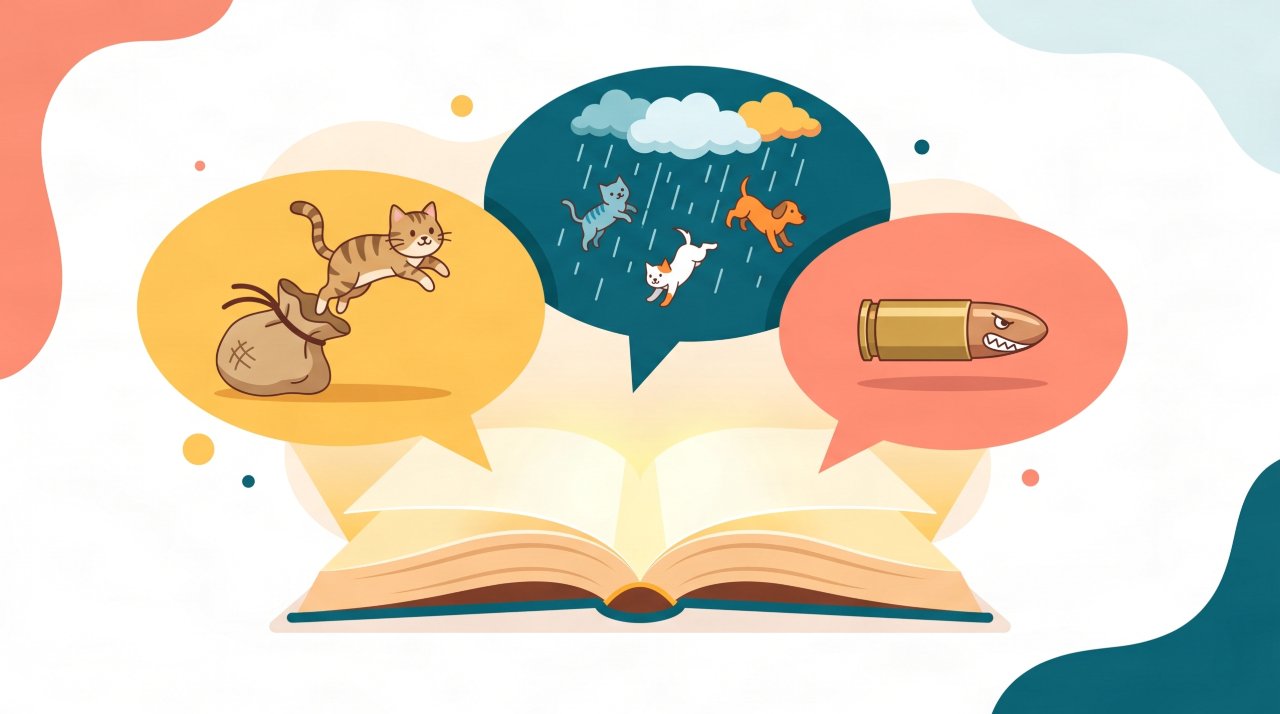
There are roughly 25,000 idiomatic expressions in the English language, and native speakers use dozens of them every single day without thinking twice. If you’ve ever read the phrase “bite the bullet” and pictured someone chewing on ammunition, you already know how confusing idioms can be.
This guide gives you clear, simple meanings for the most common English idioms and their meanings, plus real sentence examples you can use straight away. You’ll also find tips on how to actually start using idioms naturally, an essential skill that most other lists skip entirely.
What Exactly Is an Idiom?
An idiom is a phrase whose meaning you can’t figure out just by reading the individual words. The words together create a meaning that’s completely different from their literal sense.
For example, “it’s raining cats and dogs” doesn’t mean animals are falling from the sky. It simply means it’s raining very heavily. That’s the core trick with idioms: the figurative meaning is the real meaning.
According to linguists at Merriam-Webster, an idiom is defined as “an expression in the usage of a language that is peculiar to itself either grammatically or in having a meaning that cannot be derived from the conjoined meanings of its elements.” In short, you have to learn them, not decode them.
Why Idioms Are Hard to Learn (And That’s Totally Normal)
Here’s something most lists won’t tell you: idioms are cognitively harder to process than regular phrases. Research in psycholinguistics shows that non-literal language activates multiple brain regions simultaneously, which takes more mental effort than literal sentences.
You’re not slow or confused for struggling with idioms; you are responding to a genuine linguistic challenge. Even advanced English learners with strong grammar skills report idioms as one of their top frustrations.
The good news? Once you learn an idiom’s meaning and see it used in a sentence, you usually remember it for life.
The 50+ Most Common Idioms and Their Meanings
Below you’ll find a reference table of the most frequently used English idioms, their plain-English meanings, and a real sentence example for each. Use it as a bookmark and come back whenever you hit an unfamiliar phrase.
Idioms About Time
1. Beat the clock
Meaning: Finish something before the deadline.
Example: “She beat the clock and submitted her application just in time.”
2. In the nick of time
Meaning: Just barely before it’s too late.
Example: “The firefighters arrived in the nick of time.”
3. Once in a blue moon
Meaning: Very rarely.
Example: “He visits his hometown once in a blue moon.”
4. Around the clock
Meaning: All day and night without stopping.
Example: “The hospital staff works around the clock during emergencies.”
5. Kill time
Meaning: Do something unimportant while waiting.
Example: “We played card games to kill time at the airport.”
Idioms About Emotions and Feelings
6. Bite the bullet
Meaning: Accept something painful or difficult without complaining.
Example: “I didn’t want to apologise, but I bit the bullet and did it.”
7. On cloud nine
Meaning: Extremely happy.
Example: “After getting the job offer, she was on cloud nine.”
8. Under the weather
Meaning: Feeling slightly sick or unwell.
Example: “I am a bit under the weather today, so I might skip the gym.”
9. Bent out of shape
Meaning: Upset or angry about something minor.
Example: “Don’t get bent out of shape over a small mistake.”
10. Keep your chin up
Meaning: Stay positive during a tough time.
Example: “Keep your chin up; things will get better soon.”
Idioms About Work and Effort
11. Burn the midnight oil
Meaning: Work very late into the night.
Example: “She burned the midnight oil to finish the report by morning.”
12. Get the ball rolling
Meaning: Start something, especially a project or process.
Example: “Let’s get the ball rolling on the new marketing campaign.”
13. Pull someone’s leg
Meaning: Tease or joke with someone.
Example: “Are you serious? Or are you pulling my leg?”
14. Bite off more than you can chew
Meaning: Take on more than you can handle.
Example: “I think he bit off more than he could chew with three projects at once.”
15. Cut corners
Meaning: Do something the quick or cheap way, sacrificing quality.
Example: “The contractor cut corners and the building had problems within a year.”
16. Hit the ground running
Meaning: Start something with energy and enthusiasm from the very beginning.
Example: “The new manager hit the ground running and improved results in week one.”
17. Go back to the drawing board
Meaning: Start over from the beginning because something failed.
Example: “The proposal was rejected, so we went back to the drawing board.”
18. Bite the hand that feeds you
Meaning: Harm someone who helps or supports you.
Example: “Complaining publicly about your sponsor is biting the hand that feeds you.”
Idioms About Communication and Truth
19. Spill the beans
Meaning: Reveal a secret.
Example: “Don’t spill the beans about the surprise party!”
20. Beat around the bush
Meaning: Avoid getting to the main point.
Example: “Stop beating around the bush and tell me what happened.”
21. Straight from the horse’s mouth
Meaning: Directly from the original, reliable source.
Example: “I heard it straight from the horse’s mouth: she is leaving the company.”
22. Let the cat out of the bag
Meaning: Accidentally reveal something meant to be secret.
Example: “He let the cat out of the bag when he mentioned the gift.”
23. Put your foot in your mouth
Meaning: Say something embarrassing or tactless by accident.
Example: “I really put my foot in my mouth when I asked if she was pregnant.”
24. Give someone the cold shoulder
Meaning: Deliberately ignore someone.
Example: “After the argument, she gave him the cold shoulder all week.”
Idioms About Money and Success
25. Break the bank
Meaning: Cost too much; spend all your money.
Example: “This restaurant is great and won’t break the bank.”
26. Hit the jackpot
Meaning: Win a large prize or achieve something very lucky.
Example: “He hit the jackpot with that business idea.”
27. Make ends meet
Meaning: Earn just enough money to cover expenses.
Example: “With two jobs, she barely makes ends meet.”
28. Penny-wise, pound-foolish
Meaning: Careful with small amounts of money but wasteful with large ones.
Example: “Buying cheap tools that break immediately is penny-wise, pound-foolish.”
29. Cost an arm and a leg
Meaning: Be extremely expensive.
Example: “That handbag costs an arm and a leg.”
Idioms About Decision-Making and Risk
30. Sit on the fence
Meaning: Avoid taking a side or making a decision.
Example: “You can’t sit on the fence when the team needs a leader.”
31. Burn your bridges
Meaning: Permanently damage a relationship or opportunity.
Example: “Quitting without notice burns your bridges with that employer.”
32. Take the bull by the horns
Meaning: Face a challenge directly and with confidence.
Example: “She took the bull by the horns and addressed the conflict head-on.”
33. Miss the boat
Meaning: Miss an opportunity, often because you acted too late.
Example: “He missed the boat on that investment because prices doubled since then.”
34. A blessing in disguise
Meaning: Something that seems bad at first but turns out to be good.
Example: “Losing that job was a blessing in disguise; the next one was much better.”
Idioms About People and Relationships
35. Hit it off
Meaning: Like someone immediately upon meeting them.
Example: “We hit it off straight away and have been friends ever since.”
36. Rub someone the wrong way
Meaning: Irritate or annoy someone without intending to.
Example: “His tone always rubs people the wrong way.”
37. See eye to eye
Meaning: Agree with someone.
Example: “They don’t always see eye to eye, but they respect each other.”
38. A leopard can’t change its spots
Meaning: People can’t fundamentally change who they are.
Example: “He says he’ll be different, but a leopard can’t change its spots.”
Idioms About Difficulty and Challenges
39. Hit a brick wall
Meaning: Reach a point where no more progress is possible.
Example: “The research hit a brick wall when funding was cut.”
40. Between a rock and a hard place
Meaning: Forced to choose between two equally bad options.
Example: “She was between a rock and a hard place with her decision.”
41. The last straw
Meaning: The final problem in a series that finally makes you act.
Example: “His rude comment was the last straw, and she quit that afternoon.”
42. Bite the dust
Meaning: Fail, end, or die.
Example: “Three more startups bit the dust during the economic downturn.”
Idioms About Knowledge and Learning
43. Learn the ropes
Meaning: Learn how to do a job or activity.
Example: “Give him a few weeks to learn the ropes.”
44. In the dark
Meaning: Without information or knowledge about something.
Example: “I was kept in the dark about the decision until it was too late.”
45. Pick someone’s brain
Meaning: Ask someone questions to benefit from their knowledge.
Example: “Can I pick your brain about starting a small business?”
A Quick Reference Table: 10 Must-Know Idioms
| Idiom | Meaning | Example Sentence |
|---|---|---|
| Break a leg | Good luck | “Break a leg at your audition tonight!” |
| The ball is in your court | It’s your decision now | “I have made my offer. The ball is in your court.” |
| Spill the beans | Reveal a secret | “Who spilled the beans about the surprise?” |
| Hit the nail on the head | Exactly right | “You hit the nail on the head with that analysis.” |
| Cost an arm and a leg | Very expensive | “Fixing the car cost an arm and a leg.” |
| Under the weather | Feeling unwell | “I am under the weather; can we reschedule?” |
| Bite the bullet | Accept something hard | “Just bite the bullet and have the conversation.” |
| Let the cat out of the bag | Reveal a secret | “She let the cat out of the bag too soon.” |
| Once in a blue moon | Very rarely | “He calls once in a blue moon.” |
| On cloud nine | Extremely happy | “She’s been on cloud nine since the engagement.” |
How to Actually Start Using Idioms Naturally
Reading a list is one thing. Using idioms in real conversation is another. Here’s what actually works.
Start with just five. Pick five idioms from this list that feel natural to your life. Practice dropping them into your sentences over the next week through writing, text messages, or daily conversation.
Notice them in the wild. When you watch TV, listen to podcasts, or read English content, you’ll start spotting idioms everywhere. According to research from Cambridge English, exposure through authentic language use is one of the most effective ways to internalise figurative expressions.
Don’t force them all at once. Using ten idioms in one paragraph sounds unnatural and can confuse readers or listeners. One or two per conversation is plenty.
Where Idioms Come From: The Origins Angle Competitors Skip
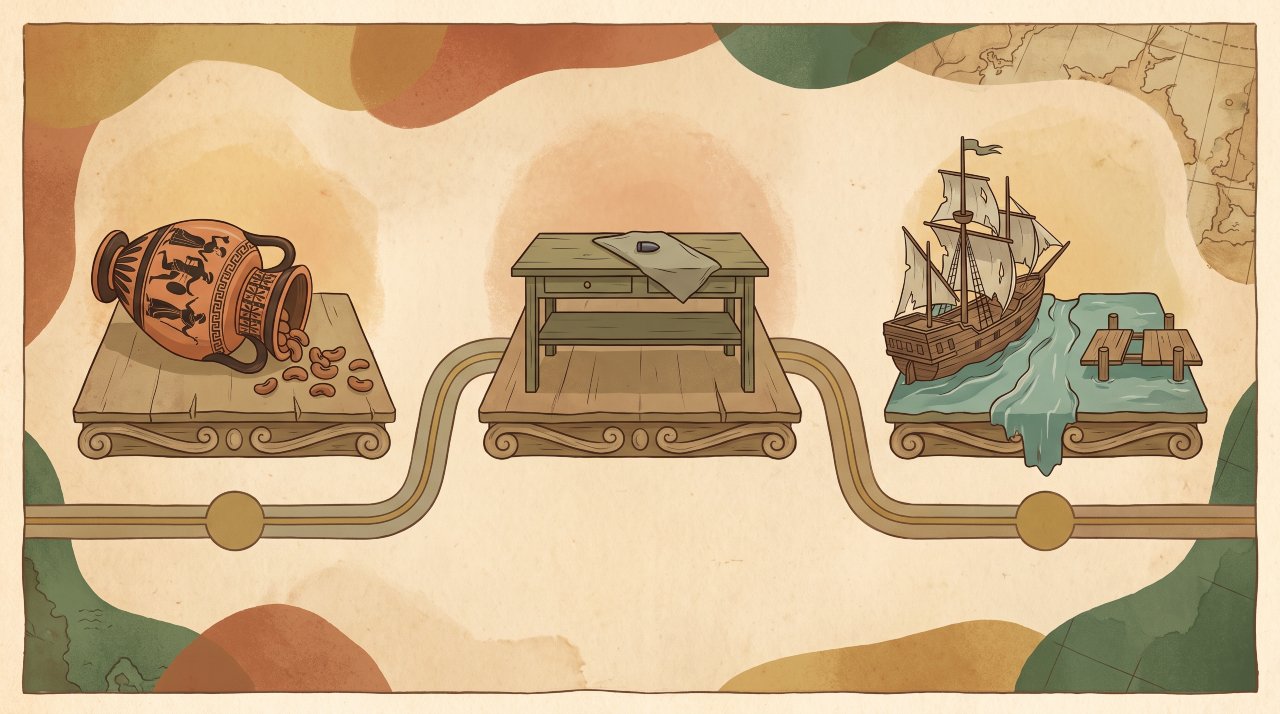
Many idioms have fascinating histories that make them much easier to remember. “Bite the bullet” dates back to 19th-century surgery, when patients bit down on a bullet during painful operations before anaesthesia existed. Knowing that, you won’t forget what it means.
“Spill the beans” likely comes from ancient Greek voting practices, where beans were dropped into jars to vote, where spilling them revealed the result too early. You can read more about the history of English idioms and figurative language at the Online Etymology Dictionary, which traces thousands of phrases back to their roots.
These stories stick in your memory far better than a plain definition. When you learn the “why” behind a phrase, the meaning locks in.
One Honest Limitation You Should Know
No list covers every idiom you’ll encounter, and that’s the honest truth. English is regional. Idioms used freely in Texas might confuse someone in New York, and American expressions often mean something different in British English.
“Under the bus” is widely understood across the US. But “Bob’s your uncle” (meaning “and there you have it”) is almost entirely British. If you’re learning for a specific context, pay attention to regional patterns in the content you consume.
Also, idioms shift over time. Some phrases from the 1990s already feel dated. The best way to stay current is to consume modern English content like podcasts, articles, and social media, and absorb new expressions as they appear.
You can cross-reference unfamiliar idioms with the Cambridge Dictionary’s idiom section, which regularly updates its database with contemporary usage.
FAQ: Idioms and Meanings
What is an idiom with a simple example?
An idiom is a phrase that means something different from its literal words. For example, “break a leg” literally describes breaking a bone, but it actually means “good luck.” You’d say it to a friend before a big performance or exam.
What are the most common English idioms?
Some of the most frequently used English idioms include “under the weather,” “bite the bullet,” “spill the beans,” “cost an arm and a leg,” and “hit the nail on the head.” These appear regularly in everyday conversation, writing, and media.
What is the difference between an idiom and a phrase?
A phrase is any group of words that functions as a unit. It can be literal or figurative. An idiom is specifically a type of phrase where the meaning can’t be guessed from the words alone. All idioms are phrases, but not all phrases are idioms.
How do you explain idioms to beginners?
Tell beginners that an idiom is a “secret code” that English speakers share. The words say one thing, but the meaning is something completely different. Show them the literal meaning first, then the real meaning, and always give a sentence example. That three-step approach works better than just stating a definition.
Why do English idioms confuse non-native speakers?
Non-native speakers learn vocabulary word by word, so a phrase like “let the cat out of the bag” seems to describe something that never happened. The figurative meaning only makes sense once you have been told it; there is no way to guess it from grammar or vocabulary knowledge alone. That’s why a reliable reference list matters so much.
Can idioms change meaning over time?
Yes, some idioms shift or become outdated. “Cool your jets” and “don’t touch that dial” were once very common but now feel slightly old-fashioned to younger speakers. Others stay stable for centuries. The safest approach is to stick with widely-used idioms and check current usage if you’re unsure.
Your Clearest Path Forward
The one thing to take away from this guide: idioms make sense once you know their meaning, and they become natural once you practise using them. You don’t need to memorise 80 idioms this week.
Here’s your specific next step: Pick any 5 idioms from this list today. Write one sentence for each in a notebook or notes app. Then use at least one of them in a real conversation or message before Friday. That single habit, repeated weekly, will build your idiom fluency faster than any course or app.
Bookmark this page and come back whenever you encounter a phrase that doesn’t quite make sense. We’ll keep this list updated as English continues to grow.


Alan Sledge is the writer and founder behind Letters & Letters. A lifelong lover of words, Alan has always been drawn to the small mysteries hidden in everyday language, why we say what we say, where our favorite sayings came from and the quotes that manage to put feelings into words better than we ever could ourselves.

Alan Sledge
Alan Sledge is the founder and lead researcher behind Letters & Letters. A lifelong student of linguistic history, he cross-references every word origin, idiom, and quote against primary archival manuscripts, the Oxford English Corpus, and 18th-century print lexicons.