
We live in an era of public performance. Social platforms celebrate curated images, loud self-promotion, and temporary applause.
Yet genuine human character operates in silence. When external praise fades, what remains is the private alignment between our words and actions.
That quiet alignment is integrity. At Alan Sledge, our archive of famous quotations examines how history’s greatest thinkers defined this virtue.
Quick Answer: What Are the Most Famous Quotes on Integrity?
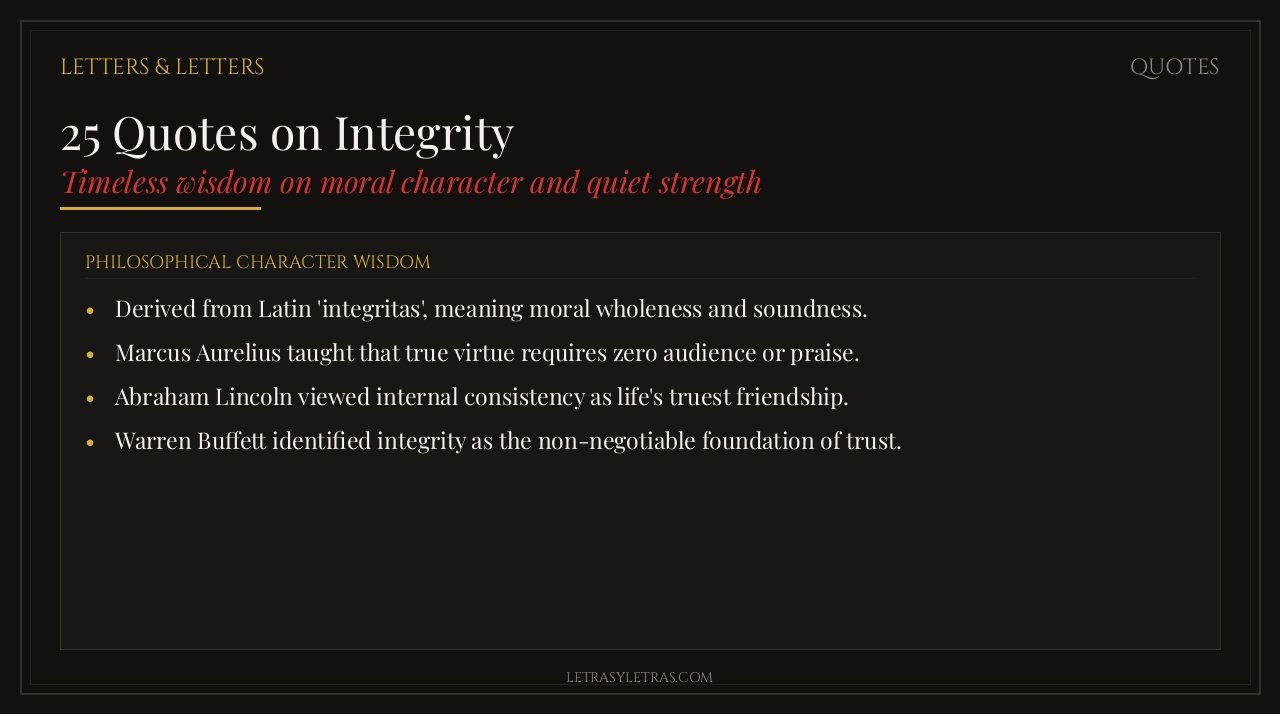
The most enduring quotes on integrity come from classical philosophers, moral leaders, and statesmen who prioritized private virtue over public applause. Thinkers such as Marcus Aurelius, Abraham Lincoln, and Warren Buffett defined integrity as doing what is right without an audience. Their verified words demonstrate that genuine character requires moral consistency, personal accountability, and unflinching truthfulness.
Key Takeaways: Core Principles of Moral Wholeness
- Etymological Root: Integrity originates from Latin integritas, signifying wholeness, soundness, and an unbroken moral state.
- The Undivided Self: A person of integrity behaves identically in public view and behind locked doors.
- Stoic Discipline: Roman Stoics considered moral alignment the only true possession that external tyrants could never steal.
- Leadership Foundation: Modern executives and statesmen view character as non-negotiable; talent without integrity creates systemic ruin.
- Courage in Action: Upholding personal standards often demands standing alone against popular consensus and social pressure.
The Ancient Etymology of Moral Wholeness
Before examining historical reflections, we must appreciate the linguistic foundation of the word itself. Language reflects how our ancestors understood human psychology.
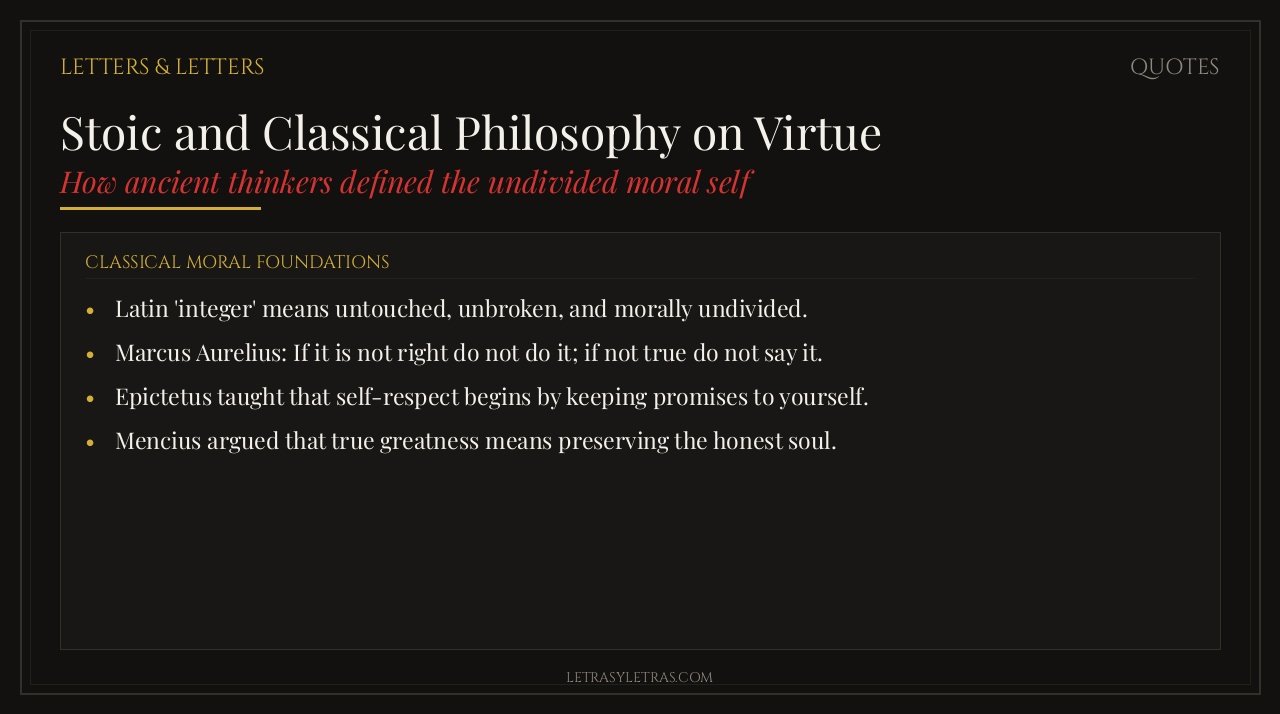
According to the Online Etymology Dictionary entry for integrity, the term stems from Latin integritas. That noun derives from the adjective integer, meaning untouched, whole, or complete.
The Latin root joins the prefix in-, meaning not, with tangere, meaning to touch. An integer is an intact number, free from fractional division.
Applied to human character, an integer describes an undivided life. A person possessing integrity does not wear different moral masks for different social circles.
Their private conduct matches their public speech. Academic ethicists at the Stanford Encyclopedia of Philosophy define integrity as this exact state of moral integration.
When principles remain whole under external pressure, character remains unbroken. Let us examine twenty-five verified reflections on this foundational virtue.
Pillar 1: Ancient Philosophy and the Undivided Self
Ancient sages recognized that true happiness requires internal harmony. They taught that violating personal principles inflicts immediate psychological injury upon oneself.
1. Marcus Aurelius
“If it is not right do not do it; if it is not true do not say it.”
Written in Book Twelve of his private journal Meditations, this sentence guided the Roman emperor through plague and war. Marcus commanded the Roman army along the frozen Danube river.
He carried absolute imperial authority over millions of citizens. Yet he reminded himself daily that supreme power gives no permission to abandon basic moral truth.
Marcus understood that rational self-control constitutes real royalty. His journals survive today through classical collections like the Tufts University Perseus Digital Library.
2. Seneca the Younger
“Virtue is nothing else than right reason.”
In his Moral Letters to Lucilius, Seneca argued that virtue is practical rationality. Ethical living is not emotional impulse or social dogma.
Right reason requires seeing reality clearly without selfish distortions. When we act with integrity, we honor the rational order of nature.
3. Mencius (Mengzi)
“The great man is he who does not lose his child-heart.”
Fourth-century BCE Chinese philosopher Mencius taught that human beings possess innate moral seeds. A child instinctively values honesty, fairness, and compassion.
Worldly ambition, cynicism, and fear corrupt that original purity over time. True greatness consists in guarding that sincere moral core throughout adulthood.
4. Epictetus
“First say to yourself what you would be; and then do what you have to do.”
Born into physical slavery in Roman Hierapolis, Epictetus understood harsh constraints. He realized that masters could chain his body but could never control his character.
Integrity begins with intentional self-definition. Once you decide your moral identity, every daily choice must execute that conviction.
5. Aristotle
“We are what we repeatedly do. Excellence, then, is not an act, but a habit.”
Historian Will Durant famously condensed Aristotle’s Nicomachean Ethics into this memorable phrasing. Aristotle taught that character is an acquired behavioral habit.
One honest choice does not make an honest person. Repeated truth-telling over decades forms an unshakeable moral backbone.
Pillar 2: Consistency Behind Closed Doors
Reputation is what society assumes you are. Character is who you remain when nobody is looking through the keyhole.
6. Abraham Lincoln
“Character is like a tree and reputation like its shadow. The shadow is what we think of it; the tree is the real thing.”
Lincoln wrote these words during years of intense political vitriol. Hostile newspapers labeled him an uncouth tyrant, while cabinet members plotted behind his back.
He refused to waste emotional energy chasing shifting public opinions. Lincoln tended the roots of personal principle, knowing that shadows constantly change length.
7. Ralph Waldo Emerson
“Nothing can bring you peace but yourself. Nothing can bring you peace but the triumph of principles.”
In his 1841 masterwork Self-Reliance, Emerson warned against copying fashionable crowds. External approval provides temporary excitement, not lasting spiritual stability.
Peace arises only when your internal conscience approves of your conduct. When principles triumph over convenience, anxiety dissolves completely.
8. Thomas Paine
“Character is much easier kept than recovered.”
Writing in The American Crisis during the American War of Independence, Paine understood human vulnerability. Building trust requires years of consistent, dependable behavior.
A single act of deception can shatter that architecture in seconds. Guarding integrity daily is far easier than rebuilding a ruined reputation.
9. John Wooden
“The true test of a man’s character is what he does when he thinks no one is watching.”
Legendary basketball coach John Wooden made moral character the centerpiece of his coaching philosophy. He cared more about personal values than national championship trophies.
Wooden taught athletes that public victories mean nothing if achieved through secret corner-cutting. Private discipline creates permanent self-respect.
10. George Washington
“I hope I possess firmness enough to maintain what I consider the most enviable of all titles, the character of an honest man.”
Writing to Alexander Hamilton in 1788, Washington contemplated the presidency. He did not seek royal crowns or aristocratic honors.
For America’s first president, honesty was the highest human station. Power without honesty is merely temporary tyranny.
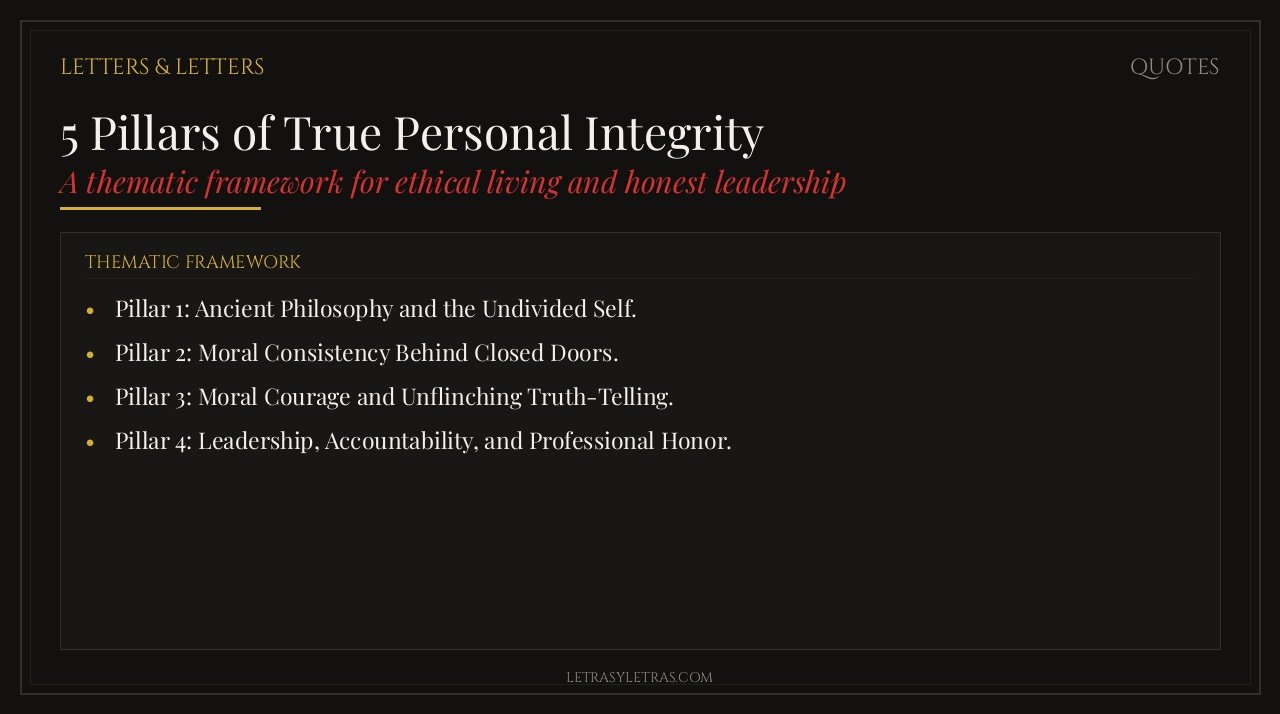
Pillar 3: Moral Courage and Truth-Telling
Speaking the truth is rarely comfortable. When society embraces comfortable illusions, stating reality becomes an act of open rebellion.
11. Aleksandr Solzhenitsyn
“The simple step of a courageous man is not to partake in falsehood, not to support false actions.”
Surviving eight years in Soviet labor camps, Solzhenitsyn understood totalitarian power. Totalitarian states force citizens to repeat absurd official lies.
Solzhenitsyn realized that an individual cannot instantly change an empire. But an individual can refuse to let lies pass through their own mouth.
12. Martin Luther King Jr.
“The time is always right to do what is right.”
Delivered during an address at Oberlin College in 1964, this line dismantled political stalling. Opponents of civil rights constantly urged patience, prudence, and delay.
King rejected the excuse of waiting for favorable conditions. Justice cannot be postponed until convenience makes courage effortless.
13. Mark Twain
“Always do right. This will gratify some people and astonish the rest.”
In a handwritten note to a youth society in 1901, Twain captured human irony. People talk constantly about honesty, yet genuine integrity remains remarkably rare.
When someone acts with total fairness, cynical spectators are shocked. Twain used satire to remind us how radical decency can be.
14. Frederick Douglass
“I prefer to be true to myself, even at the hazard of incurring the ridicule of others, rather than to be false.”
Escaping chattel slavery in Maryland, Douglass became an eloquent voice for human freedom. Pro-slavery critics attacked him with ferocious verbal and physical abuse.
Douglass refused to compromise his principles to placate hostile audiences. He understood that self-betrayal is far more agonizing than external mockery.
15. Thomas Jefferson
“Honesty is the first chapter in the book of wisdom.”
In an 1819 letter to Nathaniel Macon, Jefferson summarized political philosophy. Clever schemes and complex intellectual theories cannot replace basic truthfulness.
Without honesty at the foundation, wisdom collapses into selfish manipulation. True intelligence begins with an honest accounting of facts.
Pillar 4: Leadership, Trust, and Professional Honor
In business, sports, and statecraft, skill attracts attention. But integrity alone earns lasting loyalty and enduring respect.
16. Warren Buffett
“In looking for people to hire, you look for three qualities: integrity, intelligence, and energy. And if they don’t have the first, the other two will kill you.”
The billionaire investor offered this advice to business students in Omaha. Intelligence and energy are formidable human engines.
However, without a moral rudder, brilliant energy creates financial fraud and corporate ruin. Character must always govern capability.
17. Dwight D. Eisenhower
“The supreme quality for leadership is unquestionably integrity. Without it, no real success is possible.”
As Supreme Allied Commander in World War Two, Eisenhower managed colossal armies and colossal egos. Generals Patton, Montgomery, and de Gaulle clashed constantly.
Eisenhower maintained allied unity because subordinates trusted his complete fairness. Troops knew he would never sacrifice lives for personal glory.
18. Peter Drucker
“Integrity may not be easy to define, but it is not difficult to see if it is present or absent.”
The father of modern management consulting analyzed thousands of organizations. Leaders often claimed high values in corporate mission statements.
Yet employees instinctively detect hypocrisy within days. Character reveals itself through small daily choices, not polished speeches.
19. Barbara Jordan
“If you’re going to play the game, you’re going to play it right, or you’re not going to play it at all.”
During the 1974 Watergate impeachment hearings, congresswoman Barbara Jordan electrified America. Her defense of the United States Constitution demanded strict institutional accountability.
Jordan believed public office is a sacred trust. When leaders bend rules for personal survival, democracy itself suffers damage.
20. Alan Greenspan
“Rules cannot substitute for character.”
Speaking to university graduates, the former Federal Reserve chairman addressed economic ethics. Modern society produces mountains of regulatory statutes and compliance checklists.
Yet clever lawyers can circumvent written regulations with ease. Sustainable commerce relies on the internal honesty of market participants.
Pillar 5: Everyday Accountability and Self-Respect
Integrity is not reserved for historic crises. It is built across ordinary moments, mundane conversations, and unrecorded personal promises.
21. Joan Didion
“To have that sense of one’s intrinsic worth which constitutes self-respect is potentially to have everything.”
In her famous 1961 essay On Self-Respect, Didion examined moral courage. People lacking self-respect live in constant dread of exposure.
When you take full responsibility for your life, fear of judgment vanishes. Self-respect is the quiet reward of keeping faith with yourself.
22. C.S. Lewis
“Integrity is doing the right thing, even when no one is watching.”
While often quoted as a folk saying, this principle reflects Lewis’s theological writings in Mere Christianity. Lewis taught that morality is about internal transformation.
God cares about what we become, not merely what we avoid doing in public. Private choices shape the soul for eternity.
23. Maya Angelou
“Courage is the most important of all the virtues because without courage, you cannot practice any other virtue consistently.”
Poet and activist Maya Angelou highlighted the vital engine behind integrity. You may desire to be kind, generous, or honest.
Yet when fear of social rejection strikes, cowardly hearts fold quickly. Courage provides the stamina required to uphold virtue under pressure.
24. Confucius
“To see what is right and not do it is want of courage.”
Recorded in the Analects, this ancient maxim links intellectual awareness to action. Knowing moral truth is useless if fear paralyzes behavior.
Integrity bridges the gap between seeing what is fair and doing it. Action is the only proof of belief.
25. Albert Einstein
“Whoever is careless with the truth in small matters cannot be trusted with important affairs.”
The Nobel Prize-winning physicist demanded rigorous precision in scientific experiments. An error in a minor equation invalidates an entire cosmological theory.
Einstein applied that exact scientific discipline to human relationships. Minor daily deceptions reveal a defective moral compass.
Thematic Overview Table
| Philosophical Pillar | Key Thinkers | Core Moral Premise | Daily Practical Application |
|---|---|---|---|
| Stoic & Ancient Virtue | Marcus Aurelius, Seneca, Mencius | The undivided soul aligns thoughts with actions. | Never act against conscience for quick profit. |
| Private Consistency | Lincoln, Emerson, John Wooden | Character is what survives when cameras are off. | Keep personal commitments made to yourself. |
| Moral Truth-Telling | Solzhenitsyn, MLK Jr., Douglass | Refuse participation in collective falsehoods. | Speak up when peer groups mock truth. |
| Leadership & Honor | Warren Buffett, Eisenhower, Jordan | Talent without integrity creates systemic disaster. | Hire and partner only with honest people. |
| Everyday Self-Respect | Joan Didion, CS Lewis, Einstein | Little choices accumulate into our permanent destiny. | Tell the truth even in trivial details. |
Debunking Common Misattributed Integrity Sayings
The internet contains thousands of inspiring quote graphics. Unfortunately, many popular sayings about character are falsely attributed to famous historical figures.
One notorious example is the quote: Character is what you do when nobody is looking. This phrase is frequently credited to nineteenth-century novelist C.S. Lewis.
Extensive literary searches through Lewis’s published books reveal zero instances of this exact sentence. While the sentiment matches his moral philosophy, the quote emerged through twentieth-century coaches like John Wooden.
A second common misattribution credits Abraham Lincoln with saying: To test a man’s character, give him power. Lincoln never uttered this phrase during his speeches or debates.
Nineteenth-century orator Robert G. Ingersoll actually coined this observation in his 1885 lecture about Lincoln. Later biographers confused the admirer’s words with Lincoln’s own speech.
Similar to our research on the origin of the word sincere, myths flourish because they sound appealing. Preserving factual accuracy in quotations is itself an essential act of intellectual integrity.
The Psychology of Living an Undivided Life
Why do these historical voices command our attention across centuries? Modern psychological research confirms what ancient philosophers understood through reflection.
Living a divided life creates immense cognitive strain. When you lie, your brain must manage two conflicting versions of reality.
You must constantly remember what you promised to one person and what you hid from another. That deception generates persistent chronic stress and subconscious guilt.
By contrast, integrity creates immense psychological lightness. When you speak the truth, you never have to remember your script.
Your internal thoughts, spoken words, and outward actions move in harmonious rhythm. Much like our study on quotes on humility, moral clarity produces quiet inner peace.
You sleep with a calm mind, free from fear of future exposure. That unshakeable peace of mind is the true reward of character.
Frequently Asked Questions
What is the etymological origin of the word integrity?
The word integrity stems from the Latin noun integritas, meaning wholeness, soundness, and purity. It derives from the Latin adjective integer, meaning untouched and complete.
Who first said integrity is doing the right thing when no one is watching?
While often attributed to C.S. Lewis, modern researchers trace this exact phrasing to mid-twentieth-century speakers, including coach John Wooden. Lewis expressed matching ideas in Mere Christianity.
Why did Warren Buffett say integrity is the most important hiring trait?
Buffett argued that intelligence and energy without integrity destroy companies. A brilliant and energetic person lacking character uses their talents for deception and selfish fraud.
What is the difference between integrity and honesty?
Honesty refers to telling the factual truth in words. Integrity is broader, encompassing total consistency between moral principles, speech, and private actions.
Which Stoic philosopher wrote extensively about personal integrity?
Roman emperor Marcus Aurelius wrote extensively about moral integrity in his private journal Meditations. He commanded himself to avoid falsehood and unrighteous actions daily.
Alan Sledge is the lead writer at letrasyletras.com. He uncovers the authentic histories behind our favorite words and sayings.


Alan Sledge is the writer and founder behind Letters & Letters. A lifelong lover of words, Alan has always been drawn to the small mysteries hidden in everyday language, why we say what we say, where our favorite sayings came from and the quotes that manage to put feelings into words better than we ever could ourselves.