
Quick Answer: Origin of the Word Quarantine
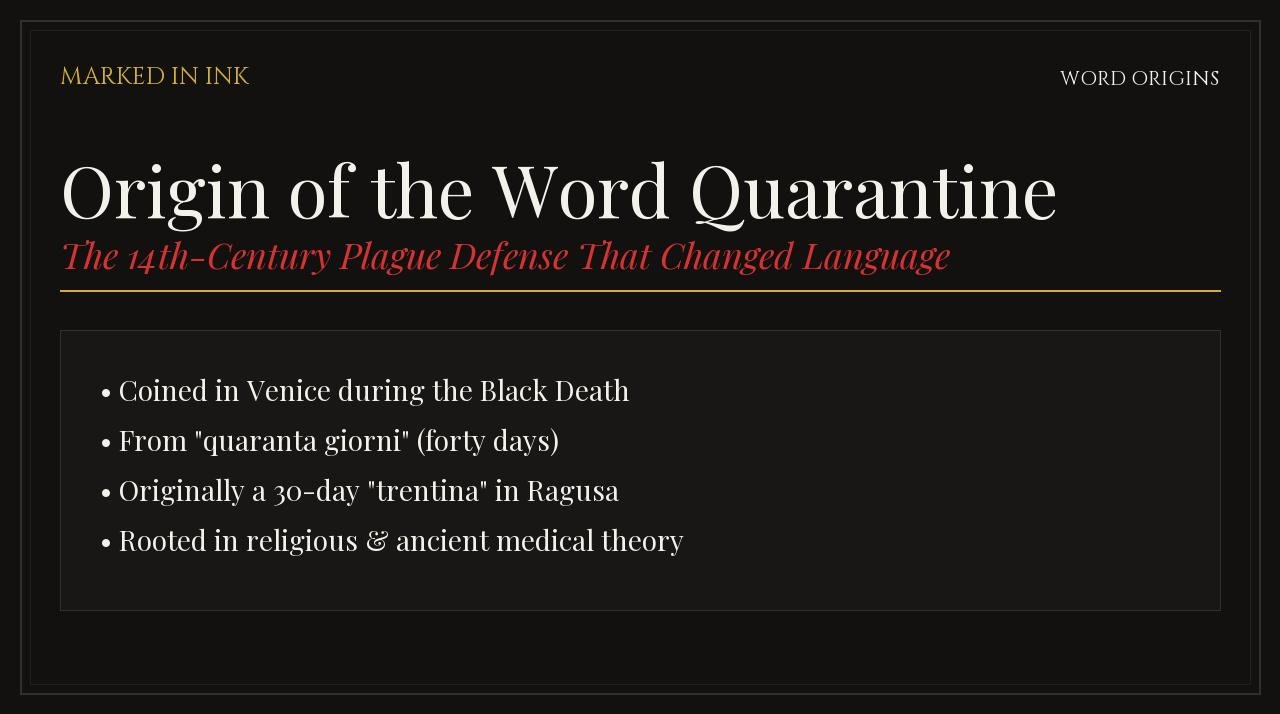
The word quarantine comes from the Venetian Italian phrase “quaranta giorni.” This translates directly to “forty days.” In the 14th century, the port city of Ragusa initially required incoming ships to isolate for 30 days. Venice later extended this mandatory isolation period for plague ships to 40 days. Officials named this new policy a “quarantina.” This ensured latent disease symptoms would appear before sailors came ashore. English speakers adopted the term in the 17th century. It now refers to any period of forced medical isolation.
Key Takeaways
- Originates from “quaranta giorni,” meaning forty days.
- Created during the Black Death in 14th-century Venice.
- Replaced an earlier 30-day isolation called a “trentina.”
- Linked to religious symbolism of the number 40.
- Entered English in the 17th century for maritime law.
During the 14th century, Europe faced the terrifying threat of the Black Death. Coastal cities needed a way to protect their people from infected ships. This urgent need gave birth to the origin of the word quarantine.
Its history reveals a grim but fascinating chapter of disease control. The concept actually started as a 30-day period. Port authorities eventually extended this isolation time.
A Plague Approaches: Why Ragusa Chose 30 Days
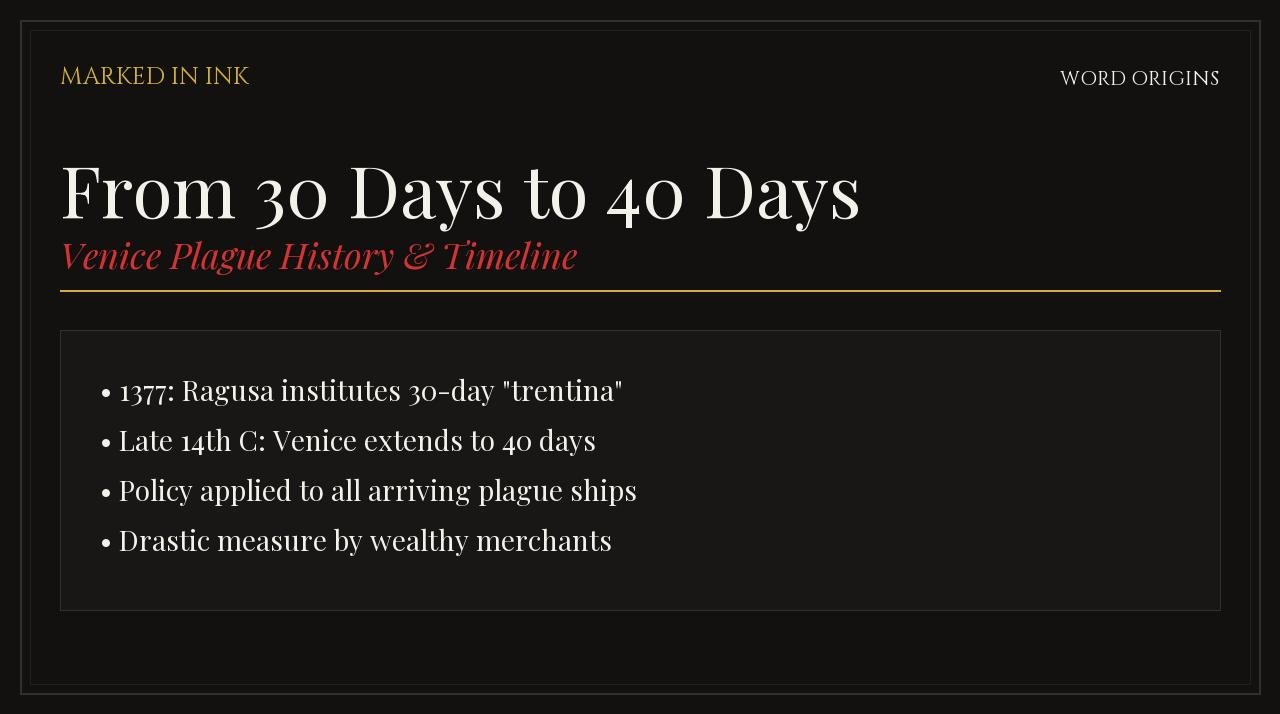
Organized defense against plague outbreaks began in 1377. Ragusa, now Dubrovnik, passed a strict maritime law. Ships from infected areas had to isolate before entering the harbor.
Authorities mandated a 30-day waiting period for these vessels. They called this time a “trentina,” based on the Italian word for thirty. You can read more about maritime terms by studying origin of the word berserk.
This initial rule proved inadequate for stopping the spread. Rats carrying the disease often survived the first isolation period. A stronger measure was urgently needed to protect the mainland.
The Shift to 40 Days: Venice Creates the Quarantina
Venice observed the failures of the 30-day rule. Wealthy merchants took drastic action to secure their ports. They extended the isolation period for arriving ships to 40 days.
This new policy required a fresh name. Venetian authorities called it a “quarantina.” It derives directly from “quaranta giorni,” meaning forty days. For context on historical terminology, checking out origin of the phrase bless you provides interesting comparisons.
Ships dropped anchor at nearby islands for the entire duration. Cargo was aired out while sailors waited anxiously for clearance. According to Online Etymology Dictionary, the term became a permanent fixture of maritime law.
Breaking Down the Italian Roots
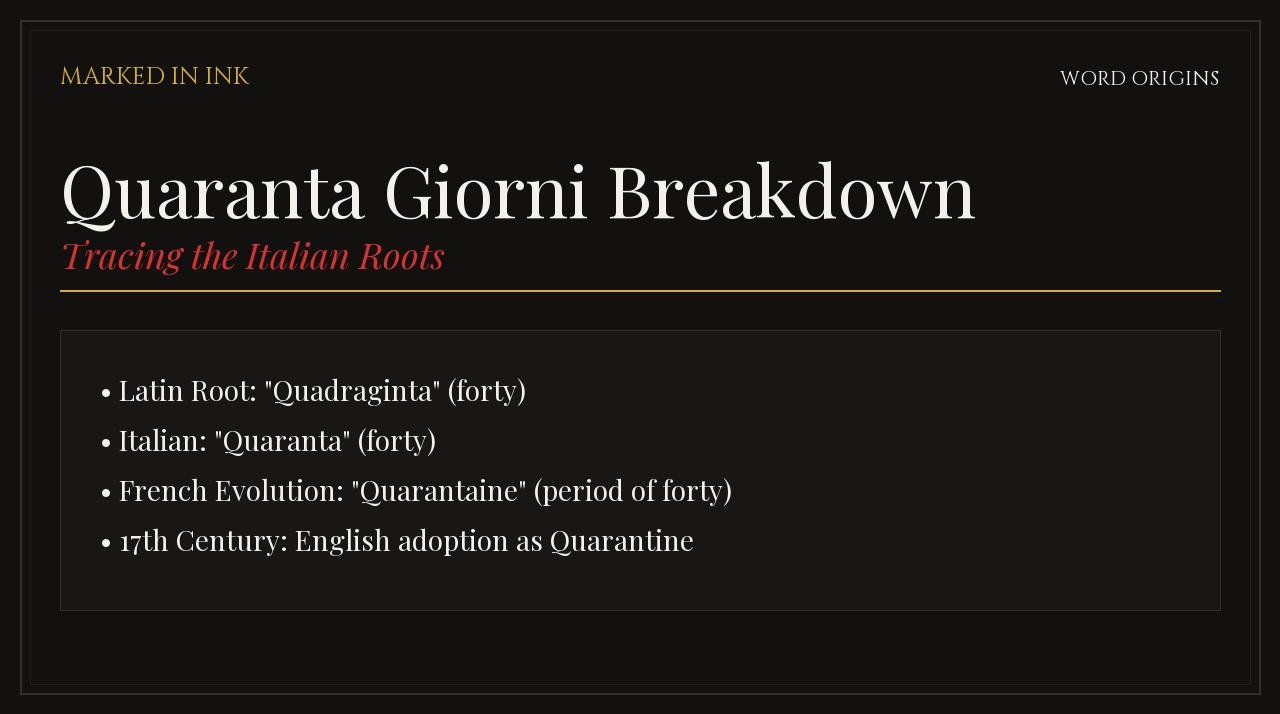
The Italian word “quaranta” comes from Latin. Its original root is “quadraginta,” which translates to forty. This numerical base is central to the word’s identity.
In French, the term became “quarantaine.” This means a period of forty. English speakers borrowed this in the 1600s. You might find similar linguistic borrowing in the origin of the word salary.
Why Exactly 40 Days? Religious and Medical Theories
Historians debate the specific reason for choosing 40 days. The number holds massive significance in Western history and religion. It appears repeatedly in Christian and Jewish texts.
The Great Flood rained for 40 days and nights. Jesus fasted in the wilderness for a 40-day period. Additionally, the season of Lent lasts for exactly 40 days.
Medical theories of the time also played a role. Ancient Greek medicine suggested diseases took 40 days to resolve. Merriam-Webster notes that the numerical association is often forgotten today.
How Quarantine Entered the English Language
The word first appeared in English documents during the 17th century. Early usages referred directly to ship isolation practices. Its meaning remained tightly linked to maritime health regulations.
Over the decades, the definition broadened significantly. It began to describe any period of medical isolation. Those studying linguistics often compare this to the origin of the phrase caught red handed.
By the 19th century, it was used for land-based isolation. Hospitals established specific wards bearing the name. Its original connection to the number forty faded from public consciousness.
Modern Evolution Beyond Public Health
Today, the term applies to many different situations. Computer scientists use it for isolating malicious software files. Agricultural inspectors apply it to imported plants and animals.
Recent global events brought the word into daily conversation. People isolated in their homes for just a few weeks. If you enjoy studying common terms, check out english idioms and meanings.
The linguistic shift is complete and permanent. A word born from medieval plague defense now describes everyday health precautions. It stands as a testament to how human language adapts.
When was the word quarantine first used?
The original Italian term was first used in the 14th century. English speakers adopted the modern spelling in the 17th century.
What does quarantine literally mean?
Its literal translation is “forty days.” It comes from the Venetian phrase “quaranta giorni.”
Why was quarantine originally 40 days?
It was likely a mix of religious symbolism and ancient medical theory. The number 40 was considered significant for purification.
Did quarantine used to be 30 days?
Yes. The original practice in 1377 Ragusa mandated a 30-day isolation. This was called a “trentina” before being extended.
Are quarantine and isolation the same thing?
In modern usage, they are very similar. Historically, the specific word denoted a strict 40-day period for incoming ships.
We hope this exploration of history clarified the origin of the word quarantine. Learning about historical disease control offers fascinating insights into our modern vocabulary. Feel free to explore more historical terms and phrases on our site.


Alan Sledge is the writer and founder behind Letters & Letters. A lifelong lover of words, Alan has always been drawn to the small mysteries hidden in everyday language, why we say what we say, where our favorite sayings came from and the quotes that manage to put feelings into words better than we ever could ourselves.