
Human beings search for motivation when pursuing ambitious goals. Feelings of excitement burn bright for several days before vanishing. When initial energy fades, unfinished projects and broken promises remain behind.
Lasting achievement does not rely on emotional highs. True accomplishment demands steady, reliable habits that function regardless of mood. History demonstrates that structured self-governance transforms ordinary efforts into extraordinary results.
Reading curated quotes on discipline reminds us that ancient philosophers and modern innovators faced identical struggles. By examining their wisdom, we uncover practical rules for mastering our daily choices.
Quick Answer: Quotes on Discipline and Self-Mastery
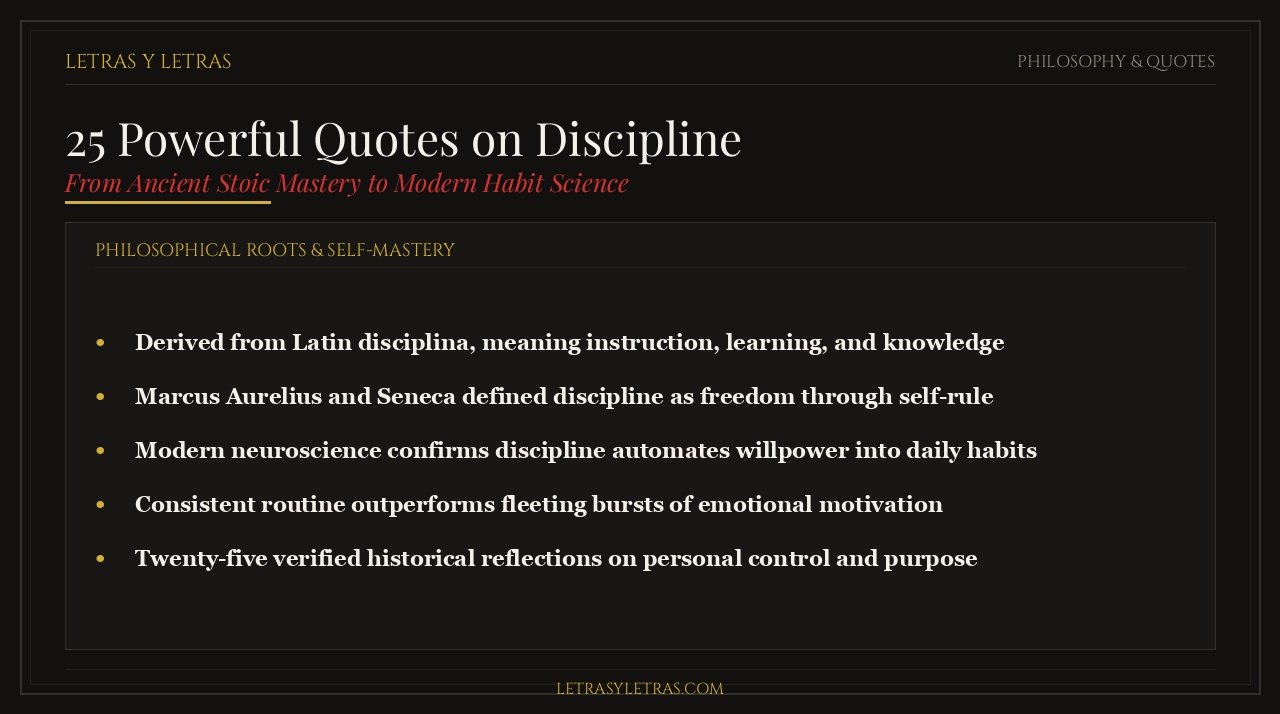
Quotes on discipline represent centuries of recorded wisdom on self-governance and intentional living. The concept traces back to the Latin noun disciplina, meaning instruction, learning, and apprenticeship. Classical thinkers such as Seneca and Marcus Aurelius treated discipline as mental liberation. Modern cognitive research supports their view, demonstrating that consistent habits conserve mental energy. Influential maxims from historical leaders highlight five core pillars: mental sovereignty, overcoming delay, environmental systems, emotional control, and enduring character. Rather than waiting for fleeting motivation, disciplined individuals design reliable daily routines that produce compound personal growth over time.
Key Takeaways
- Discipline originates from Latin disciplina, denoting teaching, training, and scholarly growth.
- Stoic philosophers viewed personal restraint as the ultimate path toward psychological freedom.
- Daily behavioral systems consistently outperform temporary bursts of emotional motivation.
- Self-control functions through habit automation, reducing reliance on draining willpower reserves.
- Small compound daily actions generate profound long-term character and tangible achievement.
The Classical Etymology of Discipline: Learning, Not Punishment
Modern society often equates discipline with rigid punishment or grim sacrifice. School administrators speak of disciplinary hearings. Parents associate the term with correcting juvenile misbehavior.
This punitive definition represents a significant departure from antiquity. In ancient Rome, the Latin noun disciplina held a noble philosophical meaning. It signified instruction, education, training, and the acquisition of systematic knowledge.
The term stemmed from the noun discipulus, which translates as pupil or learner. The verb discere meant to learn. Discipline was therefore the process of apprenticing oneself to wisdom.
Scholars examining texts in the Perseus Digital Library classical Latin lexicon note this essential distinction. Roman thinkers never considered discipline a form of self-inflicted misery. Discipline was the deliberate method by which a citizen mastered an art.
Roman legionaries studied military discipline to survive brutal skirmishes. Philosophers cultivated mental discipline to protect inner peace from political turmoil. Mastering oneself was seen as the highest expression of personal dignity.
Pillar 1: Ancient Stoic Mastery and Sovereignty of Mind
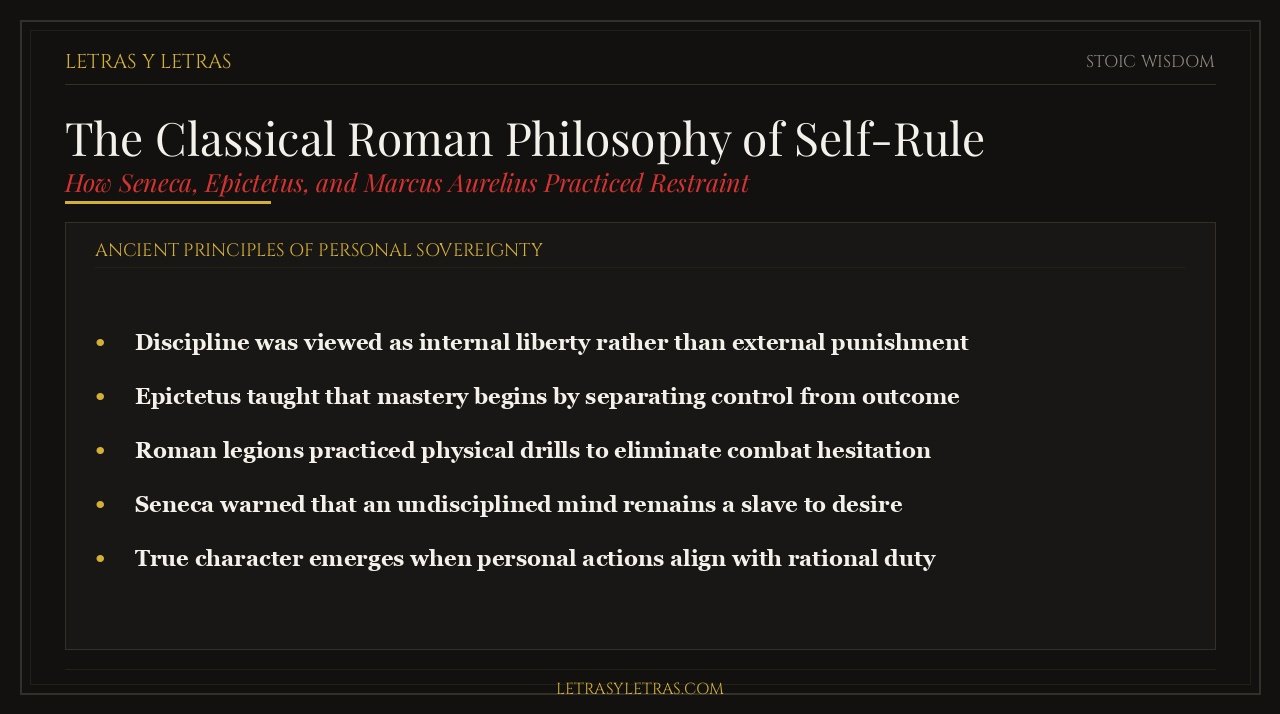
Ancient Stoic philosophy placed self-control at the foundation of all virtue. Roman thinkers realized that external circumstances remained outside individual control. Personal responses, however, belonged entirely to the thinker.
The following five quotations demonstrate how ancient practitioners viewed self-command:
1. Seneca: The Greatest Empire
“Most powerful is he who has himself in his own power.”
Lucius Annaeus Seneca served as an advisor in imperial Rome. Seneca watched absolute rulers succumb to paranoia and unchecked greed. True authority, Seneca argued, begins by governing personal impulses.
When an individual controls inner appetite, external threats lose their grip. Seneca urged his correspondent Lucilius to examine daily actions each evening. Self-rule creates an unshakeable citadel within the human mind.
2. Marcus Aurelius: The Impeding Obstacle
“The impediment to action advances action. What stands in the way becomes the way.”
Writing privately in his personal journal, Emperor Marcus Aurelius confronted plague and military rebellion. Aurelius refused to indulge in self-pity or resentment. He viewed difficult obstacles as raw material for sharpening character.
Every frustrating circumstance offers an opportunity to practice patience, courage, and resolve. Marcus Aurelius reminded himself that complaining alters nothing. Disciplined minds convert hardships into fuel for moral growth.
3. Epictetus: The Path to Authentic Freedom
“No man is free who is not master of himself.”
Born into chattel slavery in modern Turkey, Epictetus understood physical confinement intimately. After gaining emancipation, he taught that external bondage could not touch a disciplined mind. Uncontrolled desires, he warned, enslave people far more than physical chains.
A person ruled by anger or lust remains a captive to circumstance. Epictetus instructed his pupils to distinguish between things within their control and things outside it. True freedom requires ruthless detachment from external praise or blame.
4. Musonius Rufus: The Value of Hard Training
“Since a human being happens to be neither soul alone nor body alone, one must train both.”
Known as the Roman Socrates, Musonius Rufus demanded physical endurance alongside intellectual study. Rufus believed physical comfort weakens mental resolve. Daily bodily training taught students to embrace discomfort without complaint.
Enduring cold, hunger, and fatigue prepared Roman citizens for unexpected political reversals. Rufus argued that intellectual theory without physical execution is worthless vanity. The body must obey the rational dictates of the soul.
5. Zeno of Citium: Conquering Personal Desire
“Man conquers the world by conquering himself.”
Zeno founded the Stoic school after surviving a devastating shipwreck off the coast of Greece. Rather than lamenting his lost fortune, Zeno began teaching philosophy in Athens. Conquering internal grief allowed him to establish enduring ethical thought.
His students gathered under the painted porch to study self-mastery. Zeno taught that an individual who conquers internal passions needs no royal crowns. Inner peace proves far more durable than worldly fame.
As documented in our collection of famous quotes and quotations, Stoic maxims emphasize mental ownership. Their principles remain intensely relevant for modern life.
Pillar 2: The War Against Delay and Resistance
Every creative worker and entrepreneur battles internal resistance. Many people construct elaborate excuses to avoid demanding tasks. Others reorganize desks, check messages, or delay action until tomorrow.
Accomplished creators recognize resistance as a predictable emotional obstacle. These five insights reveal how seasoned practitioners defeat daily hesitation:
6. Steven Pressfield: The Professional Mindset
“Amateurs play for fun. The professional plays for keeps and shows up every single day.”
Author Steven Pressfield spent years struggling before publishing acclaimed historical novels. In his writing manual, Pressfield draws a sharp line between amateurs and professionals. Professionals work through exhaustion, uncertainty, and creative resistance without waiting for divine inspiration.
Amateurs wait until conditions feel favorable before sitting down to work. Seasoned writers understand that inspiration only arrives after labor begins. Showing up consistently separates masters from dreamers.
7. Victor Hugo: Defeating Distraction by Design
“Inspiration comes only to those who work every day.”
Facing tight publishing deadlines for his epic masterpiece, Victor Hugo took extreme measures. Hugo instructed his valet to lock away his formal clothing. Left wearing only a gray knitted shawl, Hugo had no choice except to write.
Removing environmental options forced his focus onto manuscript pages. Hugo demonstrated that voluntary constraints liberate creative production. When excuses become physically impossible, progress accelerates dramatically.
8. Benjamin Franklin: The Value of Fleeting Hours
“Lost time is never found again, and what we call time enough always proves little enough.”
Benjamin Franklin organized his waking hours around a rigorous daily schedule. Franklin tracked thirteen personal virtues in a small notebook each evening. His methodical discipline enabled prolific discoveries in printing, science, and international diplomacy.
Franklin understood that hours slip away through imperceptible distractions. Guarding one schedule requires vigilant daily protection. Time invested with purpose compounds into extraordinary life achievement.
9. Leonardo da Vinci: Resisting Early Temptations
“It is easier to resist at the beginning than at the end.”
Leonardo da Vinci filled thousands of manuscript pages with anatomical sketches and engineering concepts. Leonardo observed that destructive habits take root when small compromises are excused. Halting a distraction immediately requires far less energy than untangling an established vice.
Allowing a single slip creates psychological permission for repeated errors. Leonardo guarded his morning studio time with intense vigilance. Nip procrastination in the bud before it blossoms into permanent failure.
10. Samuel Johnson: The Chains of Subtle Custom
“The chains of habit are too weak to be felt until they are too strong to be broken.”
Lexicographer Samuel Johnson compiled the first authoritative English dictionary through sheer labor. Johnson understood that minor daily delays seem harmless in isolation. Over months and years, however, small indulgences calcify into unbreakable mental barriers.
An extra hour in bed or an abandoned exercise session appears insignificant today. Repeated fifty times, that choice establishes a destructive character trait. Conscious discipline must shatter weak links before they forge iron chains.
Similar shifts occurred in our origin of the word hazard guide. A casual dice game eventually evolved into serious danger.
Pillar 3: The Architecture of Daily Habit and Systems
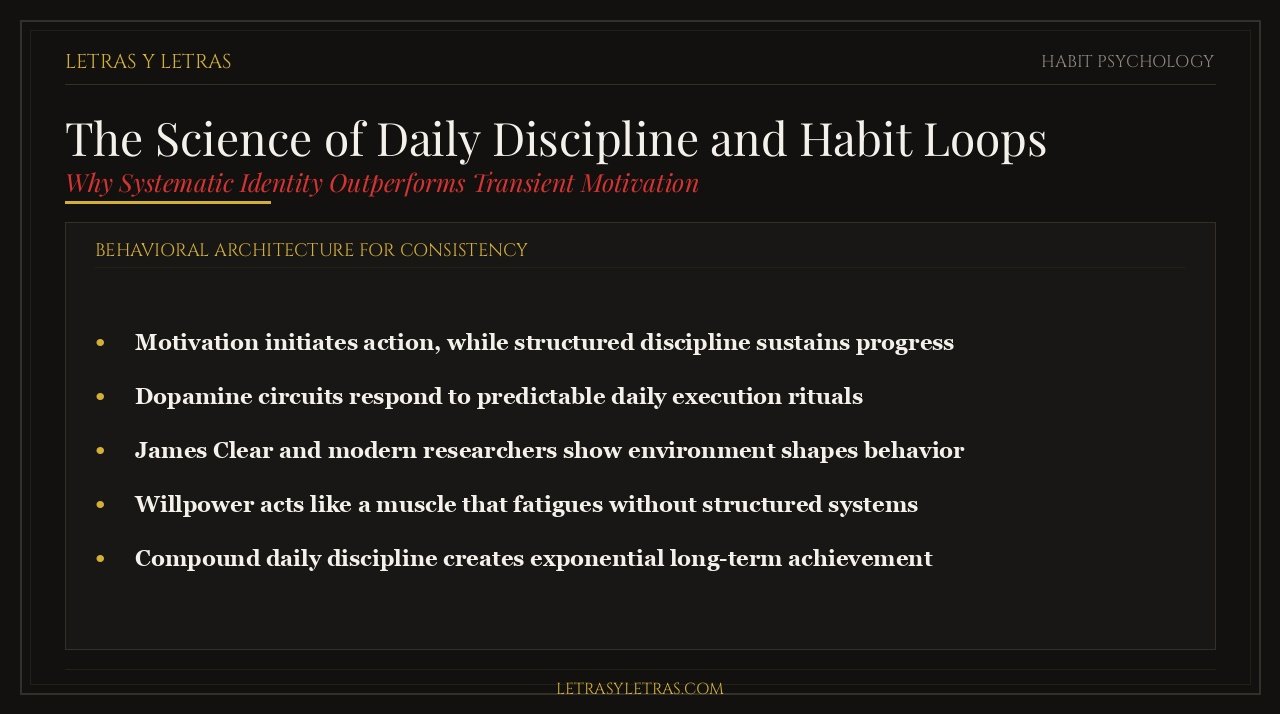
Relying on raw willpower is a losing long-term strategy. Willpower resembles physical muscle tissue that tires under continuous strain. Sustainable progress requires intelligent environmental design and daily rituals.
These five observations demonstrate why structural systems supersede emotional enthusiasm:
11. James Clear: Falling to the Level of Systems
“You do not rise to the level of your goals. You fall to the level of your systems.”
Modern behavioral writer James Clear emphasizes the distinction between aspirations and habits. Setting ambitious goals clarifies direction, but daily systems deliver execution. A disciplined life relies on well-designed routines rather than wishful thinking.
Winners and losers often share identical athletic or business ambitions. The decisive factor lies in daily execution protocols. Small systematic adjustments produce exponential improvements over extended time horizons.
12. Will Durant: Repeated Actions Define Character
“We are what we repeatedly do. Excellence, then, is not an act, but a habit.”
Historian Will Durant synthesized Aristotle philosophical ethical teachings in his survey of Western thought. While often misattributed directly to Aristotle, Durant captured the core message. Moral greatness is forged through persistent daily practice rather than occasional heroic gestures.
A single act of courage does not make someone brave. Consistent truth-telling across decades establishes authentic integrity. Character is the sediment left behind by thousands of routine daily decisions.
13. W H Auden: Routine as Moral Necessity
“Routine, in an intelligent man, is a sign of ambition.”
English poet Auden adhered to an unbending daily timetable throughout his literary career. He rose at six, wrote for precise blocks, and observed strict evening curfews. Far from stifling creativity, his rigid routine freed his intellect from administrative trivia.
When daily logistics become automatic, mental energy flows directly into creative production. Auden viewed predictable hours as a protective fortress. Without routine, creative genius dissolves in chaotic distraction.
14. John Wooden: Character in Total Secrecy
“The true test of a man character is what he does when nobody is looking.”
Legendary basketball coach John Wooden guided UCLA teams to ten national championships. Wooden taught players that championship performances arise from private practice drills. Players who neglected fundamental drills when alone invariably faltered under arena lights.
Discipline proves its authenticity when public praise is absent. Sweeping the floor or reviewing notes in solitude reveals real commitment. Private habits inevitably produce public reputations.
15. Frederick Alexander: Deciding Habits That Shape Tomorrow
“People do not decide their futures, they decide their habits and their habits decide their futures.”
Vocal educator Frederick Alexander pioneered influential techniques for physical posture and conscious control. He demonstrated that reflexive bodily habits control physical performance. Altering underlying automatic habits produces profound, enduring transformation.
Most individuals dream of distant milestones while ignoring immediate behavior. Alexander shifted attention to subtle movement patterns. Master your immediate habits, and the future arranges itself naturally.
Pillar 4: Emotional Restraint and Inner Sovereignty
Discipline involves far more than waking early or completing physical labor. The most demanding discipline governs internal emotions, speech, and instinctive reactions. Preventing anger or panic from hijacking intellect marks genuine maturity.
The following thinkers illuminated the quiet power of emotional composure:
16. Lao Tzu: The Distinction Between Strength and Power
“Mastering others is strength. Mastering yourself is true power.”
Ancient philosopher Lao Tzu recorded core Daoist wisdom in the classic Tao Te Ching. Physical force and political dominance remain fragile and temporary. An individual who governs internal cravings exercises enduring spiritual authority.
Coercing subordinates requires constant vigilance and external enforcement. In contrast, self-mastery generates an unshakeable foundation of inner quiet. True authority rests in absolute contentment with one own conduct.
17. Plato: The Greatest Personal Victory
“The first and greatest victory is to conquer yourself.”
In his famous dialogues, Greek philosopher Plato examined justice in human societies. Plato argued that a chaotic soul cannot build a harmonious state. Subordinating unruly appetites to rational discernment constitutes the highest human duty.
A commander who captures enemy cities while remaining a slave to greed achieves hollow glory. Plato likened the human psyche to a chariot drawn by unruly horses. Reason must hold the reins with steady, disciplined hands.
18. Miyamoto Musashi: A Thousand Days of Practice
“A thousand days of training to develop, ten thousand days of training to polish.”
Legendary swordsman Miyamoto Musashi survived sixty duels across feudal Japan. In The Book of Five Rings, Musashi rejected shortcut techniques. Flawless execution during deadly combat required decades of quiet, unglamorous drills.
Superficial competence appears quickly after initial study. True mastery, however, demands thousands of repetitions in solitude. Musashi taught warriors to look beyond superficial flourishes and honor patient craft.
19. Friedrich Nietzsche: Possessing Will Over Drift
“He who cannot obey himself will be commanded. That is the nature of living creatures.”
German philosopher Friedrich Nietzsche challenged thinkers to overcome passive intellectual conformity. Individuals who lack clear internal discipline surrender control to societal pressure. Those who fail to govern their thoughts become instruments of external forces.
Nietzsche despised passive drift and herd mentality. Self-determination demands intense personal accountability and moral courage. If you do not direct your own steps, someone else will gladly dictate your path.
20. Viktor Frankl: The Sacred Space of Response
“Between stimulus and response there is a space. In that space is our power to choose our response.”
Psychiatrist Viktor Frankl survived the horrific brutality of concentration camps. Frankl witnessed that guards could strip away clothes, food, and family. They could never extinguish his internal freedom to choose his moral attitude.
Most animals react instinctively to external stimuli without pause. Humans possess the unique cognitive gift of self-reflection. Cultivating that pause between impulse and action is the essence of emotional discipline.
This moral fortitude mirrors the community solidarity explored in our origin of the word boycott. Principled refusal provides unmatched strength against external pressure.
Pillar 5: Long-Term Greatness and the Cost of Regret
Every human choice carries a specific price tag. We can endure the brief discomfort of daily discipline now, or bear the heavy burden of remorse later. Time marches forward regardless of our choices.
These five enduring maxims highlight the profound contrast between effort and regret:
21. Jim Rohn: Weighed in Ounces and Tons
“We must all suffer one of two things: the pain of discipline or the pain of regret. Discipline weighs ounces while regret weighs tons.”
Business philosopher Jim Rohn taught thousands of entrepreneurs about personal development. Rohn reminded listeners that discipline involves manageable daily trade-offs. The silent agony of wasted potential, however, haunts a person for decades.
Waking early or skipping dessert brings momentary physical irritation. Looking back on thirty years of missed opportunities brings soul-crushing remorse. Choose the lighter burden of daily consistency every morning.
22. Jocko Willink: Freedom Through Structure
“Discipline equals freedom.”
Retired military commander Jocko Willink led special operations forces in intense combat environments. Popular culture views discipline as a rigid cage. Willink explains that financial, physical, and mental freedom only exist through rigorous discipline.
Financial freedom requires disciplined spending and saving habits. Physical vitality demands disciplined nutrition and rigorous exercise. Without internal structure, people become prisoners of debt, illness, and anxiety.
23. George Washington: The Soul of Collective Effort
“Discipline is the soul of an army. It makes small numbers formidable and procures success to the weak.”
During the American War of Independence, George Washington commanded ragged, unpaid colonial troops. Outmatched by British regular infantry, Washington prioritized drill and cohesion. Strict camp discipline transformed disorganized volunteers into a resilient fighting force.
Washington knew that passion alone cannot hold battle lines against artillery fire. Habitual obedience to command created collective courage. Cohesion multiplies human power beyond all material calculations.
24. Abraham Lincoln: Sharpening the Axe
“Give me six hours to chop down a tree and I will spend the first four sharpening the axe.”
President Abraham Lincoln recognized that brute labor without disciplined preparation yields mediocre results. Hacking away with a dull blade exhausts the woodsman. Methodical sharpening ensures swift, precise execution when action begins.
Disciplined individuals invest patient hours in research, preparation, and skill acquisition. Amateurs rush into execution and make avoidable blunders. Preparation is the silent foundation of effortless mastery.
25. Ralph Waldo Emerson: Doing the Feared Deed
“Do the thing you fear, and the death of fear is certain.”
American essayist Ralph Waldo Emerson urged citizens toward profound self-reliance. Fear thrives when we hesitate before difficult duties. Stepping directly into necessary friction dissolves apprehension and strengthens resolve.
Every avoided challenge increases psychological dread. Taking disciplined action reclaims personal agency immediately. Courage is not the absence of fear, but the habit of stepping forward anyway.
Ancient Romans valued this purity of character, as examined in our origin of the word sincere. Honest self-examination strips away pretension and clarifies genuine priorities.
Comparative Traditions of Personal Discipline
Different philosophical traditions approach self-governance with unique priorities. The table below outlines major historical frameworks:
| Philosophical Tradition | Core Thinkers | Primary Focus | Daily Application |
|---|---|---|---|
| Roman Stoicism | Seneca, Marcus Aurelius, Epictetus | Control of internal judgment and rational duty | Morning journaling, reflection, enduring discomfort |
| Classical Greek Ethics | Plato, Aristotle | Virtue through repeated habitual moderation | Balancing physical training with scholarly study |
| Eastern Philosophy | Lao Tzu, Miyamoto Musashi | Inner stillness, non-attachment, relentless craft | Repetitive technique, quiet focus, emotional poise |
| Early American Pragmatism | Benjamin Franklin, George Washington | Structured daily routines and public character | Tracking daily virtues, strict time budgeting |
| Modern Behavioral Science | James Clear, Viktor Frankl | Habit loops, environmental cues, identity shift | Reducing friction, stacking cues, conscious pauses |
The Cognitive Science of Discipline: Why Systems Beat Willpower
For decades, popular culture treated willpower as a moral trait. People who struggled with diet or deadlines were labeled lazy. Contemporary cognitive neuroscience presents a radically different portrait.
Research published by the American Psychological Association research on willpower reveals that deliberate restraint consumes neural glucose. Every decision made throughout a busy morning drains cognitive reserves. By late evening, individuals experience mental fatigue.
Highly disciplined individuals do not possess superhuman willpower. Instead, they structure their environments to minimize temptation. They automate essential decisions into friction-free habits.
A habit loop consists of three primary components: cue, routine, and reward. When a cue triggers a practiced routine automatically, prefrontal cortex exertion remains minimal. The action occurs without exhausting internal debate.
Consider an author who sits down at seven each morning. The clock striking the hour serves as a clear environmental trigger. Routine replaces internal friction with reliable execution.
A Practical Framework for Building Daily Self-Mastery
Translating inspiring quotes on discipline into tangible results requires a coherent strategy. Without structured implementation, philosophical maxims remain pleasant slogans. Apply these four tactical steps to build enduring personal habits:
First, reduce initial friction on desirable behaviors. Prepare exercise clothing the previous evening. Place nutritious food in plain sight while hiding distracting digital devices in another room.
Second, establish non-negotiable anchor rituals. Anchor demanding new habits to established behaviors. Reviewing quarterly goals immediately after pouring morning tea creates a reliable behavioral bridge.
Third, adopt identity-based language. Rather than saying you are trying to write, identify as a writer. Behavior naturally conforms to deeply held personal identity.
Fourth, measure consistency rather than immediate outcome. Focus on showing up five days per week rather than measuring instant results. Small daily deposits compound into massive achievement over months.
Frequently Asked Questions
What is the true origin of the word discipline?
The word discipline comes from the Latin noun disciplina, meaning instruction, education, and knowledge. It derives from discipulus, meaning student or learner. In classical antiquity, discipline represented scholarly apprenticeship rather than punitive correction.
Why does daily discipline outperform temporary motivation?
Motivation is an emotional state influenced by sleep, diet, and mood. Discipline operates through automated habit architecture and environmental systems. Reliable routines ensure progress continues even when emotional enthusiasm wanes.
What did Stoic philosophers teach about self-control?
Stoic thinkers like Seneca and Epictetus taught that inner self-command constitutes authentic human liberty. While external outcomes remain outside our control, personal choices and ethical responses remain completely sovereign.
How does modern science explain willpower depletion?
Cognitive science demonstrates that conscious restraint taxes executive brain circuits. Highly disciplined people avoid draining willpower by automating healthy choices into daily habit loops.
Who famously stated that discipline equals freedom?
Retired naval commander and author Jocko Willink popularized the maxim discipline equals freedom. Willink argues that financial, physical, and professional liberty arise from rigorous daily self-governance.
How can someone build discipline when feeling overwhelmed?
Begin by shrinking the desired action into an effortless micro-habit. Reduce friction by preparing materials beforehand and executing at the exact same hour daily. Focus on maintaining streak consistency before increasing difficulty.
Alan Sledge is the lead writer at letrasyletras.com, uncovering historical wisdom and word origins.


Alan Sledge is the writer and founder behind Letters & Letters. A lifelong lover of words, Alan has always been drawn to the small mysteries hidden in everyday language, why we say what we say, where our favorite sayings came from and the quotes that manage to put feelings into words better than we ever could ourselves.