
Bright yellow warning signs line modern highways, factory floors, and airport runways. We instinctively associate the word hazard with high-voltage electricity, toxic chemicals, and steep cliff edges. Danger feels like its natural meaning.
Centuries ago, the word meant something entirely different. Calling an object a hazard had nothing to do with physical safety or bodily harm. It referred to a pair of polished animal bones rattling across a wooden tabletop.
The origin of the word hazard began as an addictive medieval dice game. It traveled from sun-drenched Middle Eastern fortresses into European royal courts. Over five centuries, a gambling craze transformed into our universal term for peril.
Quick Answer: Origin of the Word Hazard
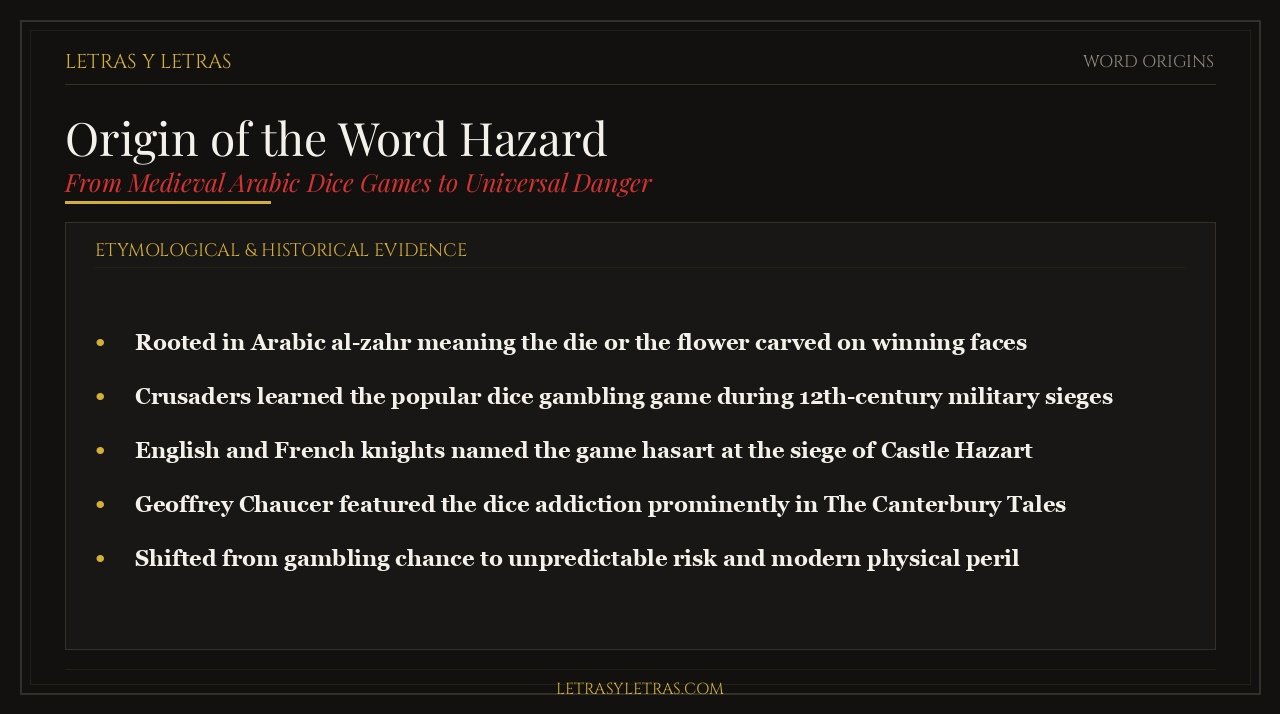
The origin of the word hazard traces back to the Arabic noun al-zahr, meaning the die or the flower carved on winning faces of ancient gaming cubes. During the twelfth-century Crusades, French and English knights learned this popular dice gambling game while besieging Castle Hazart in Palestine. European soldiers adopted the term as hasart in Old French to describe high-stakes dice games. The game entered Middle English during the 1300s, where Geoffrey Chaucer famously condemned its corrupting influence in The Canterbury Tales. By the late sixteenth century, the word evolved from an unpredictable game of chance into the abstract concept of risk, before finally signifying physical danger and peril.
Key Takeaways
- Derived from Arabic al-zahr, originally signifying bone dice or engraved flower motifs.
- Crusader knights adopted the dice game outside the walls of Castle Hazart in Palestine.
- Middle English absorbed hasard as a gambling craze that ruined nobles and commoners.
- Geoffrey Chaucer condemned the vice of hasardry in the fourteenth-century Canterbury Tales.
- Semantic drift shifted the meaning from rolling dice to general risk and modern peril.
The Arabic Roots: Al-Zahr and the Floral Die
To discover where hazard started, we must investigate medieval Arabic linguistics. Etymologists trace the earliest root to the Arabic noun al-zahr. In classical Arabic literature, the term referred to dice.
Linguists offer two compelling explanations for how the noun developed. One scholarly camp links al-zahr directly to the Arabic word for flower. Ancient bone dice carved in the Levant featured an engraved floral symbol on the highest-scoring face.
Rolling the flower meant instant victory for the player. Competing scholars suggest that the root simply denoted the cubic gaming pieces themselves. In both interpretations, the term described a physical game of chance.
Dice gaming was intensely popular across medieval Levantine trade hubs. Merchants, soldiers, and travelers rolled dice in caravanserais from Damascus to Cairo. The game relied on quick bets and rapid payouts.
When Western European armies marched east during the Crusades, they entered this vibrant gaming culture. Soldiers spent months camping outside fortified desert cities. Cultural exchange occurred at the gambling table.
Crusaders at the Gates: The Siege of Castle Hazart
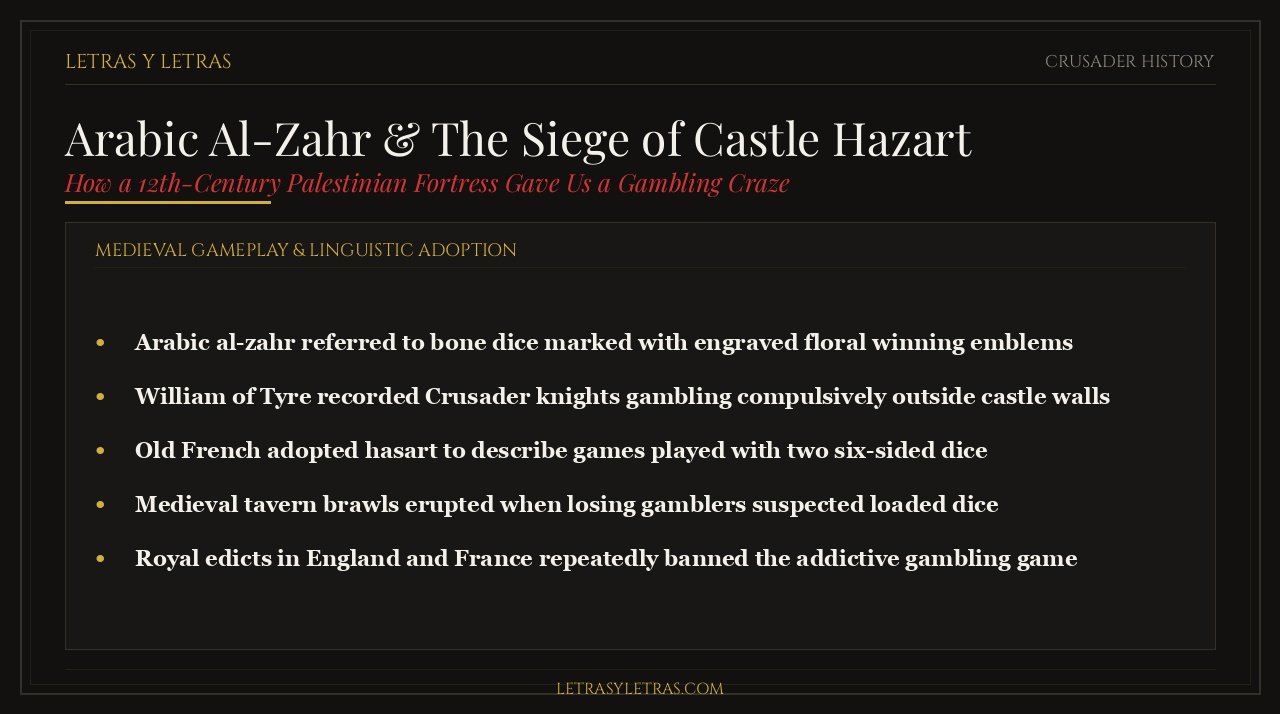
Medieval chroniclers recorded a dramatic connection between the dice game and Crusader military campaigns. During the twelfth century, European knights laid siege to a Palestinian fortress called Castle Hazart. The castle was also known as As-Sadir.
Military sieges in the Middle Ages involved endless weeks of exhausting inactivity. Outside fortress walls, armies waited for defenders to starve. Boredom among young, heavily armed knights was a dangerous problem for commanders.
Knights turned to gambling to pass the sweltering desert hours. They learned local dice rules and began wagering armor, warhorses, and captured gold. Chronicler William of Tyre documented rampant gambling among Christian forces.
Crusaders associated the addictive game directly with the Palestinian fortress where they played it. Soldiers referred to the pastime as the game of Hazart. When knights returned home to France and England, they brought the rules with them.
The phonetic similarity between Arabic al-zahr and Castle Hazart cemented the name in Western memory. European mouths smoothed the syllables into Old French hasart. A regional military pastime became a continental sensation.
Old French Hasart: A Gambling Craze Sweeps Europe
By the thirteenth century, the game of hazard was sweeping through medieval France. Nobles played in private castle chambers, while peasants rolled dice on tavern dirt floors. The obsession crossed all social classes.
The game involved two six-sided dice and complex betting rounds. A thrower rolled a main number between five and nine. Players wagered if subsequent throws would hit winning combinations or roll losing numbers.
Fortunes vanished in a single evening over a few bad throws. Wealthy barons lost ancestral manors, hunting hounds, and family jewels. Desperate losers frequently accused opponents of using weighted or shaved dice.
Violent tavern brawls broke out constantly across Paris and London. Bloodshed over dice became so rampant that monarchs intervened. King Louis IX of France issued strict royal ordinances banning dice manufacture in 1254.
Royal decrees did little to curb the addiction. Dice makers carved smaller bones that gamblers easily hid inside sleeves or boots. The game persisted in secret basements and alleyways throughout the Middle Ages.
Chaucer and Middle English: The Sins of Hasardry
The French word crossed the English Channel following the Norman Conquest. By the fourteenth century, Middle English fully absorbed the term as hasard. English writers viewed the game as a serious moral disease.
No author captured this medieval anxiety better than Geoffrey Chaucer. In The Canterbury Tales around 1387, Chaucer preached a fierce sermon against dice in The Pardoner’s Tale. Chaucer used the noun hasardry.
The Pardoner denounced hasardry as the corrupt mother of deceit, perjury, and blasphemous swearing. He described young men wasting their youth in taverns, shaking dice until their pockets were bare. To Chaucer, hasardry destroyed human character.
The text illustrates that fourteenth-century speakers never used hazard to mean physical peril. A hazard was strictly a game, and a hazarder was a compulsive gambler. The word described human vice rather than environmental danger.
Like ancient Norse fighters in our origin of the word berserk, medieval gamblers created lasting vocabulary. The gambling term was about to begin a massive semantic expansion.
The Mechanics of Medieval Hazard: Ancestor of Modern Craps
Grasping how medieval hazard functioned helps explain its linguistic evolution. Unlike modern board games, hazard was fast, loud, and entirely based on pure mathematical probability. It was the direct ancestor of modern casino craps.
The shooter rolled two dice to establish a main number. This main number had to be six, seven, or eight to continue smoothly. Once established, the shooter rolled for a secondary chance number.
Certain dice totals caused an instant loss called crabs. If a player threw a pair of ones or a twelve, the shooter lost immediately. The term crabs evolved centuries later into the American word craps.
Because dice totals depended on random chance, players felt at the mercy of unpredictable forces. A sudden roll could bring immense wealth or complete ruin. The dice board became a metaphor for human helplessness.
Writers began noticing that life itself resembled a round of hazard. Sickness, shipwrecks, and political changes felt as random as rolling a pair of bones. The metaphor began creeping out of gambling dens.
Semantic Drift: From Dice Rolls to Unpredictable Risk
During the sixteenth century, the word underwent a profound linguistic transition. Linguists describe this process as metaphorical extension. Speakers began using hazard as an active verb meaning to risk or to venture.
Merchants spoke of hazarding their capital on risky overseas trading voyages. Military commanders talked of hazarding their regiments in battle. In both cases, people were placing a wager on an uncertain future outcome.
William Shakespeare used the word frequently in this transitional sense. In The Merchant of Venice, suitors must hazard all they possess to win Portia’s hand. During Richard III, the desperate king declares he has set his life upon a cast.
Richard was willing to stand the hazard of the die. Shakespeare brilliantly connected the literal dice roll to political survival. The word still carried its gaming heritage, but its emotional weight had broadened.
By 1600, hazard meant any situation where success was not guaranteed. It encompassed financial speculation, personal romance, and military maneuvers. The transition from dice game to general uncertainty was nearly complete.
From Risk to Peril: The Final Leap into Physical Danger
The final semantic shift occurred during the seventeenth and eighteenth centuries. As commercial shipping and industrial manufacturing expanded, society needed precise language to describe physical dangers. Hazard stepped into that role.
Maritime insurance underwriters played a major role in this evolution. Marine policies in London listed perils of the sea, including storms, sunken reefs, and pirate attacks. Insurers grouped these dangers under the heading of marine hazards.
A subtle change in meaning took place. The word no longer merely described the act of taking a risk. It became the physical object or condition that created the danger in the first place.
A submerged granite reef was a navigation hazard. Loose gunpowder in a warehouse was a fire hazard. By the nineteenth century, factories posted warning signs alerting workers to mechanical hazards.
The original connection to dice gaming faded from common memory. Millions used the word daily without realizing they were invoking an ancient Arabic dice tournament. The gambler’s cube had transformed into a universal warning.
Chronological Milestones in the Evolution of Hazard
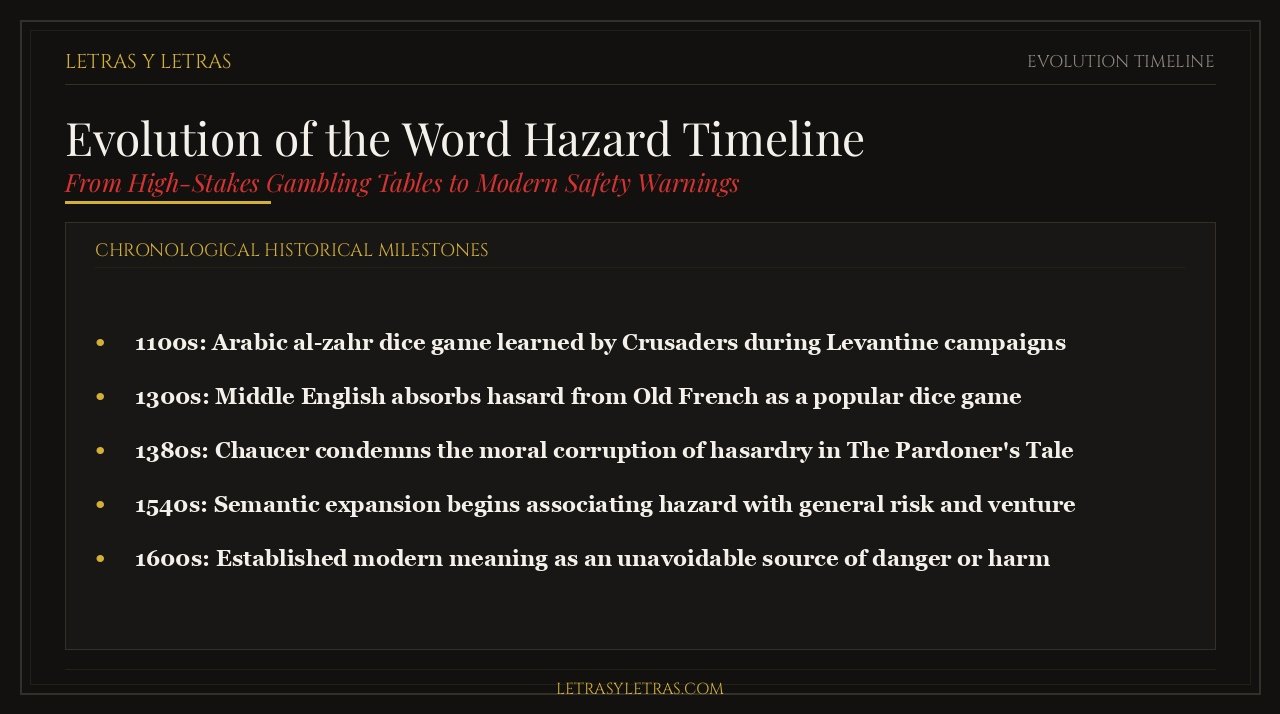
The chronological timeline below summarizes how hazard moved from ancient dice to modern danger:
| Historical Era | Linguistic Source | Evolutionary Milestone |
|---|---|---|
| Early 1100s | Arabic (al-zahr) | Word denotes bone dice with engraved flower patterns on winning faces. |
| c. 1180 | Crusader campaigns (Palestine) | Knights adopt the dice game outside Castle Hazart (As-Sadir). |
| 1250s | Old French (hasart) | Gambling craze spreads through France; King Louis IX bans dice making. |
| c. 1387 | Middle English (hasard) | Chaucer condemns the social corruption of hasardry in Canterbury Tales. |
| 1590s | Early Modern English | Shakespeare expands hazard into a verb meaning to risk life or fortune. |
| Present Day | Modern English | Universal noun for physical danger, toxic risk, and safety warnings. |
Debunking False Myths: Spanish Wind and Golf Bunkers
Linguistic urban legends frequently attach themselves to words with surprising origins. We examined similar fabricated tales in our study of the origin of the word sincere. The word hazard has generated several popular etymological myths.
One common myth claims that hazard derives from an Old Spanish term for hot desert wind. Proponents argue that travelers facing dangerous dust storms coined the word. Historical Spanish records show that Spanish azar was borrowed directly from Arabic al-zahr, proving the gaming root.
Another persistent fable claims that Scottish golfers invented the word to describe sand traps. In golf rules, sand bunkers and water bodies are officially termed hazards. Golfers assumed the game created the vocabulary.
Historical golf records easily refute this claim. Scottish golfers adopted hazard during the eighteenth century from common English speech. The sport borrowed an existing word meaning unpredictable danger, not the other way around.
The Online Etymology Dictionary affirms that the dice etymology is indisputable. Archival documentation across Arabic, French, and English confirms the game of al-zahr as the sole origin.
How Hazard Birthed Modern Craps in New Orleans
The historical evolution of hazard did not end when the word became synonymous with danger. Instead, the original dice game continued evolving on its own parallel track. In 1805, the game crossed the Atlantic Ocean to Louisiana.
A wealthy French-Creole aristocrat named Bernard de Marigny brought the game of hazard from London to New Orleans. Marigny loved gambling and introduced the rules to his wealthy social circle. Local American players found the traditional rules too complicated.
Americans simplified the betting rounds, focusing on throwing a seven or eleven on the initial cast. Working-class dock workers along the Mississippi River adopted the fast-paced game. They played on street corners and steamboat decks.
Locals nicknamed the game craps, derived from the old hazard term crabs for an unlucky roll of two. American craps became one of the most famous casino games in the world. The ancient game lived on under a new name.
Today, a craps table in Las Vegas preserves the direct mathematics of medieval Palestine. When modern players roll dice on green felt, they repeat an ancient ritual. The game that gave us hazard still captivates players.
Other Gaming and Gambling Words in Everyday English
Hazard is not the only common word that started at the gaming table. English is filled with metaphors borrowed from cards, dice, and bets. We use them constantly without recognizing their gambling ancestry.
Consider the expression to leave in the lurch. It originated from an old French board game called lourche, where being trapped meant losing. Similarly, hitting the jackpot comes directly from nineteenth-century draw poker rules.
We see maritime and military parallels across our analysis of the origin of the phrase under the weather. You can also explore espionage codes in our breakdown of the origin of the phrase read between the lines.
Historical expressions thrive because games mirror human struggle. Dice rolls capture our anxiety about luck, timing, and survival. Language permanently preserves these human obsessions inside everyday words.
Frequently Asked Questions
What is the literal origin of the word hazard?
The literal origin comes from the Arabic noun al-zahr, meaning the die. Crusaders adopted the dice game in Palestine during the twelfth century. European soldiers brought the game home, calling it hasart in Old French before it entered English.
How did a dice game become a word for danger?
The word shifted through semantic broadening over five centuries. Because dice rolls were unpredictable, hazard came to mean any uncertain risk. By the seventeenth century, insurers and industries applied it to physical sources of danger.
What was Castle Hazart?
Castle Hazart, also known as As-Sadir, was a Palestinian fortress besieged by Crusaders in the twelfth century. Bored European knights played dice outside its walls, associating the game with the castle location.
Did Chaucer write about hazard?
Yes, Geoffrey Chaucer wrote extensively about the game in The Canterbury Tales around 1387. In The Pardoner’s Tale, Chaucer condemned the vice of hasardry as the corrupt source of deceit and swearing.
How is hazard related to modern casino craps?
Hazard is the direct ancestor of modern craps. In 1805, Bernard de Marigny brought hazard to New Orleans, where players simplified its rules. An unlucky roll in hazard called crabs gave the American game its name.
Does hazard come from an Old Spanish word for wind?
No, the Spanish wind theory is a disproven folk etymology myth. Spanish azar derives directly from Arabic al-zahr. Historical linguistic records confirm that the word stems exclusively from medieval dice gaming.
Alan Sledge is the lead writer at letrasyletras.com, uncovering the true historical origins behind everyday words.


Alan Sledge is the writer and founder behind Letters & Letters. A lifelong lover of words, Alan has always been drawn to the small mysteries hidden in everyday language, why we say what we say, where our favorite sayings came from and the quotes that manage to put feelings into words better than we ever could ourselves.