
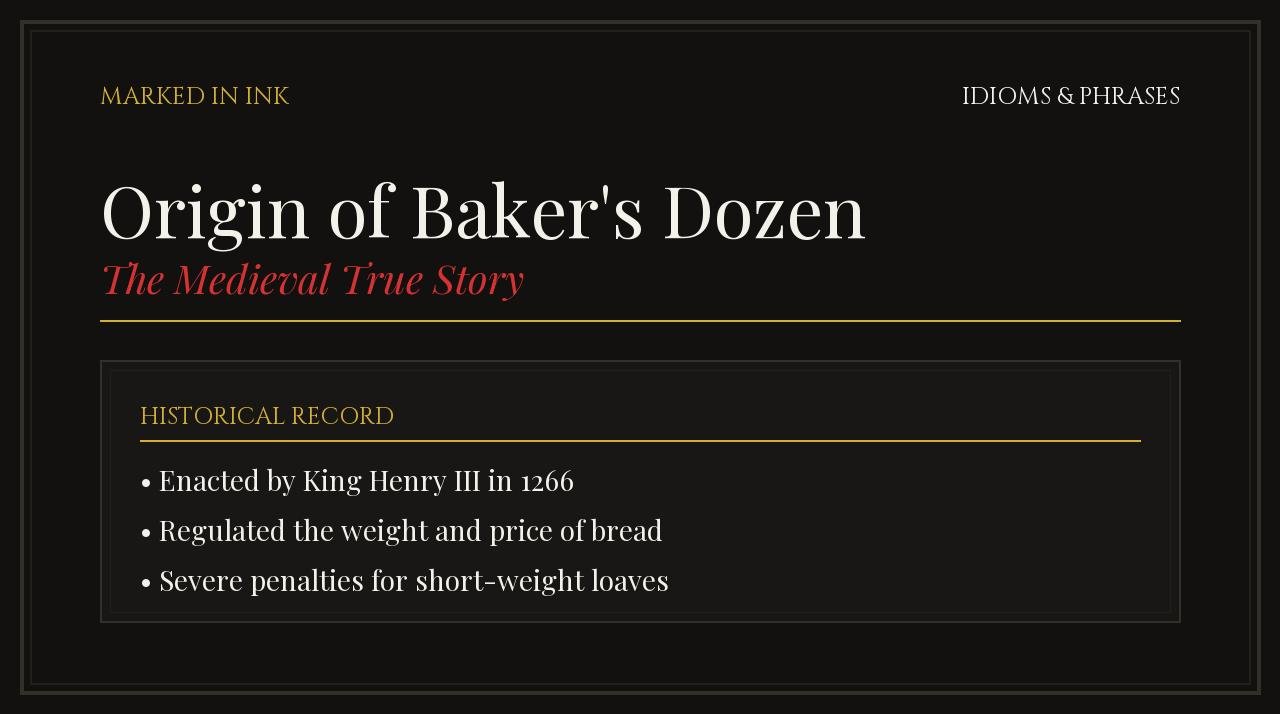
Quick Answer: Origin of the Phrase Baker’s Dozen
The origin of the phrase baker’s dozen dates back to 13th-century England. King Henry III enacted the Assize of Bread and Ale in 1266 to regulate the weight and price of bread. Bakers who sold short-weight loaves faced severe penalties, including hefty fines or being locked in the public pillory. Because medieval baking was imprecise and loaves often lost weight in the oven, bakers began adding a 13th loaf (called the “vantage loaf”) to every dozen sold. This extra bread guaranteed the total weight met legal standards, protecting the baker from punishment. Therefore, a baker’s dozen came to mean 13 instead of 12.
Key Takeaways
- A baker’s dozen is exactly 13 instead of 12.
- The practice originated from the 1266 Assize of Bread and Ale.
- Bakers added a 13th loaf to avoid fines for selling short-weight bread.
- The 13th loaf was historically called the vantage loaf.
- The phrase has no religious connection to the Last Supper.
Have you ever found an extra roll in your order? This popular phrase traces back to medieval England. At that time, a missing roll was a serious crime.
Our primary keyword is the origin of the phrase baker’s dozen. Its history is surprisingly intense and very stressful. A lightweight loaf could land a baker in the town pillory.
To avoid brutal fines, bakers started adding a 13th loaf. This extra bread acted as insurance against strict royal laws. Today we view this extra item as a generous bonus.
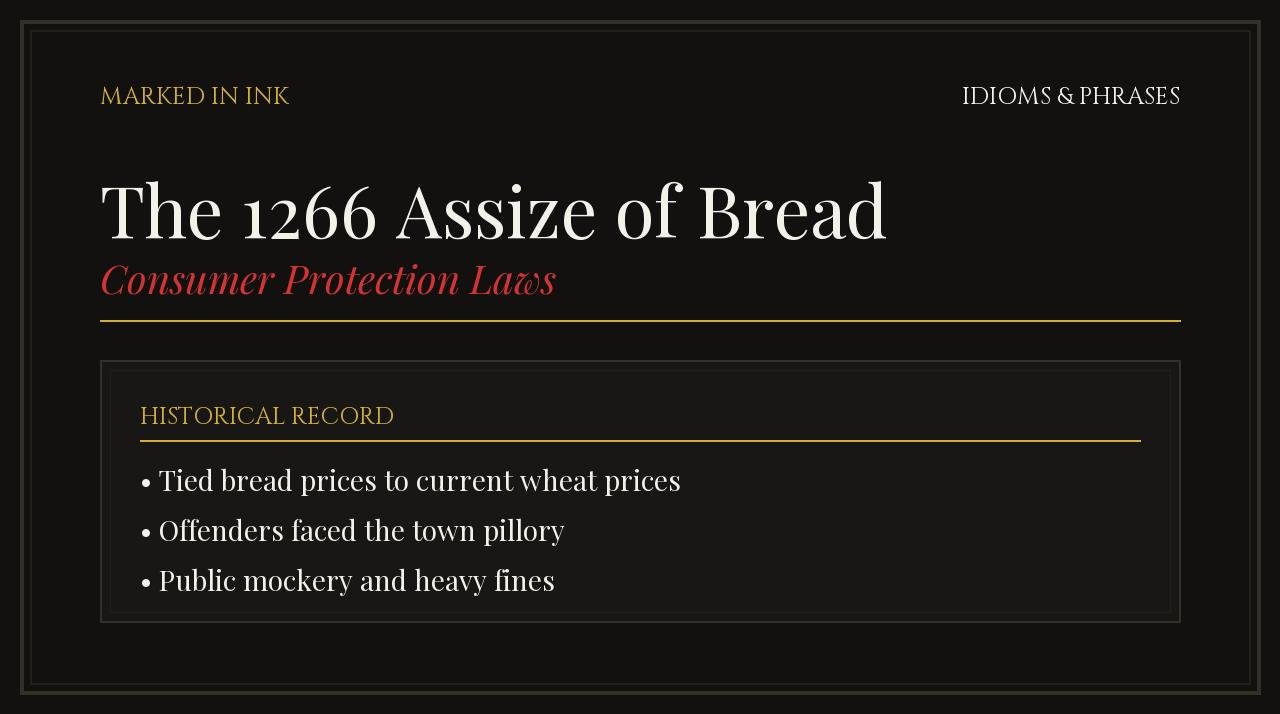
The 1266 Assize of Bread and Ale
This phrase’s history begins with King Henry III. He instituted the strict Assize of Bread and Ale in 1266. This statute tied bread prices directly to current wheat prices.
Medieval towns relied heavily on bread as a dietary staple. A dishonest baker could easily shortchange the public. They did this by shrinking loaf sizes while maintaining prices.
The Assize established severe penalties for selling short-weight bread. Punishments were swift and deeply humiliating for all offenders.
The Merriam-Webster dictionary states the phrase appeared later. However, the actual physical practice started here. A baker caught breaking the rules could lose their business.
Fear of the Pillory: Medieval Penalties
The consequences for shortchanging customers were utterly terrifying. Fines were steep and could ruin a small bakery overnight. Worse than financial ruin was the threat of physical punishment.
Repeat offenders were dragged to the local town square. They were frequently locked in the heavy wooden pillory. Angry townsfolk would throw mud at the disgraced tradesman.
Baking in medieval ovens was never an exact science. An honest baker could accidentally produce an underweight batch. Moisture loss made it difficult to predict final loaf weights.
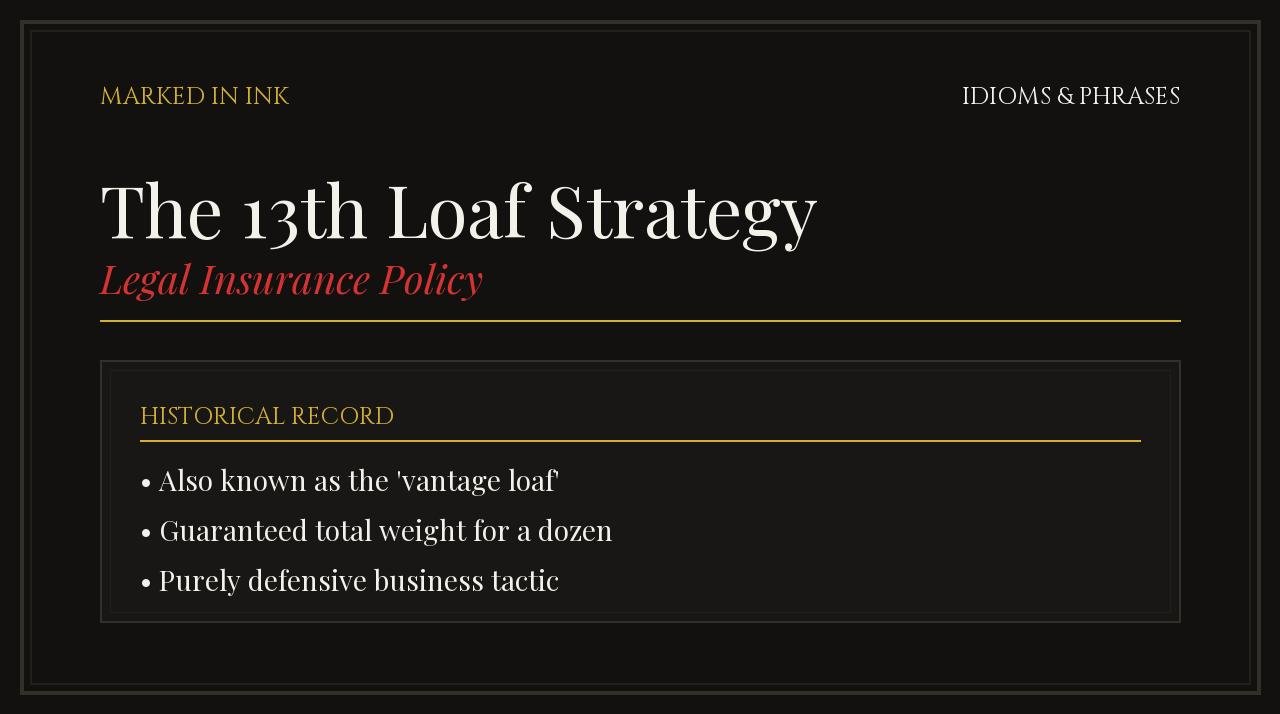
The 13th Loaf: Legal Self-Defense
To protect themselves, bakers adopted a simple mathematical fix. Whenever a retailer bought a dozen loaves, they added one. This 13th loaf was often called the “vantage loaf.”
This logic was purely a defensive strategy. Extra weight easily satisfied the legal requirement for a dozen. This insurance policy became an industry standard across England.
The Online Etymology Dictionary records the phrase appearing much later. Giving 13 items persisted as a custom for many centuries. Over time, it evolved into a symbol of generosity.
Debunking Superstition Myths
Several myths surround this specific linguistic oddity. One popular theory claims the number 13 was religious. It suggests bakers gave a 13th loaf to honor Jesus.
Another common myth involves a “baker’s superstition.” Some people believe bakers added bread to ward off evil. This fictional theory ignores the harsh legal realities.
Read our english idioms and meanings guide. You will see how legal history trumps common mythology. This 1266 law is the only verifiable cause.
Early Citations in English History
The exact words did not appear in writing until 1599. Early printed texts refer to the custom as well-known. This proves the practice was deeply ingrained in the culture.
In 1599, the phrase appeared in a popular play. The custom was so universally understood by then. Writers did not need to explain why 13 meant a dozen.
For language evolution, check the origin of the phrase caught red handed. History is often tied directly to ancient laws and punishments. This baker’s trick is a prime example.
FAQ: Origin of the Phrase Baker’s Dozen
Why is a baker’s dozen 13 instead of 12?
Medieval bakers added an extra loaf to avoid strict fines. This ensured they met the legal weight requirements. King Henry III established these rules in 1266.
Did bakers really go to jail for lightweight bread?
They faced severe punishments for selling short-weight bread. Offenders were heavily fined and sometimes lost their baking rights. Many were locked in the public pillory for humiliation.
What was the vantage loaf?
The vantage loaf was the historical term used. It referred to the 13th loaf added to a dozen. This extra item functioned purely as a legal safety net.
Is a baker’s dozen always 13?
It is traditionally exactly 13 items. Some historical records indicate it could sometimes be 14. This happened if the loaves were particularly small.
Does the phrase have religious origins?
No, it has no religious origin. Popular myths incorrectly link the number 13 to the Last Supper. It is entirely based on medieval English consumer laws.
We hope this exploration sheds light on a common phrase. Enjoy our famous quotes and quotations for more fascinating history. Thank the strict laws of King Henry III for extra bagels!


Alan Sledge is the writer and founder behind Letters & Letters. A lifelong lover of words, Alan has always been drawn to the small mysteries hidden in everyday language, why we say what we say, where our favorite sayings came from and the quotes that manage to put feelings into words better than we ever could ourselves.