

Political commentators invoke the expression when disgraced public officials apologize before television cameras. Defense attorneys cite the idiom when prosecutors dismiss theatrical displays of remorse in courtrooms. Ordinary people whisper the phrase whenever a dishonest acquaintance feigns sympathy after causing deliberate harm.
In contemporary English, shedding crocodile tears denotes an insincere, hypocritical display of grief or remorse. The metaphor accuses the weeper of hiding malicious joy behind theatrical sorrow. We use the phrase instinctively without pondering why an ancient reptile became humanity chief symbol of emotional deceit.
The true origin of the phrase crocodile tears bridges ancient folklore, medieval travel chronicles, and startling modern biology. For centuries, scholars dismissed the weeping reptile as a fable. Modern zoological science, however, revealed a bizarre biological reality operating beneath the ancient metaphor.
Quick Answer: Origin of the Phrase Crocodile Tears
The phrase crocodile tears traces to an ancient myth popularized across medieval Europe by fourteenth-century travel chronicles. Writers like Sir John Mandeville claimed that Nile crocodiles wept mournfully over human victims before eating them. Renaissance scholar Erasmus codified the Latin proverb crocodili lachrymae in 1500, defining it as hypocritical grief. William Shakespeare popularized the idiom in sixteenth-century tragedies like Othello. Modern biological research confirms that crocodiles do shed tears while feeding on dry land. The tearing results from mechanical pressure forcing lacrimal fluid through sinuses during feeding, rather than genuine emotional remorse.
Key Takeaways
- Crocodile tears describes insincere, performative grief designed to manipulate others.
- Sir John Mandeville 1356 travelog popularized the legend of weeping Nile predators.
- Erasmus and William Shakespeare cemented the phrase in European literature.
- Zoological studies prove crocodilians physically shed tears while consuming food.
- Medicine recognizes Bogorad syndrome, causing humans to cry while chewing meals.
The Anatomy of Hypocrisy: Defining Crocodile Tears
Few human behaviors provoke as much revulsion as false sympathy. Genuine tears represent vulnerable human grief, physical pain, or deep emotional empathy. When tears are weaponized for social manipulation, society regards the display as contemptible.
The idiom crocodile tears captures this specific psychological deception with extraordinary precision. It does not merely describe someone who lies with spoken words. Rather, the metaphor describes a performer who recruits physical weeping to disguise predatory intentions.
The Encyclopedia Britannica crocodile tears overview notes how universally the idiom functions across modern tongues. Spanish speakers recognize lágrimas de cocodrilo. French literature frequently condemns larmes de crocodile.
A predator that openly attacks generates understandable fear. Conversely, a predator that cries while eating its victim introduces horrifying cognitive dissonance. This contrast between appearance and reality established the metaphor across global rhetoric.
Politicians deploy the charge to dismantle adversary press conferences. Editorial columnists rely on the expression to criticize corporate greenwashing. Ordinary citizens recognize the insult instantly.
The phrase remains irreplaceable because no single synonym carries equivalent dramatic power. Words like disingenuous or deceitful lack the haunting visual image of weeping fangs. To understand how this image arose, we must turn to medieval travel manuscripts.
Medieval Bestiaries and the Nile Legend: Mandeville in 1356
Ancient Greek naturalists recorded curious fables regarding reptiles along the River Nile. Early collectors of proverbs noted that crocodiles were rumored to weep after slaughtering travelers. The legend did not achieve massive European fame, however, until the fourteenth century.
Around 1356, an immensely popular manuscript titled The Travels of Sir John Mandeville circulated across European scriptoriums. The book claimed to document exotic wonders observed during pilgrimages across the Middle East, Africa, and Asia. Medieval readers devoured its vivid descriptions of distant marvels.
In his chapter on the River Nile, Mandeville recorded an unforgettable depiction of crocodilian behavior. He wrote that in this land lived great numbers of fierce serpents called crocodiles. These serpents slay men and eat them weeping, the author solemnly declared.
Earlier medieval encyclopedias had repeated similar zoological claims. In 1398, scholar John Trevisa translated Bartholomaeus Anglicus Latin treatise De Proprietatibus Rerum into Middle English. The text explained that when the crocodile finds a man, he slays him and then weeps upon him before swallowing.
Etymological documentation in the Online Etymology Dictionary crocodile entry confirms this fourteenth-century literary transmission. Medieval monks copied the weeping crocodile tale into illuminated bestiaries. Sermons used the weeping beast as a moral warning against treacherous friends.
Medieval audiences readily accepted the story because bestiaries treated animal behavior as divine allegories. Nature was viewed as a living sermon composed by God. The weeping Nile reptile offered preachers a dramatic symbol of Judas and demonic deceit.
The Renaissance Humanists: Erasmus and Latin Adages
As the Middle Ages gave way to the European Renaissance, classical scholarship experienced a profound revival. Humanist scholars combed through ancient Greek and Latin manuscripts to assemble classical wisdom. Chief among these intellectual pioneers was Dutch humanist Desiderius Erasmus of Rotterdam.
In 1500, Erasmus published his influential collection of classical proverbs titled Adagia. The volume served as an indispensable textbook of rhetoric, style, and philosophy for educated elites across Europe. Erasmus included the ancient Greek and Latin phrase Crocodili lachrymae.
Erasmus defined crocodile tears as the false sorrow of those who pretend grief while secretly plotting malice. He explained that ancient authors used the adage against hypocrites who simulate compassion toward people they intend to destroy. His elegant commentary elevated the folk fable into standard European rhetoric.
Renaissance schoolmasters required students to memorize Erasmus adages as part of classical Latin training. Aspiring diplomats, poets, and theologians encountered the weeping crocodile during their school years. The phrase became a permanent fixture of educated Western discourse.
European vernacular writers quickly translated the Latin proverb into regional tongues. By the mid-sixteenth century, English pamphleteers used crocodile tears to denounce political rivals. The metaphor had completed its transition from bestiary curiosity to everyday literary weapon.
The intellectual authority of Erasmus ensured that the phrase was not dismissed as peasant folklore. It became a sophisticated figure of speech employed by philosophers, statesmen, and dramatists. Its greatest theatrical triumphs were about to unfold upon the London stage.
The Elizabethan Stage: Spenser, Shakespeare, and Treachery
Elizabethan England possessed an insatiable appetite for dramatic betrayal, political intrigue, and moral tragedy. Sixteenth-century playwrights and poets found the weeping crocodile metaphor ideally suited to their theatrical plots. The idiom began appearing in masterpieces of English literature.
In 1590, epic poet Edmund Spenser published The Faerie Queene, an allegorical romance celebrating Tudor court virtues. Spenser compared treacherous foes to the crafty crocodile that weeps beside the Nile to lure innocent travelers. The weeping sound served as a deceptive trap to snare unsuspecting passersby.
Playwright William Shakespeare deployed the metaphor with devastating psychological nuance across multiple tragedies and histories. In Henry VI, Part 2, Shakespeare writes of mourners who deceive like the mournful crocodile with sorrow snaring relenting passengers. The bard recognized how easily public displays of mourning could camouflage treason.
Shakespeare most famous usage occurs in his masterpiece Othello, composed around 1603. Driven half-mad with jealousy by Iago lies, Othello confronts his innocent wife Desdemona. Seeing her honest weeping, Othello roars that every drop she sheds would prove a crocodile.
In Antony and Cleopatra, Shakespeare returns to the Egyptian predator while dramatizing royal Roman rivalries. Lepidus weeps copiously during a banquet, prompting Mark Antony to observe his crocodile tears with sardonic amusement. The theatrical motif resonated deeply with Jacobean playgoers.
Shakespeare genius cemented crocodile tears into the English language for all subsequent centuries. Audiences internalized the image of weeping as a mask for lethal betrayal. The phrase became an indelible staple of English dramatic rhetoric.

The Biological Reality: Do Crocodiles Actually Weep?
For hundreds of years, educated people assumed that weeping crocodiles were pure biological fantasy. Skeptical Enlightenment scientists noted that reptiles lack emotional tear ducts and mammalian facial expressions. Biologists laughed at the notion that armor-plated river predators felt remorse for their meals.
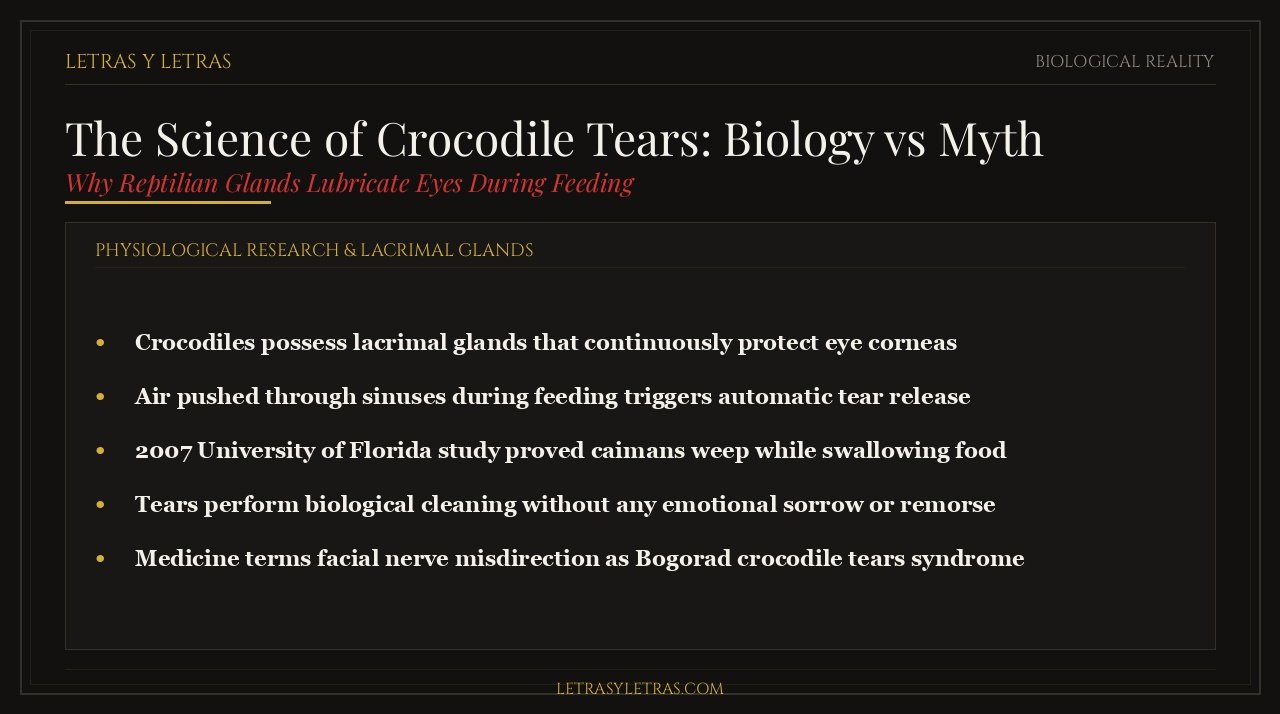
Yet zoological research in the late twentieth and early twenty-first centuries produced an astonishing discovery. Crocodiles do weep real tears while eating food. The ancient legend was factually correct about the physical moisture, even if completely wrong about the emotion.
Like all terrestrial vertebrates, crocodilians possess functional lacrimal glands and Harderian glands situated near the eye sockets. These glands secrete protein-rich fluids that lubricate the eye and cleanse foreign debris. A specialized transparent third eyelid, known as the nictitating membrane, sweeps across the eye to protect it underwater.
When crocodiles leave the water to consume prey on dry land, their eyes begin to dry out in open air. In 2007, zoologist Kent Vliet of the University of Florida conducted a landmark study on crocodilian feeding behaviors. Vliet filmed captive caimans and alligators feeding on dry ground in controlled settings.
The research established conclusively that five out of seven animals wept copiously while swallowing meat. Bubbling fluids gathered at the corners of their eyes and streamed down their scaly cheeks. The study proved that reptilian tearing during meals is an authentic biological phenomenon.
The biological mechanism is entirely physical rather than psychological. When crocodiles feed, they thrash violently, hiss loudly, and swallow enormous portions of meat whole. This intense muscular effort forces compressed air through their sinuses, stimulating the lacrimal glands to pump tears over the cornea.
Medical Nomenclature: Bogorad Crocodile Tears Syndrome
The connection between biology and the idiom became so profound that twentieth-century medicine adopted the phrase formally. Clinical neurologists use crocodile tears syndrome to describe a rare and fascinating human neurological condition. The disorder reveals how nerve pathways can become miswired after facial trauma.
Medical research in the National Library of Medicine Bogorad syndrome clinical guide outlines the exact neurological etiology. The condition was first described by Russian neuropathologist F A Bogorad in 1928. It typically develops in patients recovering from Bell palsy or traumatic damage to the seventh cranial nerve.
During normal facial nerve function, separate nerve fibers control salivation in the mouth and lacrimation in the eyes. When a damaged facial nerve attempts to regenerate after injury, regenerating axons sometimes take incorrect routes. Salivary nerve fibers grow mistakenly into the lacrimal gland controlling tear production.
Consequently, whenever the patient smells delicious food, chews a meal, or anticipates eating, their salivary reflexes trigger eye weeping. The patient cries uncontrollably while happily enjoying lunch or dinner. Such tears occur without any sadness, distress, or grief.
Bogorad named the condition after the classical idiom because patients wept copiously while eating. The clinical adoption provides a brilliant historical full-circle moment. An ancient travel myth became a Shakespearean idiom, proved to be reptilian biology, and entered modern medical textbooks.
Modern therapies, including targeted botulinum toxin injections, help alleviate this distressing clinical condition. The medical name stands as a permanent tribute to ancient linguistic imagination. Even clinical science preserves the poetry of ancient metaphors.
Chronological Milestones in the History of Crocodile Tears
The historical timeline below summarizes the major literary, philosophical, and scientific milestones of the phrase crocodile tears:
| Historical Era | Source or Author | Key Milestone | Cultural Significance |
|---|---|---|---|
| 850 to 900 CE | Photius of Constantinople | Byzantine scholar records proverb of weeping Nile predators. | Earliest surviving written record of reptilian remorse legend. |
| 1356 CE | Sir John Mandeville | Travel manuscript describes crocodiles eating humans weeping. | Propels the myth into widespread medieval European popular folklore. |
| 1500 CE | Desiderius Erasmus | Publishes Adagia with Crocodili lachrymae defined as hypocrisy. | Establishes the Latin expression as an essential rhetorical tool. |
| 1590 to 1603 CE | Spenser and Shakespeare | Edmund Spenser and Shakespeare feature crocodile tears in drama. | Immortalizes the idiom as universal English symbol of deceit. |
| 1928 CE | F A Bogorad | Russian neurologist coins crocodile tears syndrome in medicine. | Names gustatory lacrimation disorder after the classical phrase. |
| 2007 CE | Kent Vliet (Univ of Florida) | Zoological study films caimans and alligators crying during meals. | Scientifically proves physical tearing occurs during reptilian feeding. |
Debunking Common Myths About Crocodile Tears
Because ancient superstition and zoological curiosity intertwine in this idiom, misunderstandings circulate widely. Examining historical and biological records dispels three common misconceptions:
The primary myth claims crocodiles shed tears because they feel genuine remorse for their prey. Victorian moralists often framed animal behavior through human psychological guilt. Reptilian brains completely lack mammalian emotional empathy.
Crocodiles tear up solely due to physical pressure and dry land respiration. The tears clean the eye surface without indicating regret. Conflating physical lubrication with moral sorrow is pure anthropomorphism.
A second myth asserts that William Shakespeare invented the phrase in his play Othello. While Shakespeare popularized the idiom on the English stage, the proverb existed in Latin and Greek for centuries. Erasmus had documented the expression over a century before Shakespeare wrote his tragedy.
A third myth claims the phrase originated among Roman gladiators fighting beasts in the Colosseum. Historical etymology reveals zero Latin texts linking gladiator spectacles to weeping crocodiles. The story traveled through medieval Christian travelogs rather than Roman arenas.
We observe similar myth debunking in our origin of the word sinister study. Folklore often constructs dramatic origins when authentic historical facts are forgotten.
The Psychology of Performative Grief: Why the Metaphor Endures
Why does the crocodile tears metaphor remain so vital across modern culture? Language evolves constantly, yet this medieval figure of speech survives in daily journalism and digital conversation. The expression endures because it exposes a timeless human vulnerability.
Human societies rely fundamentally on empathy and shared emotion to maintain social cohesion. When a community member weeps, social conditioning prompts others to offer comfort and lower defenses. Malicious actors understand that simulated tears offer the ultimate psychological armor.
Modern public relations crises frequently feature orchestrated performances of regret. Corporate executives deliver tearful apologies while quietly protecting shareholder profits. The public instinctively identifies these maneuvers as crocodile tears.
Authentic emotional integrity stands as the vital opposite of performative grief. We examined historical standards of purity and truth in our origin of the word sincere guide. Genuine character rejects deceitful emotional posturing.
Tragic leadership also crumbles when rulers substitute obstinacy for authentic compassion. Review high-stakes Bronze Age command in our meaning of the name Agamemnon study. Inflexible pride ultimately invites catastrophe.
Hidden vulnerabilities frequently undermine formidable organizations that appear invincible. Explore fatal flaws in our origin of the phrase Achilles heel analysis. Unexamined weaknesses precipitate ruin.
Community resistance often organizes peacefully to defeat deceptive authorities. We traced collective moral power in our origin of the word boycott history. United action checks the abuse of power.
Linguistic history also reminds us of playful vernacular humor. Discover relaxed counterculture slang in our origin of the phrase cool beans guide. Playful speech lightens everyday human interaction.
Unpredictable risks demand constant moral vigilance. Explore medieval gambling origins in our origin of the word hazard investigation. Careless actions inevitably invite peril.
Peaceful retreats inspire human longing for tranquility and truth. Reflect upon ancient walled gardens in our origin of the word paradise study. Seeking truth elevates human consciousness.
Disciplined character guards the soul against deceptive emotional impulses. Explore timeless wisdom in our curated collection of quotes on discipline. Cultivating inner self-mastery protects human integrity from deceit.
Frequently Asked Questions
What does the phrase crocodile tears mean?
Crocodile tears refers to a false or insincere display of grief, sorrow, or remorse. It describes someone who pretends to mourn while secretly harboring malicious or selfish intent.
Do crocodiles actually cry in real life?
Yes, crocodiles physically shed tears while eating on dry land. The tearing is caused by biological lubrication and sinus pressure during feeding, rather than any emotional sorrow.
Where did the myth of weeping crocodiles come from?
The myth originated in ancient Greek folklore and became famous in medieval Europe through Sir John Mandeville fourteenth-century travel book. Mandeville claimed Nile crocodiles wept while eating men.
Who introduced the phrase crocodile tears to English literature?
Sixteenth-century writers like Edmund Spenser and William Shakespeare popularized the phrase in English literature. Shakespeare used it in tragedies like Othello and Henry VI.
What is crocodile tears syndrome in medicine?
Crocodile tears syndrome is a neurological condition where misdirected facial nerve fibers cause patients to shed tears while eating. It was first described by F A Bogorad in 1928.
Why is the phrase crocodile tears still popular today?
The phrase remains popular because it provides an unforgettable metaphor for performative hypocrisy. It exposes public figures and deceptive individuals who manipulate others through false grief.
Alan Sledge is the lead writer at letrasyletras.com, uncovering historical wisdom and word origins.


Alan Sledge is the writer and founder behind Letters & Letters. A lifelong lover of words, Alan has always been drawn to the small mysteries hidden in everyday language, why we say what we say, where our favorite sayings came from and the quotes that manage to put feelings into words better than we ever could ourselves.

Alan Sledge
Alan Sledge is the founder and lead researcher behind Letters & Letters. A lifelong student of linguistic history, he cross-references every word origin, idiom, and quote against primary archival manuscripts, the Oxford English Corpus, and 18th-century print lexicons.