
Military strategists use the expression when analyzing vulnerable supply lines during modern warfare. Financial analysts cite the idiom when diagnosing hidden debt in massive global corporations. Sports commentators repeat the phrase whenever a star athlete reveals a glaring tactical weakness.
In modern conversation, an Achilles heel signifies a fatal vulnerability hidden inside an otherwise invincible system. We assume the phrase possesses ancient Greek roots. Most people believe Homer coined the metaphor during the Trojan War.
The true origin of the phrase Achilles heel contains a dramatic literary surprise. In ancient Greek epics, the greatest warrior of Greece was completely mortal. The famous dipping myth and the popular English idiom emerged centuries later.
Quick Answer: Origin of the Phrase Achilles Heel
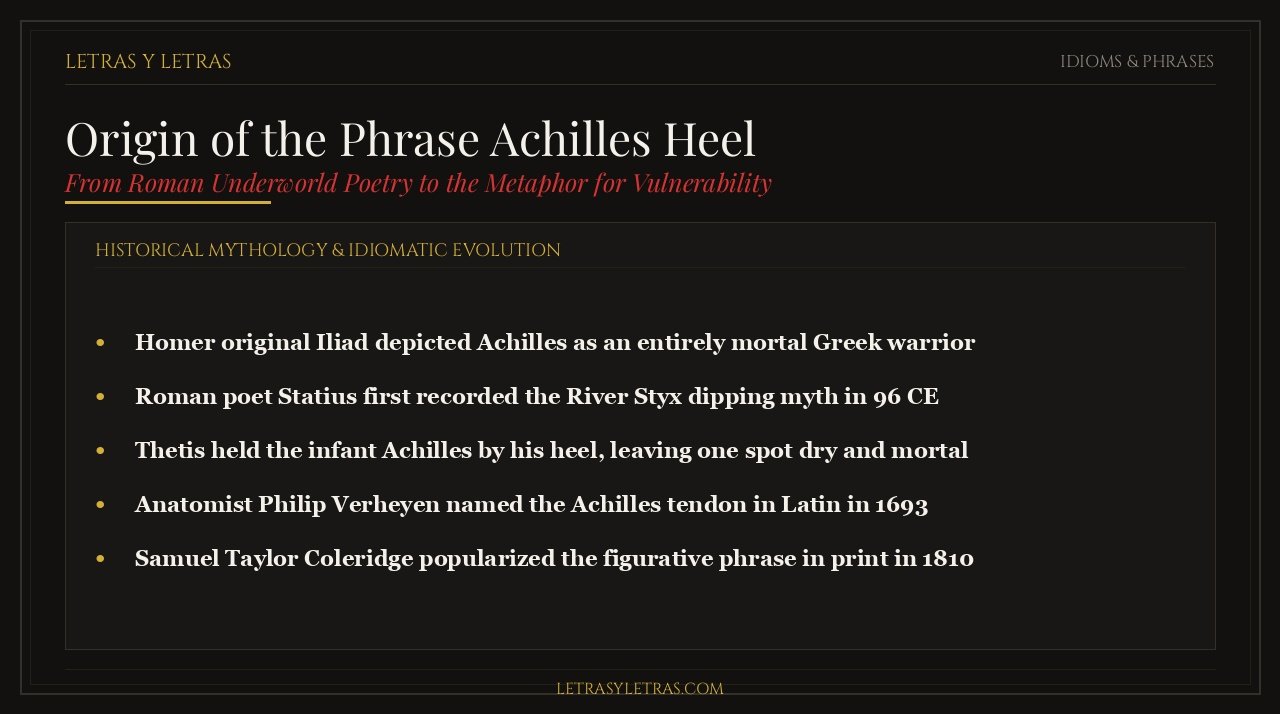
The origin of the phrase Achilles heel traces to Roman mythology rather than Homeric Greek literature. In Homer eighth-century BCE epic the Iliad, Achilles was an ordinary mortal who bled when struck. The invulnerability myth first appeared in 96 CE in the Achilleid, an epic poem by Roman author Statius. Statius wrote that Achilles mother, the sea nymph Thetis, dipped her infant son into the River Styx. Thetis held him by his heel, leaving that spot untouched by magical waters. In 1693, Flemish anatomist Philip Verheyen named the Achilles tendon after dissecting his own amputated leg. British writer Samuel Taylor Coleridge first used Achilles heel as a figurative metaphor in 1810.
Key Takeaways
- Homer Iliad depicted Achilles as mortal, vulnerable, and capable of bleeding.
- Roman poet Statius invented the River Styx dipping story eight centuries later in 96 CE.
- Flemish physician Philip Verheyen coined the anatomical Achilles tendon in 1693.
- English essayist Samuel Taylor Coleridge published the earliest figurative idiom in 1810.
- Represents a universal metaphor for critical vulnerability in otherwise powerful entities.
The Homeric Achilles: Mortality, Blood, and Bronze Armor
Popular memory assumes that Greek mythology always treated Achilles as an invulnerable demigod. Readers picture an immortal warrior who shrugged off flying arrows and bronze spears. Ancient Greek manuscripts tell a remarkably different story.
In the eighth century BCE, Homer composed the Iliad, the foundation of Western literature. Nowhere in the twenty-four books of the Iliad does Homer describe Achilles as impervious to physical harm. Achilles is flesh and blood.
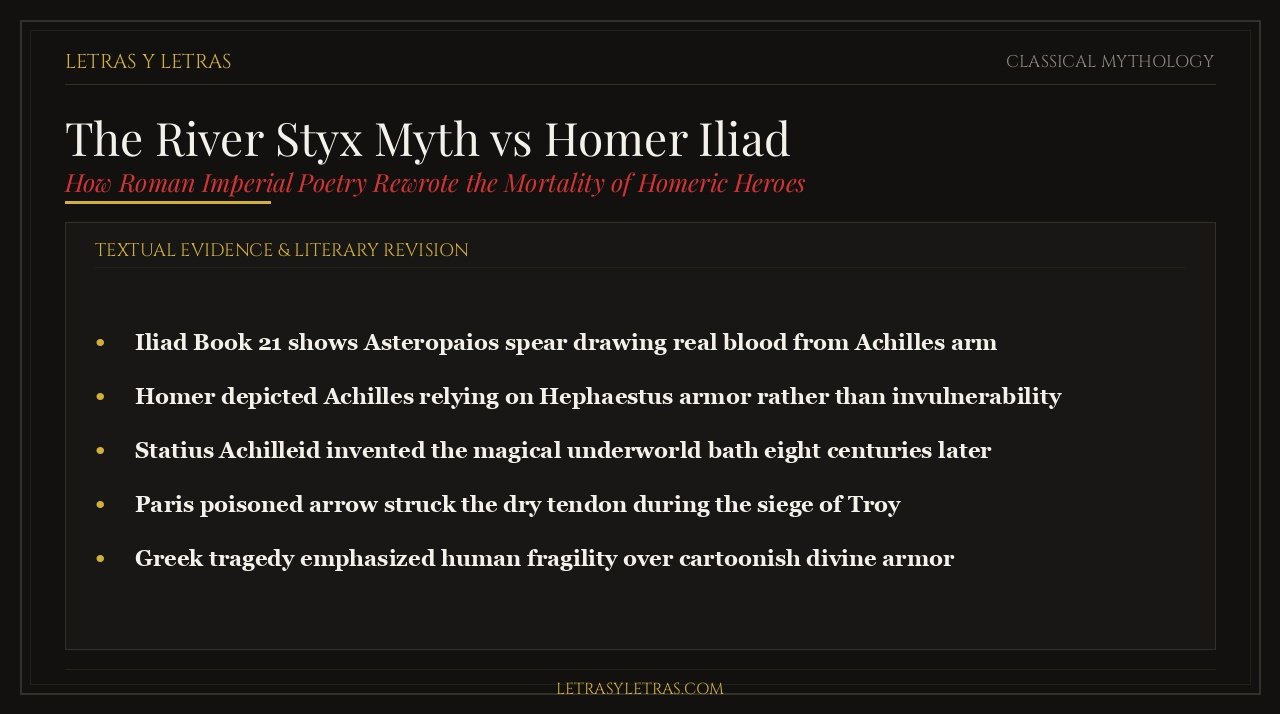
The warrior depends heavily on protective armor forged by Hephaestus, the divine blacksmith god. If his skin could repel iron blades, magnificent armor would serve no practical defensive purpose. Homer emphasizes human frailty in every clash.
In Book 18 of the Iliad, Homer devotes over one hundred lines to describing the divine shield forged by Hephaestus. The metalwork features celestial constellations, peaceful cities, fertile vineyards, and armed warfare. If Achilles could not suffer bodily harm, the poet would not celebrate defensive armor with such grandeur.
Textual evidence in the Perseus Digital Library Homer Iliad Book 21 proves Achilles mortality conclusively. During the battle beside the River Scamander, the Paeonian champion Asteropaios challenges Achilles to combat. Asteropaios throws two bronze spears at the same instant.
One spear strikes Achilles heavy shield. The second missile grazes his right forearm, tearing skin and drawing visible dark blood. Feeling sharp pain, Achilles shouts in anger as a distinctly mortal warrior.
Why Classical Greek Tragedy Demanded Human Vulnerability
Homer understood dramatic storytelling far better than later Roman romantics. In Greek heroic culture, honor depended entirely on facing authentic mortal danger. A hero who cannot die risks nothing by entering battle.
Achilles confronts a profound existential choice throughout the epic. His divine mother, the sea nymph Thetis, reveals two possible paths for his life. He can return home to live long in comfortable obscurity, or fight at Troy and perish young.
Achilles consciously chooses brief life and eternal glory. If magical river water protected his torso, that heart-wrenching choice would collapse into absurdity. His mortality gives his rage, grief, and eventual sacrifice moral weight.
Achilles also grieves uncontrollably when his companion Patroclus dies in battle. The Greek hero fears drowning in river currents and mourns his approaching doom. He is a fragile human being facing tragic destiny.
Classical Athenian audiences revered this mortal Achilles. Fifth-century playwrights like Aeschylus and Sophocles staged dramas about his grief without mentioning magical heel baths. The invulnerability tale belonged to a much later imperial era.
The Invention of Invulnerability: Statius and the Roman Achilleid
Where did the dipping story originate if Homer never recorded it? The earliest surviving written account appears nearly nine centuries after Homer. It belongs to Roman imperial literature during the reign of Emperor Domitian.
Around 96 CE, the Neapolitan Roman poet Publius Papinius Statius began composing the Achilleid. Statius planned an ambitious Latin epic chronicling the entire life of the Greek warrior. Although Statius died before finishing the work, his opening book survived.
In Statius narrative, Thetis seeks desperately to protect her infant child from tragic prophecy. She carries the newborn baby down to the underworld domain of the dead. Standing beside murky banks, she immerses him in the River Styx.
The magical underworld waters coat the infant skin, making him impervious to mortal weapons. Thetis held her child tightly by the back of his foot. The water never touched the skin beneath her clutching fingers.
That dry patch became the single point of physical vulnerability on his body. Statius introduced the dramatic plot device that modern audiences remember today. A Roman poet imagination permanently altered Greek mythology.
The Fall of the Champion: Paris, Apollo, and the Poisoned Arrow
Homer Iliad concludes before Achilles meets his end on the plains of Troy. The epic finishes with the solemn funeral rites of Trojan Prince Hector. To discover how Achilles fell, ancient readers consulted other epic cycles.
The lost archaic epic Aethiopis recounted the final days of the Trojan siege. During a furious assault against the Scaean Gates, Achilles drove Trojan forces backward. Trojan Prince Paris stood upon the high stone battlements with bow and quiver.
Paris was an ordinary archer without great martial renown. The god Apollo, however, guided the flight of his arrow across windy battle lines. Classical authors debate if the arrow carried lethal snake venom.
Roman poet Ovid describes the moment vividly in Book 12 of his Metamorphoses. Apollo directs the shaft toward the single spot that could end the hero life. The arrow pierced the unprotected tendon above the heel.
The greatest warrior of the ancient world collapsed in dust. His fall demonstrated that overwhelming physical prowess cannot protect a man from destiny. The single unfortified point caused total ruin.
Ancient Greek vase paintings capture this poignant moment with exquisite detail. Athenian black-figure pottery from the sixth century BCE depicts Greek warriors carrying Achilles lifeless body from the field. Even in visual art, his mortality remained central to his tragic legend.
The Medical Bridge: Philip Verheyen and the Achilles Tendon in 1693
For more than fifteen hundred years following Statius, the heel myth lived in poetry and visual art. Renaissance painters depicted Thetis bathing her infant son in classical river landscapes. In 1693, the story crossed unexpectedly into medical science.
Flemish physician Philip Verheyen served as professor of anatomy at the University of Leuven. Verheyen suffered from severe illness that required his lower leg to be surgically amputated. Rather than despairing, the dedicated doctor turned his tragedy into scholarship.
Verheyen preserved his severed limb and dissected the tissues himself. He focused intense study on the thick, fibrous band connecting calf muscles to the heel bone. In 1693, he published his anatomical discoveries in Corporis Humani Anatomia.
Verheyen named the structure chorda Achillis, later standardized as tendo Achillis. He selected the classical name to honor the vulnerable mythic warrior. Severing this critical fibrous cord leaves any human being unable to stand, run, or march.
Verheyen anatomical nomenclature remains universal in modern medical textbooks. His terminology established a permanent bridge between classical mythology and physical human biology. The tendon kept the hero name alive in clinics worldwide.
The Idiomatic Birth: Samuel Taylor Coleridge in 1810
Although doctors spoke of the Achilles tendon in the eighteenth century, ordinary people did not use the phrase metaphorically. English speakers did not say Achilles heel when describing weaknesses in arguments or institutions.
The Online Etymology Dictionary Achilles entry records that figurative usage emerged in the early nineteenth century. The earliest documented appearance in print dates to 1810. English Romantic poet and essayist Samuel Taylor Coleridge coined the idiom in his publication The Friend.
Coleridge was analyzing British imperial politics and geopolitical vulnerability. Coleridge described political instability in Ireland as a critical strategic danger. He called Ireland that Achilles heel of the British Empire.
Coleridge metaphor captured public attention immediately across London literary salons. It provided an unforgettable visual image of vulnerability inside massive strength. Within decades, British essayists and parliamentarians adopted the phrase.
By the 1840s, British newspapers used Achilles heel to criticize military fortifications and economic policies. American periodicals picked up the phrase during the 1850s. The literary allusion evolved into an indispensable English idiom.
During the Victorian era, British prime ministers like William Gladstone referenced the phrase in parliamentary debates. Orators used the classical allusion to critique naval defenses and colonial budgets. The expression became a staple of educated political rhetoric.
Chronological Milestones in the History of Achilles Heel
The historical timeline below summarizes the major literary and linguistic milestones that created this famous idiom:
| Historical Period | Author and Text | Key Milestone | Significance to Idiom |
|---|---|---|---|
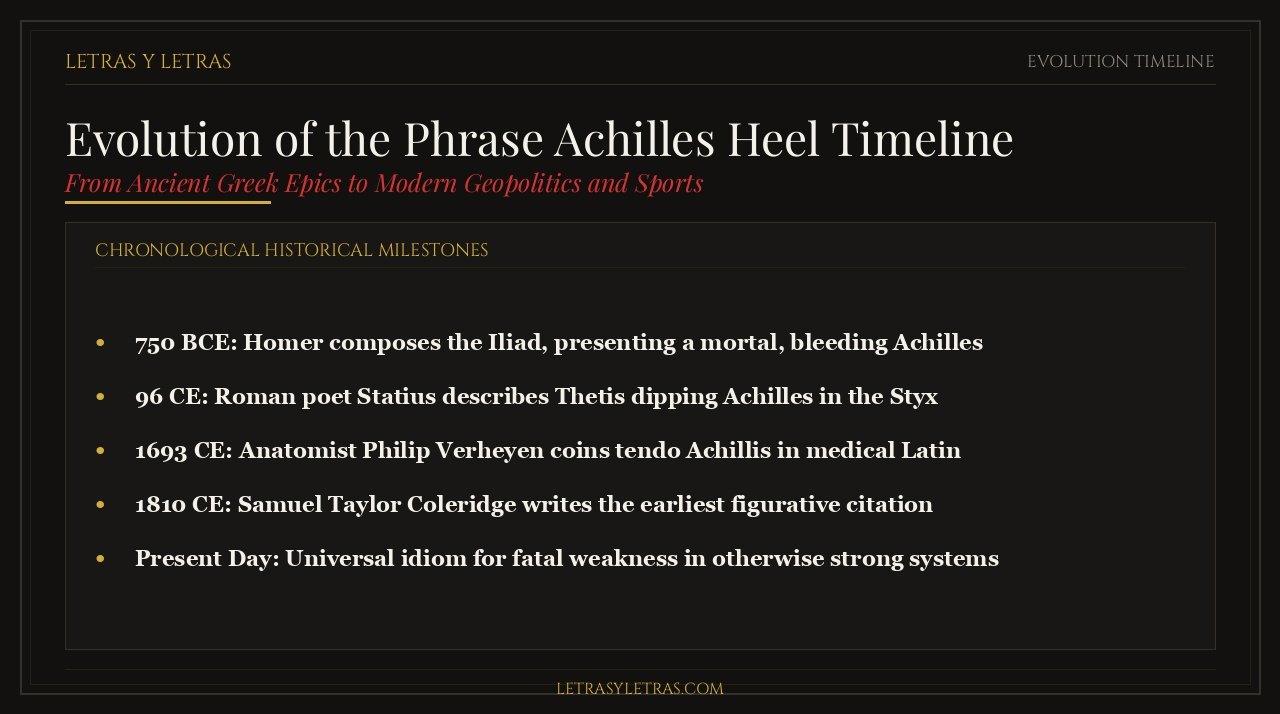
| 750 BCE | Homer (The Iliad) | Achilles is wounded on his forearm by Asteropaios bronze spear. | Presents Achilles as an entirely mortal, vulnerable hero who bleeds. |
| 96 CE | Statius (The Achilleid) | Thetis dips infant Achilles into the underworld waters of River Styx. | First recorded appearance of magical invulnerability and dry heel. |
| 100 CE | Hyginus and Ovid | Paris shoots Achilles in the vulnerable heel during Trojan siege. | Establishes the heel strike as the singular cause of hero demise. |
| 1693 CE | Philip Verheyen | Flemish physician names tendo Achillis in Latin anatomy manual. | Connects classical myth directly to human musculoskeletal medicine. |
| 1810 CE | Samuel Taylor Coleridge | Coleridge describes Ireland as the Achilles heel of British power. | First documented figurative usage in English literary publications. |
| Present Day | Global English Usage | Applied to cybersecurity, financial markets, sports, and politics. | Universal metaphor for fatal flaw in otherwise formidable systems. |
Debunking Common Myths About the Origin of Achilles Heel
Because the Trojan War is familiar to many, misunderstandings about this phrase occur frequently. Looking closely at classical scholarship resolves three persistent misconceptions:
The primary myth asserts that Homer invented the River Styx dipping tale. Students assume high school translations of the Iliad contain the story. In truth, the scene appears nowhere in Homer epic poetry.
Homer never mentioned the River Styx conferring physical armor. Roman poet Statius invented the episode more than eight hundred years later. Confusing Homer with Statius overlooks major shifts in ancient storytelling.
A second myth assumes that an arrow to the heel was a minor scratch that somehow killed Achilles. Classical scholars note that ancient arrowheads carried virulent poisons. Additionally, archer god Apollo guided the shaft directly into critical bone marrow.
A third myth assumes William Shakespeare used the phrase in his Elizabethan plays. Shakespeare wrote Troilus and Cressida about the Trojan War without once using the idiom Achilles heel. The expression did not exist in English until Coleridge coined it in 1810.
We saw similar linguistic evolutions in our origin of the word boycott guide. Surnames and myths often require centuries before transforming into everyday idioms.
Why the Achilles Heel Metaphor Remains Irreplaceable
Why does this classical expression remain so popular across modern culture? Language evolves constantly, discarding obsolete idioms and coining fresh slang. Yet Achilles heel has survived for more than two centuries.
The metaphor endures because it describes a universal psychological and structural truth. Human beings recognize that strength often breeds dangerous complacency. Formidable organizations frequently ignore small internal weaknesses until disaster strikes.
Consider modern computer networks protected by multi-million-dollar cryptographic firewalls. A single employee clicking an insecure email link compromises the entire corporate database. That phishing email serves as the digital Achilles heel of the company.
Engineers encounter identical principles in aerospace and mechanical design. Complex machines contain single points of critical failure. A compromised O-ring or micro-fracture in a titanium bolt can dismantle an entire space vehicle.
In athletic competition, an elite tennis player may possess world-class groundstrokes and rapid footwork. An unreliable second serve, however, allows disciplined opponents to exploit the match. The weakness nullifies all other advantages.
True resilience requires identifying small internal flaws before adversaries exploit them. We explore this honesty of character in our origin of the word sincere guide. Genuine strength begins with candid self-assessment.
Similar self-mastery emerges in our reflections on quotes on discipline. Governing small daily details prevents catastrophic failures down the road.
You can also discover historical linguistic shifts in our guide to the origin of the word paradise. Words preserve humanity deepest philosophical lessons across millennia.
Frequently Asked Questions
Did Homer invent the story of the Achilles heel?
No, Homer never wrote that Achilles was invulnerable or dipped into the River Styx. In the Iliad, Achilles was an ordinary mortal who bled when struck. Roman poet Statius recorded the dipping myth in 96 CE.
Why did Thetis dip Achilles into the River Styx?
According to Roman myth, sea nymph Thetis knew her son was fated to die at Troy. She immersed him in the underworld river to grant him physical invulnerability and protect him from early death.
Why was the heel the only vulnerable part?
Thetis held the infant Achilles by his heel as she lowered him into the water. The skin covered by her fingers remained dry, leaving that single spot vulnerable to mortal weapons.
Who named the Achilles tendon in human anatomy?
Flemish anatomist Philip Verheyen named the Achilles tendon in 1693 in his textbook Corporis Humani Anatomia. Verheyen dissected his own amputated leg and named the fibrous cord after the mythological hero.
When was the phrase Achilles heel first used in English?
The earliest documented figurative usage in English appeared in 1810. Poet and essayist Samuel Taylor Coleridge used the phrase in his periodical The Friend to describe geopolitical vulnerabilities.
What does the idiom Achilles heel mean today?
Today, an Achilles heel refers to a fatal weakness in an otherwise powerful person or institution. If exploited, the flaw can cause complete downfall.
Alan Sledge is the lead writer at letrasyletras.com, uncovering historical wisdom and word origins.


Alan Sledge is the writer and founder behind Letters & Letters. A lifelong lover of words, Alan has always been drawn to the small mysteries hidden in everyday language, why we say what we say, where our favorite sayings came from and the quotes that manage to put feelings into words better than we ever could ourselves.

Alan Sledge
Alan Sledge is the founder and lead researcher behind Letters & Letters. A lifelong student of linguistic history, he cross-references every word origin, idiom, and quote against primary archival manuscripts, the Oxford English Corpus, and 18th-century print lexicons.