
Two estranged business partners sit across a polished conference table after months of bitter courtroom litigation. Outside corporate lawyers finalize settlement documents, dividing disputed assets with cold mathematical precision. Both executives shake hands, agreeing it is time to bury the hatchet.
Modern society uses this colorful idiom whenever warring adversaries resolve personal disputes and resume peaceful interaction. We utter the phrase casually in family arguments, political campaigns, and workplace conflicts. The expression feels like a warm colloquial metaphor for mutual forgiveness.
Yet the true origin of the phrase bury the hatchet was a literal sacred diplomatic ceremony. The practice was founded by the Haudenosaunee Confederacy centuries before European arrival in North America. Indigenous leaders buried physical iron axes and war clubs to forge unbreakable peace.
Quick Answer: Origin of the Phrase Bury the Hatchet
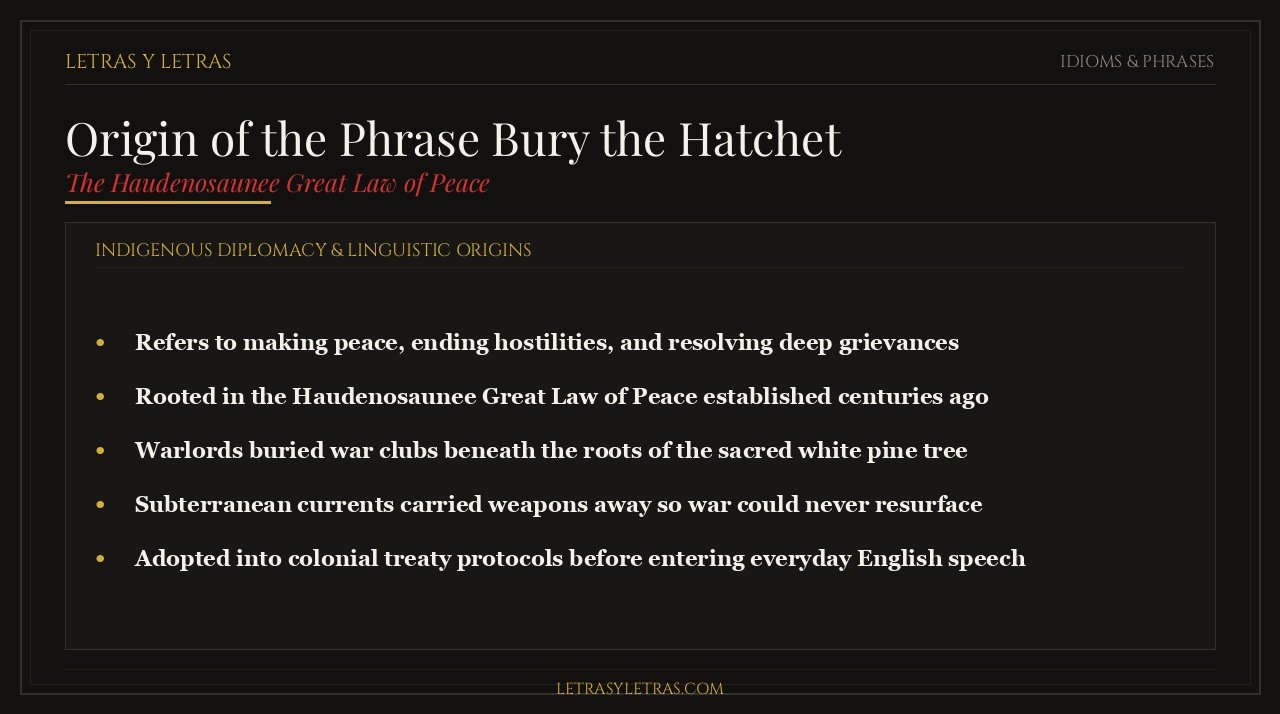
The phrase bury the hatchet means ending a conflict, resolving grievances, and establishing lasting peace between enemies. It originates from a sacred diplomatic ceremony practiced by the Haudenosaunee Confederacy, also known as the Iroquois League. According to oral tradition, the Great Peacemaker Deganawida united five warring nations under the Great Law of Peace. The leaders uprooted a majestic white pine tree, known as the Tree of Peace, exposing a subterranean stream. Chiefs threw their stone war clubs and tomahawks into the cavern, allowing swift water to wash weapons away forever. European colonists adopted the ceremony during seventeenth-century councils, incorporating the phrase into everyday English.
Key Takeaways
- Bury the hatchet describes concluding hostilities and establishing harmonious mutual relations.
- Rooted in the Haudenosaunee Great Law of Peace uniting five indigenous nations.
- Peacemaker Deganawida uprooted the sacred Tree of Peace over an underground stream.
- Weapons were cast into flowing waters so future generations could never retrieve them.
- Documented in colonial American treaty proceedings as early as 1680.
The Modern Idiom: Ceasing Feuds and Choosing Reconciliation
Modern English speakers employ bury the hatchet to describe settling disputes without lingering resentment. Friends use the expression to repair bruised feelings after heated arguments over politics or sports. Families evoke the phrase during holiday reunions to silence long-standing personal feuds.
In contemporary usage, the image of burying an axe seems dramatic and slightly theatrical. Modern people do not carry bladed weapons into municipal disputes or boardroom meetings. The violent weapon serves purely as a rhetorical symbol for hostility.
We admire the idiom because it demands action rather than passive forgetting. Burying something requires physical labor, deliberate intention, and irreversible placement under solid soil. The phrase insists on putting grievances where hands can no longer reach them.
Lexical documentation in the Merriam-Webster dictionary defines the idiom as settling an argument. The authority notes that the expression reflects Native American peacemaking ceremonies. This linguistic record traces colonial encounters with indigenous diplomacy.
Long before British settlers arrived along the Atlantic coastline, indigenous leaders cultivated profound peacemaking protocols. Their ritual mechanisms were designed to break perpetual cycles of blood vengeance. Examining this heritage reveals one of history most sophisticated diplomatic agreements.
The Haudenosaunee Confederacy and the Great Law of Peace
The Haudenosaunee Confederacy originally brought together five sovereign indigenous nations across upstate New York. These nations were the Mohawk, Oneida, Onondaga, Cayuga, and Seneca peoples. In the eighteenth century, the Tuscarora nation joined to form the Six Nations.
Prior to confederation, these neighboring nations endured brutal generations of continuous intertribal warfare. Retaliatory raids ignited vicious cycles of mourning wars, where grief demanded fresh blood and captives. Communities lived inside heavily fortified palisade villages in constant terror of surprise ambushes.
Scholarly research at the Encyclopedia Britannica Iroquois Confederacy overview explains this historic alliance. Oral histories describe the arrival of a visionary prophet known as the Peacemaker, named Deganawida. Traveling across the waterways in a white stone canoe, Deganawida brought a message of unity.
Deganawida partnered with Hiawatha, an Onondaga statesman who had lost his daughters to violent raids. Together with a respected clan mother named Jigonhsasee, they composed the Gayanashagowa, or Great Law of Peace. This oral constitution established a participatory democratic confederacy governed by consensus.
The Great Law of Peace outlawed blood feuds among the member nations completely. In place of retaliatory warfare, the confederacy created a Grand Council of fifty sachem chiefs. Dispute resolution was transferred from battlefields to ceremonial council fires.
Deganawida and the Uprooting of the Sacred White Pine
To seal this historic confederation, Deganawida enacted a profound physical ceremony at Onondaga Lake. On the central council grounds, he selected a towering Eastern white pine tree. The white pine was chosen because its needle clusters grow in bundles of five.
These five needle clusters represented the five united nations bound together in enduring peace. Deganawida called this majestic evergreen the Tree of Peace. Its long white roots, called the Great White Roots of Peace, spread in four cardinal directions.
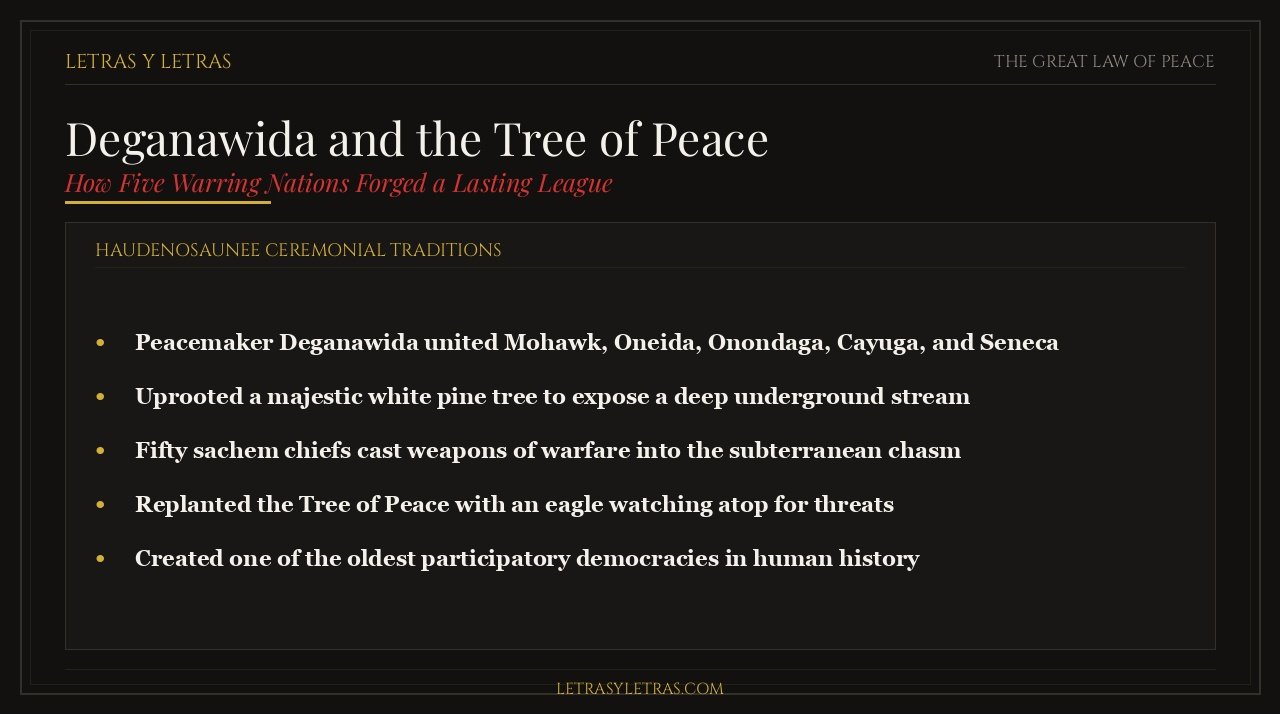
With the assistance of the assembled chiefs, Deganawida uprooted the massive pine tree by its roots. The uprooted trunk revealed a deep cavern beneath the earth through which a swift subterranean stream flowed. Deganawida called upon every sachem chief and warrior to step forward.
He instructed the men to cast all weapons of warfare directly into the subterranean chasm. War clubs, stone axes, flint arrowheads, and spears tumbled into the dark rushing waters. The underground current swept the violent instruments away into distant subterranean depths.
Deganawida then replanted the great pine tree firmly over the chasm. Earth was tamped down tightly over the roots so no trace of the weapons remained. Peacemaking was anchored into the physical geography of the planet.
The Underground River: Why Weapons Were Never Recovered
The ceremonial detail of the subterranean river carries immense psychological importance. If warriors had merely buried their axes in shallow garden topsoil, they could dig them up tomorrow. A temporary peace could be revoked during the next sudden flare of anger.
By dropping the weapons into moving underground water, the Peacemaker removed them permanently. The river washed the blades away into unknown depths where human hands could never reach them. This ceremony symbolized the total, irrevocable destruction of vengeful thoughts.
Deganawida placed an eagle atop the highest branch of the replanted Tree of Peace. The sharp-eyed eagle symbolized watchful vigilance against approaching dangers from distant lands. Peace was not a passive surrender, but an active, vigilant defense of justice.
Historical analysis at the Online Etymology Dictionary notes the evolution of indigenous weapon terminology. The English word hatchet derived from Old French hachette, meaning a small axe. English settlers applied this European noun to Native stone tomahawks and war clubs.
The ceremony transformed an instrument of slaughter into a living monument of harmony. These buried weapons nourished the roots of a living tree that sheltered future generations. This powerful visual metaphor left an indelible impression upon European observers.
Seventeenth-Century Colonial Treaties and Council Fires
When Dutch, French, and English colonists arrived in North America, they encountered the Haudenosaunee League. European governors quickly realized that the Confederacy was the dominant military force in the Northeast. To secure fur trade routes, colonial diplomats had to learn Haudenosaunee diplomatic protocol.
Colonial treaty conferences were elaborate affairs held around outdoor council fires. Speeches lasted for days, punctuated by exchanges of purple and white wampum belts. Whenever a treaty concluded, indigenous leaders performed the symbolic burial of weapons.
English colonial magistrates willingly adopted this ceremonial language in official negotiations. At Albany, Philadelphia, and Montreal, British governors spoke of burying the hatchet deep in the ground. They promised that the covenant chain of friendship would remain bright and unrusted.
If conflict erupted anew between colonists and tribes, diplomats spoke of unburying the hatchet. To dig up the axe meant that peace was broken and war declared. The physical metaphor governed North American frontier diplomacy for nearly two centuries.
Colonial clerks recorded these formal speeches verbatim inside official provincial treaty minutes. Through these administrative records, the indigenous ceremonial phrase entered the English written lexicon. A Native American diplomatic concept became naturalized in colonial speech.
From Samuel Sewall to Washington Irving: Written English Records
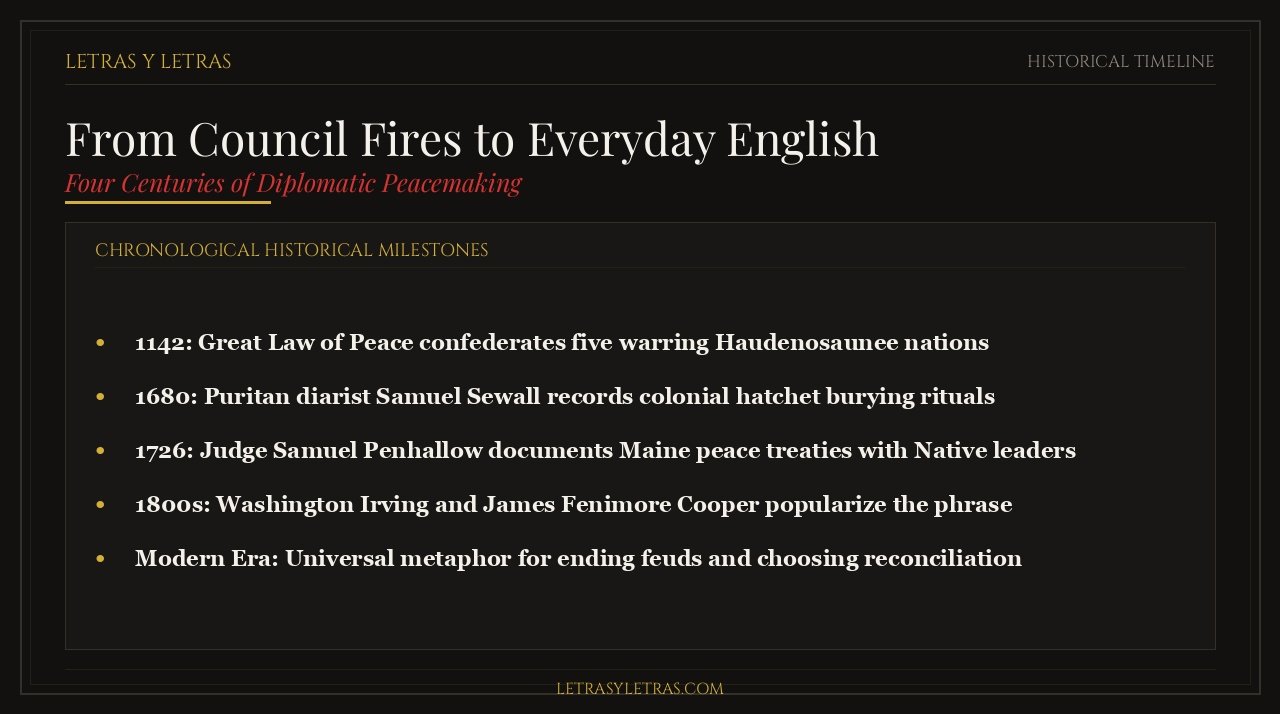
The earliest known appearance of the phrase in English literature dates to the seventeenth century. In 1680, Massachusetts Puritan magistrate Samuel Sewall recorded the idiom in his personal diary. Sewall described a peace conference where Native leaders spoke of putting away their weapons.
In 1726, historian Samuel Penhallow published his chronicle of frontier warfare in New England. Penhallow recounted how indigenous leaders promised to bury the hatchet so deep that no sun could shine upon it. His widely read history helped spread the expression throughout colonial households.
By the early nineteenth century, celebrated American authors adopted the phrase for mainstream fiction. Washington Irving used bury the hatchet in his humorous sketches of early New York life. James Fenimore Cooper featured the ceremonial idiom prominently across his Leatherstocking Tales.
Cooper novels achieved massive international popularity, introducing the phrase to readers across Britain and Europe. Victorian journalists began applying the idiom far beyond frontier diplomacy. British newspapers used bury the hatchet to describe parliamentary reconciliations and corporate labor agreements.
By the twentieth century, the phrase had completed its transition into global figurative English. Few modern people who use the idiom recall the five nations or Onondaga Lake. Yet every utterance pays unconscious homage to an indigenous peace constitution.
The Calumet and the Hatchet: Complementary Indigenous Symbols
In traditional indigenous diplomacy, burying the hatchet was rarely performed in isolation. It formed one half of a complete ritual pair alongside the smoking of the sacred calumet. The calumet was an elaborately decorated ceremonial tobacco pipe.
Burying the hatchet represented the negative half of peacemaking: the elimination of violence and vengeance. Smoking the calumet pipe represented the positive half: the establishment of sacred fellowship and mutual goodwill. Tobacco smoke carried the vows of the diplomats upward toward the Creator.
European settlers adopted both customs into their popular cultural folklore. The peace pipe became as famous in western fiction as the buried tomahawk. Together, these rituals constituted a sophisticated system of diplomatic statecraft.
The ceremony recognized that peace is fragile and requires active emotional renewal. True reconciliation cannot occur while hearts remain bitter and suspicious. The ritual cleansing of minds was as vital as the physical burial of iron blades.
The Haudenosaunee called this peaceful state Skennen, meaning health, peace, and righteousness. Peace was not merely the absence of battle, but active spiritual harmony. The buried hatchet allowed human souls to flourish without fear.
Chronological Milestones in the History of Bury the Hatchet
The historical table below traces key milestones in the development of the idiom across world history:
| Historical Era | Diplomatic Milestone | Ceremonial Action | Impact on English Language |
|---|---|---|---|
| c. 1142 to 1450 | Great Law of Peace | Peacemaker uproots Tree of Peace | Establishes the original sacred physical ritual of casting weapons into rushing waters. |
| 1680 | Puritan Diary of Samuel Sewall | Colonial treaty documentation | First recorded appearance of the ritual phrase in private English written records. |
| 1726 | Samuel Penhallow History | New England frontier chronicles | Documents indigenous leaders promising to bury the hatchet so deep no sun could shine on it. |
| 1809 to 1826 | American Frontier Fiction | Irving and Cooper literature | Popularizes the idiom across international English readers through bestselling adventure novels. |
| Late 1800s | Victorian Print Media | Political journalism | Expands beyond frontier warfare into parliamentary politics and labor reconciliation. |
| 20th Century to Present | Global Vernacular | Everyday speech and idioms | Universal English metaphor for putting aside old grievances and choosing forgiveness. |
Debunking Common Myths About Burying the Hatchet
Because western cinema popularized stylized depictions of Native Americans, several persistent myths surround the idiom. Examining historical records dispels three frequent errors:
The primary myth claims European colonists invented the phrase to mock Native American warfare. In reality, European diplomats deeply respected the ceremony and adopted the phrase to show diplomatic honor. The practice was entirely indigenous in design, philosophy, and execution.
A second myth asserts that warriors literally buried iron metal tomahawks made in European foundries during ancient times. The ceremony long predated European trade metal. Ancient Haudenosaunee warriors buried flint axes, heavy war clubs, and stone celts.
A third myth claims the ritual was practiced identically by every Native American tribe across North America. While widespread, the ceremonial uprooting of the Tree of Peace was specific to the Haudenosaunee Confederacy. Neighboring tribes maintained distinct diplomatic ceremonies for peacemaking.
We observed similar cultural embellishments debunked in our origin of the phrase burning bridges analysis. Popular imagination frequently flattens complex historical ceremonies into simplified Hollywood tropes.
The Cultural Psychology of Peace, Grievance, and Resolution
Why does burying the hatchet continue to resonate so deeply across human psychology? The answer lies in the universal burden of nursing chronic grudges. Clinging to past resentments poisons the mind, trapping individuals in perpetual cycles of bitterness.
Burying a grievance demands courage, humility, and the willingness to relinquish moral superiority. It acknowledges that continuing a conflict is far more destructive than forgiving a past offense. By letting go of our metaphorical weapons, we free ourselves to rebuild trust.
Maintaining mental resolve and ethical self-governance is essential for enduring peace. Discover timeless reflections on inner strength in our curated quotes on discipline collection. Governing personal anger is the foundation of lasting harmony.
Uncompromising honesty must guide every genuine peace settlement and partnership. Discover classical definitions of truth in our origin of the word sincere investigation. Lasting enterprise requires pure, unadulterated integrity.
Societies throughout history established communal limits to maintain civil order and safety. Discover medieval evening safety decrees and curfew bells in our origin of the word curfew investigation. Protective community boundaries preserve civilization.
Catastrophic crises have repeatedly tested human resilience and political treaties across history. Examine celestial omens and fallen stars in our origin of the word disaster reflection. Facing unexpected trials demands steady wisdom.
Public health defenses also required collective sacrifice and strict border isolation across centuries. Trace Venetian plague galleys and forty days of isolation in our origin of the word quarantine study. Organized community defenses protect human life.
Commercial honesty and fair measurement have long defined social trust in marketplace trade. Learn how medieval bread statutes created a buffer loaf in our origin of the phrase baker dozen guide. Fair trade builds lasting community fellowship.
Bodily vitality and physical capacity inspired rich anatomical vocabulary across the ancient world. Explore classical Roman anatomy and rodent metaphors in our origin of the word muscle analysis. Physical strength must always serve social harmony.
Sudden illness and biological vulnerability also remind us of fragile human mortality. Examine maritime naval history and seasickness in our origin of the phrase under the weather reflection. Weathering hardship requires patient endurance.
Confronting dangerous habits directly often demands sudden willpower without hesitation. Learn how withdrawal medicine forged a universal idiom in our origin of the phrase cold turkey guide. Overcoming adversity demands disciplined resolve.
Human beings possess delicate vulnerabilities beneath outward facades of power. Examine anatomical vulnerability in our analysis of the origin of the phrase Achilles heel. Recognizing mortality prevents tragic hubris.
Superstition and historical biases also shaped European linguistic perceptions of human action. Examine Roman augury and directional omens in our origin of the word sinister review. Words carry surprising shadows from antiquity.
Unpredictable risks and speculative gambles carried lasting consequences across medieval Europe. Trace medieval dice games and Crusader history in our origin of the word hazard investigation. Prudent calculation shields merchants from disaster.
Serene sanctuaries offer the ultimate antidote to worldly conflict and turmoil. Explore ancient Persian walled gardens in our origin of the word paradise reflection. The human spirit continually strives toward fellowship and peace.
Frequently Asked Questions
What is the literal meaning of bury the hatchet?
Bury the hatchet means ending an ongoing conflict, settling old grievances, and making peace with an opponent.
Where did the phrase bury the hatchet originate?
The phrase originates from a sacred peacemaking ceremony practiced by the Haudenosaunee Confederacy in North America.
What was the Tree of Peace?
The Tree of Peace was an Eastern white pine uprooted by Peacemaker Deganawida to bury weapons in subterranean waters.
Why were weapons cast into an underground stream?
Flowing subterranean waters carried the weapons away so future generations could never retrieve them for war.
When was the phrase first recorded in English?
Puritan magistrate Samuel Sewall recorded the phrase in his personal Massachusetts diary in 1680.
How did the phrase become popular in everyday English?
Authors like Washington Irving and James Fenimore Cooper popularized the idiom across nineteenth-century adventure literature.
Alan Sledge is the lead writer at letrasyletras.com, uncovering historical wisdom and word origins.


Alan Sledge is the writer and founder behind Letters & Letters. A lifelong lover of words, Alan has always been drawn to the small mysteries hidden in everyday language, why we say what we say, where our favorite sayings came from and the quotes that manage to put feelings into words better than we ever could ourselves.

Alan Sledge
Alan Sledge is the founder and lead researcher behind Letters & Letters. A lifelong student of linguistic history, he cross-references every word origin, idiom, and quote against primary archival manuscripts, the Oxford English Corpus, and 18th-century print lexicons.