
Weightlifters hoist heavy steel barbells inside modern fitness centers to build physical power. Sprinters drive spiked shoes into synthetic tracks, pushing bodily limits through explosive speed. Society admires muscular definition as the ultimate symbol of athletic prowess.
Yet beneath our modern celebration of physical force lies an astonishing linguistic secret. Every time we praise someone for having great muscles, we are comparing their flesh to a tiny rodent. The word muscle does not originate from steel, stone, or martial weaponry.
The true origin of the word muscle connects classical Roman anatomy with whimsical zoological observation. Ancient physicians who watched human flesh contract saw the rippling movements of a small mouse under skin. The metaphor crossed classical Greece, imperial Rome, and medieval Europe before shaping modern biology.
Quick Answer: Origin of the Word Muscle
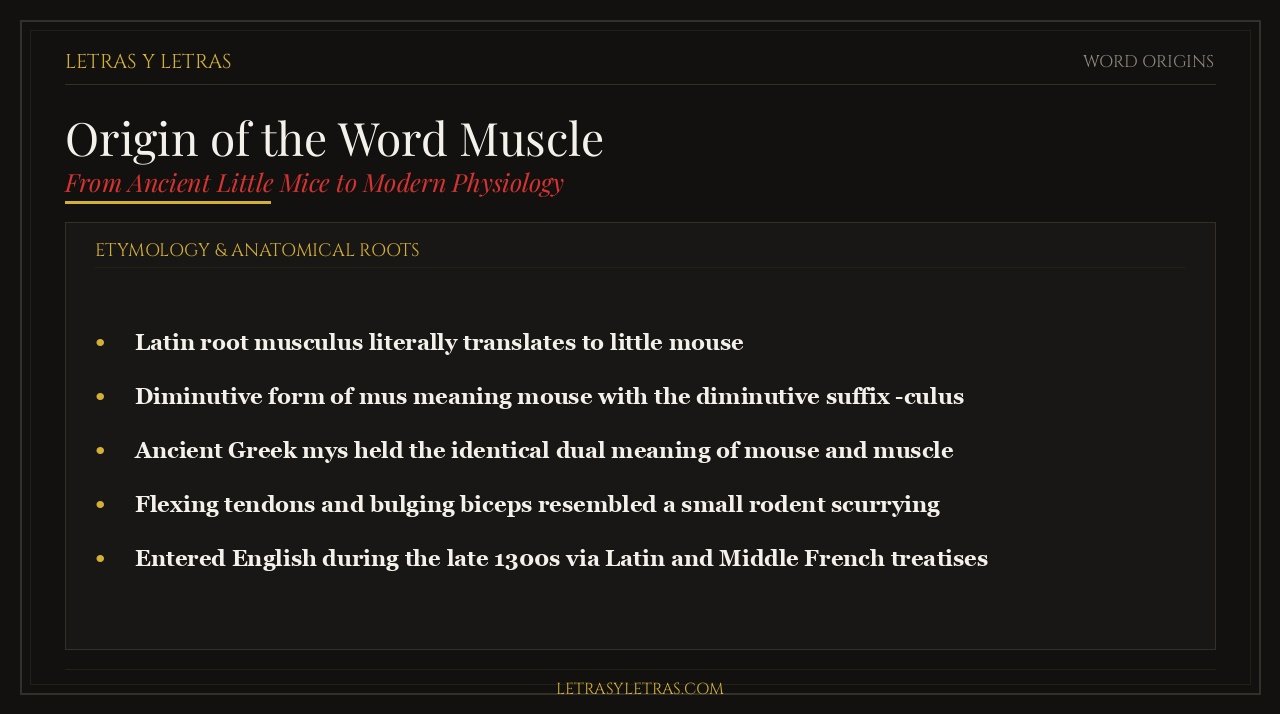
The word muscle originated in classical Latin as musculus, which literally translates to little mouse. The term is a diminutive form of mus, meaning mouse, formed with the suffix -culus. Ancient Greek physicians shared an identical linguistic concept, using mys to designate both mice and contractile body tissue. When an arm or leg flexes, the rounded muscle belly contracts and shifts beneath the skin, creating a rippling motion that ancient anatomists compared to a little mouse crawling under a blanket. In addition, a dissected muscle features a red central body that tapers into white tendons, visually mirroring a rodent body, head, and tail. The term entered English in the late fourteenth century through Middle French and medieval Latin surgical treatises.
Key Takeaways
- Muscle derives from Latin musculus, which literally means little mouse.
- Ancient Greek mys held the identical dual meaning of mouse and contractile tissue.
- Flexing muscle bellies reminded classical physicians of rodents scurrying under skin.
- The edible bivalve mollusk mussel shares the exact same Latin etymological root.
- Entered the English language during the late 1300s via medieval medical treatises.
The Modern Powerhouse: When Athletic Might Meets a Little Mouse
Modern culture associates muscles with intimidation, physical domination, and mechanical force. Action heroes flex sculpted physiques across cinema screens. Political commentators describe powerful military alliances as nations flexing their geopolitical muscle.
Our contemporary mental picture of muscle is masculine, rigid, and metallic. We speak of muscle cars, muscle memory, and muscling through obstacles. The term evokes unbreakable granite rather than fragile woodland creatures.
Coaches and physiotherapists speak of muscle fibers, motor units, and lactic acid thresholds during strenuous training. Athletes track muscle hypertrophy through specialized digital body scans and high-protein nutrition plans. The ancient biological creature behind the name remains entirely invisible to modern gym enthusiasts.
Lexical documentation in the Merriam-Webster dictionary traces the noun directly to Latin musculus. The entry confirms that the word meant little mouse in classical Rome. This linguistic irony illustrates how ancient thinkers observed the natural world with playful practicality.
Ancient anatomists did not possess motorized industrial machines to inspire their anatomical nomenclature. They lacked hydraulic pistons and electric engines for mechanical analogies. Instead, they described the marvelous inner workings of the human frame using familiar animals.
The Latin Root: Musculus and Diminutive Suffixes
To understand the morphology of muscle, one must examine Roman grammatical structure. The Latin base noun was mus, meaning mouse or small rodent. This word descended from Proto-Indo-European roots that named small scurrying animals across prehistoric Eurasia.
Latin speakers frequently added diminutive suffixes to base nouns to indicate affection, small size, or visual resemblance. By attaching the suffix -culus to mus, Roman grammarians created musculus. The word literally denoted a little mouse.
The diminutive noun was versatile in everyday Roman speech. It could describe an actual baby field mouse scampering through a kitchen pantry. Romans also applied the term to small military siege shelters creeping toward enemy walls.
Scholars at the Online Etymology Dictionary note that musculus became the standard anatomical term. When Roman physicians observed human physiology, the diminutive noun was ready for adoption. A practical household animal supplied the foundation of European medicine.
Greek Mys and Ancient Indo-European Cognates
The comparison between mice and contracting flesh was not unique to Latin speakers. In ancient Greece, the noun mys possessed the identical double meaning. A Greek speaker used mys to mean both a living rodent and a human muscle.
This dual meaning appears in the medical texts of Hippocrates and philosophical dialogues of Aristotle. Hellenic anatomists dissected animal bodies and observed living athletes with keen scientific curiosity. They recognized that flexed muscles moved with independent, organic life beneath the skin.
Linguists find cognates of this rodent metaphor throughout the Indo-European language family. Old Church Slavonic used myshi for mouse and myshica for arm muscle. Sanskrit texts recorded mus for mouse, while Old High German preserved mus for bicep.
Scientific analysis in the Encyclopedia Britannica muscle overview explains this widespread linguistic heritage. Multiple ancient civilizations independently noticed that contracting bodily tissue resembled small scurrying animals. The metaphor was universal across the ancient world.
The Anatomical Metaphor: Rippling Flesh and Rodent Movement
Why did ancient physicians perceive a mouse when inspecting human flesh? The answer becomes obvious when watching an athlete perform strenuous physical exercise. Two distinct visual parallels convinced classical observers to adopt the name.
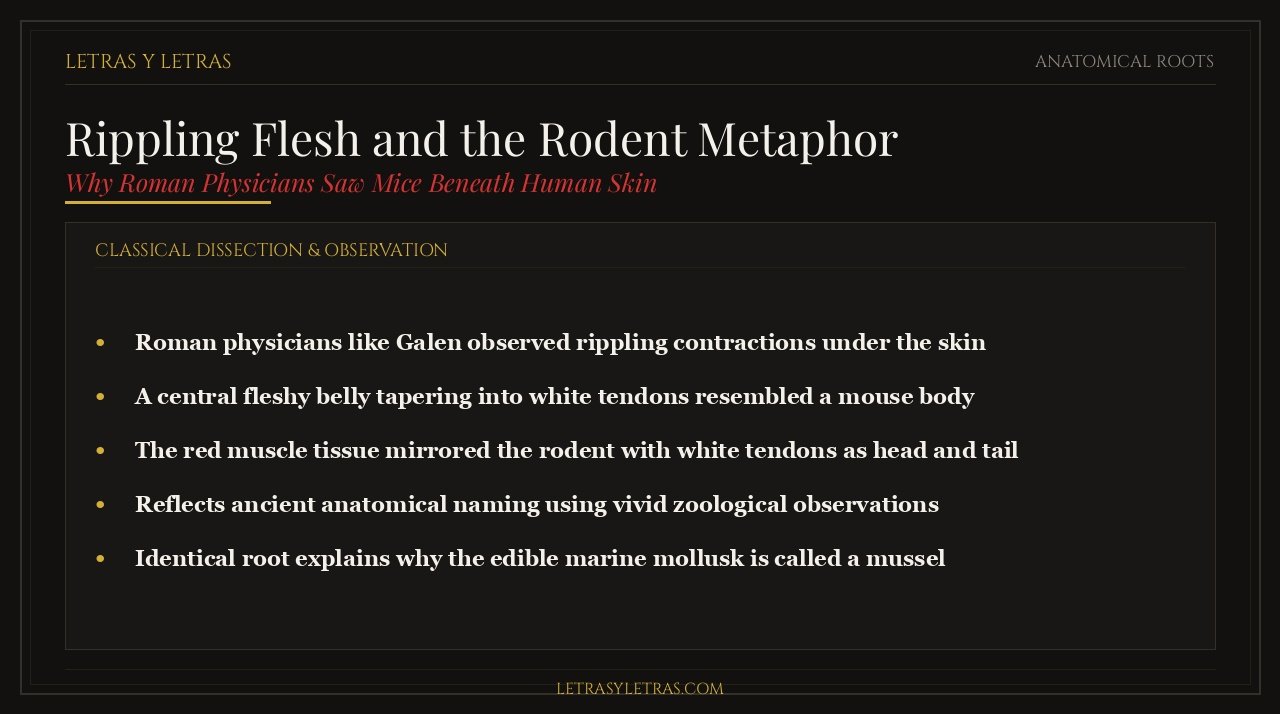
The primary parallel was kinetic movement beneath the skin. When someone bends their elbow, the bicep muscle contracts, bulges, and ripples. To early onlookers, the sudden bulging bulge looked like a small mouse creeping beneath a fabric blanket.
The second parallel was the physical shape of an excised muscle. When an anatomist dissected a skeletal muscle, the organ presented a characteristic tapered form. A plump, rounded red belly of muscle tissue occupied the center.
At either end, the red fleshy tissue tapered into tough, white, fibrous tendons. The central belly mirrored the rounded body of a small rodent. White tendons at each extremity looked remarkably like a snout and a slender tail.
The animal metaphor captured both the kinetic motion of living tissue and its static anatomical geometry. Ancient medical vocabulary excelled at using organic shapes to anchor technical descriptions. The little mouse became a permanent fixture of medical textbooks.
Galen and Classical Roman Anatomical Nomenclature
The physician who did the most to cement musculus in medical science was Galen of Pergamon. Living in the second century CE, Galen served as physician to Roman gladiators. He treated horrific combat wounds, gaining intimate firsthand knowledge of human musculature.
Galen conducted extensive dissections on Barbary macaques and domestic pigs to map bodily structures. He produced voluminous medical treatises that classified hundreds of individual muscles across the mammalian frame. Galen systematically adopted musculus as the formal Latin anatomical designation.
Galenic anatomy dominated European and Islamic medicine for more than a thousand years. Medieval university faculties treated Galen writings as indisputable scientific authority. Medical students memorized his anatomical terminology verbatim during classroom lectures.
In 1543, Flemish anatomist Andreas Vesalius published his masterpiece on human anatomy. Vesalius directly dissected human cadavers, illustrating muscular layers with detailed Renaissance woodcut engravings. His celebrated medical atlas preserved the traditional Latin nomenclature, cementing musculus in modern scientific discourse.
Through Galen and Vesalius, the little mouse survived across centuries of cultural upheaval. Byzantine scribes and Arab translators preserved the texts through the Dark Ages. When European universities revived medical dissection, musculus returned to university dissection halls.
The Curious Linguistic Twin: Muscle Versus Mussel
The etymological story of muscle contains a fascinating culinary sibling. Anyone dining at a seafood restaurant has encountered the edible black marine bivalve called a mussel. Few diners realize that muscle and mussel are the exact same word.
Romans used Latin musculus to describe small shellfish clinging to rocky sea coasts. The dark, rounded, tapered shell of the mollusk reminded coastal fishermen of a tiny mouse. This marine creature received the identical rodent diminutive as human biceps.
When English borrowed the word from Latin and Old French, both meanings shared identical spelling. Medieval English manuscripts used muscle to designate both bodily tissue and edible coastal shellfish. Context alone informed readers if an author meant meat or seafood.
English writers tolerated this orthographic ambiguity for several centuries. By the late eighteenth and nineteenth centuries, lexicographers sought greater orthographic precision. Printers standardized the spelling mussel for the shellfish, reserving muscle for anatomy.
Medieval Latin to Middle English: Medical Dissemination
The word muscle completed its crossing into the English vernacular during the late Middle Ages. During the fourteenth century, English physicians began translating Continental medical manuals into the native tongue. French medical scholars had already shortened Latin musculus to muscle.
In the 1380s and 1390s, Middle English medical manuscripts first recorded the term. Scholar John of Trevisa included the word in his extensive encyclopedic translations. Surgical manuals like Lanfranc Science of Cirurgie instructed English barbers and surgeons using the loanword.
Prior to this adoption, Anglo-Saxon speech relied on Germanic terms like lira or braun. The old word brawn originally meant boar meat before expanding to mean human muscular tissue. This French Latin loanword, however, carried academic prestige that eventually displaced native terms.
By the Renaissance, William Shakespeare and his contemporaries used muscle routinely in dramatic poetry. The word had shed its foreign novelty, becoming a naturalized component of everyday English speech. It was ready for modern physiological science.
Chronological Milestones in the History of Muscle
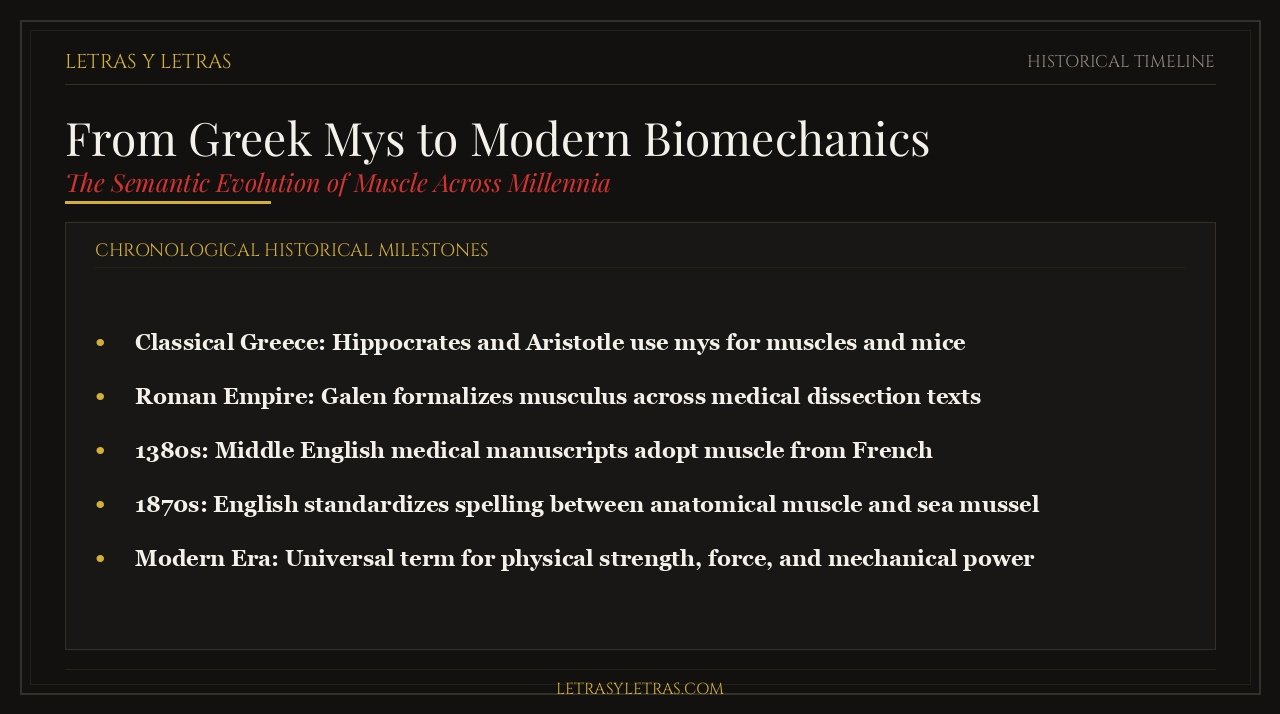
The historical timeline below summarizes the major linguistic, anatomical, and cultural milestones in the evolution of the word muscle:
| Historical Era | Linguistic Source | Literal Meaning | Scientific Impact |
|---|---|---|---|
| Classical Greece | Ancient Greek mys | Mouse and bodily muscle | Hippocrates and Aristotle establish the foundational Mediterranean anatomical metaphor. |
| Roman Republic | Classical Latin musculus | Little mouse diminutive | Coined from mus plus diminutive suffix -culus to name rippling tissue. |
| 2nd Century CE | Galen of Pergamon | Formal anatomical classification | Standardizes musculus across medical dissection texts and surgical manuals. |
| 14th Century | Middle French muscle | Contractile muscular tissue | Adapts Latin terminology for Continental surgery and vernacular education. |
| 1380s to 1390s | Middle English treatises | Fleshy motor organ | First recorded in English medical writings by John of Trevisa and Lanfranc. |
| 1800s | Modern English Lexicography | Spelling distinction | Standardizes muscle for anatomical tissue and mussel for the marine mollusk. |
| 20th Century to Present | Global Biomechanics | Physical power and force | Universal term for athletic power, biomechanical function, and figurative strength. |
Debunking Common Myths About the Origin of Muscle
Because the connection between mice and muscular biceps is counterintuitive, popular folklore has generated alternative explanations. Examining classical linguistics dispels three persistent myths:
The primary myth claims the word derives from Latin moles, meaning a heavy mass, rock, or burden. Proponents argue that lifting heavy masses produced the word muscle. Comparative linguistics confirms the root is strictly mus, denoting a rodent.
A second myth asserts that ancient Greek athletes named the bicep after mythological muses because athletic form represented divine art. While poets celebrated physical beauty, ancient Greek grammar clearly distinguishes the muse from mys. The mouse etymology is universally supported by philological evidence.
A third myth claims the shellfish mussel was named after human biceps because opening the shell required significant hand strength. In reality, both words were named after mice independently due to their small, tapered shapes. Neither biological entity was named after the other.
We saw similar folk myths debunked in our origin of the phrase crocodile tears guide. Popular imagination frequently invents heroic legends to explain earthy, whimsical word origins.
The Cultural Psychology of Physical Strength and Language
Why does discovering the rodent origin of muscle provoke such delight and surprise among modern readers? The answer lies in the psychological contrast between physical power and humble vulnerability. We expect the vocabulary of bodily power to sound fierce and monumental.
Learning that our mightiest bodily tissues bear the name of timid field mice humbles our physical pretensions. It reminds us that human beings remain organic mammals, intimately bound to the animal kingdom. Ancient language reflected gentle humor alongside scientific observation.
The human body possesses delicate vulnerabilities alongside immense physical power. Explore anatomical vulnerability in our analysis of the origin of the phrase Achilles heel. Recognizing bodily fragility prevents tragic overconfidence.
Physical training requires unwavering commitment and mental mastery. Discover enduring reflections on mental resolve in our curated quotes on discipline collection. Governing individual appetites is the cornerstone of lasting peace.
Enduring physical trials directly often demands sudden willpower. Learn how withdrawal medicine forged a universal idiom in our origin of the phrase cold turkey guide. Confronting physical adversity opens the path to renewal.
Sudden illness and fatigue also remind us of mortal limitations. Examine maritime naval history in our origin of the phrase under the weather investigation. Physical health requires mindful stewardship.
Recreational physical habits can also carry unexpected hazards. Trace equestrian horse racing and tavern culture in our origin of the word cocktail history. Balanced habits enrich daily life.
Communities also require structural boundaries to maintain collective safety. Discover medieval fire prevention and Norman decrees in our origin of the word curfew investigation. Social boundaries preserve civilization.
Great physical calamities have often challenged human resilience. Examine Renaissance celestial omens in our origin of the word disaster reflection. Ancient cosmologies sought meaning amidst chaos.
Superstition and spatial language also reveal bodily perceptions over time. Examine Roman left-hand omens in our origin of the word sinister study. Words evolve unexpected meanings across centuries.
Recreational gambling often evolved into universal warnings of peril. Trace medieval dice games in our origin of the word hazard investigation. Reckless pursuits carry lasting consequences.
Uncompromising honesty is equally necessary when cultivating personal health. Discover ancient standards of truth in our origin of the word sincere investigation. True renewal demands unadulterated integrity.
Tranquil retreats provide the ultimate environment for bodily renewal. Explore ancient Persian walled gardens in our origin of the word paradise reflection. The human spirit constantly strives toward health and harmony.
Frequently Asked Questions
What is the literal meaning of the word muscle?
The word muscle literally means little mouse, derived from Latin musculus, a diminutive form of mus meaning mouse.
Why did Romans name muscles after mice?
Romans noticed that flexing muscles rippled beneath the skin like a small mouse scurrying under a blanket.
Does the Greek word for muscle also mean mouse?
Yes, ancient Greek mys held the identical double meaning of mouse and muscle, used by Hippocrates and Aristotle.
Are muscle and mussel related words?
Yes, the marine shellfish mussel comes from the exact same Latin word musculus, named because its shell resembled a mouse.
When did the word muscle enter the English language?
The word entered English during the late fourteenth century, around the 1380s, through medieval Latin and French surgical texts.
Who popularized musculus in medical science?
Roman physician Galen of Pergamon popularized musculus across his extensive second-century anatomical treatises and surgical manuals.
Alan Sledge is the lead writer at letrasyletras.com, uncovering historical wisdom and word origins.


Alan Sledge is the writer and founder behind Letters & Letters. A lifelong lover of words, Alan has always been drawn to the small mysteries hidden in everyday language, why we say what we say, where our favorite sayings came from and the quotes that manage to put feelings into words better than we ever could ourselves.

Alan Sledge
Alan Sledge is the founder and lead researcher behind Letters & Letters. A lifelong student of linguistic history, he cross-references every word origin, idiom, and quote against primary archival manuscripts, the Oxford English Corpus, and 18th-century print lexicons.