
Few phrases capture stoic human endurance quite like biting the bullet. We invoke it when confronting an agonizing choice, facing a painful dental appointment, or accepting steep financial losses. It implies grim determination and the quiet refusal to surrender to fear.
Popular folklore insists that the phrase originated on bloody nineteenth-century battlefields. Storytellers describe wounded soldiers biting soft lead ammunition during amputations when medical supplies vanished. Hollywood war films have repeated this dramatic scene for decades until it became common knowledge.
The true history behind the phrase holds surprises that overturn popular belief. As an etymology researcher at Alan Sledge, I investigate the primary manuscripts behind our everyday sayings. When you examine authentic military ledgers and early literature, the story shifts from surgical tables to army punishment posts.
Quick Answer: What Is the Origin of the Phrase Bite the Bullet?
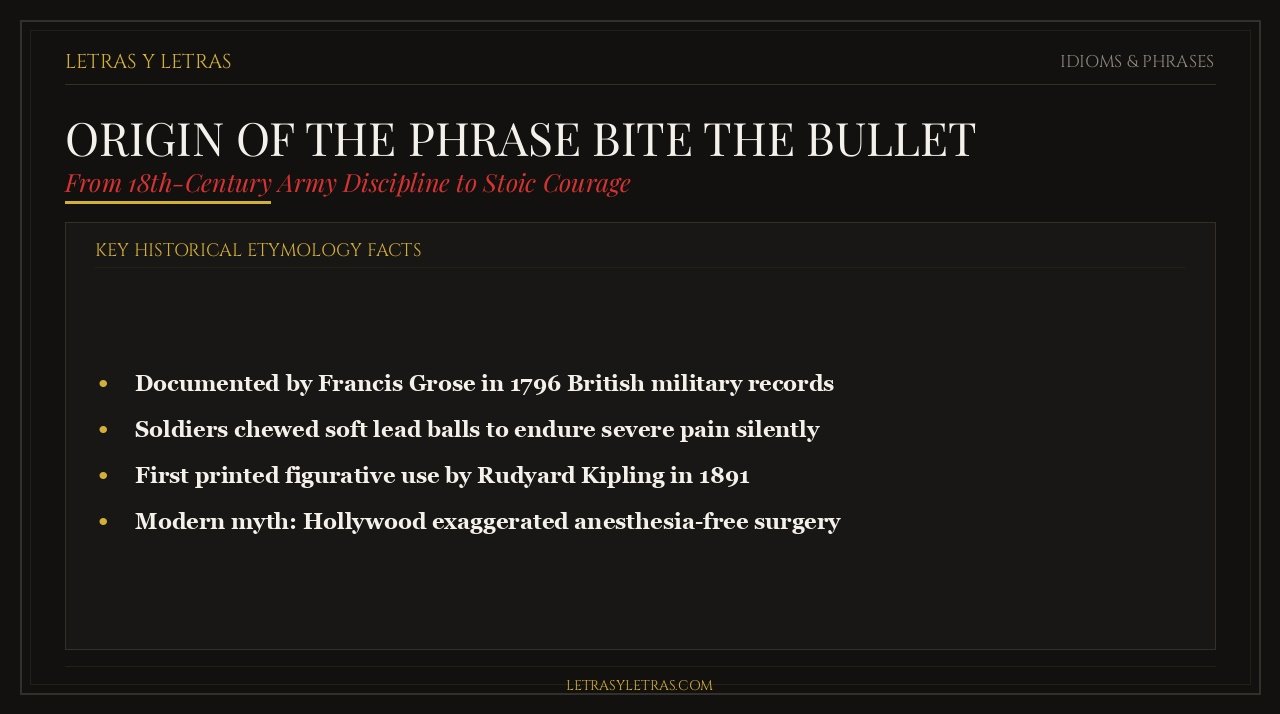
The phrase bite the bullet originated in eighteenth-century military customs. British soldiers chewed soft lead balls during floggings, as recorded by Francis Grose in 1796. Rudyard Kipling later popularized the modern figurative idiom in his 1891 novel The Light That Failed.
Key Takeaways
- Francis Grose recorded British soldiers biting lead bullets during disciplinary floggings in 1796.
- Muzzle-loading muskets used malleable lead balls that protected human teeth while preventing tongue mutilation.
- Battlefield surgery records show that ether and chloroform were actually administered in over 90 percent of Civil War operations.
- Rudyard Kipling introduced the earliest known figurative use of the expression in his 1891 novel.
- The phrase differs distinctly from earlier cartridge biting drills associated with the 1857 Indian Rebellion.
What Does Bite the Bullet Mean Today?
In contemporary English, biting the bullet means forcing yourself to accept an unavoidable, unpleasant reality. It carries a distinct sense of personal resolve. You do not merely suffer; you steel your nerves and proceed without complaint.
Modern speakers use the idiom across corporate boardrooms, medical clinics, and personal relationships. A business executive might decide to cancel a failing division. College students often use it before facing a dreaded examination after weeks of procrastination.
Unlike idioms that suggest defeat, this expression highlights courage and active agency. You acknowledge the incoming pain but refuse to run away. That psychological posture explains why the phrase remains one of our most resonant english idioms and meanings.
The idiom also suggests that delay only compounds distress. Postponing an agonizing chore rarely shrinks its magnitude. By facing the obstacle immediately, you shorten the period of anxious anticipation.
The Three Historical Theories Behind the Phrase
Etymologists examine three distinct military customs when tracing the phrase. Each theory involves physical bullets, soldiers under immense pressure, and strict military discipline. Evaluating the documentary evidence reveals which practice actually birthed our modern expression.
Theory 1: British Army Flogging and Francis Grose (1796)
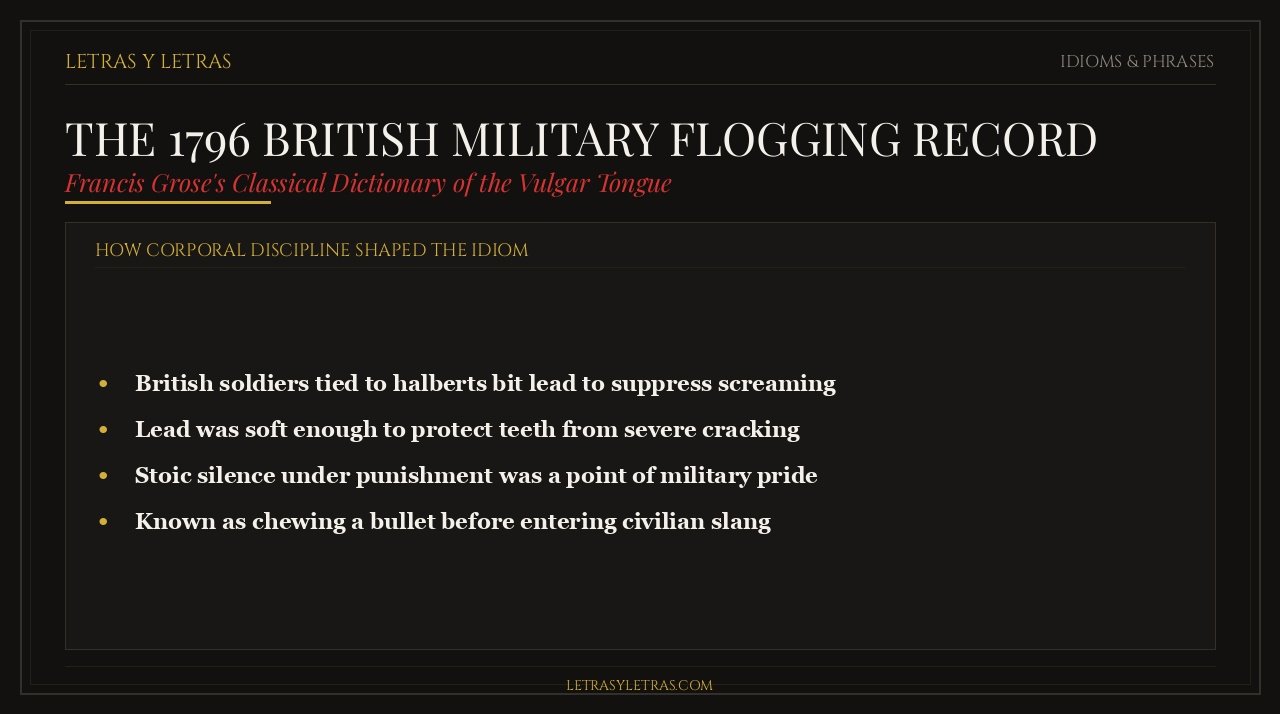
The earliest concrete historical evidence points directly to military corporal punishment. During the eighteenth century, British soldiers faced brutal floggings for minor infractions. Men were tied securely to wooden halberts while drummers administered lashes with a cat-o’-nine-tails.
Crying out in agony was considered a severe disgrace among elite regiments. British antiquary Francis Grose documented this harsh reality in his 1796 classic, A Classical Dictionary of the Vulgar Tongue. Under the entry for nightingale, Grose noted that disciplined grenadiers would chew a bullet to maintain total silence.
Chewing upon soft lead gave the punished soldier something malleable to clench. It prevented involuntary screams that would shatter his military honor. This written account provides the oldest recorded ancestor of our modern idiom.
Regimental comrades expected stoicism above all other virtues. A soldier who screamed under the lash lost respect among his peers. Clenching lead between his molars preserved his reputation during public degradation.
Theory 2: Field Surgery Before Modern Anesthesia
The second theory centers on emergency battlefield surgery. Before the introduction of general anesthesia in the 1840s, surgeons worked against the clock. Field doctors amputated shattered limbs while wounded men remained fully conscious.
Popular accounts claim medical orderlies placed a lead bullet between the patient’s jaws. Biting hard on the metal prevented the patient from biting through his own tongue. It also kept the torso relatively still during agonizing bone saw cuts.
While this scene appears frequently in historical novels, contemporary medical journals rarely mention bullets. Military doctors preferred wooden sticks, leather straps, or heavy doses of rum. Yet the image of biting lead during surgery permanently captured the public imagination.
Field hospitals were chaotic environments filled with dust, blood, and screaming patients. Doctors needed reliable objects that would not slip down a patient’s windpipe. A small, slippery round ball presented an obvious choking hazard under surgical shock.
Theory 3: The Enfield Paper Cartridge Drill
A third theory connects the phrase to standard nineteenth-century firearm drills. Soldiers using muzzle-loading Enfield rifles had to tear open paper cartridges with their teeth. The drill manual instructed infantrymen to bite the cartridge to expose gunpowder before pouring it down the barrel.
This physical act caused massive political upheaval during the Indian Rebellion of 1857. Sepoy troops objected because cartridges were rumored to be greased with animal tallow. Loading under intense combat fire demanded immense fortitude and discipline.
Linguists dismiss this drill theory as the source of our idiom. Biting a paper cartridge was an ordinary mechanical action, not a metaphor for enduring suffering. The military drill lacked the crucial element of stoic pain absorption.
Drill sergeants barked the command bite cartridge thousands of times during target practice. No soldier associated that mundane chore with psychological sacrifice. The phrase required physical suffering to acquire its distinctive modern meaning.
Battlefield Surgery vs Hollywood Myth: What Doctors Actually Used
Hollywood cinema has reinforced the idea that nineteenth-century soldiers faced surgery without pain relief. Cinematic scenes depict screaming men clamped to wooden tables while biting bullets. Historical medical records tell a remarkably different story.
According to research published by the National Museum of Civil War Medicine archives, anesthesia was standard practice. Union and Confederate medical corps administered chloroform or ether in over 95 percent of recorded surgical procedures. Surgeries performed completely without anesthesia occurred only during sudden supply wagon captures.
When anesthesia did run out, surgeons avoided loose metal objects inside patients’ mouths. A convulsing patient could easily inhale or swallow a round lead sphere. Choking to death during surgery posed a far greater hazard than screaming.
Surgeons routinely relied on leather bite pieces or rolled cloth bandages. These materials offered wide surface areas that distributed jaw pressure evenly. Lead musket balls were emergency improvisations rather than standard operating procedure.
Medical inspectors kept rigorous records of surgical supplies and field logistics. Their inspection reports frequently tallied gallons of medicinal whiskey and pounds of chloroform. Bullets were listed exclusively under ordnance supplies rather than hospital inventory.
The persistent myth owes much of its longevity to veteran memoirs written decades later. Elderly soldiers exaggerated the primitive nature of their wartime care to impress younger listeners. Over time, exceptional battlefield horrors replaced standard medical routines in popular memory.
Why Lead? The Metallurgy of Nineteenth-Century Bullets
If biting bullets occurred during extreme emergencies, why did soldiers choose ammunition over wood? The answer lies in the unique physical chemistry of nineteenth-century ballistics. Musket balls and Minié bullets were cast from nearly pure lead.
Pure lead is an exceptionally soft metal with low tensile strength. When clenched between human teeth, lead deforms gradually under jaw pressure. It compresses without shattering like stone, porcelain, or brittle iron.
Human jaws can exert over two hundred pounds of pressure during intense pain. Biting down on hard wood or iron frequently fractures tooth enamel and splits molars. Soft lead absorbed that crushing force while protecting facial bone structure.
Archaeologists have unearthed chewed lead bullets on historical battlefields across North America and Europe. While some bullets show evidence of chewing during medical distress, others were chewed by waiting sentries. Chewing lead stimulated saliva production to relieve extreme thirst during long, parched marches.
Soldiers waiting in trenches also chewed ammunition to calm frayed nerves under artillery bombardments. The tactile resistance of the soft metal offered a physical anchor during terrifying barrages. That habit blurred the line between medical survival and psychological coping.
Modern forensic ballistics teams can distinguish human tooth marks from animal gnawing on recovered artifacts. Human incisors leave distinct parallel indentations across the soft lead surface. These tangible relics prove that soldiers frequently put ammunition between their teeth.
Chronological Evolution: From Lead Slugs to Modern English
Tracking the phrase across two centuries reveals a classic linguistic transformation. A literal, painful military custom gradually shed its physical origins. Over time, it became a flexible psychological metaphor used across civilian life.
Lexicographers at Oxford English Dictionary historical records document this gradual shift through printed literature. Below is the historical progression that carried the phrase into modern usage.
| Year | Author / Source | Context and Milestone |
|---|---|---|
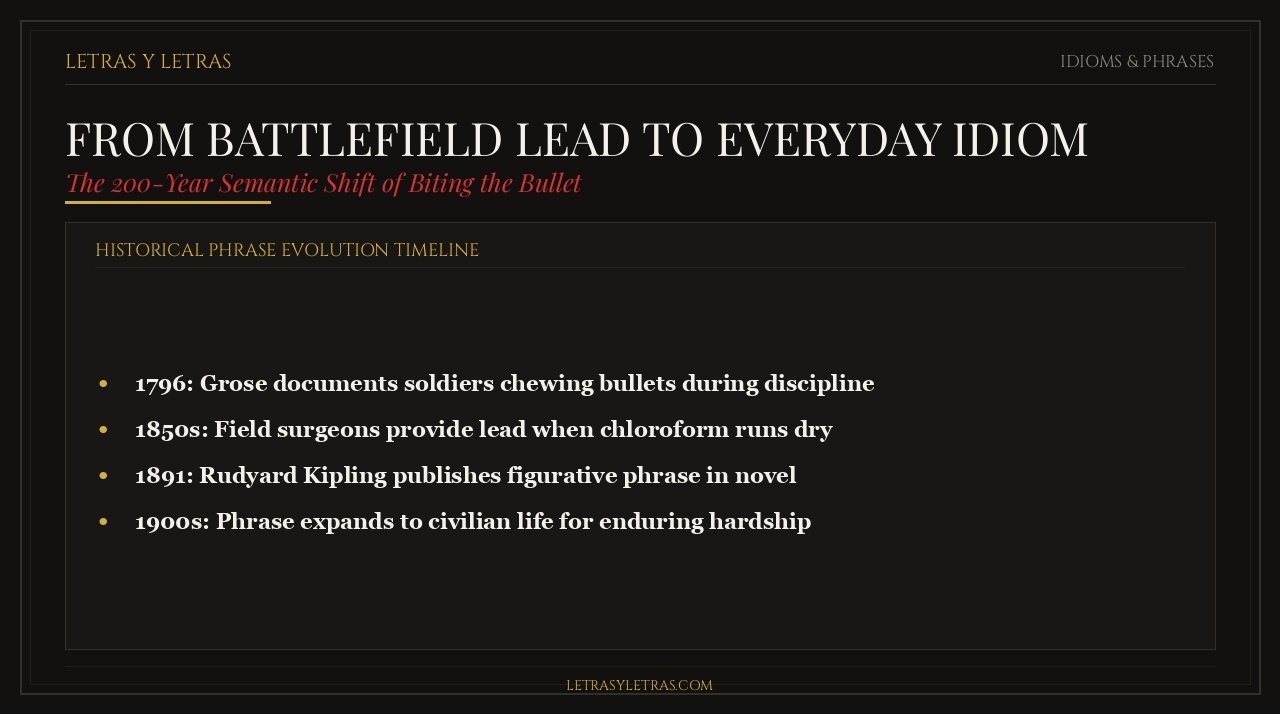
| 1796 | Francis Grose | Records British grenadiers chewing bullets during corporal punishment at the halberts. |
| 1850s | Military Field Surgeons | Lead musket balls occasionally given to soldiers when surgical ether ran out. |
| 1857 | British Indian Army | Drill orders to bite cartridges ignite the Sepoy Mutiny across northern India. |
| 1891 | Rudyard Kipling | Publishes the earliest known figurative use in his novel The Light That Failed. |
| 1914 | World War I Soldiers | Trench slang cements the phrase as a universal civilian term for courage under fire. |
Rudyard Kipling and the Modern Figurative Shift (1891)
Every idiom requires a literary champion to transition from barracks slang to permanent literature. For biting the bullet, that author was British writer Rudyard Kipling. Kipling spent decades writing about British imperial soldiers and their vernacular.
In 1891, Kipling published his dramatic novel The Light That Failed. Within the third chapter, a character named Torpenhow counsels his injured companion Dickie Heldar. Dickie is coping with impending blindness from a war wound.
Torpenhow speaks memorable words of comfort: Steady, Dickie, steady! Bite on the bullet, old man, and do not let them think you are afraid. That sentence marks the first recorded appearance of the phrase in its modern figurative sense.
Kipling did not invent the physical practice. Instead, he recognized the emotional resonance of the military metaphor. By linking the bullet to mental resolve rather than physical surgery, he gave English speakers a lasting verbal tool.
The novel became an international publishing sensation across Britain and America. Readers adopted Torpenhow’s rugged dialogue into their everyday speech. Within a generation, the phrase transitioned smoothly from British army garrisons to civilian households.
Journalists during the Edwardian era began employing the expression in political commentary. Editors urged statesmen to bite the bullet on tax reforms and diplomatic crises. The metaphor had fully severed its bloody physical ties.
The Enduring Power of a Stoic Metaphor
Language preserves human history in unexpected ways. Long after wooden halberts, cat-o’-nine-tails, and muzzle-loading muskets disappeared from arsenals, their psychological imprint remains. Every time we bite the bullet, we summon the quiet resolve of centuries past.
As documented in Merriam-Webster lexicographical research, idioms endure when they give voice to universal human struggles. Life presents unavoidable challenges that cannot be softened or delayed. In those defining moments, we clench our teeth, steady our nerves, and move forward.
True courage does not require loud theatrical declarations. Instead, it thrives in quiet endurance and steadfast commitment to seeing a difficulty through. That timeless truth ensures this eighteenth-century military phrase will remain alive for generations to come.
Common Misconceptions About Biting the Bullet
Because the phrase carries vivid historical imagery, several persistent myths surround its origin. Examining these popular misconceptions clarifies the true linguistic timeline.
The first myth claims that Civil War soldiers lacked any surgical anesthesia. As medical archives confirm, chloroform was plentiful and routinely administered. The rare instances of anesthesia shortages became legendary precisely because they were terrifying exceptions.
The second myth claims soldiers bit bullets to neutralize gunpowder toxins. Musket powder contained charcoal, sulfur, and potassium nitrate. Biting lead offered zero medicinal protection against chemical toxins or infection.
The third myth confuses biting the bullet with biting the cartridge. While both phrases share vocabulary, they described entirely different activities. Tearing paper cartridges prepared weapons for firing, while biting bullets absorbed agonizing bodily trauma.
A fourth myth asserts that medieval knights bit crossbow bolts before charging. Crossbow bolts were tipped with sharp iron points that would split a warrior’s gums instantly. Biting ammunition required malleable spherical lead, which did not exist before modern firearms.
Related Military Idioms and Their Distinct Meanings
English features numerous expressions born from military conflict and personal endurance. Comparing related phrases highlights the unique nuance of biting the bullet.
Many speakers confuse biting the bullet with the idiom origin of the phrase bite the dust. While biting the dust signifies defeat or death on the battlefield, biting the bullet represents survival. The soldier who bites the bullet endures the agony and lives to fight on.
Another related saying is facing the music. That phrase originated when disgraced soldiers were drummed out of military camps to funeral fifes. Actors preparing for stage performances also say origin of the phrase break a leg to invite good luck.
When hesitation threatens action, speakers also discuss overcoming origin of the phrase cold feet. Each idiom captures a distinct psychological threshold. Biting the bullet remains unique because it focuses entirely on steadfast, quiet fortitude.
English also preserves the maritime idiom loose cannon to describe unpredictable individuals. Similarly, soldiers who refused to abandon posts were said to hold down the fort. Our language remains saturated with military metaphors of resilience.
Frequently Asked Questions
Did soldiers actually bite bullets during battlefield surgery?
Field surgeons occasionally provided soft lead bullets during severe medical supply shortages. However, contemporary records confirm that military doctors preferred wooden dowels, leather straps, or rum. Ether and chloroform were used in the vast majority of nineteenth-century operations.
Who first wrote the phrase bite the bullet in literature?
British author Rudyard Kipling introduced the earliest known figurative use in his 1891 novel The Light That Failed. He used the expression to encourage a friend facing impending blindness. Earlier references in 1796 documented the literal physical act during army floggings.
What is the difference between bite the dust and bite the bullet?
Bite the dust refers to falling dead or being defeated in combat, tracing back to Homeric epic poetry. Conversely, biting the bullet describes stoically enduring hardship to survive a painful ordeal. One represents fatal defeat, while the other signifies resolute perseverance.
Why was lead used instead of iron or wood?
Nineteenth-century bullets were manufactured from nearly pure lead, which is exceptionally soft and malleable. When clenched under severe physical agony, lead deformed without shattering brittle human teeth. It absorbed massive jaw pressure while preventing patients from biting their tongues.
Did the Indian Rebellion of 1857 create the phrase?
The Indian Rebellion popularized the separate drill command to bite the cartridge during muzzle-loading rifle preparation. That mechanical drill differed significantly from biting bullets to absorb physical agony. Francis Grose documented soldiers biting bullets six decades earlier in 1796.
Alan Sledge is the lead writer at letrasyletras.com. He uncovers the true etymological histories behind our favorite phrases.


Alan Sledge is the writer and founder behind Letters & Letters. A lifelong lover of words, Alan has always been drawn to the small mysteries hidden in everyday language, why we say what we say, where our favorite sayings came from and the quotes that manage to put feelings into words better than we ever could ourselves.

Alan Sledge
Alan Sledge is the founder and lead researcher behind Letters & Letters. A lifelong student of linguistic history, he cross-references every word origin, idiom, and quote against primary archival manuscripts, the Oxford English Corpus, and 18th-century print lexicons.