
Few phrases capture sudden hesitation quite like cold feet. You hear it whispered in church vestibules before nervous weddings.
You hear it in boardroom negotiations before major corporate mergers. When a person backs away from a major commitment, society nods knowingly. Yet the origin of the phrase cold feet has nothing to do with bridal nerves or winter chills.
As an essayist exploring historical expressions at Alan Sledge, I love unearthing forgotten idioms. The phrase began as a clever, face-saving excuse used by nineteenth-century card players. It was a polite lie invented to escape bankruptcy at the poker table.
Quick Answer: What Is the Origin of the Phrase Cold Feet?
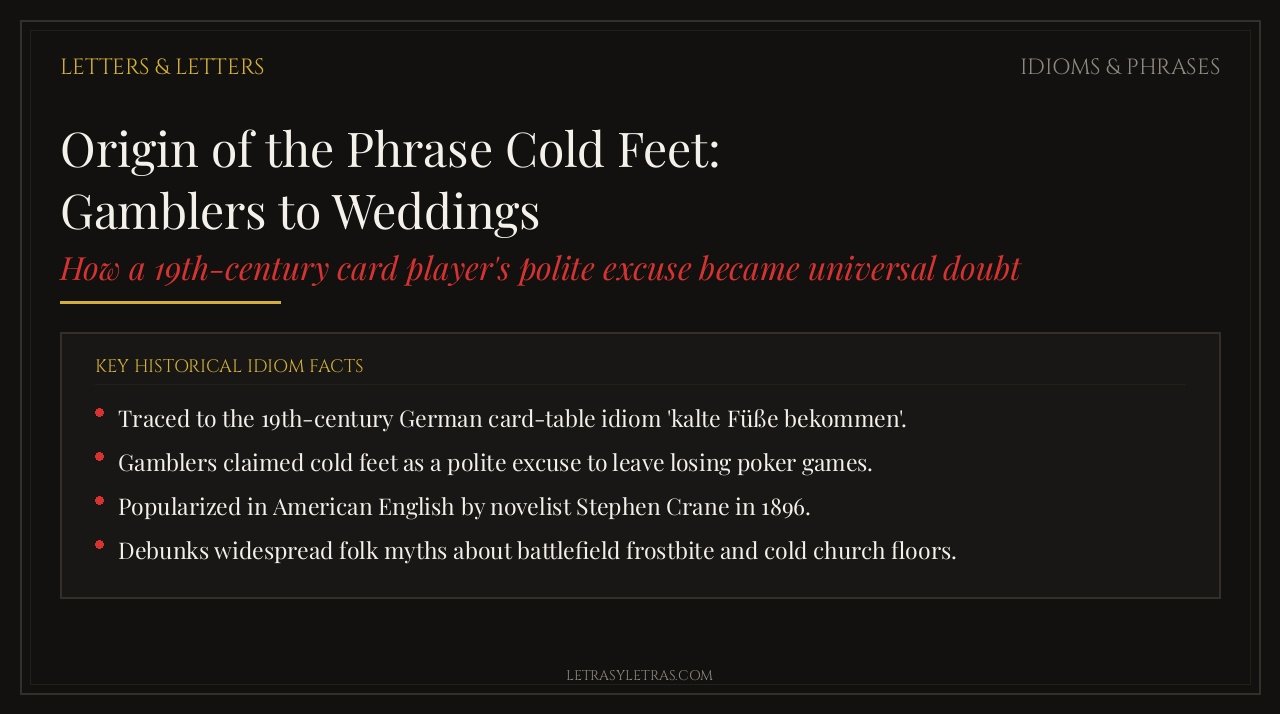
The phrase cold feet originated in nineteenth-century Germany as a gambling colloquialism, kalte Fuesse bekommen. Card players used freezing feet as a polite social excuse to quit playing when losing money. German novelist Fritz Reuter recorded the scene in his 1862 novel Ut mine Stromtid. The expression entered American literature through author Stephen Crane in the 1896 edition of Maggie: A Girl of the Streets. Over subsequent decades, the phrase expanded from gambling tables to military cowardice and wedding hesitation.
Key Takeaways
- Traces to the nineteenth-century German card-table idiom ‘kalte Fuesse bekommen’.
- Losing gamblers claimed cold feet to leave card tables without admitting poverty.
- German author Fritz Reuter published the earliest popular literary account in 1862.
- American novelist Stephen Crane popularized the expression in his 1896 novella Maggie.
- Debunks common urban legends about battlefield trench frostbite and church stone floors.
The Popular Folk Myths: Trenches and Church Aisles
Before tracing the documented literature, we must address two persistent folk etymologies. Many modern readers assume the phrase was born on the battlefield.
One widespread myth claims that soldiers in cold trenches developed frostbite. According to this story, freezing soldiers claimed cold feet to avoid charging enemy lines. While trench foot was a horrific reality in military history, the idiom predates trench warfare by decades.
Another popular theory points toward historic wedding ceremonies. Storytellers claim that nervous brides or grooms stood on unheated stone church floors in winter. In this telling, freezing flagstones caused shivering feet, prompting second thoughts.
Neither story withstands linguistic scrutiny. Respected lexicographers at the Oxford English Dictionary confirm that the phrase began in cardrooms. The physiological metaphor was social rather than thermal.
Like our investigation into the origin of the word handicap, a gaming custom evolved into common speech. Card players needed a graceful exit, and physiology provided a fitting excuse.
The German Connection: Kalte Fuesse Bekommen
The authentic linguistic trail leads directly to nineteenth-century Germany. In German vernacular, the idiom kalte Fuesse bekommen meant to get cold feet.
The phrase belonged to the colorful jargon of professional gamblers and tavern card players. Gambling saloons were tense, competitive environments where reputation mattered immensely.
A gentleman could never admit that he was out of money. Admitting financial ruin brought social disgrace and exposed a player to ridicule. In addition, admitting fear of an opponent was considered cowardly.
Instead, a savvy card player fabricated a physical complaint. When a player sensed that luck had abandoned him, he stood up from the green felt table. He rubbed his boots and complained that poor room circulation had frozen his toes.
The excuse was polite and unchallengeable. No gentleman could force a companion to sit in discomfort with freezing extremities. The player walked away with his remaining coins and his honor intact.

Nineteenth-century card players invented the excuse of cold feet to exit losing poker games with dignity.
Fritz Reuter and the 1862 Novel
The earliest prominent literary record of this gambling custom appeared in 1862. German novelist Fritz Reuter published his celebrated rural masterpiece, Ut mine Stromtid.
In Reuter’s story, a card player finds himself in a hazardous gambling match. Recognizing that the stakes have grown dangerously high, the character decides to quit. He deliberately claims that his feet have grown ice cold.
The narrator notes that the player did not actually feel cold. He simply wanted an excuse to leave the table before losing his shirt. The phrase captured the psychological reality of self-preservation disguised as physical distress.
Reuter’s book became an international bestseller across nineteenth-century Europe. In 1878, English translator Ellen Frewer published an English edition titled Seed-time and Harvest on Project Gutenberg. The novel introduced English readers to the curious German gambling expression.
Scholars also point to an older Italian proverb recorded by Ben Jonson in 1605. In his satirical play Volpone, Jonson referenced an Italian idiom meaning cold on one’s feet. Within Italian street slang, having cold feet signified having empty pockets.
Card Sharp Etiquette in European Saloons
To grasp why this excuse worked, we must examine nineteenth-century gaming etiquette. Card games like Skat, Whist, and Faro were governed by strict gentlemanly codes.
Walking away abruptly from a game while winning was considered bad form. Walking away while losing could prompt accusations of cowardice or bad sportsmanship. Players needed a pretext that offended nobody.
Drafty wooden floors in German inns made cold feet a plausible physical complaint. In winter, potbelly stoves warmed only the upper torso of seated players. Cold air pooled along the timber floorboards.
A gambler could feign numbness in his extremities without casting aspersions on his companions. It was a face-saving convention that allowed everyone to preserve dignity. The table accepted the excuse with a knowing chuckle.
Over time, the literal complaint shifted into an ironic code phrase. If a man said his feet were cold, everyone at the table understood the truth. He was out of cash, out of nerve, and ready to go home.
Stephen Crane and the American Breakthrough
While European authors used the phrase, American author Stephen Crane brought it into everyday English. Crane was a master observer of urban street slang and social realism.
In 1893, Crane privately published his groundbreaking novella, Maggie: A Girl of the Streets. The story depicted the harsh realities of working-class life in the Bowery of New York City.
In 1896, publisher D. Appleton and Company issued a revised second edition. Crane polished the dialogue to reflect contemporary Manhattan street speech.
In this revised 1896 edition, Crane inserted the immortal line. A character reflects on a failed enterprise, stating bluntly: “I knew this was the way it would be. They got cold feet.”
Because the line was absent in 1893, historians can date the phrase’s American arrival precisely. Between 1893 and 1896, the expression swept through New York saloons and political wards. Crane recognized its vivid power and recorded it for posterity.
| Year | Key Source | Historical Milestone |
|---|---|---|
| 1605 | Ben Jonson’s play ‘Volpone’ | Cites Italian proverb ‘cold on the feet’ meaning a total lack of money. |
| 1862 | Fritz Reuter’s novel ‘Ut mine Stromtid’ | Records German card players using ‘kalte Fuesse’ to politely quit games. |
| 1878 | English translation ‘Seed-time and Harvest’ | Introduces the card-table gambling idiom to British and American readers. |
| 1896 | Stephen Crane’s novel ‘Maggie’ | First major appearance in American fiction; solidifies meaning of losing courage. |
| 1914 | World War I military slang | Coined ‘cold-footer’ as derogatory slang for someone avoiding military combat. |
| 1950s | Post-war Western culture and cinema | Becomes universal romantic idiom for anxiety and second thoughts before marriage. |
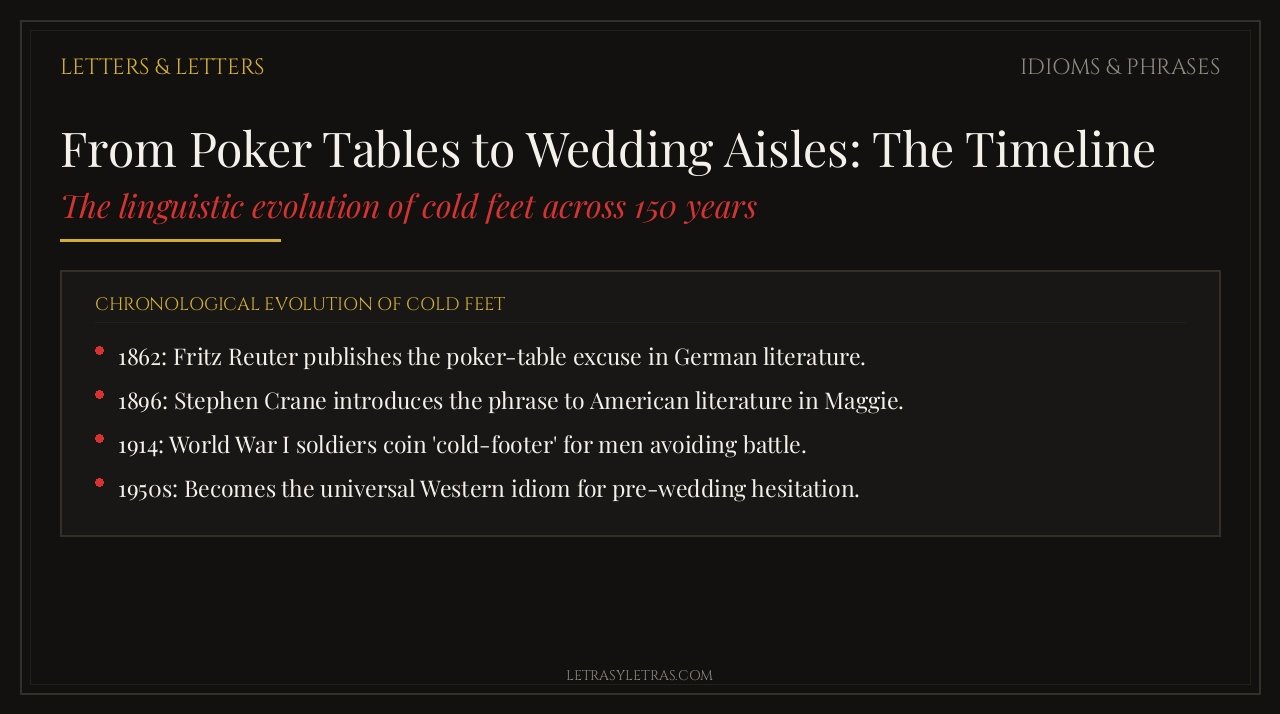
The evolutionary timeline tracing cold feet from 1862 European literature to modern romance.
The Cold-Footer Era: Military Cowardice in WWI
Following Stephen Crane’s publication, the phrase evolved rapidly. By the early twentieth century, it moved beyond commercial ventures into wartime politics.
During World War I, soldiers in Great Britain, Australia, and Canada coined the noun cold-footer. The term was a biting insult directed at men who avoided military service.
A cold-footer was a man who lacked the spine to enlist. In trench conversation, it described a soldier who hesitated when the whistle blew to attack.
Newspapers adopted the insult to shame young men into joining volunteer battalions. The physical imagery of frozen feet aligned naturally with cowardice. Fear was conceptualized as a cold sensation paralyzing a person’s ability to advance.
Like our study of the origin of the word tragedy, ancient physical instincts colored modern words. A gambler’s excuse had hardened into a soldier’s insult.
The Biology of Fear: Why the Metaphor Works
Why did the phrase cold feet resonate so powerfully with generations of speakers? The answer lies in human biology and the physiological response to fear.
When an individual faces acute terror or sudden anxiety, the autonomic nervous system reacts. The body triggers the ancestral fight-or-flight mechanism.
To prepare the organism for survival, the heart directs blood toward critical organs. Blood rushes into the brain, lungs, and large thigh muscles. At the same time, peripheral blood vessels constrict sharply.
This vasoconstriction reduces blood circulation to the extremities. As blood departs the skin, hands and feet turn literally icy and clammy. The physical sensation of severe anxiety is cold extremities.
Medical records archived by the National Institutes of Health library explain this biological process. Language instinctively mirrored the body. An idiom that began as an excuse matched the true physical sensation of panic.
Temperature in the English Mind: Cold Blood and Cold Shoulders
English speakers frequently associate warmth with affection and cold with detachment. We speak of a warm welcome or a cold glare.
Consider related idiomatic expressions that use temperature to describe psychological states. Acting in cold blood implies calculating cruelty devoid of human sympathy. To give someone the cold shoulder describes intentional social rejection.
In that broader linguistic landscape, cold feet occupies a unique emotional niche. It does not signify malice or hostility. Instead, it captures paralysis and vulnerability.
A person with cold feet wants to proceed, but dread holds them back. The body feels rooted to the floor, incapable of taking the next forward step. That precise physical metaphor explains why the expression outlasted centuries of linguistic change.
From Poker Tables to the Wedding Aisle
During the middle of the twentieth century, the phrase underwent its final transformation. It migrated from military conflicts into the intimate sphere of romance and marriage.
Wedding preparations in post-war America grew increasingly elaborate and expensive. Nuptials involved major legal, financial, and emotional transitions. Committing to a single partner for life felt momentous.
It was natural for nervous brides and grooms to feel panic before the ceremony. Popular playwrights, screenwriters, and novelists seized on the phrase cold feet.
In Hollywood romantic comedies, getting cold feet became an essential plot device. Audiences sympathized with anxious protagonists pacing in dressing rooms. The term lost its harsh associations with military cowardice.
Instead, cold feet became relatable and human. It described ordinary, understandable self-doubt before making an irreversible choice. A gambler’s trick had become a badge of emotional honesty.
Connecting Words: Everyday Idioms of Doubt and Courage
The story of cold feet demonstrates how English constantly repurposes physical sensations into moral ideas. We speak of having cold feet just as we speak of having a heavy heart.
Our curated collection of english idioms and meanings contains numerous expressions rooted in physical reactions. From sweat on the brow to butterflies in the stomach, our bodies shape our vocabulary.
Literature consistently celebrates the struggle between fear and resolve. When you browse our collection of famous quotes and quotations, you find writers analyzing this very hesitation.
Knowing the authentic history enriches everyday conversations. The next time a friend hesitates before a major decision, you can smile knowingly. You will recall a clever German gambler standing up from a tavern table, saving his money and his pride.
Frequently Asked Questions
Did the phrase cold feet come from battlefield frostbite?
No, historical linguists confirm that battlefield frostbite is an urban legend. While soldiers did suffer from trench foot, the phrase originated decades earlier among German card players. Gamblers claimed freezing feet as a face-saving excuse to leave losing games.
Who first used the phrase cold feet in American literature?
American author Stephen Crane first popularized the phrase in his 1896 novella Maggie: A Girl of the Streets. Crane inserted the line into the revised second edition to capture contemporary Manhattan slang.
What does getting cold feet before a wedding mean?
Getting cold feet before a wedding means experiencing a sudden wave of panic, doubt, or hesitation about marriage. It describes emotional anxiety rather than an actual physical chill.
What was a cold-footer during World War I?
During World War I, British and Commonwealth soldiers used cold-footer as a derogatory term for a draft dodger or coward. It described someone who lacked the courage to enlist or fight at the front line.
Is there a physiological reason fear causes cold feet?
Yes, acute anxiety triggers vasoconstriction, which redirects blood toward vital organs and away from extremities. This natural fight-or-flight response makes hands and feet feel literally cold and clammy during intense stress.
Alan Sledge is the founder and lead writer at letrasyletras.com, dedicated to uncovering the true etymological histories behind our favorite words and phrases.


Alan Sledge is the writer and founder behind Letters & Letters. A lifelong lover of words, Alan has always been drawn to the small mysteries hidden in everyday language, why we say what we say, where our favorite sayings came from and the quotes that manage to put feelings into words better than we ever could ourselves.