
Few words in our modern lexicon carry as much moral weight as sincere. We sign personal letters with it and demand it from political leaders. Most importantly, we treasure genuine honesty in our closest personal relationships.
For centuries, a fabricated story has distorted how people explain this term. Millions believe an urban legend about Roman sculptors, marble statues, and melted wax. The real Latin etymology is far older and grounded in ancient agriculture.
Quick Answer: Origin of the Word Sincere
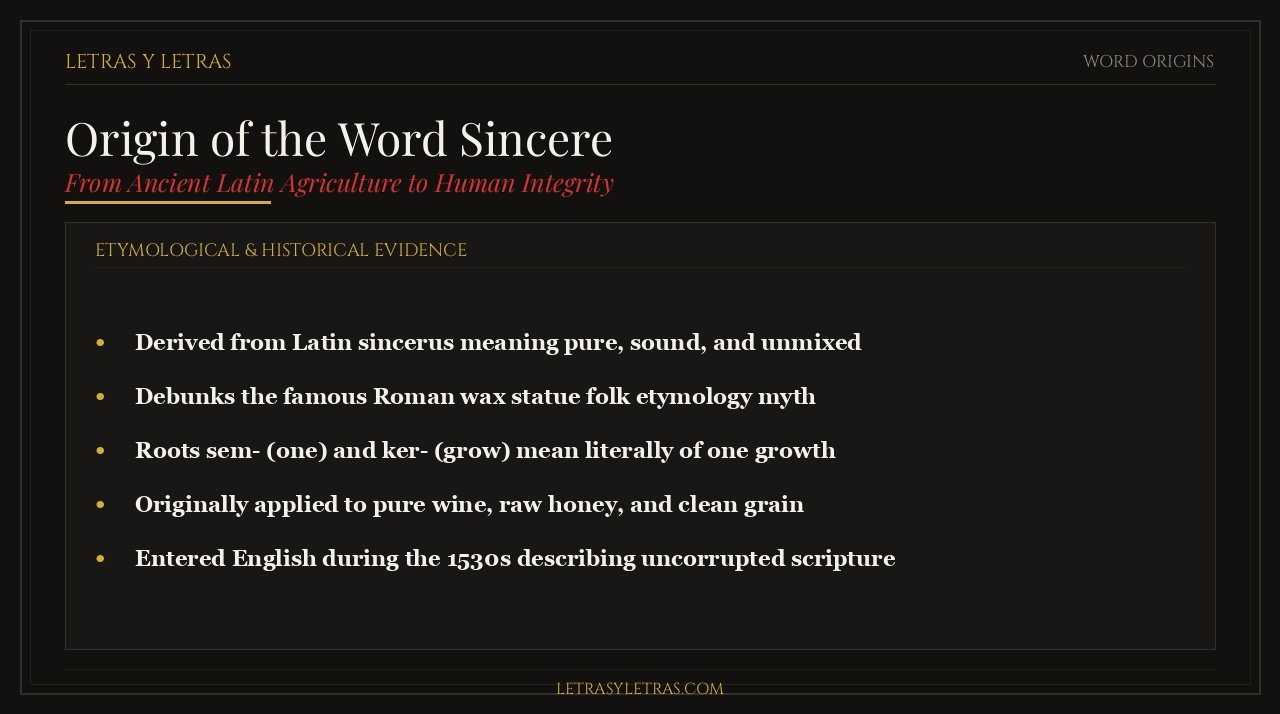
The word sincere comes from Latin sincerus, meaning pure and unadulterated. Linguists trace the term to Proto-Indo-European roots sem- and ker-, meaning of one growth. Romans originally applied the word to unmixed wine and virgin honey.
Key Takeaways
- Derived from Classical Latin sincerus, denoting purity, soundness, and wholeness.
- The Roman wax statue story is a seventeenth-century European preaching myth.
- Ancient Romans originally used sincerus for unmixed wine, virgin honey, and clean grain.
- Linguistic roots sem- and ker- translate literally to of one single growth.
- Entered Early Modern English in the 1530s, initially describing pure religious doctrine.
The Famous Roman Wax Myth: A Story Too Good to Be True
Ask five people at a gathering where sincere comes from. At least two will recount the marble sculpture legend. The tale sounds convincing, dramatic, and morally satisfying.
According to this tale, dishonest sculptors in ancient Rome often made catastrophic chisel mistakes. When a tool slipped and chipped fine Carrara marble, the artisan faced financial ruin. To hide flaws, corrupt carvers allegedly blended white beeswax with crushed marble dust.
Under dim workshop lamps, the patched stone looked completely flawless. Unwary art collectors purchased the piece believing they owned an immaculate masterpiece. Disaster struck once the owner placed the statue in a sunlit villa courtyard.
Hot Mediterranean sunlight melted the soft beeswax filler. The hidden fracture reappeared, exposing the craftsman’s shameful fraud. Honest stonecutters therefore began advertising their work as sine cera, meaning without wax.
From this commercial warranty, our modern English virtue was supposedly born. Preachers love using this story in Sunday sermons. Motivational speakers routinely repeat it on stage during leadership seminars.
The entire narrative is completely false. It belongs alongside the voting jar myth in the origin of the phrase spill the beans. Historical documentation reveals a vastly different linguistic truth.

Why Classical Scholars and Etymologists Reject the Myth
Classical philologists, Latin linguists, and museum curators reject the wax tale entirely. Their objections rest on three insurmountable pillars. These pillars are grammar, historical literature, and Roman commercial law.
The grammatical objection is absolute. In Latin word formation, combining the preposition sine with the noun cera never creates an adjective like sincerus. Latin prepositions do not merge with first-declension nouns to form words ending in -erus.
If Roman builders had invented an adjective meaning without wax, standard Latin morphology would have created inceratus. Alternatively, it would have yielded a construction like sineceris. The grammatical leap to sincerus is impossible.
The historical written record provides zero support. Ancient Rome produced prolific chroniclers who documented craftsmanship in exhaustive detail. Pliny the Elder wrote thirty-seven books of his encyclopedic Natural History.
Pliny dedicated massive chapters to marble quarrying, bronze foundry work, and sculpture techniques. He never mentions carvers using wax to conceal stone cracks. The famous architect Vitruvius authored ten books on construction standards without mentioning the term once.
Roman civil law regulated commercial contracts with strict penalties. The Digest of Justinian contains extensive laws on vendor fraud and hidden product defects. Roman jurists never recorded any commercial warranty called sine cera.
The Online Etymology Dictionary notes that linguists rejected the wax story over a century ago. The tale owes its popularity to imaginative Renaissance writers, not Roman artisans.
Who Actually Invented the Wax Legend?
If ancient Romans never used the phrase, who created the legend? Archival evidence points directly to early modern European scholars during the seventeenth century. Renaissance humanists loved inventing speculative word histories.
Scholars during that era lacked comparative linguistics databases. They routinely inspected modern words and invented fanciful back-formations. Writers attempted to explain historical syllables by dissecting words into arbitrary Latin parts.
In 1617, English scholar John Minsheu published his multilingual dictionary titled Ductor in Linguas. In his sincere entry, Minsheu suggested tentative derivations. He briefly noted that the word might connect to sine cera.
Minsheu was not even discussing marble statues. He referred to beekeepers who sold pure honey clarified without honeycomb wax pieces. The transition from honey jars to classical marble statues happened shortly after.
Seventeenth-century English preachers seized on Minsheu’s passing note. Church ministers realized that a melting marble statue offered an unforgettable moral illustration. A cracked statue masked by wax provided an effective metaphor for spiritual hypocrisy.
Ministers repeated the sermon from pulpits across England and colonial America. Generation after generation listened to the dramatic homily. Over time, congregations accepted the pious sermon illustration as documented historical fact.
The Real Root: Ancient Latin Agriculture and Pure Harvests
To discover the true origin of the word sincere, we must look to ancient Roman farms. In archaic Latin, sincerus was a sensory term describing pure physical substances. It meant whole, unadulterated, unmixed, and clean.
Early Roman life centered on agriculture, vineyards, olive orchards, and grain fields. Wealth was measured in raw harvests. Sellers often cheated buyers by cutting valuable liquids with cheap fillers.
Roman wine merchants used the phrase vinum sincerum to describe virgin, unwatered wine. Cellar masters contrasted this genuine vintage with inferior batches diluted with river water, chalk, or lead sweeteners. The wine was sincere because it was unmixed.
Roman beekeepers spoke of mel sincerum to describe raw honey free from added tree sap. Farmers praised clean wheat that contained no chaff or weed seeds. The word described physical purity long before it described personal character.
Classical literature preserves this agricultural usage. The Roman poet Horace used the phrase sincerum vas in his famous Epistles. Horace warned that unless a clay jar is completely clean, whatever liquid you pour inside turns sour.
The original text can be inspected through the Perseus Digital Library classical collection. The poetic metaphor relied on clean earthenware pots, not marble statues.
The Deep Roots: One Growth and Single Stock
Modern historical linguistics traces words back before the founding of Rome. By comparing Latin with ancient Sanskrit and Greek, scholars reconstructed the Proto-Indo-European elements forming sincerus. The compound splits into two ancient components.
The first element derives from the Proto-Indo-European root *sem-. This root meant one, single, united, or together. It produced the Latin word simplex, which gave us the English adjective simple.
The same root generated the Latin adverb semel, meaning once. It also produced ancient Greek words beginning with homo-, as well as native Germanic words like same. The root fundamentally signifies unity and singularity.
The second element comes from the Proto-Indo-European root *ker-, meaning to grow or nourish. This root produced the Latin verb crescere, meaning to grow. It also gave us the English nouns crescent, increase, and create.
Ancient Romans worshipped Ceres, the goddess of agriculture, whose name sprang from this identical root. We still preserve her agricultural legacy every morning when eating breakfast cereal. The root *ker- represents biological nourishment.
When prehistoric speakers united *sem- with *ker-, they created a compound meaning of one growth. A sincere harvest grew from a single unpolluted seed. It was not grafted onto foreign branches or blended with inferior crops.
Scholarly etymological records accessible through Oxford Reference resources affirm this single-growth derivation. Linguists recognize of one growth as the true etymological origin of sincere.
From Harvest Purity to Human Integrity: The Roman Semantic Shift
How did a description of unwatered wine evolve into a term for human integrity? The transformation occurred during the late Roman Republic. Brilliant Latin authors began using agricultural vocabulary to articulate complex ethical ideas.
Marcus Tullius Cicero was central to this linguistic evolution. In philosophical works like De Amicitia, Cicero frequently praised fides sincera. He used the phrase to describe loyal, unfeigned friendship free from hidden motives.
To Cicero, a sincere friend was someone whose words matched their inward thoughts. Just as vinum sincerum contained no hidden water, a sincere companion hid no secret jealousy. The individual stood whole and unmixed.
The historian Tacitus praised sinceritas as an essential civic virtue. Tacitus contrasted honest republican speech with the manipulative flattery spoken in imperial palaces. By the end of antiquity, sincerus described authentic human character.
Latin Philosophical Contrasts: Sincerus Versus Simulatio
Roman philosophers understood human psychology through sharp linguistic contrasts. When writers praised sinceritas, they paired it against two dangerous social vices. These vices were simulatio and dissimulatio.
To a Roman thinker, simulatio meant pretending to possess virtues you lacked. In contrast, dissimulatio meant hiding your true motives behind polite conversation. The sincere individual engaged in neither deceptive practice.
Seneca the Younger explored this dynamic in his moral essays. Seneca argued that a peaceful mind requires consistent inward wholeness. When a person lives sincerely, their actions require no elaborate defense.
This psychological clarity passed directly into modern Romance languages. Spanish adopted the adjective sincero with identical meaning. Italian preserved sincero, Portuguese maintained sincero, and French refined it into sincère.
Every daughter language of Latin inherited the classical definition of undivided wholeness. None of these languages developed folklore about stone statues. The wax myth remained an Anglo-American curiosity born in Protestant pulpits.
Chronological Evolution of the Word Sincere
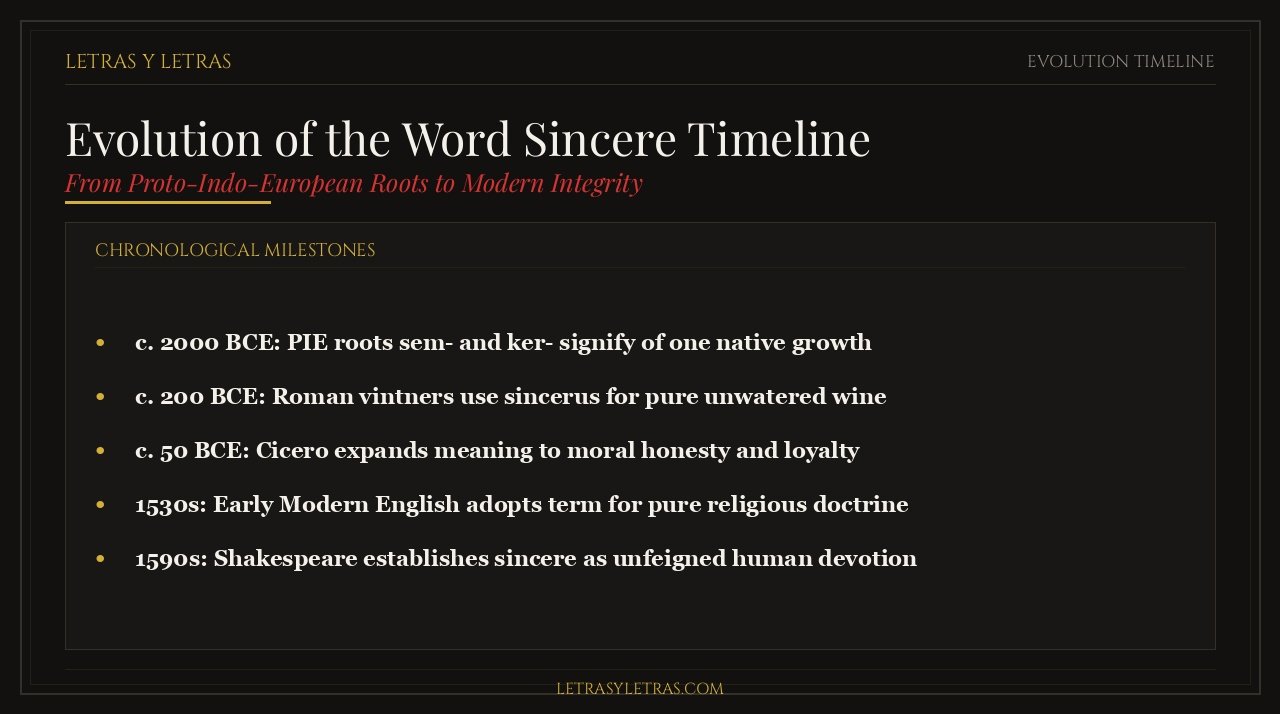
The historical timeline below summarizes the major linguistic milestones tracking the word from ancient roots to our modern vocabulary:
| Historical Era | Language Source | Linguistic Milestone |
|---|---|---|
| c. 2000 BCE | Proto-Indo-European (*sem- + *ker-) | Roots meaning one and to grow unite to signify of one single growth. |
| c. 200 BCE | Archaic Latin (sincerus) | Used for physical goods: unwatered wine, raw honey, and clean wheat. |
| c. 50 BCE | Classical Latin (Cicero, Horace) | Metaphor shifts from farm crops to moral honesty and unfeigned loyalty. |
| c. 1350 CE | Middle French (sincère) | Adopted in French writing to describe uncorrupted texts and honest speech. |
| c. 1530 CE | Early Modern English | First printed English records, initially describing pure religious doctrine. |
| 1617 CE | John Minsheu Dictionary | Speculative sine cera note published, giving rise to the modern wax myth. |
| Present Day | Modern English | Established virtue for authenticity; wax myth debunked by linguists. |
Arrival in English: From Religious Scripture to Modern Letters
The word did not travel directly from Roman soldiers to English soil. English scholars borrowed the term from Middle French sincère during the early sixteenth century. The earliest printed English appearances occurred during the 1530s.
Early English writers did not use the word for personal signatures. Sincere initially served a theological purpose during the English Reformation. Protestant scholars used the adjective to describe pure biblical doctrine uncorrupted by medieval additions.
In William Tyndale’s New Testament translation, readers were advised to seek the sincere milk of the word. Translators meant pure, untainted scriptural teaching. The phrasing directly mirrored Roman agricultural descriptions of unwatered milk.
By the 1590s, Elizabethan playwrights expanded the word into secular human relationships. William Shakespeare used sincere across multiple plays to contrast true devotion with theatrical flattery. In King Lear, genuine love stands in stark contrast to deceitful speech.
John Milton continued this poetic tradition in Paradise Lost during the 1660s. Milton described faithful angels rendering sincere obedience to heaven. He contrasted this unblemished loyalty with Satan’s disguised flattery and rebellion.
By the eighteenth century, letter writers adopted yours sincerely as a formal closing phrase. American statesmen like Benjamin Franklin closed personal correspondence with this formula. Today, millions sign correspondence with an ancient Roman agricultural virtue.
Famous Sayings: Imitation as the Sincerest Flattery
The linguistic concept of sincerity gave birth to several enduring English sayings. The most famous aphorism emerged in 1820 from English writer Charles Caleb Colton. Colton wrote that imitation is the sincerest form of flattery.
Colton’s maxim captured how human behavior mirrors inward admiration. Empty compliments can be calculated and false. When someone actively copies your techniques or lifestyle, their imitation proves genuine admiration.
The phrase remains an everyday staple across business, creative arts, and modern culture. Similar linguistic patterns appear across our exploration of the origin of the phrase silver lining. Idioms often reflect ancient virtues adapted to modern social commentary.
Why the True Origin Matters
People often cling to the wax statue myth because it offers an entertaining mental picture. A cracked marble statue patched with wax feels like a tidy fable. The authentic linguistic history offers a far deeper lesson.
The wax myth frames sincerity as the absence of deception. It suggests that honesty merely means you did not patch a flaw or cheat a customer. This framing reduces personal integrity to a negative commercial standard.
The genuine Proto-Indo-European root presents a positive virtue. Being sincere means you are of one growth. Your inward thoughts and outward words spring from the identical root.
Tracing how our ancestors formed vocabulary enriches how we speak today. We see similar cultural values reflected across our guide to english idioms and meanings. You can also explore cultural traditions in our study of the origin of the phrase bless you.
Frequently Asked Questions
Does sincere mean without wax in Latin?
No, sincere does not mean without wax. Combining Latin sine and cera does not produce the adjective sincerus. Historical linguists confirm that sincerus comes from Proto-Indo-European roots meaning of one growth.
Where did the Roman marble wax myth start?
The marble wax legend started in seventeenth-century Europe. Lexicographer John Minsheu suggested a speculative connection to strained honey in his 1617 dictionary. English preachers adapted the idea to marble statues for sermons, spreading the folk myth widely.
What was the original Roman meaning of sincerus?
In ancient Rome, sincerus described physical farm goods that were unmixed and pure. Roman farmers used it for unwatered wine, clean honey, and sound wheat. Philosophers like Cicero later applied the term to honest human character.
When did sincere enter the English language?
Sincere entered English during the 1530s from Middle French sincère. Its earliest usage was theological, describing uncorrupted religious doctrine and pure scripture. Playwrights like Shakespeare later popularized the word for authentic human emotions.
What is the literal translation of the linguistic roots of sincere?
The Proto-Indo-European root *sem- means one or single, while *ker- means to grow. Combined, they translate literally to of one single growth. The term described living crops that grew from pure native seed without foreign grafting.
Alan Sledge is the founder and lead writer at letrasyletras.com, dedicated to uncovering the true etymological histories behind our favorite words and phrases.


Alan Sledge is the writer and founder behind Letters & Letters. A lifelong lover of words, Alan has always been drawn to the small mysteries hidden in everyday language, why we say what we say, where our favorite sayings came from and the quotes that manage to put feelings into words better than we ever could ourselves.