
A quiet afternoon library study room suddenly echoes with an explosive sneeze. Heads turn across wooden tables as startled patrons glance toward the sound. A nearby student whispers bless you before returning to silent reading.
Modern society repeats this phrase as an automatic social courtesy. People utter the words in crowded office elevators, family living rooms, and busy grocery checkout lines. The response feels natural, polite, and completely universal.
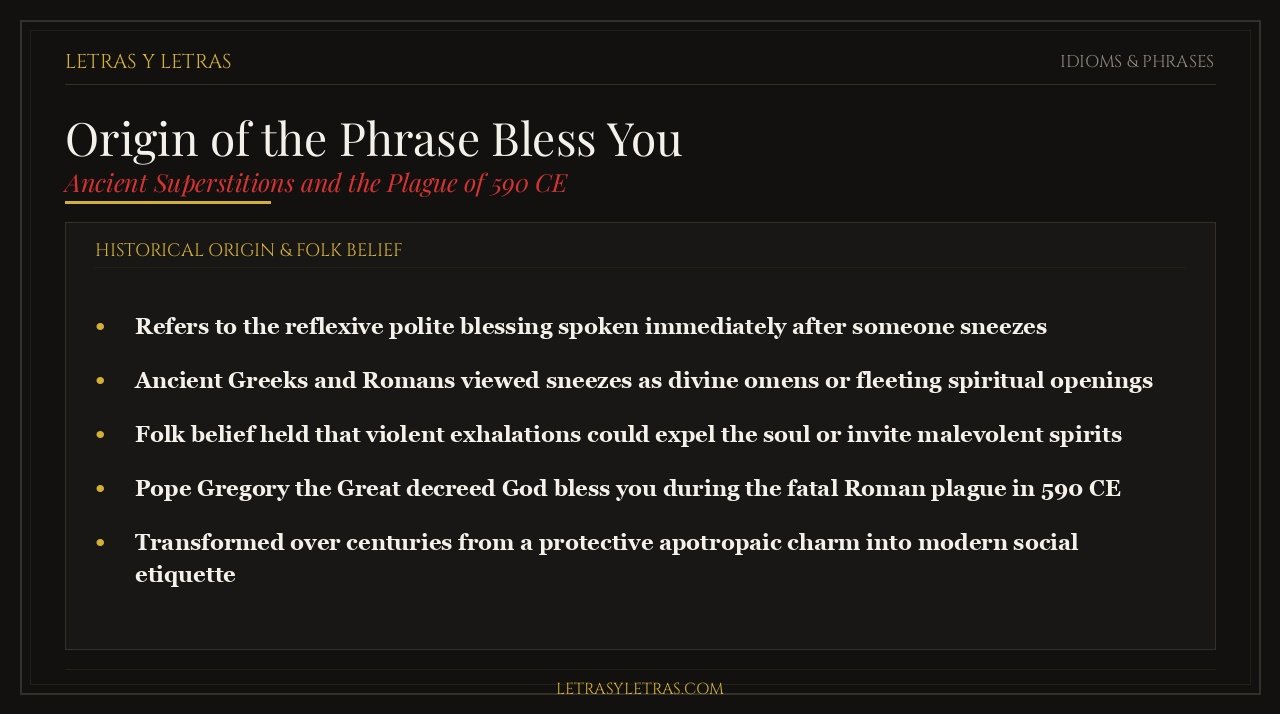
Yet the true origin of the phrase bless you predates modern medicine and germ theory by millennia. Ancient civilizations viewed sneezing as an ominous event involving wandering souls and invisible spirits. Pope Gregory the Great later codified the prayer during a deadly Roman plague in 590 CE.
Quick Answer: Origin of the Phrase Bless You
The phrase bless you originated from ancient spiritual beliefs combined with medieval public health crises. Early societies believed a sneeze could expel the human soul or invite malevolent spirits into the body. In 590 CE, a deadly plague swept through Rome, killing Pope Pelagius II. Newly elected Pope Gregory the Great ordered citizens to pray God bless you immediately whenever anyone sneezed. Sneezing was a fatal early symptom of respiratory plague, making the blessing a literal plea for divine survival. Over centuries, the phrase shifted from a protective religious spell into secular social etiquette.
Key Takeaways
- Serves today as a polite secular reflex after someone sneezes.
- Traces back to ancient beliefs that breath contained the living human soul.
- Pope Gregory the Great decreed the prayer during the fatal 590 CE Roman plague.
- Sneezing was considered an early symptom of sudden pneumonic death in antiquity.
- Modern cardiology disproves the common myth that the heart stops during a sneeze.
The Modern Reflex: Polite Etiquette in a Secular World
Modern etiquette considers blessing a sneezing neighbor an essential civic habit. When someone coughs or hiccups, bystanders remain silent and mind their own business. Yet a single sneeze prompts an immediate verbal response from complete strangers.
Failing to offer the customary blessing can feel strangely rude in close quarters. We treat the gesture as a gentle verbal band-aid, reassuring the sneezer that their loud bodily outburst caused no offense. The reflex smooths social friction in crowded urban spaces.
Most speakers repeat the phrase without considering its religious or historical heritage. We treat it as secular manners rather than a theological invocation. It represents an instinctual ritual of shared human empathy.
Research in the Merriam-Webster dictionary defines bless you as good wishes offered after a sneeze. The entry notes that modern usage serves as standard social politeness. Contemporary dictionaries reflect centuries of gradual cultural transformation.
To understand why this single bodily function demands a verbal prayer, we must travel back to classical antiquity. Ancient Mediterranean cultures viewed human breath through a mystical lens. A sudden sneeze was seen as a divine message from otherworldly forces.
Ancient Omens: Sneezes as Divine Prophecies in Greece and Rome
In classical Greece, a sneeze was interpreted as an augury sent directly by Olympian gods. Philosophers and military commanders monitored involuntary sneezes for signs of divine approval or impending disaster. The violent expulsion of air seemed too forceful to be purely accidental.
Historians record that the Athenian general Xenophon delivered an impassioned speech to his troops before battle. A soldier in the ranks sneezed loudly during a pause in Xenophon remarks. The entire army interpreted the sound as a favorable sign from Zeus and cheered with renewed bravery.
Greeks responded to sneezes with the protective blessing zeu soson, meaning may Zeus save you. Roman citizens adopted a similar custom, greeting sneezers with salve, meaning be healthy, or absit omen, meaning avert the omen. Romans viewed sneezes as fateful portents that required immediate verbal defense.
Roman naturalists like Pliny the Elder wrote about the universal custom of acknowledging sneezes. Pliny observed that even emperors observed the ritual with solemn respect. He questioned why society felt an urgent psychological need to salute involuntary sneezes.
The answer lay deep inside ancient spiritual beliefs about human anatomy. To classical thinkers, human breath was not merely oxygen and carbon dioxide. Breath was the physical vessel of the immortal human spirit.
The Expelled Soul: Ancient Fears of Spiritual Vulnerability
Ancient folklore across Europe, Asia, and the Middle East identified breath with the vital life force. In Latin, the noun spiritus signified both physical breathing and the immortal soul. Similarly, Greek pneuma carried the identical dual meaning of breath and spiritual essence.
Because the soul resided in the lungs and chest, a sudden violent sneeze posed severe spiritual danger. Early folk beliefs held that an explosive exhalation might blow the soul out of the body entirely. If the spirit escaped into the surrounding room, the person might die on the spot.
A companion superstition warned of demonic possession during that fleeting split-second opening. While the mouth was open and the lungs emptied, malevolent spirits could slip inside the defenseless body. Demons were thought to lurk in shadow, waiting for an opportunity to claim an unprotected soul.
Uttering a blessing served as an immediate apotropaic charm to seal the physical vessel. Calling upon divine protection created a spiritual shield that kept the soul inside and repelled evil spirits. The spoken blessing was a serious magical defense against supernatural harm.
These ancient spiritual fears established the behavioral template for acknowledging sneezes. However, an actual biological catastrophe during the early Middle Ages transformed the folk custom into official papal law. That turning point arrived with the devastating Roman epidemic of 590 CE.
Pope Gregory the Great: The Roman Plague of 590 CE
In the spring of 590 CE, catastrophic disaster struck the city of Rome. Severe floods from the Tiber River had drowned surrounding farmlands, destroying grain supplies and breeding disease. Soon, a virulent outbreak of bubonic and pneumonic plague erupted across the crowded streets.
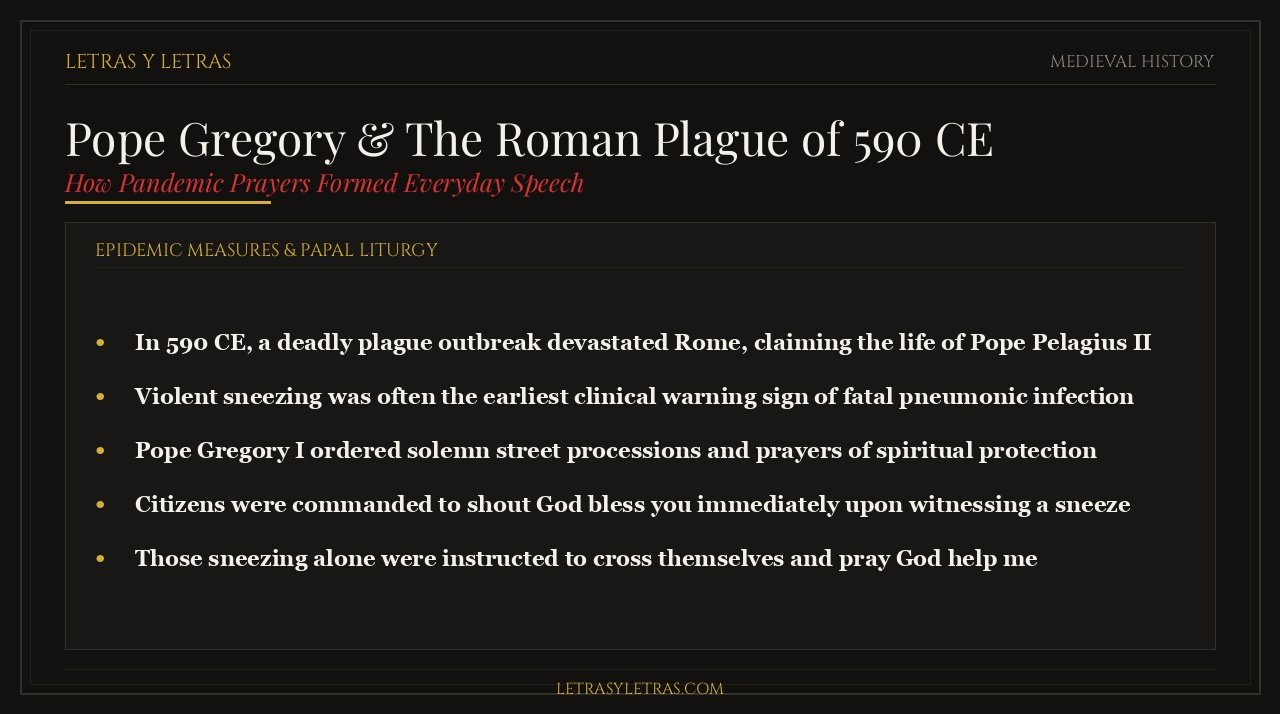
The Britannica biography of Saint Gregory records that plague killed Pope Pelagius II in 590 CE. Panic gripped the Roman population as healthy citizens collapsed and died within hours. Newly elected Pope Gregory I faced an apocalyptic humanitarian crisis.
Pneumonic plague attacked the respiratory system with terrifying speed and lethal efficiency. Victims suffered severe chest pain, coughing spells, and violent bouts of explosive sneezing. In many clinical cases, an unexpected sneeze was the earliest sign that fatal infection had taken hold.
Pope Gregory decreed seven solemn litanies and organized massive penitential processions through Rome. The pontiff ordered citizens to recite continuous prayers for divine mercy. Among his specific pastoral decrees was a mandatory command regarding sneezes.
Gregory instructed that anyone who heard a neighbor sneeze must immediately shout Deus te benedicat, meaning God bless you. The phrase was a desperate deathbed prayer for someone facing imminent mortality. For those sneezing alone, the pope instructed them to cross themselves and pray God help me.
The Heart Stopping Myth: Modern Physiology Versus Folk Belief
Alongside plague history, another pervasive folk legend claims that human hearts stop beating during a sneeze. According to this popular misconception, the blessing celebrates a person miraculous return from momentary clinical death. Generations of parents have passed this colorful biological tale down to their children.
Scientific analysis in the Library of Congress science archives completely debunks the stopped-heart theory. Cardiologists explain that the heart electrical system continues uninterrupted throughout a sneeze. The sinus node never ceases generating electrical impulses.
However, the physical sensation that inspired this myth has a genuine medical foundation. Before sneezing, a person takes a deep involuntary breath and closes their vocal cords. This rapid action creates enormous intrathoracic pressure inside the chest cavity.
The sudden spike in pressure briefly constricts blood flow returning to the heart. When the sneeze erupts, pressure plummets and blood surges back, causing the next heartbeat to feel unusually heavy. This subtle rhythm variation creates an illusion that the heart skipped a beat.
While physiology explains the physical sensation, the myth persists in popular imagination. People love dramatic explanations for everyday bodily quirks. Even without a stopping heart, sneezing remains a remarkable physical phenomenon that commands public attention.
Cross-Cultural Traditions: Gesundheit, Salud, and Global Courtesy
The impulse to respond to a sneeze is not unique to English-speaking nations. Nearly every human culture maintains a dedicated verbal response for this reflexive bodily eruption. Comparing these international traditions reveals fascinating cultural values.
In German-speaking countries, people respond with Gesundheit, which translates literally to health. German culture prioritized physical wellness over theological appeals, wishing the sneezer strong bodily vitality. English speakers frequently borrow Gesundheit as a secular alternative to religious blessings.
Romance languages focus on similar themes of vitality and longevity. In Spain and Latin America, people say Salud, meaning health, or invoke Jesús for spiritual protection. Italian speakers exclaim Salute, while French speakers say à vos souhaits, meaning to your wishes.
Islamic tradition prescribes a beautiful reciprocal exchange after a sneeze. A Muslim who sneezes says Alhamdulillah, praising God for clearing nasal passages. Bystanders respond with Yarhamukallah, praying that God grants mercy, while the sneezer replies with prayers of peace.
These global parallels demonstrate that sneezing evokes a universal human instinct for solidarity. By invoking God, health, or good fortune, communities surround the sneezer with goodwill. The custom unites diverse civilizations across centuries.

The Medieval Apotropaic Charm: Warding Off Demonic Incursion
During the European Middle Ages, the papal blessing merged with superstitious folklore about the supernatural. Medieval peasants lived in constant fear of demonic interference in daily life. Illness, crop failure, and sudden accidents were blamed on unseen malevolent entities.
The sneeze was considered a moment of acute physical and spiritual vulnerability. When an individual sneezed, their eyes closed instinctively and their body convulsed. Folk superstition held that a person defenses dropped completely during that brief sensory blackout.
Demons were believed to circle overhead like invisible birds of prey. Folk storytellers warned that an evil spirit could enter an open mouth before the sneezer caught their breath. Without an immediate holy countermeasure, the victim could become possessed or cursed.
Saying God bless you functioned as an apotropaic charm that repelled demonic forces instantly. The holy name created a barrier that no demon could cross. Medieval Christians believed the verbal blessing saved souls from eternal spiritual ruin.
Over successive generations, the religious intensity of the custom began to soften. As scientific discovery explained infectious disease, demons faded from medical textbooks. Yet the linguistic habit remained firmly embedded in conversational English.
Chronological Milestones in the History of the Phrase
The table below outlines key milestones in the evolution of sneeze blessings from ancient antiquity to modern global society:
| Historical Era | Cultural Milieu | Sneeze Perception | Linguistic Response |
|---|---|---|---|
| 800 BCE to 300 BCE | Classical Greece | Divine omens and prophecies from Zeus | Greeks invoke zeu soson to seek divine favor and avert misfortune. |
| 100 BCE to 200 CE | Roman Republic and Empire | Fateful signs requiring greeting | Romans greet sneezers with salve and absit omen as polite civic duty. |
| 590 CE | Plague of Rome | Fatal early symptom of pneumonic plague | Pope Gregory I decrees Deus te benedicat as mandatory emergency prayer. |
| 1347 to 1400 | Black Death in Medieval Europe | Demonic vulnerability and mortal terror | Christian communities use God bless you as protective apotropaic charm. |
| 1800s | Victorian Etiquette Manuals | Formal social manners and public decorum | Phrase shortens to bless you, transitioning toward modern secular courtesy. |
| 21st Century | Global Modernity | Involuntary biological reflex | Universal reflex of civic politeness, empathy, and social connection. |
Debunking Common Myths About Bless You
Because folk etymology thrives on dramatic legends, several misconceptions surround the sneeze blessing. Examining historical and scientific records dispels three prominent myths:
The primary myth claims that your heart completely stops beating during a sneeze. Clinical cardiology confirms that electrical heart activity continues without pausing. Pressure fluctuations may alter pulse sensation, but the heart never stops.
A second myth asserts that sneezing with open eyes causes eyeballs to pop out of sockets. Human optical anatomy firmly anchors the eyes within bony cranial orbits. Eyelids close instinctively to prevent expelled droplets from entering the eyes.
A third myth claims the nursery rhyme Ring Around the Rosie originated the custom of blessing sneezes. Folklorists have demonstrated that the rhyme dates only to Victorian England, long after the plague had vanished. The blessing predated the children rhyme by more than a thousand years.
We observed similar mythological stories corrected in our peanut gallery analysis. Popular imagination frequently substitutes colorful urban legends for authentic historical facts.
The Psychology of Social Courtesy, Empathy, and Shared Vulnerability
Why does the custom of blessing a sneeze endure in an increasingly secular and scientific era? The answer lies in the psychological dynamics of sudden bodily vulnerability. A sneeze is an explosive biological reflex that strips away outward composure in public.
For a brief second, the person loses control over their facial muscles, breath, and posture. By offering a polite blessing, bystanders acknowledge that involuntary moment with warmth and reassurance. The gesture restores dignity to the sneezer and reaffirms social bonds.
Maintaining personal discipline and observing considerate speech in shared environments creates peaceful communities. Explore timeless reflections on mental resolve in our curated quotes on discipline collection. Thoughtful speech builds social cohesion.
Resolving unexpected tensions and treating neighbors with gentleness prevents unnecessary civic discord. Learn how ancient peacemakers forged enduring treaties in our origin of the phrase bury the hatchet guide. Empathy strengthens community harmony.
Authentic social gestures reflect pure human concern without superficial affectation. Discover classical definitions of honesty in our origin of the word sincere investigation. Genuine courtesy springs from selfless regard for others.
Societies throughout history established strict public health boundaries to protect citizens from infectious contagion. Trace Venetian plague galleys and forty days of isolation in our origin of the word quarantine study. Organized community defense shields human life.
Careless words and unthinking disclosures can unravel delicate social trust in an instant. Learn how medieval market scams created a proverb in our let the cat out of the bag guide. Guarding personal speech preserves mutual respect.
Civil authorities also created evening safety decrees to prevent crime and domestic accidents across centuries. Discover medieval evening safety decrees and curfew bells in our origin of the word curfew investigation. Clear social boundaries preserve civilization.
Decisive strategic choices often require cutting off all possibility of retreat. Learn how ancient military commanders forged unyielding courage in our origin of the phrase burning bridges guide. Bold commitment shapes human history.
Commercial dishonesty and counterfeit goods have invited public retribution across world history. Discover how medieval bread statutes created a buffer loaf in our origin of the phrase bakers dozen analysis. Honest standards protect communities from exploitation.
Catastrophic crises have repeatedly tested human resilience and economic systems across history. Examine celestial omens and astrological grief in our origin of the word disaster reflection. Facing unexpected trials demands steady wisdom.
Bodily vitality and physical resilience inspired rich anatomical vocabulary across the ancient world. Explore classical Roman anatomy and rodent metaphors in our origin of the word muscle analysis. Physical strength must always serve social harmony.
Sudden illness and biological vulnerability also remind us of fragile human mortality. Examine maritime naval history and seasickness in our origin of the phrase under the weather reflection. Weathering hardship requires patient endurance.
Overcoming destructive physical dependencies often requires swift, unhesitating willpower. Discover how withdrawal medicine forged a universal idiom in our origin of the phrase cold turkey guide. Enduring adversity leads toward renewal.
Superstition and historical biases also shaped European linguistic perceptions of human action. Examine Roman augury and directional omens in our origin of the word sinister review. Words carry surprising shadows from antiquity.
Social protests and organized resistance have repeatedly challenged unfair hierarchies across history. Discover how Irish tenants united against oppressive landlords in our origin of the word boycott history. Collective solidarity reshapes unjust social systems.
Social recreation and festive tavern culture also produced vibrant colloquial expressions over time. Trace equestrian horse racing and cocktail recipes in our origin of the word cocktail history. Communal traditions reflect complex human rituals.
Frequently Asked Questions
Why do people say bless you when you sneeze?
People say bless you due to ancient soul beliefs and medieval plague prayers instituted in 590 CE.
Did Pope Gregory the Great start the phrase bless you?
Yes, Pope Gregory I decreed God bless you during the 590 CE Roman plague as a prayer for survival.
Does your heart really stop when you sneeze?
No, your heart never stops beating during a sneeze, although chest pressure changes can make the rhythm feel slightly different.
What did ancient Greeks say when someone sneezed?
Ancient Greeks said zeu soson, meaning may Zeus save you, believing a sneeze was an omen from the Olympian gods.
What is the difference between bless you and Gesundheit?
Bless you is an English religious appeal, while German Gesundheit wishes physical health without theological reference.
Is it considered rude not to say bless you?
In many Western cultures, acknowledging a sneeze is standard polite etiquette, though modern secular settings consider it optional.
Alan Sledge is the lead writer at letrasyletras.com, uncovering historical wisdom and word origins.


Alan Sledge is the writer and founder behind Letters & Letters. A lifelong lover of words, Alan has always been drawn to the small mysteries hidden in everyday language, why we say what we say, where our favorite sayings came from and the quotes that manage to put feelings into words better than we ever could ourselves.