
Human beings have wrestled with discontent for thousands of years. We frequently overlook our present blessings while chasing future desires. Finding true peace requires a deliberate shift in our daily attention.
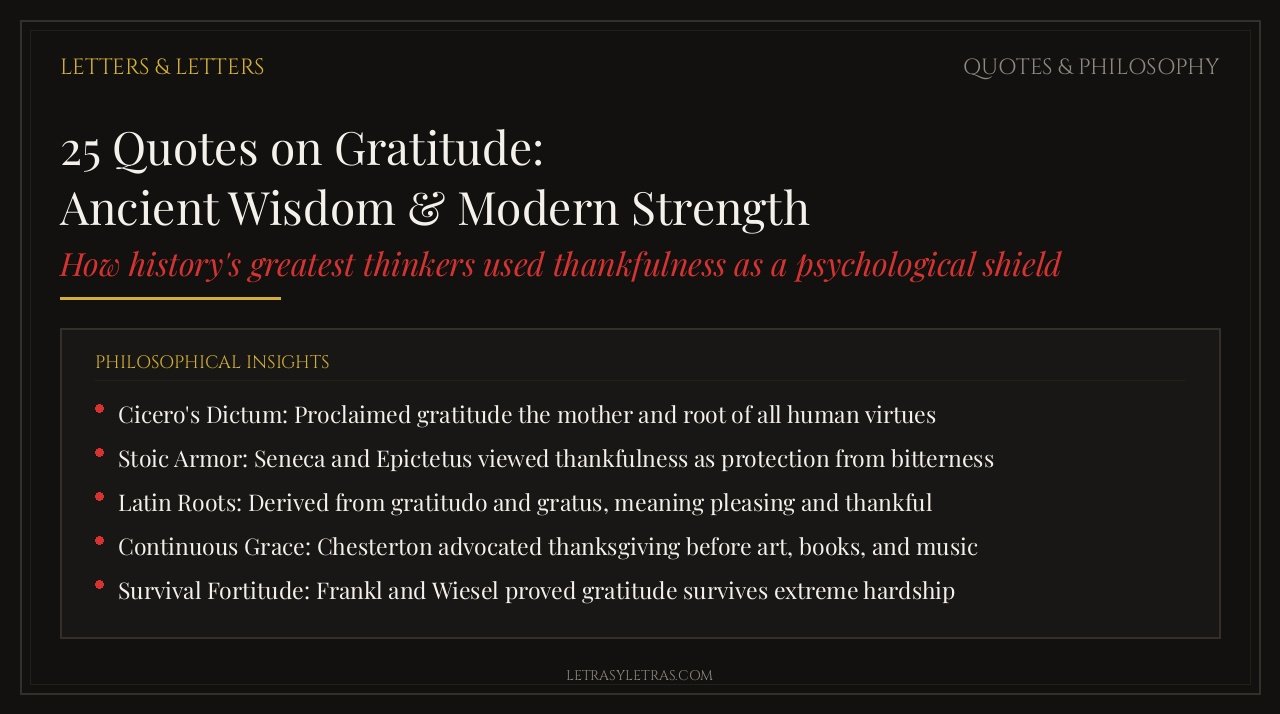
The finest thinkers in history treated thankfulness as a psychological shield. Here are 25 verified quotes on gratitude to strengthen your character and cultivate peace. These historical insights show how ancient leaders and modern writers turned thankful awareness into lasting strength.
As an essayist writing at Alan Sledge, I study how ancient words shape modern thinking. When you read classical texts, you notice something striking. The greatest minds never viewed thankfulness as polite weakness, but as fierce mental discipline.
Quick Answer: The Meaning and Power of Gratitude
The word gratitude traces to Latin gratitudo, coming from gratus, meaning pleasing, agreeable, and thankful. Classical philosophers like Cicero and Seneca viewed thankfulness as the foundation of civic honor and inner strength. Practicing active appreciation shields the mind against bitterness, fosters contentment, and provides stability during severe adversity.
Key Takeaways
- Cicero classified thankfulness as the parent virtue from which all other human virtues spring.
- Roman Stoics used thankfulness as a psychological barrier against bitterness and envy.
- The English noun entered Middle English during the 15th century through Old French.
- Modern concentration camp survivors verified that gratitude provides vital mental fortitude during trauma.
- True thankfulness is an active cognitive discipline rather than a fleeting emotional reaction.
Classical Antiquity and the Stoic Fortress
Ancient Rome and Greece produced profound reflections on human nature. Roman statesmen recognized that ungrateful citizens destroyed social bonds. They studied how thankful minds resisted tyranny and sudden misfortune.
Philosophers like Seneca and Marcus Aurelius treated daily appreciation as vital mental training. They reflected on death to sharpen their appreciation for life. Exploring authentic marcus aurelius quotes shows how the emperor began each dawn with thanksgiving.
1. “Gratitude is the greatest of virtues and the mother of all others.” (Cicero, Pro Plancio)
The Roman statesman argued that all moral integrity flows from a thankful spirit. Without thankfulness, courage turns selfish and justice becomes cold calculation. Roman society recognized this virtue as the glue of civic trust.
2. “A grateful person is rich in satisfaction. The ungrateful man suffers perpetual poverty.” (Seneca, De Beneficiis)
The Stoic philosopher wrote seven full books examining social generosity and gratitude. Greedy individuals never enjoy what they hold. Their refusal to appreciate present gifts keeps them spiritually destitute.
3. “He is wise who grieves not for what he lacks, but rejoices for what he has.” (Epictetus)
The former slave taught philosophy in Greece after gaining his freedom. Longing for unattainable things guarantees constant misery. True freedom begins by celebrating the simple possessions already in hand.
4. “When you arise in the morning, think of what a precious privilege it is to be alive.” (Marcus Aurelius)
The emperor began his personal journal by thanking his tutors, friends, and family. Nature granted him another dawn to serve his fellow citizens. That grateful attitude preserved his sanity during plague and frontier warfare.
5. “The ungrateful man is like a leaky vessel which retains nothing good.” (Plutarch, Moralia)
The Greek biographer warned that toxic cynicism ruins every pleasant encounter. Generosity poured into an unthankful heart disappears without a trace. Keeping your mind clear protects your capacity to receive love.

The Linguistic Evolution of Gratitude
Examining the vocabulary of thankfulness enriches our emotional life. The Latin root gratus gave rise to dozens of modern European terms. It shares deep connections with grace, graciousness, and gratuitous acts of kindness.
Linguists trace the term through the Merriam-Webster dictionary entry to ancient roots. The word moved from church Latin into 14th-century French courtly prose. English scribes adopted the noun around 1430 to describe civic loyalty and religious reverence.
| Historical Period | Leading Thinker | Core Philosophy and Legacy |
|---|---|---|
| Classical Rome (54 BC) | Cicero | Identified gratitude as the supreme foundation supporting all civic virtue and justice. |
| Imperial Rome (65 AD) | Seneca the Younger | Described thankfulness as an inner fortress protecting the soul from insatiable greed. |
| Renaissance England (1591) | William Shakespeare | Portrayed ingratitude as a monstrous wound that corrupts friendships and destroys royal kingdoms. |
| Romantic Era (1854) | Henry David Thoreau | Advocated continuous sensory mindfulness and appreciation for the natural living world. |
| Post-War Era (1946) | Viktor Frankl | Demonstrated that intentional gratitude preserves psychological survival amidst extreme human cruelty. |
Renaissance and Enlightenment Wisdom
During the Renaissance, writers revived classical texts with tremendous energy. Playwrights and essayists used the stage to condemn ungrateful rulers. They celebrated genuine thankfulness as proof of a noble soul.
Early modern thinkers understood that human connection requires reciprocal appreciation. Studying quotes on humility reveals that thankfulness and modesty walk hand in hand. Arrogant personalities cannot feel grateful because they believe they are owed everything.
6. “O Lord that lends me life, lend me a heart replete with thankfulness.” (William Shakespeare)
The playwright repeatedly contrasted royal ambition with simple human thankfulness. In his tragedies, ungrateful children cause terrible ruin. A humble, grateful heart remains humanity’s safest refuge.
7. “I speak to paper as to the first person I meet, thankful for the listening ear.” (Montaigne)
The French author invented the modern personal essay inside his quiet country tower. Every honest conversation served as a gift worth recording. His writing reminds us to value ordinary connections and attentive friends.
8. “A free man thinks of death least of all; his wisdom is a meditation on life.” (Spinoza)
The Dutch philosopher lived with great simplicity while grinding optical lenses in Amsterdam. He rejected bitter theological disputes in favor of joyous reason. True wisdom celebrates existence itself with profound, quiet reverence.
9. “Gratitude bestows reverence, allowing us to encounter everyday epiphanies.” (John Milton)
The English poet composed his greatest verses after losing his sight completely. Even in physical darkness, he maintained deep reverence for inspiration. His disciplined mind found sacred wonder in invisible thoughts.
10. “Gratitude is a fruit of great cultivation; you do not find it among gross people.” (Samuel Johnson)
The famous lexicographer knew that natural human instincts lean toward entitlement. Refining your character requires constant effort and polite self-restraint. Only thoughtful individuals take time to notice and thank their benefactors.

Nineteenth-Century Philosophy and Transcendentalist Wonder
The nineteenth century brought industrial factories and rapid urban growth. Thinkers feared that mechanization would strip wonder from daily life. They urged readers to slow down and notice the natural world.
Transcendentalists believed that the universe provides endless reasons for wonder. Our archive of famous quotes and quotations shows how these authors transformed everyday routines into spiritual exercises. They discovered that joy lives in the present moment.
11. “Cultivate the habit of being grateful for every good thing that comes to you.” (Ralph Waldo Emerson)
The American essayist viewed thankfulness as a daily habit rather than a sudden feeling. When we practice noticing kindness, our visual perspective changes completely. Small blessings suddenly multiply in front of our eyes.
12. “I am grateful for what I am and have. My thanksgiving is perpetual.” (Henry David Thoreau)
The naturalist spent two years at Walden Pond living in a small wooden cabin. He reduced his material wants to experience pure sensory freedom. His daily journal shows that true wealth is measured in hours of peace.
13. “I say grace before the concert and the play, and grace before I open a book.” (G.K. Chesterton)
The English critic argued that modern people take artistic beauty for granted. We should thank artists just as we thank cooks for nourishing meals. A brilliant novel or lively symphony deserves sincere appreciation.
14. “The essence of all beautiful art, all great art, is gratitude.” (Friedrich Nietzsche)
The German thinker often criticized conventional morality, yet he revered genuine praise. Great creators produce art out of abundant joy and vitality. True masterpieces are monuments of thanksgiving for human passion.
15. “Reflect upon your present blessings, of which every man has many.” (Charles Dickens)
The Victorian novelist exposed the harsh poverty of London with fierce sympathy. His holiday stories remind readers to count their blessings every winter. Looking at what remains helps people survive bitter grief.
Modern Endurance, Resilience, and Moral Survival
The twentieth century inflicted unprecedented wars and political persecution upon the world. Ordinary people faced catastrophic losses of family, liberty, and home. In those dark moments, thankful reflection became an act of moral rebellion.
Survivors discovered that captors could seize their physical bodies but not their minds. Exploring historical quotes on perseverance proves that gratitude and stamina share identical roots. Choosing appreciation over hatred preserves our essential humanity.
16. “Everything can be taken from a man but one thing: the last of human freedoms.” (Viktor Frankl)
The Austrian psychiatrist survived Nazi concentration camps through extraordinary inner discipline. Prisoners who clung to memories of love showed greater resilience. Gratitude for a single mountain sunset sustained a starving man’s will to live.
17. “In ordinary life we receive far more than we give; gratitude makes life rich.” (Dietrich Bonhoeffer)
The German pastor wrote profound theological letters while awaiting execution for opposing totalitarian rule. Inside a military cell, he expressed radiant gratitude for his friends. Life becomes rich only when we acknowledge our debts to others.
18. “When a person doesn’t have gratitude, something is missing in his or her humanity.” (Elie Wiesel)
The Nobel laureate spent decades bearing witness to the horrors of the concentration camps. He insisted that thankfulness is the only adequate response to survival. Ignoring the kindness of others gradually hardens the human heart.
19. “This is a wonderful day. I have never seen this one before.” (Maya Angelou)
The celebrated writer endured severe childhood trauma and racism before becoming an acclaimed poet. Her daily joy was a deliberate, courageous choice. She welcomed every sunrise as an unrepeatable miracle.
20. “We ought to give thanks for all fortunes: both the pleasant and the severe.” (C.S. Lewis)
The British scholar advised thanking providence for both restful days and painful lessons. Easy days provide necessary rest, while struggles teach us patience. This balanced outlook removes terror from unpredictable events.
Daily Practice, Humility, and Quiet Abundance
Gratitude does not require wealth, fame, or dramatic adventures. It thrives in quiet kitchens, morning walks, and honest handshakes. Everyday life offers hundreds of unnoticed opportunities to say thank you.
Many popular english idioms and meanings reflect this ancient desire for balance. When we speak kindly to neighbors, we reinforce social trust. These final five sayings celebrate the quiet beauty of ordinary hours.
21. “Gratitude turns what we have into enough, and more.” (Melody Beattie)
The modern author helped millions of readers overcome chronic emotional distress. She demonstrated that appreciation transforms plain meals into feasts. Contentment arrives when you value what exists rather than craving more.
22. “At times our light goes out, rekindled by a spark from another person.” (Albert Schweitzer)
The humanitarian physician gave up fame as an organist to practice medicine in Africa. He reminded supporters that no one succeeds entirely alone. We should always remember the mentors who revived our fainting spirits.
23. “Dance till the stars come down from the rafters.” (W.H. Auden)
The celebrated poet captured the urgent joy of finite human existence. Life is short, fragile, and filled with unexpected sorrow. Celebrating our brief time on earth is the highest form of praise.
24. “Let us be grateful to the people who make us happy.” (Marcel Proust)
The French novelist described affectionate friends as charming gardeners of the human soul. They tend to our emotional wounds with patience and gentle humor. Remembering their devotion fills quiet evenings with warmth.
25. “Where there is great love, there are always miracles.” (Willa Cather)
The American novelist chronicled prairie pioneers’ grit with deep respect. Affection and thankfulness create wonders in barren landscapes. Loving your community generates abundance out of thin air.
Debunking Misattributed Gratitude Quotes
The internet frequently misattributes inspiring sayings to ancient icons. Quotes about gratitude are especially prone to creative mislabeling. Many viral memes credit ancient Greek fables or religious figures without historical evidence.
Social media frequently claims that Buddha told followers to rise and be thankful. Classical archives at the Stanford Encyclopedia of Philosophy find no trace of this phrase in the early Pali Canon. The text actually originated in a twentieth-century devotional booklet.
Similarly, viral posts attribute the phrase about gratitude turning what we have into enough to Aesop. Greek fable collections in the Perseus Digital Library contain no such line. Author Melody Beattie published that exact sentence in 1990.
Frequently Asked Questions
What is the most famous quote about gratitude?
Cicero’s statement that gratitude is the parent of all virtues remains the most famous historical quote. It has been cited by philosophers and historians for over two thousand years.
What did the Roman Stoics say about gratitude?
Stoics like Seneca and Epictetus viewed thankfulness as active psychological training. They used daily appreciation to protect their minds against envy, grief, and destructive anger.
How does practicing gratitude improve mental health?
Regular appreciation shifts cognitive focus away from perceived deficiencies toward existing resources. Modern clinical studies confirm that daily gratitude exercises reduce anxiety and improve sleep quality.
What is the etymological origin of the word gratitude?
The word comes from the Latin noun gratitudo, which derives from gratus, meaning pleasing or thankful. It entered the English language during the 15th century by way of Old French.
Alan Sledge is the lead writer at letrasyletras.com. He uncovers the true historical origins behind our favorite words and quotes.


Alan Sledge is the writer and founder behind Letters & Letters. A lifelong lover of words, Alan has always been drawn to the small mysteries hidden in everyday language, why we say what we say, where our favorite sayings came from and the quotes that manage to put feelings into words better than we ever could ourselves.