

Modern culture talks constantly about toxic personalities, self-absorption, and vanity. We see social media feeds filled with amateur diagnoses and relationship warnings. Yet few people investigate where this famous label actually originated.
The true origin of the word narcissist is far stranger than simple vanity. It began as an ancient Greek cautionary tale of numbness, grief, and divine retribution. Long before modern psychologists created diagnostic manuals, ancient poets explored the fatal trap of loving your own shadow.
As an essayist exploring word histories at Alan Sledge, I love unearthing forgotten roots. When you examine the Greek vocabulary, you discover a shocking surprise. The word for a self-obsessed individual shares its exact linguistic parent with powerful narcotic drugs.
Quick Answer: Where Does the Word Narcissist Come From?
The word narcissist originates from the mythical Greek hunter Narcissus, famously recorded in Ovid’s Metamorphoses in 8 AD. His name derives from the Greek noun narke, meaning numbness, stupor, or deadening paralysis. Havelock Ellis introduced Narcissus-like into psychology in 1898, before Sigmund Freud popularized the clinical concept in 1914.
Key Takeaways
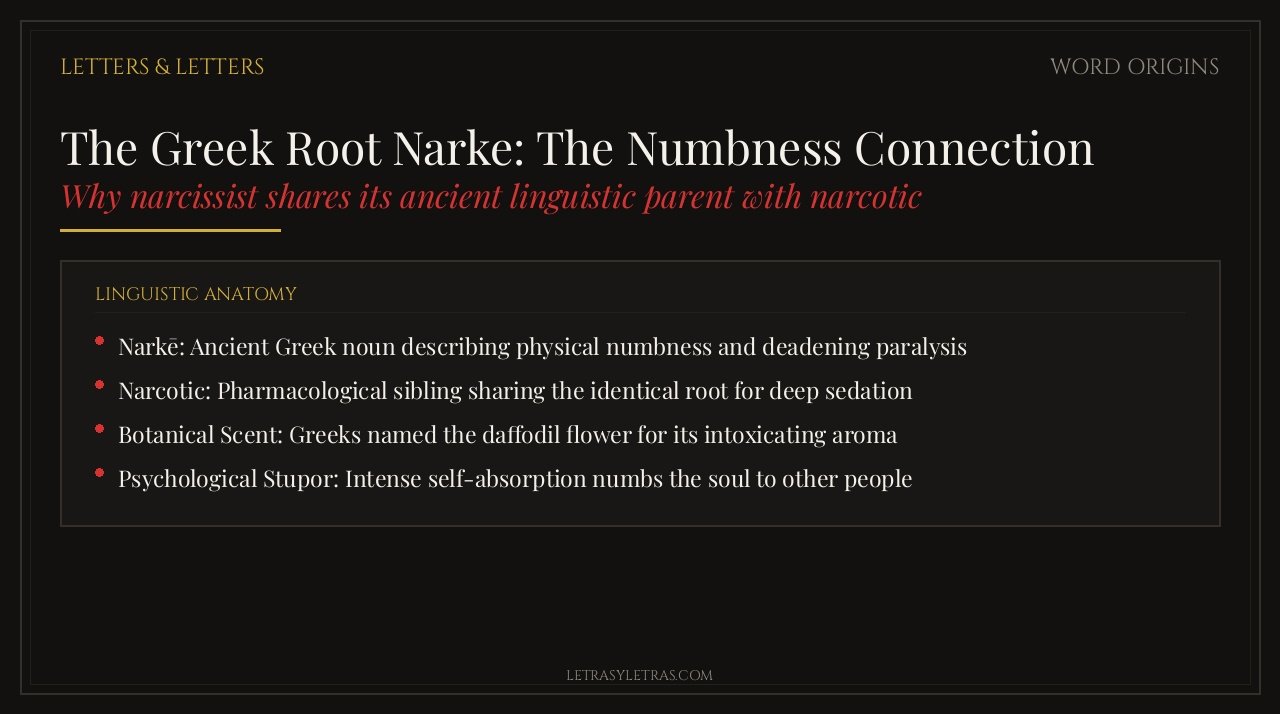
- The Greek root narke signifies numbness and physical stupor, the same parent root behind modern narcotic.
- Botanical history reveals that the intoxicating narcissus flower was named centuries before the mythological youth.
- Roman poet Ovid cemented the famous legend of Echo and Narcissus in Book III of his Metamorphoses.
- British physician Havelock Ellis first applied the myth to psychological self-absorption in 1898.
- Sigmund Freud formalized the term in 1914, transforming a mythical punishment into modern clinical theory.
The Greek Root Narkē: The Numbness Connection
Most people assume that narcissism has always described physical beauty and shallow pride. But classical philologists look deeper into ancient Greek linguistic roots. The name traces directly to the Greek noun narkē, meaning numbness, paralysis, or deadness.
This ancient root gave the medical world words like narcolepsy and narcotic. It described anything that caused physical senses to fall into heavy slumber. You can verify this connection in the Merriam-Webster dictionary etymological records.
Greeks applied the name to the spring daffodil because of its intoxicating aroma. Ancient herbalists believed that smelling the flower caused intense drowsiness and dullness. The plant possessed strong alkaloids that could stun nerves and deaden pain.
Pliny the Elder noted this medicinal property in his natural history writings. He explained that the plant was named after numbness rather than mythical boys. The connection between beauty and numbness formed the symbolic core of the ancient legend.
Self-absorption creates a profound emotional stupor. Sufferers become blind and deaf to the feelings of other human beings. Classical thinkers captured this psychological blindness through a brilliant botanical metaphor.
Ancient physicians knew that severe numbness precedes physical death. When a limb loses sensation, gangrene or decay often follows. Greek storytellers recognized that emotional numbness destroys the human spirit just as swiftly.
Ovid’s Metamorphoses: Echo, Nemesis, and the Spring
The definitive version of the myth comes from Roman poet Ovid. Writing in 8 AD, Ovid composed his masterpiece Metamorphoses during imperial peace. Book III contains the heartbreaking tragedy of Narcissus and the mountain nymph Echo.
According to Ovid, the blind prophet Tiresias delivered a chilling prophecy at birth. He warned that the beautiful child would live to old age only if he never knew himself. That paradox baffled parents who expected self-knowledge to bring wisdom.
As Narcissus grew into a handsome youth, suitors pursued him relentlessly. He rejected every admirer with cruel arrogance and cold disdain. Among his suitors was Echo, a chatty nymph cursed by the goddess Juno.
Echo had distracted Juno with idle chatter while Jupiter chased other nymphs. As punishment, Juno took away her power of independent speech. She could only repeat the last words spoken by other people.
When Echo encountered Narcissus in the forest, she tried desperately to show love. The proud youth mocked her devotion and fled into deep woods. Brokenhearted, Echo withered away in lonely caves until only her voice survived.
Echo and Narcissus represent two complementary tragedies of human communication. The cursed nymph can only produce sound without substance, while Narcissus pursues an image without body. Both figures perish because they cannot establish reciprocal connection with another human being.
Greek myths frequently punish excessive arrogance, as seen in the origin of the phrase achilles heel. A rejected youth prayed to Nemesis, the goddess of righteous vengeance. Nemesis heard the desperate plea and prepared an ironic punishment.
The goddess guided the exhausted hunter to an untouched forest spring on Mount Helicon. Its water was pure, calm, and glassy as polished silver. Bending down to drink, Narcissus saw his own reflection for the first time.
He mistook the watery image for a lovely water spirit. Narcissus reached out to embrace the phantom, but ripples broke the surface. Unable to touch his beloved, he remained paralyzed beside the silver pool.
Day by day, his physical strength evaporated under the midday sun. He could neither eat nor sleep while gazing at his watery portrait. When death took him, his body vanished and left a fragrant white flower behind.
The Evolution from Mythological Fable to Clinical Diagnosis
How did an ancient Roman tragedy become a clinical psychological disorder? The transformation took nearly two thousand years of literary and medical reinterpretation. Scholars adapted the myth to diagnose the spiritual diseases of their eras.
Examining primary sources in the Perseus Digital Library reveals how medieval monks used the fable. Early Christian writers viewed Narcissus as an emblem of vain worldliness. Medieval sermon writers warned congregations against drowning in selfish earthly pleasures.
| Historical Period | Key Figure / Publication | Conceptual Milestone |
|---|---|---|
| Ancient Rome (8 AD) | Ovid (Metamorphoses) | Establishes the definitive literary tragedy of Echo, Nemesis, and the reflective mountain spring. |
| Renaissance Italy (1374) | Giovanni Boccaccio | Moralizes the fable as an allegory of political hubris and spiritual blindness in classical treatises. |
| Victorian Era (1898) | Havelock Ellis | Coins the phrase Narcissus-like in English sexology to describe self-directed emotional attachment. |
| German Psychiatry (1899) | Paul Näcke | Translates the concept into German as Narcissismus, treating it as an independent clinical condition. |
| Vienna Psychoanalysis (1914) | Sigmund Freud | Publishes On Narcissism, defining primary and secondary self-love as fundamental stages of ego growth. |
| Chicago Psychoanalysis (1971) | Heinz Kohut | Develops self psychology, demonstrating how fragile self-esteem produces compensatory narcissistic rage. |
| American Psychiatry (1980) | APA (DSM-III) | Officially codifies Narcissistic Personality Disorder as a distinct clinical mental health diagnosis. |

From Renaissance Allegory to Victorian Sexology
During the Renaissance, poets rediscovered Ovid’s poetry with passionate excitement. Italian scholar Giovanni Boccaccio analyzed the myth in his encyclopedia of classical deities. He interpreted Narcissus as a warning against intellectual arrogance and moral pride.
English poet John Milton drew upon the myth in his 1667 epic Paradise Lost. In Book IV, Eve awakens and stares into a clear lake, captivated by her reflection. Unlike Narcissus, Eve hears an angelic voice that guides her toward genuine human companionship.
The transition into modern clinical science occurred in late Victorian Britain. In 1898, British physician Havelock Ellis published a pioneering study on autoeroticism. He searched classical literature for a term to describe people consumed by self-admiration.
Ellis described a patient whose emotional life was directed entirely inward. He called this unusual psychological state a Narcissus-like condition. The analogy matched Ovid’s narrative of someone in love with their own image.
One year later, German psychiatrist Paul Näcke coined the formal noun Narcissismus. Näcke translated Ellis’s observations into European psychiatric terminology. European medical journals quickly adopted the new German clinical label.
Greek myth often provides linguistic keys to explore human psychology. Exploring the origin of the word clue shows how mythological threads guided early thinkers through labyrinthine mental problems. Classical allegories gave doctors an enduring medical vocabulary.
Sigmund Freud and the Architecture of the Ego
The real turning point arrived in Vienna in 1914. Sigmund Freud published his landmark essay titled On Narcissism: An Introduction. Freud revolutionized the term by moving beyond simple sexual behavior.
He argued that narcissism is not merely an unusual pathology. Every infant begins life in a state of primary narcissism. Babies direct all mental energy inward toward their own survival and pleasure.
Healthy psychological growth involves directing emotional energy toward external people. Children learn to love parents, partners, and friends. Freud called this outbound emotional investment object-love.
However, traumatic rejections or developmental failures can disrupt this growth. When external relationships cause agony, the ego withdraws its love from others. Freud called this defensive retreat secondary narcissism.
The individual redirects all emotional investment back onto their own persona. Grandiose fantasies emerge to protect against inner fragility and shame. Freud’s essay transformed an ancient Greek fable into a cornerstone of psychoanalysis.
Heinz Kohut and the Discovery of Narcissistic Fragility
Decades after Freud, psychoanalysts made an essential discovery about self-absorption. In 1971, Austrian-American psychoanalyst Heinz Kohut published The Analysis of the Self. Kohut challenged the popular belief that self-absorbed people secretly adore themselves.
Kohut demonstrated that extreme arrogance usually conceals profound emotional emptiness. Children who lack parental warmth develop a damaged, fragile sense of personal worth. To compensate, they construct an impenetrable fortress of superiority.
When reality threatens this fragile illusion, the individual experiences intense shame. Kohut coined the term narcissistic rage to describe their explosive hostility. That clinical insight mirrors Ovid’s tale of a youth unable to bear imperfections.
From the Clinic to the Culture: The Modern Buzzword
During the late twentieth century, American psychiatrists expanded the definition. In 1980, the American Psychiatric Association published the landmark DSM-III manual. For the first time, Narcissistic Personality Disorder received official medical status.
Clinicians identified nine specific diagnostic criteria for the personality disorder. These symptoms included grandiosity, intense entitlement, and chronic lack of empathy. Sufferers demand constant admiration while exploiting social relationships.
Yet popular culture quickly carried the word far beyond clinic walls. Internet commentators frequently label difficult bosses and selfish ex-partners as narcissists.
Our archive of famous quotes and quotations reveals how ancient philosophers anticipated modern selfishness. Ancient writers warned that selfish vanity ruins communities.
Everyday speech frequently turns complex clinical concepts into casual insults. Modern speakers use the label loosely, much like everyday english idioms and meanings drift from their origins. When everyone is called a narcissist, the true clinical nuance fades away.
Debunking Common Myths About the Narcissist Origin
Popular internet articles often repeat inaccurate legends about this famous word. The most common myth claims that ancient Greeks named the flower after the mythical boy. Classical literature and botanical history prove the exact opposite sequence.
Centuries before Ovid composed his poems, Greek hymns celebrated the fragrant narcissus bloom. The Homeric Hymn to Demeter describes the intoxicating flower in ancient religious verse. Storytellers invented the boy to explain an existing intoxicating plant.
Another persistent myth claims that Narcissus fell in love with his personality. In Ovid’s original text, the hunter did not realize he was looking at himself. He believed he was admiring a separate, beautiful water spirit.
His tragedy was not conscious vanity, but profound perceptual deception. Only when a falling tear disturbed the water did the terrible truth dawn.
Scholars at the Stanford Encyclopedia of Philosophy highlight this crucial philosophical distinction. Self-absorption blinds people to their own genuine identity.
Frequently Asked Questions
Who first coined the word narcissist in psychology?
British sexologist Havelock Ellis introduced the term Narcissus-like in an 1898 psychological study. German psychiatrist Paul Näcke followed in 1899 with the formal noun Narcissismus.
What is the literal Greek root of narcissist?
The word stems from the Greek noun narke, meaning numbness, stupor, or deadness. It shares an identical linguistic root with medical terms like narcotic and narcolepsy.
Was the flower named after the mythical boy?
The daffodil plant was actually named long before the mythological story was written. Ancient Greeks named the flower for its heavy, sedative aroma and intoxicating chemical alkaloids.
How did Sigmund Freud define narcissism?
Freud defined narcissism as the psychological direction of emotional energy inward toward the self. He described it as a normal developmental phase that becomes pathological when exaggerated.
Alan Sledge is the lead writer at letrasyletras.com. He uncovers the true historical origins behind our favorite words and quotes.


Alan Sledge is the writer and founder behind Letters & Letters. A lifelong lover of words, Alan has always been drawn to the small mysteries hidden in everyday language, why we say what we say, where our favorite sayings came from and the quotes that manage to put feelings into words better than we ever could ourselves.

Alan Sledge
Alan Sledge is the founder and lead researcher behind Letters & Letters. A lifelong student of linguistic history, he cross-references every word origin, idiom, and quote against primary archival manuscripts, the Oxford English Corpus, and 18th-century print lexicons.