
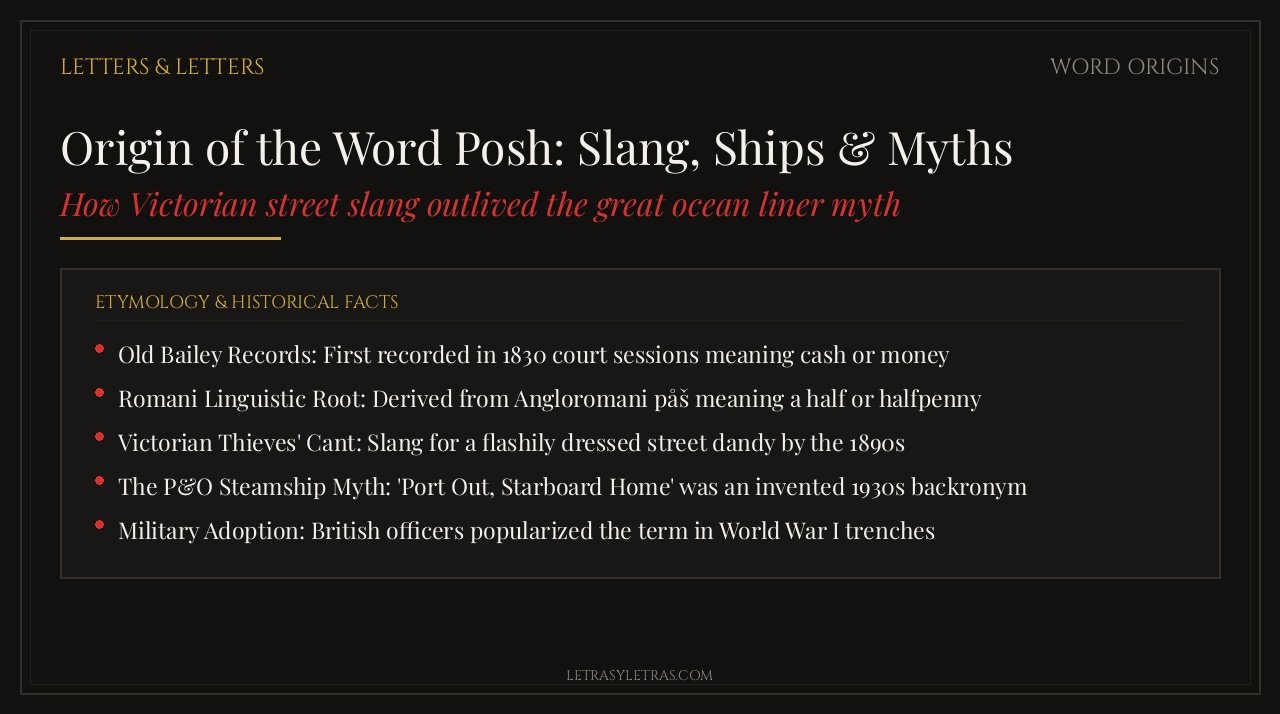
Few words evoke aristocratic privilege and refined British elegance quite like posh. We use it to describe Mayfair townhouses, bespoke suits, and private boarding schools. Yet behind this polished social exterior lies one of the most famous linguistic deceptions in modern history.
Almost everyone has heard the romantic maritime tale of ocean liners traveling to colonial India. Tour guides and trivia books repeat the story with absolute confidence. They insist that wealthy passengers purchased staterooms labeled with a convenient nautical acronym.
The true origin of the word posh has nothing to do with luxury passenger steamships. As an etymology researcher at Alan Sledge, I love unearthing the authentic paper trail behind popular speech. When you dig into Victorian criminal records, the polished surface cracks open to reveal street slang and Romani coins.
Quick Answer: Where Does the Word Posh Come From?
The word posh originated in nineteenth-century British street cant rather than luxury steamship bookings. Linguists trace the term to Angloromani cash slang meaning halfpenny or pocket money. British university students and soldiers later adopted the slang to describe fashionable clothes and stylish living.
Key Takeaways
- The popular acronym Port Out, Starboard Home is an invented twentieth-century backronym without archival proof.
- Extensive searches across historic shipping logs and maritime museum archives found zero tickets stamped POSH.
- The earliest documented English use appears in 1830 Old Bailey court transcripts meaning cash or money.
- Linguists trace the term to Angloromani vocabulary where pash signified a halfpenny coin.
- British soldiers and university students in the early 1900s transformed underground slang into high society vocabulary.
The P&O Steamship Legend: Port Out, Starboard Home
To understand the real history, we must first examine the seductive legend. During the height of the British Empire, travelers sailed regularly between London and Bombay. The Peninsular and Oriental Steam Navigation Company operated the primary passenger route across the Mediterranean and Indian Ocean.
According to folklore, the voyage through the Red Sea was notoriously scorching. Ships lacked modern air conditioning or electric fans to cool cramped wooden cabins. Wealthy colonial administrators and merchants sought every possible relief from the blistering tropical heat.
The sun traveled south of the vessel during both legs of the maritime transit. Experienced travelers realized that port cabins on the outward voyage stayed cooler in afternoon shade. On the return trip home to Britain, starboard cabins received the same comforting protection.
Storytellers claim that privileged passengers paid premium fares to secure these shaded quarters. Shipping clerks supposedly stamped tickets with letters reading P.O.S.H. The four letters stood for Port Out, Starboard Home.
This charming explanation spread across dinner parties, memoirs, and travel guides. It seemed logical, memorable, and delightfully aristocratic. Millions of English speakers accepted the tale as an unquestionable historical fact.
Why Maritime Historians Debunk the Ocean Liner Myth
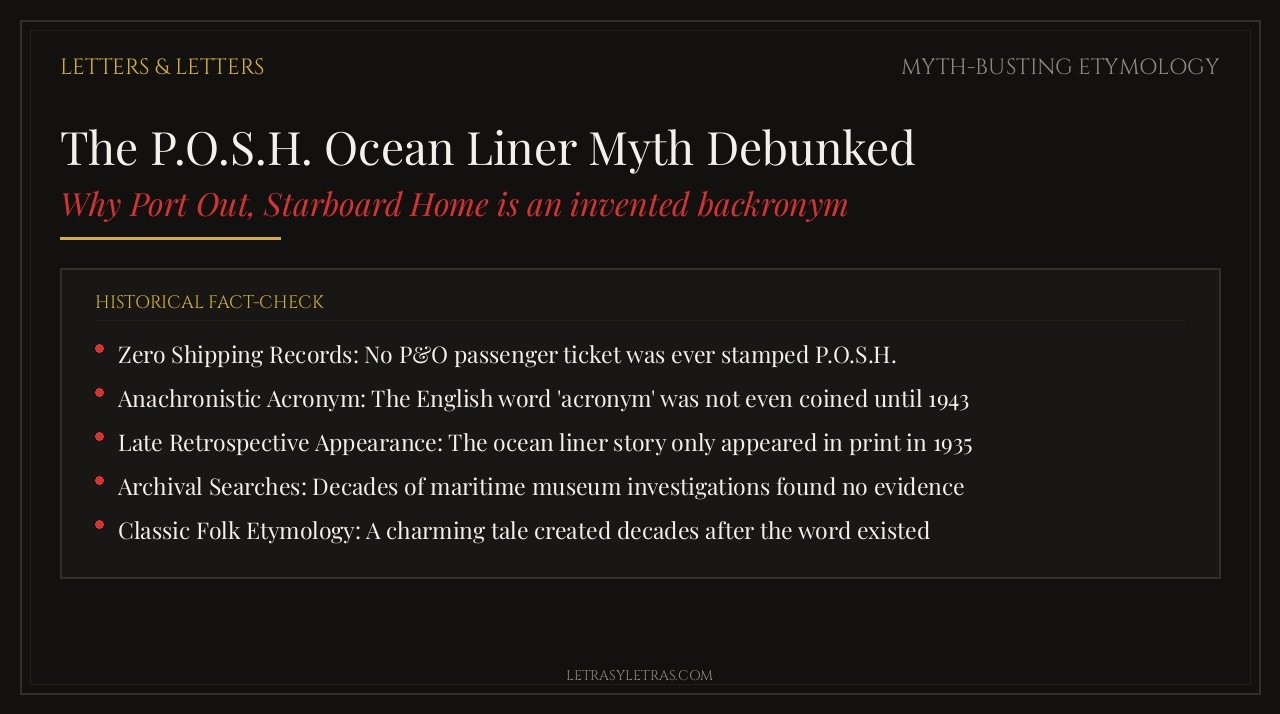
Despite its widespread popularity, language historians consider the ocean liner story complete fiction. Lexicographers have searched for physical evidence of this ticketing practice for over half a century. They investigated company ledgers, diaries, luggage tags, and passenger tickets from the Victorian era.
The result of these exhaustive searches has been absolute silence. Researchers working with the National Maritime Museum archives in Greenwich never uncovered a single stamped document. The official heritage archives of the P&O shipping line also contain zero references to such an acronym.
Maritime architects also point out severe flaws in the geographic logic of the myth. Ocean liners traveling through the Suez Canal encounter shifting coastlines and variable wind patterns. In many seasonal months, northern breezes made port-side cabins hotter rather than cooler.
Linguistics provides an even more devastating counterargument against the nautical claim. Word formation through acronyms was virtually nonexistent in nineteenth-century English. As documented in Merriam-Webster etymological research, words formed from initial letters belong almost entirely to the twentieth century.
English speakers created acronyms like radar, scuba, and laser during modern military expansion. The English noun acronym itself was not coined until 1943. Victorian clerks simply did not invent slang by stitching together initial letters of ticket phrases.
The ocean liner tale did not even appear in print until decades after posh was established slang. In fact, the earliest known printed mention of the nautical acronym surfaced in 1935. By that year, posh had already circulated across Britain for over four decades.
Folk etymologies often invent tidy backstories to satisfy human curiosity. We saw a similar dynamic when exploring the origin of the word narcissist and ancient botanical legends. When people encounter an intriguing old word with obscure roots, they invent a clever retrospective legend.
The Authentic Origin of the Word Posh: Romani Roots and London Slang
If Victorian steamships did not coin the word, where did it actually come from? To find the true paper trail, we must leave luxury cruise decks and visit Victorian street markets. The earliest documented records point to Romani travelers and working-class criminal slang.
The earliest known appearance of the word in English print dates to 1830. Legal scribes recorded the term in the Oxford English Dictionary historical records from the Old Bailey court sessions. In those early trial transcripts, posh did not mean elegant or refined.
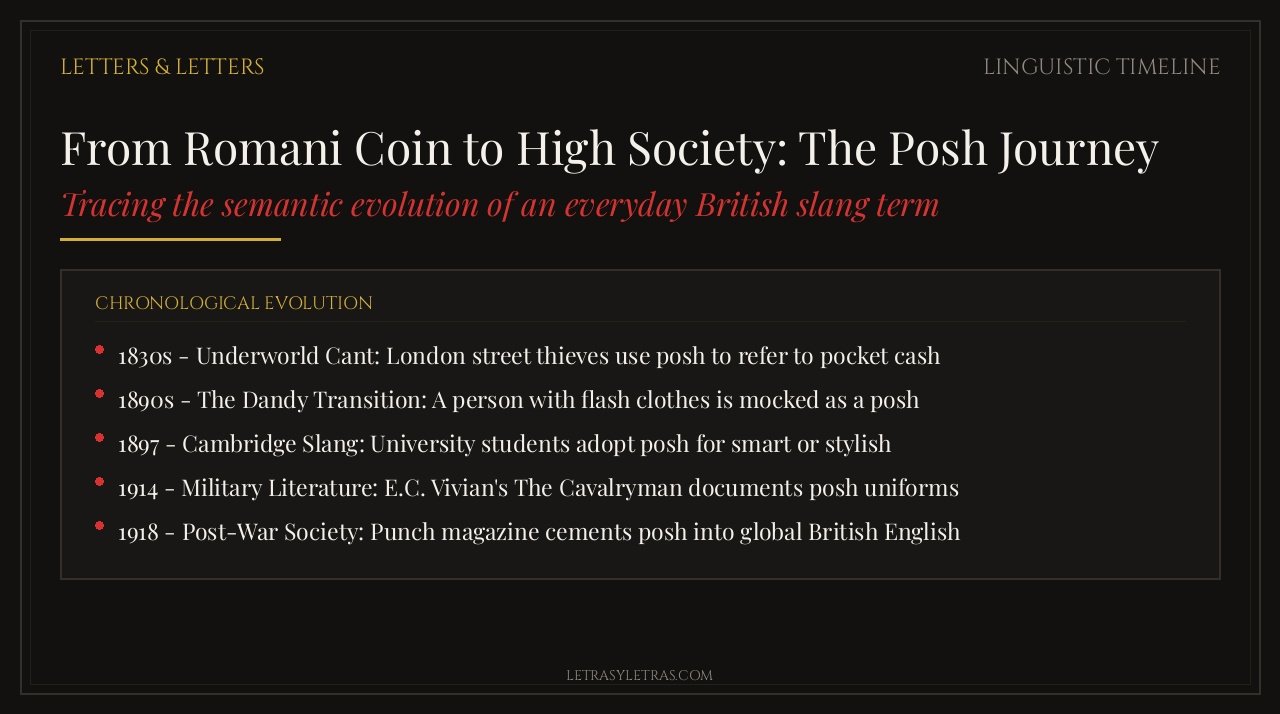
Instead, early nineteenth-century witnesses used posh as underworld slang for money or cash. A street thief boasting about his loot spoke of having plenty of posh in his pocket. The word referred directly to coins, small change, and monetary wealth.
Linguists trace this currency slang directly to the Romani language. Romanichal travelers across Britain spoke Angloromani, an expressive dialect blending Romani vocabulary with English grammar. In their speech, the word påš or posh signified a half.
Romani speakers paired this root with English currency units to name common pocket coins. They called a halfpenny a posh-hōro or påš xåra. Through daily trade in horse fairs and open-air markets, London street vendors picked up the word.
Over several decades, the specific meaning of halfpenny broadened into general pocket change. London costermongers and pickpockets adopted the term into their private thieves’ cant. By the mid-nineteenth century, posh stood as a universal slang synonym for ready cash.
Language evolves through fascinating social detours, much like the origin of the word handicap in seventeenth-century pub wagers. Once a word becomes tied to money, it easily shifts to describe the people who flaunt it.
From Flash Dandies to Cambridge: The Semantic Shift
During the late Victorian period, posh underwent a critical semantic transformation. Londoners began applying the noun not just to coins, but to flashy street characters. A young man who spent his cash on ostentatious waistcoats and canes was called a posh.
This usage carried a distinct note of working-class irony and mockery. A dandy dressed above his station drew satirical comments from neighborhood crowds. To be a posh meant showing off visible prosperity through eccentric, eye-catching garments.
By the 1890s, the noun crossed the social boundary into elite educational institutions. Wealthy university undergraduates at Oxford and Cambridge frequently borrowed street slang to sound worldly. Elite students adopted the term and smoothed away its criminal underworld edges.
The earliest recorded print citation of the adjective appears in 1897. Writers in The Cambridge Fortnightly praised a smart student room as remarkably posh. In that undergraduate context, the word had completed its transition from pocket money to stylish elegance.
Acclaimed humorist P.G. Wodehouse helped popularize the term across British boarding schools. In his 1905 school novel The Head of Kay’s, characters praised well-cut waistcoats with quite a posh look. The word now belonged to smart schoolboys and stylish young gentlemen.
Military life accelerated the word’s spread across the wider English-speaking world. In 1914, author E.C. Vivian published an army study titled The Cavalryman. He observed that cavalry soldiers made a point of wearing posh clothing on every possible occasion.
World War I cast soldiers from every social rank into the same muddy trenches. Officers and enlisted men shared mess halls, foxholes, and frontline vocabulary. Soldiers adopted posh to describe spotless parade uniforms, clean billets, and luxurious parcels from home.
When troops returned to civilian life in 1918, they brought trench slang into family homes. British satirical magazine Punch featured cartoons joking about posh civilians and glamorous outfits. Within a generation, an obscure Romani coin name became a national hallmark of class.
The Urdu Speculation: Did Safed-Pōsh Play a Supporting Role?
While Romani currency slang provides the firmest documentary trail, historians note an intriguing secondary theory. Thousands of British army officers served in colonial India throughout the nineteenth century. In garrison towns and administrative courts, British officials interacted daily with native languages.
In Hindustani and Urdu, the phrase safed-pōsh literally means white-robed. The compound pairs safed (white) with the Persian root pōsh, meaning dressed or covered. In regional Indian culture, the phrase carried strong social connotations.
Wealthy landholders, educated clerks, and respected community leaders wore clean, bleached white cotton garments. Working laborers and peasants wore unbleached or stained coarse cloth. Therefore, safed-pōsh served as a polite honorific for respectable, well-to-do gentlemen.
Returning officers may have noticed the phonetic similarity between the Urdu word and domestic British slang. Hearing posh applied to fine clothing might have reinforced their own usage. Both terms associated the exact same sound with wealth, status, and spotless garments.
Most professional lexicographers view this linguistic overlap as an intriguing reinforcement rather than the primary source. The Romani and thieves’ cant paper trail remains thoroughly documented in British archives. Yet the Indian connection explains why British colonial society embraced the term with such natural enthusiasm.
War and international movement have always enriched language, as seen in the origin of the word deadline during conflict. Different social streams often converge to solidify a single memorable slang word.
Myth vs. Reality: The Two Competing Histories of Posh
To see how profoundly folk etymology distorts reality, we can compare both versions side by side. Examining historical criteria reveals why modern lexicographers reject the nautical tale. The contrast highlights the gap between romantic fiction and documentary evidence.
| Historical Criterion | The Nautical Legend (Myth) | Documented Linguistic History (Reality) |
|---|---|---|
| Earliest Recorded Date | Claimed as 1840s; first printed in 1935 | Documented in Old Bailey court records in 1830 |
| Original Social Sphere | Aristocratic British colonial ocean liners | Romani travelers and London working-class street markets |
| Linguistic Mechanism | Acronym (Port Out, Starboard Home) | Semantic shift from coin name (pash) to dandy to stylish |
| Archival Evidence | Zero stamped tickets or P&O logs ever discovered | Abundant court files, Cambridge journals, and trench letters |
| Scholarly Consensus | Discredited folk etymology / backronym | Accepted historical etymology across major dictionaries |
Why False Acronyms Captivate the Popular Imagination
If the evidence against the ocean liner myth is so overwhelming, why does the story persist? The answer lies in human psychology and narrative appeal. We naturally prefer neat, romantic anecdotes over messy linguistic evolution.
A story about aristocratic travelers sipping tea beneath canvas awnings paints a vivid mental picture. It flatters our desire for clever historical trivia that we can recount at social gatherings. In contrast, tracing Romani coin slang through court transcripts feels far less glamorous.
Language learners frequently encounter similar invented acronyms for common words. People claim that golf stands for gentlemen only ladies forbidden, or that news represents the four cardinal directions. Every single one of these acronym explanations is completely fabricated.
Acronyms satisfy our modern obsession with engineering and efficiency. Because twentieth-century society created NASA, radar, and laser, we assume our ancestors operated with the same mental habits. But historic languages grew organically through metaphor, borrowing, and dialect mixing.
When someone tells you a word originated as an acronym before 1900, exercise healthy skepticism. True etymology is rarely neat, but it reveals the living history of real human communities. The path of posh from horse fair coins to royal ballrooms is far more remarkable than an imaginary ticket stamp.
Frequently Asked Questions
Is posh an acronym for Port Out Starboard Home?
No, posh is not an acronym for Port Out, Starboard Home. Maritime historians and lexicographers have searched shipping company archives for decades without finding a single stamped ticket. The acronym story was invented in the 1930s as a retrospective explanation.
When was the word posh first used in English?
The earliest documented appearance of posh in English print dates to 1830 in Old Bailey court records. In those nineteenth-century criminal proceedings, the word was used as thieves’ slang meaning cash or money.
What is a backronym in English linguistics?
A backronym is an acronym invented after a word already exists to provide a clever explanation. Port Out, Starboard Home is one of the most famous backronyms in the English language.
Did British soldiers popularize the word posh?
Yes, British soldiers during World War I played a major role in popularizing the word. Troops adopted trench slang to describe smart uniforms and luxurious quarters, bringing the term into mainstream civilian speech after 1918.
What does the Romani word pash mean?
In the Angloromani dialect spoken by Romani travelers in Britain, pash meant a half. It was combined with currency words to describe a halfpenny, eventually evolving into slang for general pocket cash.
The Real Luxury of Living Language
The enduring popularity of the ocean liner myth teaches us a profound lesson about storytelling. We love to believe that luxury vocabulary was born in aristocratic comfort. But genuine words rarely originate in marble salons or first-class cabins.
Travelers, market traders, soldiers, and street storytellers create language. Words rise from muddy roads and bustling docks before they ever reach drawing rooms. Posh began not as an emblem of imperial pride, but as humble copper coins jingling in a coat pocket.
The next time someone repeats the nautical legend, you can share the richer truth. Language does not need fabricated ticket stamps to be fascinating. The true history of human speech is already rich enough to treasure.


Alan Sledge is the writer and founder behind Letters & Letters. A lifelong lover of words, Alan has always been drawn to the small mysteries hidden in everyday language, why we say what we say, where our favorite sayings came from and the quotes that manage to put feelings into words better than we ever could ourselves.