
Few words in modern work provoke as much immediate tension as deadline. From finishing a quarterly financial forecast to submitting an academic paper, the ticking clock shapes daily existence.
Most professionals treat the term as an ordinary scheduling expression. Yet buried inside this familiar workplace phrase sits a stark and literal warning. The origin of the word deadline does not begin with printing presses or corporate office cubicles.
As an essayist exploring word histories at Alan Sledge, I often find that our most sanitized words conceal dramatic pasts. The true origin traces back to the horrors of the American Civil War, where crossing a simple wooden railing meant instantaneous death.
Quick Answer: What Is the Origin of the Word Deadline?
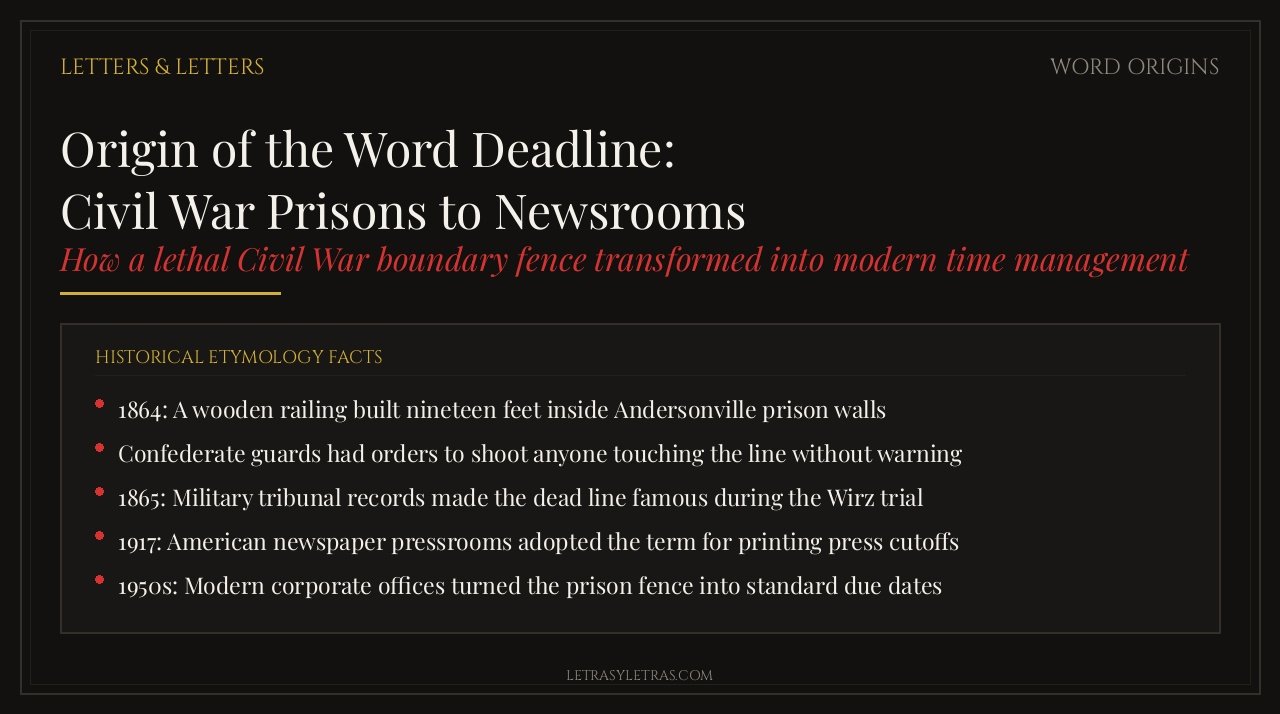
The word deadline originated during the American Civil War in Confederate prisoner of war stockades, most notably Camp Sumter at Andersonville, Georgia, in 1864. Guards constructed a wooden railing nineteen feet inside the perimeter stockade. Confederate sentries received strict orders to shoot any Union captive who crossed, touched, or reached under this boundary. The term appeared in wartime soldier diaries and the 1865 military tribunal of Captain Henry Wirz. During the early twentieth century, American newspaper printing shops adopted the phrase for the mechanical cutoff line on printing presses and the final minute for submitting news copy. By the 1950s, corporate offices turned the phrase into an everyday term for project due dates.
Key Takeaways
- Coined in 1863 and 1864 during the American Civil War as a literal physical boundary inside military prison camps.
- At Georgia’s Andersonville prison stockade, any Union captive who crossed or touched the wooden railing nineteen feet from the wall was shot without warning.
- Documented in wartime diaries of Union prisoners and in the 1865 military commission trial of Captain Henry Wirz.
- Adopted around 1917 by American newspaper pressrooms to designate the strict cutoff time when printing presses began rolling.
- Spread into corporate management, education, and everyday speech during the mid-twentieth century as a standard term for project due dates.
The Grim Reality: Andersonville Prison and Camp Sumter
To understand how a temporal limit was born, one must step back to southwest Georgia in early 1864. Confederate authorities established Camp Sumter, commonly known as Andersonville, to hold captured Union soldiers.
The facility was planned to house ten thousand prisoners. Overcrowding quickly forced more than thirty-two thousand men into an open-air enclosure of roughly twenty-six acres.
Supplies grew desperately scarce as the war dragged on. Sanitation collapsed, disease spread rapidly, and clean water became a rare commodity.
The stockade walls consisted of massive pine logs standing sixteen feet tall. To prevent captive soldiers from tunneling under the walls or storming the perimeter, prison commander Captain Henry Wirz instituted a lethal buffer zone.
Workers drove wooden posts into the Georgia clay nineteen feet inside the stockade walls. They nailed rough wooden strips across the top, creating a modest railing about four feet high.
This crude timber rail was the original dead line. Guards placed in elevated sentry boxes, known as pigeon roosts, received direct orders to fire upon any prisoner who approached it.
No formal challenge was issued before firing. Touching the wood, leaning against the posts, or reaching a hand underneath to scoop clear water was treated as an attempted escape.
Wartime photographs preserved in the Library of Congress historical records document the stark simplicity of the fence. A simple boundary divided captive misery from summary execution.

Voices from the Stockade: Union Diaries of 1864
The earliest documented uses of the phrase appear directly in the journals kept by captive Union soldiers. Men kept pocket diaries on scraps of paper, recording the daily brutality they witnessed.
Private John Ransom of the 9th Michigan Cavalry documented the lethal rule in his published Andersonville diary. He described how sentries watched the wooden rail with cocked rifles day and night.
Desperate men often lost their footing in the Georgia mud near the central creek. Stumbling across the line meant receiving an instant bullet from the watchtowers.
Other prisoners, broken by starvation and disease, chose the fence deliberately. Historians document tragic instances where hopeless men stepped over the line simply to end their suffering.
Sergeant Robert H. Kellogg of the 16th Connecticut Volunteers also described the barrier in his 1865 memoir. He noted that guards received furloughs for shooting prisoners who touched the railing.
Official Confederate records also acknowledged the term. In July 1864, Confederate Inspector-General Colonel Chandler inspected Andersonville and wrote a scathingly critical report to Richmond.
His formal dispatches specifically mentioned the dead-line, urging higher authorities to improve sanitary conditions and food supplies. Those urgent warnings went largely ignored as the Confederacy collapsed.
Visitors to the Andersonville National Historic Site today can walk the preserved grounds. White wooden stakes still mark the exact nineteen-foot perimeter where hundreds of soldiers died.
The 1865 War Crimes Trial: Captain Henry Wirz
When the Civil War ended in April 1865, the horrific conditions at Andersonville ignited fierce national outrage. Almost thirteen thousand Union soldiers had died within fourteen months inside the stockade.
Federal authorities arrested Captain Henry Wirz, the Swiss-born officer who had commanded the interior of Camp Sumter. He was brought to Washington to face a special military commission.
The trial presided over by Major General Lew Wallace lasted more than two months. Hundreds of former prisoners testified about the cruelties they had endured.
The phrase dead-line appeared repeatedly in the formal indictment against Wirz. Charge two specifically accused him of establishing a boundary line and ordering sentries to shoot any prisoner who approached it.
Transcripts from the trial show how deeply the phrase had penetrated American military consciousness. Witnesses described how sentries shot men whose arms had merely brushed the wooden railing in their sleep.
Wirz was found guilty of conspiracy and murder. On November 10, 1865, he was hanged in the courtyard of the Old Capitol Prison in Washington.
Sensational national press coverage of the Wirz trial seared the phrase dead-line into the minds of the American public. A term born in wartime squalor had achieved nationwide notoriety.
Similar physical boundaries existed in other Civil War prison camps, including Elmira in New York and Camp Douglas in Illinois. However, Andersonville remained the defining cultural reference point.
Nineteenth-Century Transitions: Farming and Railroads
Following the Civil War, the phrase dead line began appearing in civilian contexts across the United States. Language frequently migrates from military conflicts into commercial speech, as seen in the origin of the word boycott.
During the 1870s and 1880s, the phrase retained a strictly physical meaning. It always referred to a line on the ground that one must not cross under severe penalty.
On the Western frontier, ranchers and homesteaders used dead line to demarcate grazing territories. Cattlemen and sheep herders drew unofficial boundaries across public lands to keep competing livestock apart.
Any sheep entering cattle territory across the agreed dead line risked being slaughtered by armed cowboys. Local newspapers frequently reported violent boundary disputes along these frontier lines.
American railroads also adopted the term during the late nineteenth century. Rail yards designated siding tracks where disabled locomotives or obsolete freight cars were shunted aside as dead lines.
Anglers used the phrase as well to describe a stationary fishing line weighted to rest motionless on a riverbed. In all these cases, the term retained its literal sense of physical immobility and strict separation.
Just as ancient municipal safety laws created the origin of the word curfew, nineteenth-century commerce maintained physical boundaries to prevent chaos. The temporal shift was still waiting for a technological spark.

Printing Press Mechanics: Enter the Linotype
The transformation of deadline from a physical fence to a ticking clock happened in the noisy pressrooms of early twentieth-century American newspapers. Late Victorian readers witnessed an unprecedented explosion in print journalism.
Cities supported dozens of competing daily newspapers, each rushing editions to the streets. Speed determined commercial survival in a fiercely competitive market.
Ottmar Mergenthaler’s invention of the Linotype machine in the 1880s revolutionized typesetting. Hot metal slugs were cast quickly, but rotary cylinder presses still operated on rigid mechanical schedules.
On a flatbed printing press, printers used the term dead line to indicate a physical boundary mark on the press bed. If metal type extended beyond that specific line, the press cylinder clamps would crush the plates.
From this mechanical boundary, editors made an imaginative psychological leap. The physical line on the printing plate merged with the rigid delivery schedule required for daily newspaper distribution.
A newspaper editor could not hold the presses for a late-breaking story without missing delivery trains. If a reporter handed in a manuscript after the scheduled cutoff, the story was completely dead.
Lexicographers at Merriam-Webster historical archives trace this journalistic usage to the late 1910s. By 1917, trade magazines like The Fourth Estate routinely warned writers about meeting the editorial deadline.
In 1920, trade journalist Arthur Brisbane published reflections on newsroom discipline. He described the deadline as the absolute moment when the roaring mechanical presses must begin rolling.
The phrase had crossed over from space to time. Missing the deadline no longer meant taking a rifle bullet, but it meant professional ruin for an ambitious reporter.
| Year | Historical Period | Linguistic Milestone and Context |
|---|---|---|
| 1863 to 1864 | American Civil War | Union soldier diaries record the dead line inside Andersonville prison stockade as a lethal boundary fence. |
| 1865 | Wirz War Crimes Tribunal | Formal military commission indictments and nationwide trial transcripts popularize the term across the United States. |
| 1870 to 1885 | Western Frontier and Railroads | Frontier ranchers use dead line for cattle boundaries, while railroads designate inactive tracks for stored railcars. |
| 1917 to 1920 | Newspaper Pressrooms | Printers shift the term from press bed boundaries to the strict cutoff minute when copy must be sent to the Linotype machines. |
| 1940 to 1955 | Corporate Management | Post-war industrial planning and advertising agencies adopt the word as a universal term for project completion dates. |
The Corporate Boom: Conquering the Modern Office
For several decades, deadline remained largely confined to newspaper printing shops, publishing houses, and literary circles. World War Two military procurement altered that balance dramatically.
Coordinating vast wartime manufacturing chains required rigid production timetables. Factory managers, military logisticians, and government contract officers began using deadline to describe delivery targets.
Following the war, the rapid expansion of American corporate bureaucracy accelerated the word’s adoption. Advertising agencies along Madison Avenue, engineering firms, and executive offices embraced the phrase.
Management literature in the 1950s began treating deadlines as vital instruments of organizational discipline. Business leaders realized that open-ended assignments fostered procrastination.
Educational institutions quickly followed suit. School teachers and university professors began setting deadlines for term papers and laboratory experiments.
By the 1970s, deadline had established itself as a universal English noun. People spoke of tax deadlines, application deadlines, and mortgage deadlines without giving a second thought to Civil War sentries.
The term had traveled the full arc of metaphorical abstraction. A physical timber rail that stopped men with lead bullets had become an abstract boundary that stops procrastination with social accountability.
This pattern of language evolution is common in English history. Words frequently shed their violent beginnings while keeping their psychological intensity, as we discovered when examining the origin of the word sabotage.
The Psychology of the Ticking Clock
Why does the word deadline continue to carry such potent emotional weight? Psychologists and organizational researchers point to fundamental features of human cognition.
In 1955, British historian C. Northcote Parkinson published his famous adage known as Parkinson’s Law. He observed that work expands to fill the time available for its completion.
Without an enforced cutoff, tasks drift endlessly into the future. A deadline introduces external necessity, forcing the mind to prioritize essential actions over trivial distractions.
Neuroscientists explain that approaching deadlines trigger moderate releases of dopamine and cortisol. These chemical messengers sharpen concentration, narrow perceptual focus, and mobilize physical energy.
For many creative professionals, the pressure of a deadline is the primary catalyst for inspiration. Legendary author Douglas Adams famously joked that he loved deadlines because he loved the whooshing noise they made as they went by.
Yet excessive deadline pressure takes a heavy toll. Chronic stress, sleep deprivation, and occupational burnout often result when deadlines become unmanageable.
When workers feel overwhelmed by nonstop schedules, they often report feeling physically sick or origin of the phrase under the weather. Language captures our shared physical responses to intense pressure.
Balancing realistic timetables with human wellbeing remains one of the core challenges of modern workplace management. The ancient need for boundaries persists, even as our methods of enforcement change.
Language as Living History: Honoring the Past
Every language carries the memories of the people who shaped it. English words are not sterile mathematical tokens invented in laboratory isolation.
Our vocabulary preserves the dust of Roman roads, the grit of medieval workshops, and the trauma of nineteenth-century battlefields. Exploring our collection of english idioms and meanings shows how everyday conversation rests upon centuries of lived experience.
When you sit down to finish a project tonight, reflect for a moment on the word you are using. You are not facing a wooden rail guarded by rifle sentries on a hot Georgia afternoon.
Instead, you take part in a century-old cultural ritual of focus and commitment. The phrase that once marked a boundary between life and death now marks the boundary between intention and accomplishment.
As we examine our treasury of famous quotes and quotations, we see that great thinkers throughout history recognized the value of time. Treating your hours with respect is the finest way to honor the past.
Frequently Asked Questions
What was the original meaning of the word deadline?
The word deadline originally referred to a literal physical barrier in American Civil War military prisons during 1863 and 1864. At Georgia’s Andersonville prison stockade, guards constructed a light wooden railing nineteen feet inside the perimeter wall. Sentries received standing orders to shoot any prisoner who stepped over, reached under, or touched this line.
Did the word deadline originate at Andersonville prison?
Yes, while several Civil War prison camps used boundary lines, Andersonville made the phrase dead line famous throughout the nation. The tragic deaths of nearly thirteen thousand Union prisoners and the sensational 1865 military tribunal of Captain Henry Wirz cemented the phrase in American history and printed records.
When did deadline start meaning a time limit?
The transition from a physical line to a time limit occurred in the late 1910s within American newspaper newsrooms. By 1917, editors and printing press operators used deadline to describe the final moment copy could be submitted before rotary presses were locked and set to print.
How did newspaper printing change the meaning of deadline?
Printing presses had a physical limit on the press bed called a dead line beyond which type plates could not extend without damage. Newsroom editors combined this mechanical concept with the strict distribution schedules of daily papers, turning deadline into the temporal cutoff for submitting articles.
Why do deadlines create such intense psychological stress?
Deadlines trigger the release of stress hormones like cortisol and adrenaline, which narrow attention and raise heart rates. While moderate time pressure sharpens focus and fights procrastination, unrealistic deadlines cause cognitive overload, chronic anxiety, and professional burnout.
Alan Sledge is the founder and lead writer at letrasyletras.com, dedicated to uncovering the true etymological histories behind our favorite words and phrases.


Alan Sledge is the writer and founder behind Letters & Letters. A lifelong lover of words, Alan has always been drawn to the small mysteries hidden in everyday language, why we say what we say, where our favorite sayings came from and the quotes that manage to put feelings into words better than we ever could ourselves.