
When English speakers begin learning Spanish, they quickly encounter words that look strikingly different from French or Italian. While Spanish remains a Romance language descended from Latin, its vocabulary carries an unmistakable eastern melody.
Words like almohada, alcalde, azúcar, and ojalá do not trace back to Roman senators or classical poets. They are living monuments to nearly eight centuries of Islamic civilization on the Iberian Peninsula. The deep footprint of Spanish words of Arabic origin reveals one of the most remarkable cultural encounters in European history.
As an essayist exploring word histories at Alan Sledge, I find this linguistic blending breathtaking. Across the medieval world, soldiers, poets, farmers, and scholars lived side by side. Their daily exchanges permanently enriched the sounds and structures of the Spanish tongue.
Quick Answer: What Spanish Words Have Arabic Origins?
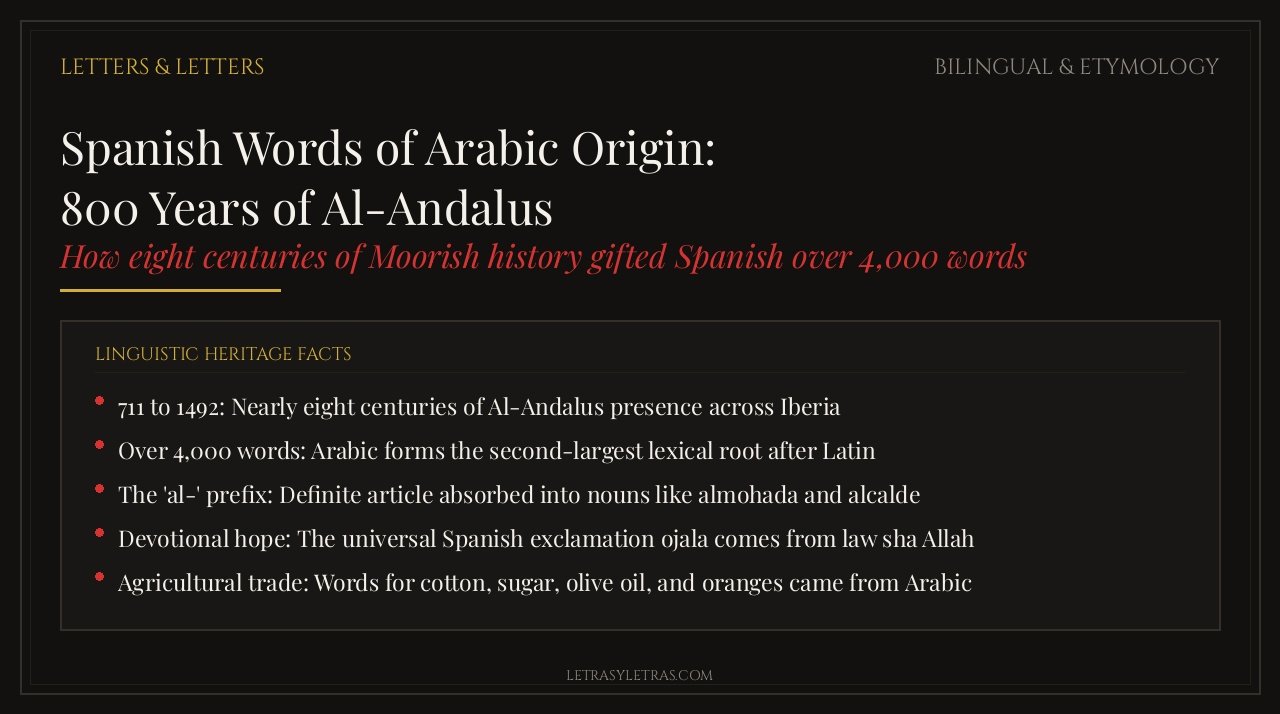
Spanish contains over four thousand words of Arabic origin, representing roughly eight percent of the total Spanish dictionary. This linguistic legacy stems from nearly eight centuries of Islamic presence in the Iberian Peninsula between 711 and 1492 AD, a civilization known as Al-Andalus. Arabic represents the second-largest lexical contributor to modern Spanish after Latin. Common loanwords include nouns beginning with the Arabic article al, such as almohada (pillow), alcalde (mayor), and algodón (cotton). Other essential daily words include aceite (cooking oil), azúcar (sugar), arroz (rice), barrio (neighborhood), and the heartfelt exclamation ojalá (from law sha Allah, meaning God willing).
Key Takeaways
- Arabic is the second-largest linguistic contributor to Spanish, providing over four thousand words.
- Nearly eight hundred years of Al-Andalus history from 711 to 1492 embedded Arabic deeply into Iberian Romance speech.
- Words starting with ‘al-‘ incorporated the Arabic definite article directly into nouns like almohada, alcalde, and algodón.
- Everyday agricultural and domestic terms including aceite, azúcar, arroz, and barrio entered Spanish through Andalusi trade and irrigation.
- Universal Spanish expressions of hope like ‘ojalá’ originate directly from the Arabic phrase ‘law sha Allah’.
Dawn of Al-Andalus: Eight Centuries of Shared Ground
The story begins in the year 711 AD. General Tariq ibn Ziyad led an army across the narrow strait separating North Africa from Iberia, landing near the great rock that still bears his name: Jabal Tariq, or Gibraltar.
Within a decade, Muslim forces established control over most of the Iberian Peninsula. They called this new province Al-Andalus. For the next seven hundred and eighty-one years, until the fall of Granada in 1492, Arabic was a primary language of government, trade, and learning.
This period was not merely an era of military conflict. In cities like Córdoba, Seville, and Granada, Muslims, Christians, and Jews created a vibrant bilingual culture. Historians often refer to this complex coexistence as the convivencia.
During the tenth century, Córdoba stood as the most sophisticated metropolis in Western Europe. While London and Paris were modest wooden towns, Córdoba boasted paved streets, public baths, running water, and royal libraries housing over four hundred thousand manuscripts.
Christian subjects living under Muslim rule, known as Mozarabs, spoke Romance dialects heavily laced with Arabic vocabulary. Conversely, educated Muslims read Romance vernacular alongside classical Arabic.
Linguistic records cataloged by the Real Academia Española linguistic database document how deeply Arabic permeated everyday speech. When northern Christian kingdoms pushed southward during the centuries-long Reconquista, they did not erase this linguistic fabric. Instead, victorious Castilian kings absorbed the rich vocabulary of the lands they conquered.

The Mystery of the ‘Al-‘ Prefix: Swallowing the Article
The most recognizable trademark of Spanish words of Arabic origin is the initial syllable al. Anyone glancing through a Spanish dictionary will notice hundreds of nouns sharing this characteristic opening.
In Arabic, al functions as the universal definite article, translating directly as the in English. When bilingual Andalusians spoke, Romance listeners heard the article and the root noun as a single unbreakable unit.
Rather than borrowing only the base noun, early Spanish speakers absorbed both parts together. This grammatical phenomenon occurred across thousands of common objects and civic titles.
Consider the humble pillow, known as the almohada. The word derives from the Andalusi Arabic al-mukhadda, which etymologists trace back to khadd, meaning cheek. An almohada was quite literally the cheek-rester.
Municipal government provides another striking example with alcalde, meaning mayor. The term comes from al-qadi, the Islamic legal judge and magistrate. Centuries after Moorish rule ended, Spanish towns still call their municipal leaders by this ancient judicial title.
Textile manufacturing also reflects this pattern. Algodón, meaning cotton, descends directly from al-qutn. Medieval Spanish weavers adopted both the plant and its Arabic title, which eventually traveled into English as cotton.
Other familiar examples abound throughout daily life. Almacén, meaning warehouse or department store, comes from al-makhzan. This same root later entered English through French to create magazine, originally meaning a storehouse for military gunpowder.
Alfombra, meaning carpet or rug, derives from al-humra. Albañil, meaning mason or bricklayer, comes from al-banna. Aljibe, a subterranean water cistern, comes from al-jubb.
Even chess pieces preserve this heritage. The Spanish bishop is called el alfil, deriving from al-fil, meaning the elephant. This ancient game reached Europe through Córdoba with its eastern animal pieces intact.
Beyond the Prefix: Everyday Arabic Loanwords
While words beginning with al are easy to spot, thousands of other Spanish words hide their Arabic ancestry behind different sounds. When Arabic words begin with sun letters like s, z, or r, the l of the article assimilates into the following consonant.
A prime culinary example is aceite, the standard Spanish word for cooking oil. In other Romance languages, speakers preserved the Latin oleum, producing French huile and Italian olio.
Spanish speakers in medieval Iberia broke sharply from their Romance cousins. They adopted the Arabic az-zayt, meaning olive juice. Spanish reserved the Latin-derived óleo strictly for sacred religious anointings and oil painting, while keeping aceite for kitchen tables.
The olive itself tells the same story. Aceituna descends directly from the Arabic az-zaytuna.
Sweet flavors carry identical roots. Azúcar, meaning sugar, comes from as-sukkar, while arroz, meaning rice, comes from ar-ruzz. Both crops required sophisticated irrigation techniques brought to Spain by Andalusi agronomists.
Fruit orchards transformed Spanish markets through eastern imports. Naranja, meaning orange, comes from the Arabic naranj, which traveled originally from Persian and Sanskrit roots. Limón, meaning lemon, derives from laymun.
Even root vegetables reflect this agricultural revolution. Zanahoria, meaning carrot, comes from the Andalusi Arabic safunariyya. Before Moorish farmers introduced cultivated orange varieties, European carrots were wild, woody, and bitter.
Urban architecture and geography also absorbed eastern terms. Barrio, meaning neighborhood or city quarter, comes from barri, designating an outer district beyond the fortress walls. Rincón, meaning an inside corner, comes from rukn.
Prepositions were not immune to this linguistic exchange. The ubiquitous Spanish preposition hasta, meaning until or up to, derives from the Arabic hatta. It is exceptionally rare for languages to borrow prepositions, illustrating the profound intimacy of medieval Andalusi contact.

The Soul of Spanish Longing: The Story of Ojalá
Among all Spanish words of Arabic origin, none carries greater emotional resonance than the exclamation ojalá. Spanish speakers use it daily to express passionate longing, profound hope, or relief.
When someone uses phrases like ojala que llueva or ojala tengas exito, they are uttering an expression that requires the subjunctive mood. The expression translates roughly as would that it were so, or I fervently hope.
Linguists confirm that ojalá derives directly from the Andalusi Arabic expression law sha Allah. In classical Arabic, this phrase combines law, meaning if, with sha, meaning to wish, and Allah, meaning God. Together, it means if God wills it.
Another related variant comes from wa-sha Allah, meaning and may God will it. Over centuries of daily use, Romance speakers contracted the syllables into a single evocative word.
What makes ojalá remarkable is its survival across Christian Spain. During the sixteenth century, the Spanish Inquisition rigorously monitored religious orthodoxy and outlawed Arabic dress, customs, and texts.
Yet devout Catholic writers like Miguel de Cervantes and Saint Teresa of Ávila used ojalá without hesitation in their classic literature. The religious invocation had softened into an emotional reflex of the Spanish soul.
Today, millions of Spanish speakers around the world utter ojalá without religious intent. It remains one of the most poetic bridges connecting medieval Andalusia to modern speech.
| Spanish Word | Arabic Origin | Original Meaning and Cultural Context |
|---|---|---|
| Almohada | Al-mukhadda | Pillow or cushion, derived from khadd, meaning cheek. Literally the cheek-rester for resting in bed. |
| Alcalde | Al-qadi | The community judge and legal arbitrator, adapted by Castilian towns as the title for mayor. |
| Aceite | Az-zayt | Olive juice or cooking oil, replacing the classical Latin oleum throughout Iberian domestic kitchens. |
| Ojalá | Law sha Allah | If God wills it. An Andalusi prayer that transformed into the universal Spanish expression for hope. |
| Barrio | Barri | Outer district or suburb located outside the primary walled city, now meaning neighborhood. |
| Azúcar | As-sukkar | Refined sugar cane, introduced to Mediterranean agriculture through Moorish irrigation systems. |
| Alfil | Al-fil | The elephant in ancient chess, preserved in Spanish as the name for the chess bishop piece. |
Mozarabic Poetry and the Sound of Old Spanish
To hear how these two languages interacted in real time, one must examine Mozarabic lyric poetry. In the eleventh century, Andalusian poets invented strophic verse forms known as muwashshahat.
At the very end of these Arabic or Hebrew poems sat a short concluding stanza called a jarcha. Written in Mozarabic using Arabic script, these verses represent the oldest surviving lyric poetry in any Romance language.
In the jarchas, young women sing of love, longing, and grief using a mixture of Romance grammar and Arabic vocabulary. One famous verse cries: Habibi, ya habibi, meaning my beloved, oh my beloved, surrounded by old Spanish verbs.
Scholars at Encyclopaedia Britannica historical archives note that this bilingual environment shaped Spanish phonetics. The distinct guttural sounds of medieval Castilian were influenced by centuries of hearing Arabic consonants.
For example, the Arabic consonant sh frequently shifted into Old Spanish x, pronounced like sh in shoe. During the seventeenth century, this sound shifted again into the modern Spanish j sound, heard in words like jabón and jarabe.
Our study of the origin of the word hazard revealed how Crusaders brought Arabic dice games to France and England. In Spain, however, the cultural transfer was far more intimate and domestic.
Global Spanish: Carrying Al-Andalus to the Americas
When Christopher Columbus sailed westward in 1492, he departed from Andalusia just months after the fall of Granada. The Spanish language carried across the Atlantic was saturated with Arabic vocabulary.
Spanish conquistadors, priests, and colonists brought terms like alcalde, barrio, acequia, and adobe to the Americas. Today, from Mexico City to Buenos Aires, municipal halls and urban quarters bear Andalusi names.
Adobe, the sun-dried clay brick that defines Southwestern architecture, derives from the Arabic al-tuba, meaning the brick. The word traveled from ancient Egypt through Arabic into Spanish, and finally into English.
Agricultural terms spread across the new continent with equal speed. Immigrants planted naranjas, limones, and arroz across fertile American river valleys, naming them with words learned in medieval Córdoba.
Even legal systems in the Americas preserved this legacy. Municipal councils throughout Latin America were presided over by alcaldes for centuries, following administrative traditions established in medieval Moorish Spain.
When you explore our guide to idioms in spanish, you see how these historic terms continue to generate vivid colloquial expressions. Centuries of migration have only expanded the reach of these ancient roots.
Language as an Open Mosaic
The story of Spanish words of Arabic origin serves as a powerful reminder of how human speech evolves. Languages do not grow strong through isolation or artificial purity.
Great languages thrive because they borrow generously from neighbors, trading partners, and conquerors alike. Spanish absorbed the best of Roman law, Visigothic governance, and Arabic science to build an expressive global tongue.
Just as ancient Persian pleasure gardens shaped the origin of the word paradise, Andalusi orchards gave Europe its most beloved fruits and flowers. Language carries the scents and flavors of forgotten caravans.
When you sit down to breakfast in Madrid or Mexico, your morning routine is steeped in Arabic history. You pour aceite into a skillet, add a pinch of azúcar to your coffee, and rest your head against an almohada.
Our treasury of famous quotes and quotations illustrates how writers across cultures celebrate the gifts of time. Knowing the roots of your words turns every conversation into an act of remembrance.
Frequently Asked Questions
How many Spanish words come from Arabic?
Linguists estimate that Spanish contains over four thousand words of Arabic origin. This represents approximately eight percent of the total Spanish vocabulary, making Arabic the second-largest lexical contributor after Latin.
Why do so many Spanish Arabic words start with al?
The letters al represent the definite article in Arabic, translating as the in English. When medieval Romance speakers adopted Arabic nouns, they heard the article and noun as a single word, absorbing the prefix directly into the new Spanish term.
What is the etymology of the Spanish word ojalá?
Ojalá derives from the Andalusi Arabic phrase law sha Allah, meaning if God wills it, or wa-sha Allah, meaning may God will it. Over centuries of daily use, it became the standard Spanish expression for heartfelt hope and longing.
Did Arabic influence Spanish grammar as well as vocabulary?
Arabic influence was primarily lexical rather than grammatical. However, Spanish did adopt the Arabic preposition hasta (from hatta) and was subtly influenced in phonetic development, prepositional phrasing, and regional idioms.
Why did Spanish adopt aceite instead of the Latin word for oil?
Medieval Iberian agriculture was heavily transformed by Moorish olive cultivation and pressing technology. Romance speakers adopted the Andalusi Arabic word az-zayt for culinary cooking oil, reserving the Latin root óleo for religious ceremonies and fine art.
Alan Sledge is the founder and lead writer at letrasyletras.com, dedicated to uncovering the true etymological histories behind our favorite words and phrases.


Alan Sledge is the writer and founder behind Letters & Letters. A lifelong lover of words, Alan has always been drawn to the small mysteries hidden in everyday language, why we say what we say, where our favorite sayings came from and the quotes that manage to put feelings into words better than we ever could ourselves.