
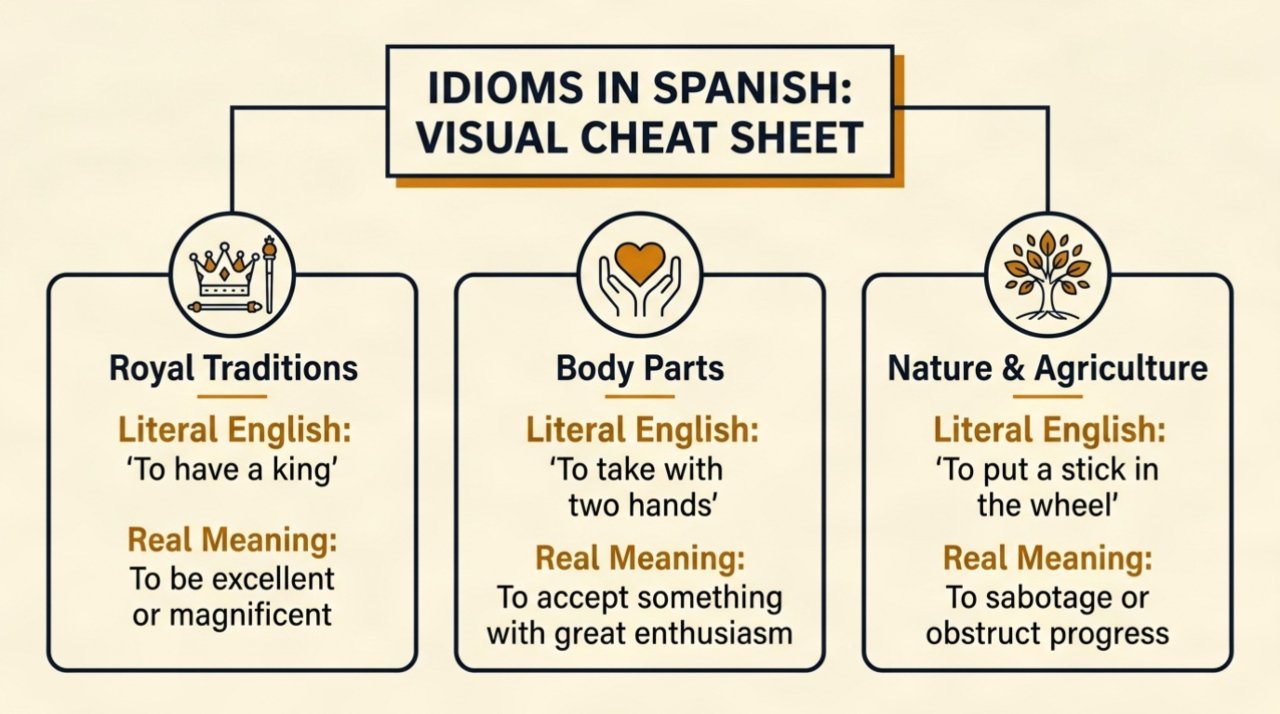
Translating word for word can lead to hilarious misunderstandings when learning a new language. Every culture builds sayings that sound bizarre to outside ears. Learning popular idioms in Spanish unlocks the rich history and humor of Spanish-speaking nations.
These fixed expressions reflect centuries of lottery draws, royal decrees, and daily habits. They show how historical events shaped the way millions of people express emotion. A phrase about throwing furniture out a window reveals an eighteenth-century lottery custom.
This guide explores famous sayings, their literal translations, and their true historical roots. You will learn why certain phrases reference animals, food, or distant countries. Examining these expressions helps you speak with greater natural rhythm and cultural awareness.
Overview
Spanish contains thousands of idiomatic expressions passed down through generations. Some sayings date back to medieval agricultural life. Others emerged during the Spanish Golden Age of literature.
This guide categorizes key expressions by their historical origins and everyday usage. We will examine phrases tied to royal lotteries, barber shops, and naval traditions. Each entry contrasts the literal English wording with its true figurative meaning.
Learning these linguistic patterns prevents awkward literal translations. You will gain insight into how Spanish speakers use humor, irony, and emphasis. Let’s begin by tracing the cultural forces that created these expressions.
Historical Context
Many famous expressions emerged during key moments in Spanish history. Royal lotteries, literary masterpieces, and military habits all left their mark on the language. Miguel de Cervantes recorded hundreds of rural proverbs in his 1605 novel Don Quixote.
In 1763, King Carlos III established the Spanish National Lottery. Winners celebrated their sudden wealth by discarding old household goods into the street. This historical event created lasting expressions about lavish spending that survive today.
Other sayings stem from maritime trade between Mediterranean ports. Sailors and merchants developed shorthand phrases to describe tricky negotiations. These historical roots show that language evolves alongside daily social changes.
1. Idioms Born from Royal Traditions and Lotteries
Royal decrees and national events inspired several famous Spanish expressions. These sayings reflect how major social shifts entered daily speech.
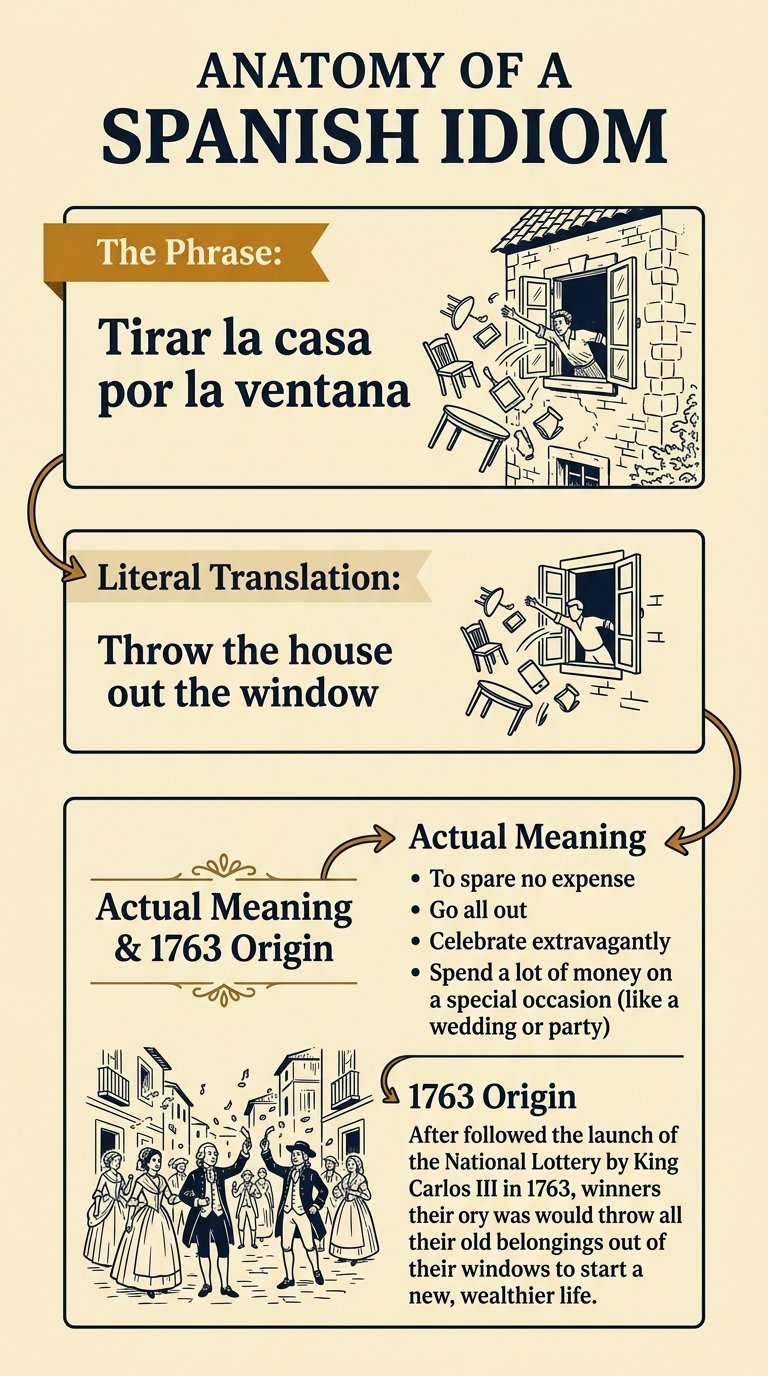
“Tirar la casa por la ventana”
- Literal Translation: To throw the house out the window
- Actual Meaning: To spare no expense or throw a lavish party
This expression dates back to 1763 when King Carlos III created the national lottery. Winners were so eager to buy new possessions that they threw old furniture out their windows. Today, people use it when someone hosts an expensive wedding or celebration.
“Hacerse el sueco”
- Literal Translation: To make oneself the Swede
- Actual Meaning: To play dumb or pretend not to notice
Linguists trace this phrase to the Latin word soccus, referring to an actor’s light shoe. Over time, the word evolved into zueco and eventually sueco. It originally described comic theater actors who played foolish characters on stage.
2. Idioms Based on Everyday Body Parts and Actions
Body parts feature prominently in Spanish conversational expressions. These sayings use physical gestures to describe mental states or social interactions.
“Tomar el pelo”
- Literal Translation: To take the hair
- Actual Meaning: To tease someone or pull their leg
This expression originated in seventeenth-century barbershops. Barbers would gently hold a customer’s hair or beard to distract them while chatting. You can read about our complete idioms guide to compare English equivalents.
“Hablar por los codos”
- Literal Translation: To talk through one’s elbows
- Actual Meaning: To talk excessively or chatter endlessly
Ancient speakers observed that animated talkers move their arms constantly. Nudging someone with an elbow during intense conversation inspired this vivid image. It remains one of the most common ways to describe a chatty friend.
“Meter la pata”
- Literal Translation: To put the animal paw in
- Actual Meaning: To make a mistake or put your foot in your mouth
This phrase comes from rural hunting traditions. It described an animal stepping into a hidden trap. Today, it applies whenever someone makes an embarrassing social blunder.
3. Idioms Derived from Nature and Agriculture
Rural life provided the foundation for many traditional proverbs. Farmers and villagers created metaphors based on livestock, crops, and seasonal weather.
| Spanish Idiom | Literal Translation | Figurative Meaning | Historical Origin |
|---|---|---|---|
| Tirar la casa por la ventana | Throw house out window | Spare no expense | 1763 National Lottery win custom |
| Tomar el pelo | Take the hair | Pull someone’s leg | 17th-century barber distraction |
| Meter la pata | Put the paw in | Make a mistake | Rural animal hunting traps |
| Pedir peras al olmo | Ask elm tree for pears | Demand the impossible | Ancient Roman agricultural lore |
| Estar en las nubes | Be in the clouds | Daydream or be distracted | Classical poetic astronomy |
“Pedir peras al olmo”
- Literal Translation: To ask the elm tree for pears
- Actual Meaning: To expect something impossible
Roman poet Ovid wrote about trees bearing unexpected fruit in ancient literature. Spanish adopted the phrase to mock unrealistic expectations. You can check our analysis of another phrase with a surprising past to see how old customs persist.
Contrast and Comparison
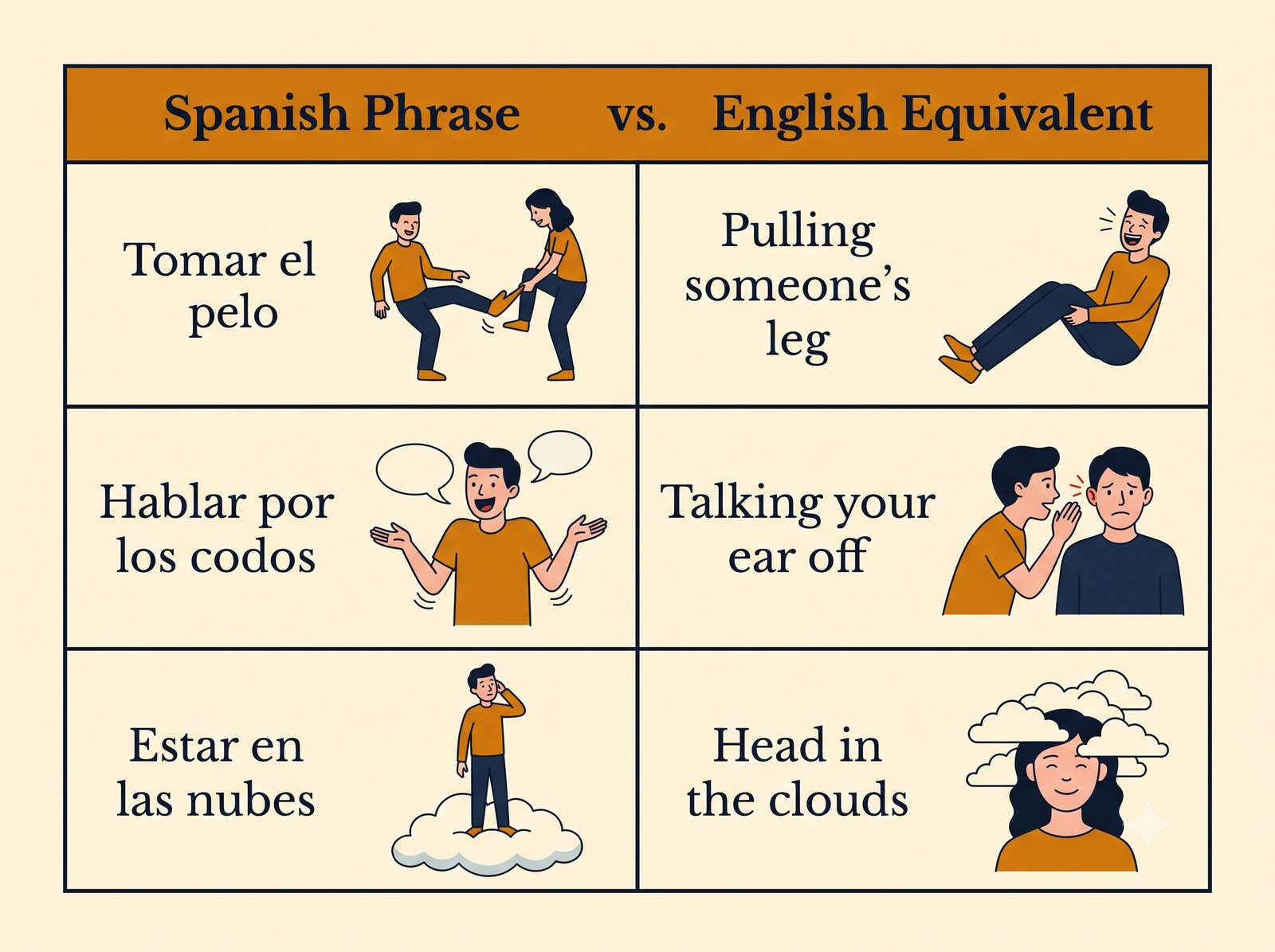
English and Spanish often use completely different imagery to convey identical ideas. Where English speakers pull someone’s leg, Spanish speakers take their hair. Recognizing these pairs speeds up language comprehension.
Comparing these expressions reveals shared human experiences across different cultures. Both languages rely on vivid physical images to describe emotional states. The table above highlights how historical events shaped Spanish phrasing.
Consulting authoritative language archives clarifies disputed origins. You can verify Spanish word roots in the Real Academia Espanola dictionary. Accessing official records ensures accurate historical context when writing or speaking.
Key Takeaways for Writers and Readers
Mastering these expressions improves both creative writing and daily conversation. Using idioms correctly demonstrates deep cultural familiarity.
- Avoid literal word-for-word translation when interpreting sayings.
- Pay attention to regional variations across Spanish-speaking countries.
- Group expressions by thematic categories like body parts or animals.
- Use context clues to determine if a phrase is formal or casual.
- Practice using common sayings in active speech to build natural rhythm.
Frequently Asked Questions
What are idioms in Spanish?
Idioms in Spanish are figurative expressions whose meaning cannot be deduced from individual words. They reflect cultural history, local humor, and traditional habits across Spanish-speaking nations.
How do idioms in Spanish differ from English idioms?
Spanish idioms often use different cultural reference points, such as lotteries, barbers, or local agriculture. While the underlying message may be identical, the visual imagery reflects distinct regional histories.
Why is literal translation incorrect for idioms in Spanish?
Translating word for word destroys the figurative meaning and creates confusing sentences. For example, translating tomar el pelo literally yields taking hair instead of teasing someone.
Which Spanish idioms are most useful for beginners?
Phrases like estar en las nubes (daydreaming) and meter la pata (making a mistake) are very common. Native speakers use these versatile expressions in everyday casual conversations.
Summary of Spanish Idioms
Exploring these linguistic roots shows how historic events shape modern speech. From lottery winners throwing furniture to barbers chatting with clients, these sayings carry living history. Learning the stories behind these expressions makes language study engaging.
Appreciating these cultural connections helps you communicate with greater precision and empathy. The words we inherit connect us to generations of storytellers across the globe.
If you enjoyed discovering these language histories, please share this guide with fellow language lovers. Bookmark Letters & Letters for fresh etymological insights published every week.


Alan Sledge is the writer and founder behind Letters & Letters. A lifelong lover of words, Alan has always been drawn to the small mysteries hidden in everyday language, why we say what we say, where our favorite sayings came from and the quotes that manage to put feelings into words better than we ever could ourselves.

Alan Sledge
Alan Sledge is the founder and lead researcher behind Letters & Letters. A lifelong student of linguistic history, he cross-references every word origin, idiom, and quote against primary archival manuscripts, the Oxford English Corpus, and 18th-century print lexicons.