
We use the word casually in modern conversation. A sports fan screams when a referee makes a controversial call. In everyday speech, going berserk simply means losing emotional control.
A thousand years ago in Scandinavia, the word described a terrifying reality. It did not refer to mild frustration or chaotic excitement. The term named elite Norse shock troops who entered a trance of destructive fury.
Quick Answer: Origin of the Word Berserk
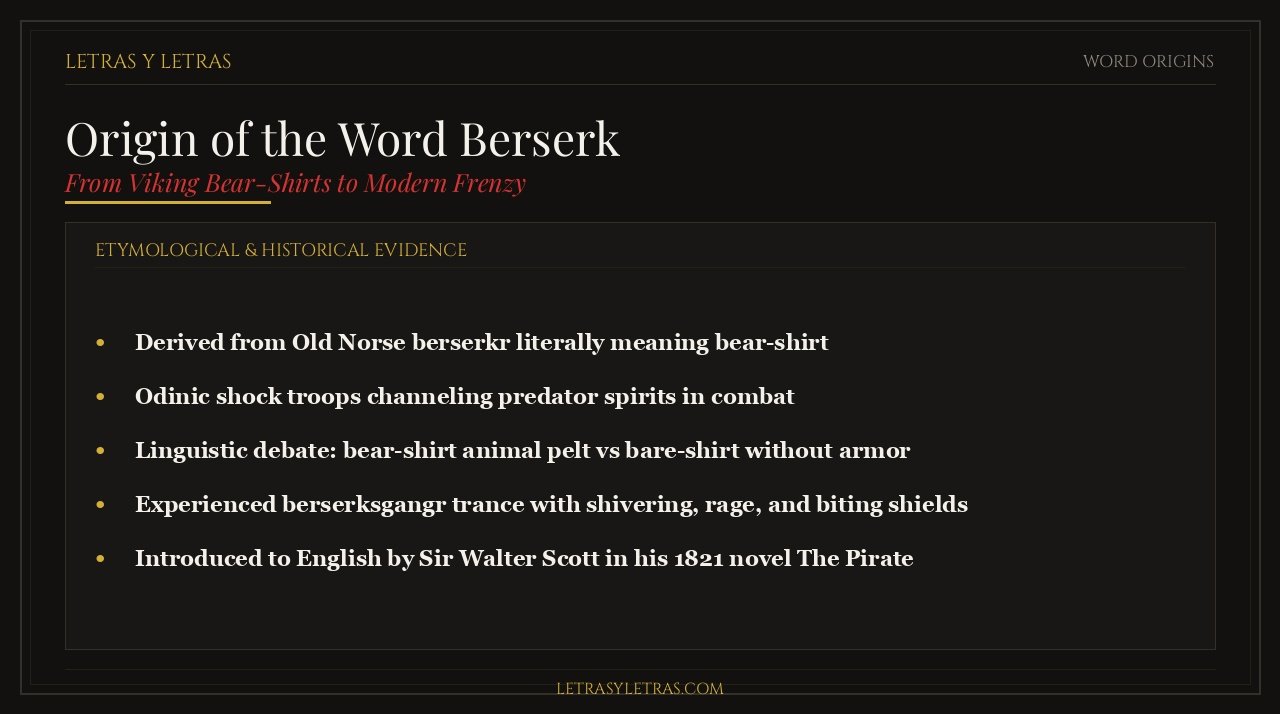
The word berserk comes from Old Norse berserkr, meaning bear-shirt. Norse warriors wore bear pelts into battle, channeling predator spirits. Scottish novelist Sir Walter Scott introduced the word to English literature in 1821.
Key Takeaways
- Derived from Old Norse berserkr, meaning bear-shirt or warrior clad in bear pelts.
- Linguists reject the bare-shirt theory, confirming ber- refers to the animal bear.
- Berserkers experienced berserksgangr, a physical trance of howling, shivering, and fury.
- Norse law codes outlawed berserker bands in 1015 CE due to violent extortion.
- Sir Walter Scott popularized the term in 1821 before modern slang evolved in 1908.
The Bear-Shirt Warriors: What Old Norse Tells Us
To discover the true origin of the word berserk, we must inspect Old Norse linguistics. The word is an ancient compound noun formed from two Germanic elements. Those elements are ber and serkr.
The second syllable causes no scholarly dispute. In Old Norse, serkr meant a shirt, tunic, or garment. It shares roots with the English word sark, an archaic term for a linen shirt.
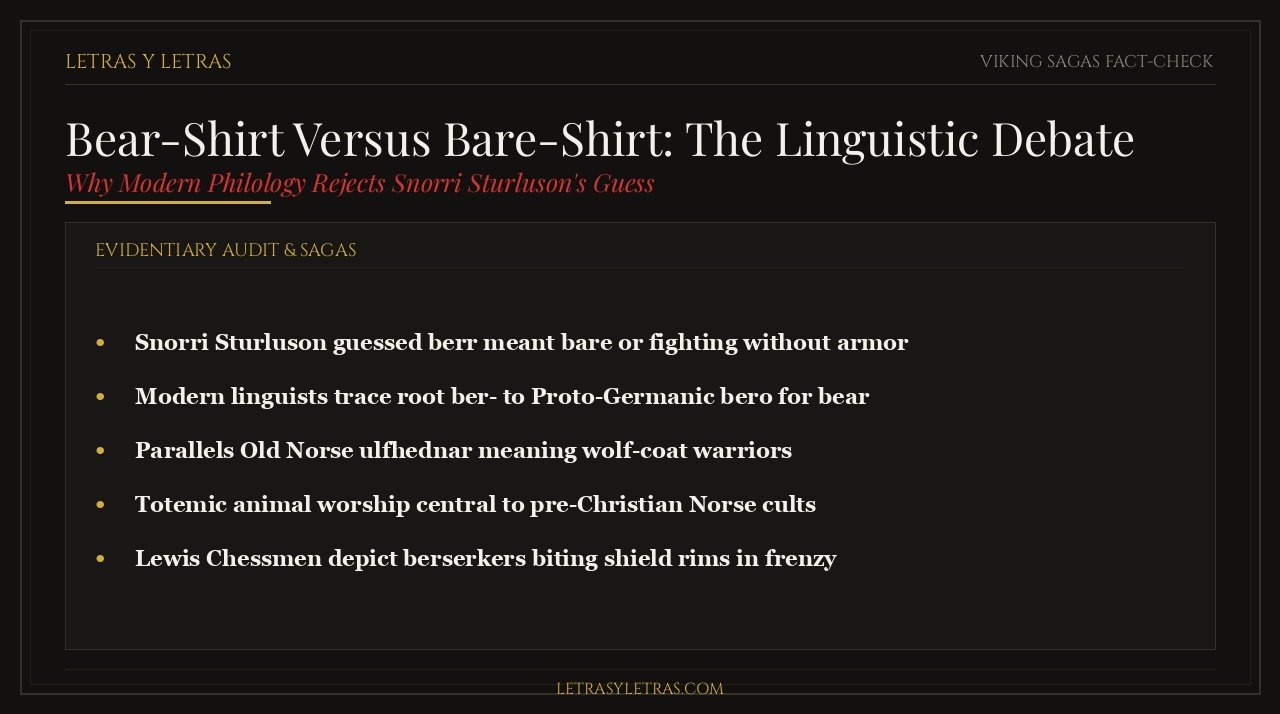
The first syllable sparked intense academic debate for over a century. In the thirteenth century, Icelandic historian Snorri Sturluson proposed a popular interpretation. Snorri suggested that ber derived from berr, meaning bare or naked.
Under Snorri’s reading, a berserker was a warrior who charged bare-chested into battle. He fought without heavy chainmail, relying entirely on the god Odin for supernatural protection. This barefoot warrior image captured romantic Victorian imaginations.
Modern philologists and comparative linguists have soundly rejected Snorri’s interpretation. Historical records confirm that ber- comes from Proto-Germanic *berô, meaning bear. A berserkr was quite literally a bear-shirt warrior.
Why Modern Philologists Reject the Bare-Shirt Theory
Linguistic evidence against the bare-shirt theory is overwhelming. The strongest proof comes from parallel Norse military brotherhoods. Old Norse texts frequently mention another group of elite fighters called the úlfhéðnar.
The noun úlfhéðnar translates cleanly as wolf-coats or wolf-pelts. These fighters dedicated themselves to Odin while wearing cured wolf skins. Pairing bear-shirts with wolf-coats reveals a clear cultural tradition of animal totems.
The Online Etymology Dictionary confirms that bear-shirt represents the established consensus among Germanic scholars. Snorri Sturluson was writing centuries after pagan rites vanished. The scholar merely guessed based on similar medieval sounds.
Pagan Germanic culture practiced ritual therianthropy, the spiritual adoption of animal forms. Warriors believed they could channel the raw ferocity of apex predators. Dressing in bear pelts was an act of ritual transformation.
By draping heavy pelts over their shoulders, Norse fighters claimed the bear’s monstrous strength. Enemies facing them on shield walls saw predatory beasts rather than ordinary men. The psychological impact proved devastating.
The Cult of Odin: The God of Ecstatic Fury
To understand why warriors adopted animal skins, we must examine Norse pagan religion. Berserkers were not mercenary soldiers. They served as dedicated religious initiates of Odin, the supreme Norse deity.
Odin’s own name holds the key to this spiritual connection. Linguists trace Odin back to the Proto-Germanic root *wōdaz. This archaic root meant ecstasy, inspired madness, poetic frenzy, and rage.
In Old High German, it produced wuot, modern German Wut, meaning intense anger. In Old English, it survived as wōd, meaning insane or wild. Odin was the master of altered mental states.
Initiates believed Odin bestowed divine battle frenzy upon his chosen champions. The god gave them immunity to mortal fear and supernatural resilience. Fighting in a bear pelt was an act of worship.
The Lewis Chessmen: Historical Proof Carved in Walrus Ivory
We possess remarkable physical evidence showing how medieval Scandinavians pictured these fighters. In 1831, a hoard of carved gaming pieces was discovered on the Isle of Lewis. Carved around 1150 CE, they are known as the Lewis Chessmen.
Several warder pieces depict berserker warriors standing guard on the chessboard. The carver rendered them with wild, bulging eyes and frantic expressions. Most famously, they are biting the upper rims of their kite shields.
Curators at the British Museum Lewis Chessmen collection note that shield-biting was a documented berserker trademark. Sagas describe warriors chewing iron rims to suppress nervous energy before combat began.
The ivory carvings confirm that berserkers wore helmets and carried sturdy weapons. They did not rush naked into battle lines. Their madness was psychological and spiritual, not an absence of clothing.
The Anatomy of Berserksgangr: The Warrior Trance
Norse sagas describe the berserker condition with clinical precision. Old Norse named this state berserksgangr, literally the berserker way or fit. It unfolded in distinct physiological stages.
The trance began with violent shivering and chattering teeth. The warrior’s face swelled and changed color, turning red with flushed blood or deathly pale. A feverish heat coursed through his limbs.
Next came uncontrollable acoustic rage. Men howled like wolves and growled like wounded bears. They struck their weapons against iron shields, working themselves into a frenzy where pain ceased to exist.
Sagas claim that during this trance, neither iron blades nor fire could harm them. In reality, their adrenaline levels were so extreme that severe injuries went unnoticed. They fought until heart failure or blood loss brought them down.
The aftermath was equally dramatic. Once the frenzy subsided, warriors collapsed into profound physical exhaustion. Men lay bedridden for days, plagued by muscle weakness and deep depression.
Berserkers in the Sagas: Egil and Bodvar Bjarki
The Icelandic sagas preserve vivid personal portraits of prominent berserker families. In Egil’s Saga, the author describes Egil Skallagrímsson’s ancestral lineage. Both his father and grandfather were notorious berserkers.
Egil’s grandfather was named Ulf, but people called him Kveld-Úlfr, meaning Evening-Wolf. As twilight fell, Ulf became quiet, withdrawn, and prone to sudden fits of animal rage. Sagas described him as hamrammr, meaning a shape-shifter.
Another celebrated account appears in the Saga of King Hrolf Kraki. The hero Bodvar Bjarki sits quietly in the king’s hall in deep meditation. Outside on the battlefield, a colossal spectral bear slaughters the enemy army.
When an ally awakens Bodvar from his trance, the phantom bear vanishes immediately. This saga tale illustrates the Norse belief in the fylgja. The fylgja was a warrior’s external animal soul acting in physical space.
Battle Formations: The Boar’s Snout and Stamford Bridge
Norse commanders deployed berserkers with strategic calculation. In massed land battles, commanders placed them at the front of a wedge formation called the Svinfylking. The term translated as the swine-array or boar’s snout.
Berserkers formed the sharp point of the charging wedge. Their role was to crash through the enemy’s locked shield wall through sheer physical terror. Once the wall cracked, ordinary Norse infantry poured through the breach.
Perhaps the most famous berserker legend occurred on English soil in 1066. At the Battle of Stamford Bridge, an unnamed giant Norse warrior held the narrow wooden bridge alone. He reportedly cut down dozens of Anglo-Saxon soldiers before an enemy speared him from below.
English chroniclers described the warrior’s terrifying frenzy in vivid detail. Chroniclers portrayed him as an unstoppable natural force. His stand marked the end of the Viking Age in Britain.
Mushrooms, Henbane, or Madness: What Caused the Fury?
Historians and medical researchers have debated what triggered this extreme physical state. In 1784, Swedish theologian Samuel Ödmann proposed that berserkers consumed fly agaric mushrooms. This red-capped mushroom contains hallucinogenic muscimol.
Modern toxicologists largely reject the mushroom hypothesis. Consuming fly agaric typically produces severe vomiting, tremors, and sluggish confusion. It rarely generates coordinated martial aggression on an active battlefield.
A more plausible botanical candidate is henbane, known botanically as Hyoscyamus niger. Henbane seeds contain hyoscyamine and scopolamine, powerful alkaloids causing wild delirium and aggressive fury. Archaeologists have discovered henbane seeds in Viking graves across Scandinavia.
Most historians believe the fury was primarily psychological rather than chemical. Pre-battle rituals, rhythmic chanting, and group hypnosis can induce dissociative states. Warriors trained their nervous systems to trigger massive adrenaline surges on command.
Similar psychological mechanisms appear in other combat traditions throughout world history. We analyze comparable military terms in our study of the origin of the phrase bite the bullet. Extreme physical stress often produces dramatic linguistic artifacts.
From Royal Shock Troops to Feared Outlaws
In early Scandinavian history, berserkers enjoyed elite social status. King Harald Fairhair employed them as personal royal bodyguards during the ninth century. At the decisive Battle of Hafrsfjord around 872 CE, berserkers defended the royal flagship.
Court skald Torbjørn Hornklofi praised their valor in his skaldic poem Hrafnsmál. He described how the wolf-coats screamed while cold iron clattered against wooden shields. Kings rewarded their ferocity with gold arm rings and high social rank.
As centralized Scandinavian kingdoms developed, uncontrollable shock troops became dangerous liabilities. Peacetime arrived, but berserkers could not turn off their violent instincts. Bands of armed men roamed the countryside demanding food and plunder.
In medieval Iceland, berserkers became notorious rural bullies. They exploited the legal custom of hólmganga, a formal duel to the death. A berserker would challenge a peaceful farmer, kill him, and claim his land and inheritance.
Scandinavian rulers took decisive legal action. Earl Eiríkr Hákonarson banned berserker bands across Norway in 1015 CE. Later in 1123 CE, the Icelandic legal code imposed banishment for anyone entering the trance.
Chronological Evolution of the Word Berserk
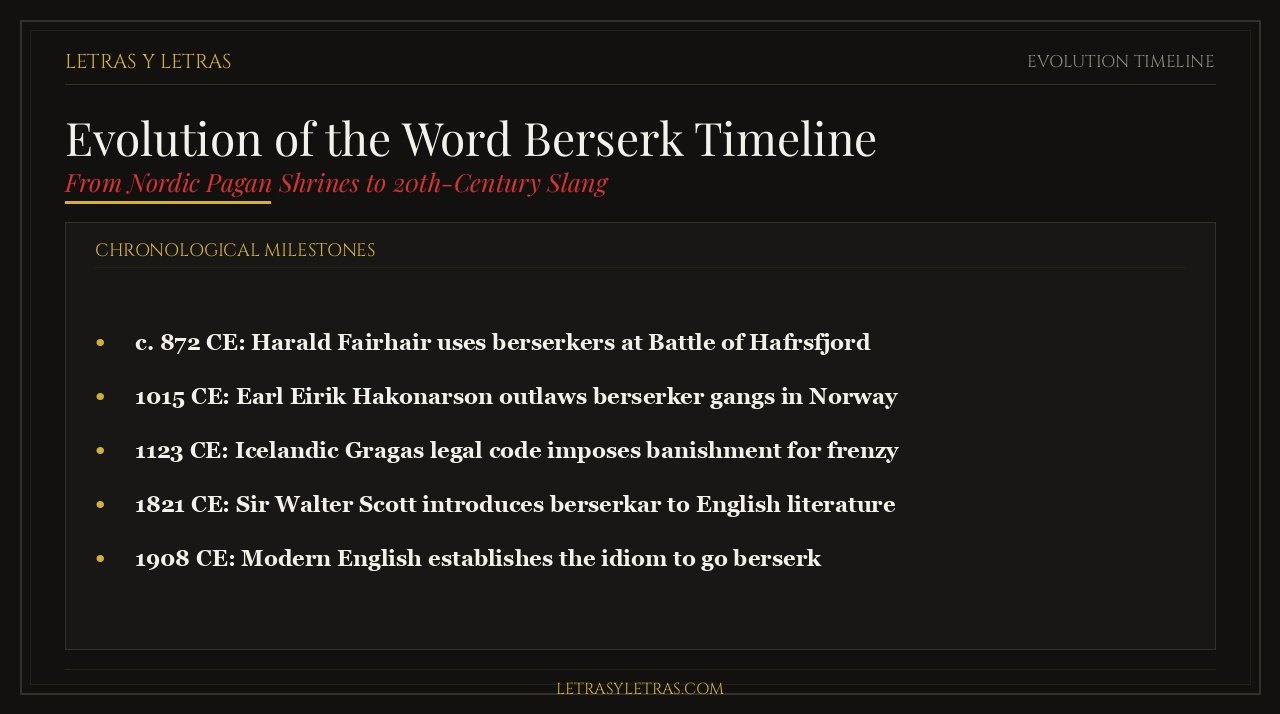
The historical timeline below summarizes the major cultural and linguistic milestones tracking the word across eleven centuries:
| Historical Era | Cultural Milieu | Linguistic and Historical Event |
|---|---|---|
| c. 872 CE | Harald Fairhair (Hafrsfjord) | Berserkers serve as royal shock troops on the flagship prow in skaldic poetry. |
| c. 1015 CE | Norwegian Royal Decree | Earl Eirik Hakonarson officially outlaws berserker bands and predatory dueling. |
| 1123 CE | Icelandic Gragas Law | Christian law code sentences anyone entering the berserksgangr trance to banishment. |
| c. 1220 CE | Snorri Sturluson (Ynglinga saga) | Snorri proposes the bare-shirt theory, arguing warriors fought without armor. |
| 1821 CE | Sir Walter Scott (The Pirate) | Scott introduces berserkar into English prose to describe wild Scandinavian fury. |
| 1850s | Victorian English Literature | Carlyle and Kingsley use berserk as a noun for reckless, heroic fighters. |
| 1908 CE | Modern English Colloquialism | The phrase to go berserk emerges as an everyday idiom for uncontrolled anger. |
Arrival in English: Sir Walter Scott and Victorian Romantics
The word vanished from European legal records for over six hundred years. It made an unexpected comeback during the nineteenth century. Scottish historical novelist Sir Walter Scott revived the term for English readers.
In 1821, Scott published his novel The Pirate, set in the remote Shetland Islands. Scott possessed a deep fascination with Scandinavian antiquities. In the novel, he described characters displaying berserkar fury.
Scott defined the term in an explanatory footnote. He explained that ancient Scandinavians experienced temporary fits of wild martial madness. Victorian writers quickly adopted the dramatic Nordic concept.
Essayist Thomas Carlyle used the term in his 1840 lectures on heroes. Novelist Charles Kingsley incorporated it into his historical fiction. In Victorian English, a berserker was viewed as a romantic, untamed warrior.
The word underwent a grammatical shift in early twentieth-century English. Originally an Old Norse noun meaning a person, it gradually became an English adjective. In 1908, printed records first document the popular phrase to go berserk.
Cognates Across Modern Scandinavian Languages
While English adopted the word as an adjective, Scandinavian languages maintained its original noun roots. In modern Norwegian and Danish, a berserk remains a person displaying uncontrolled fury. Swedish preserved the exact spelling bärsärk.
Swedish speakers use the phrase att gå bärsärkagång, meaning to go on a berserker rampage. The idiom retains the ancient grammatical structure of the Viking trance. Scandinavian legal history preserved the memory through centuries of folklore.
Linguistic preservation shows how deeply rooted the concept was in Nordic culture. We explore similar linguistic survival in our analysis of the origin of the word nemesis. Ancient pagan traditions survive across contemporary European idioms.
The Modern Semantic Shift: From Bloodshed to Commotion
Today, the word has lost its lethal association. We use it humorously to describe excited pets, frustrated drivers, and energetic children. The semantic evolution demonstrates how languages domesticate ancient terrors.
Fierce mythological figures often become mild idioms over time. What once terrified ancient communities now serves as everyday expressive color. Language softens brutal warfare into harmless hyperbole.
Scholarly etymological records compiled by Oxford Reference dictionaries track this dramatic transition. A lethal pagan shock troop transformed into a lighthearted colloquialism.
Yet the ancient history remains embedded in every syllable. When you say someone went berserk, you echo a thousand-year-old Nordic ritual. You recall bear-pelt warriors howling against sea spray on longship decks.
Exploring where our language comes from connects us with the human past. You can explore other fascinating backstories in our review of the origin of the word sincere. Everyday words carry extraordinary histories waiting to be uncovered.
Frequently Asked Questions
Does the word berserk mean bare shirt or bear shirt?
The word berserk means bear shirt. While medieval historian Snorri Sturluson suggested it meant bare shirt, modern philologists confirmed that ber- refers to the animal bear. Berserkers were warriors clad in bear skins.
Who were the historical Norse berserkers?
Berserkers were elite Norse warriors devoted to the god Odin. They fought in an intense trance called berserksgangr, displaying remarkable pain tolerance. King Harald Fairhair famously employed them as bodyguards during the ninth century.
What was the warrior trance known as berserksgangr?
Berserksgangr was a combat trance characterized by shivering, flushed skin, howling, and biting iron shields. Warriors experienced an extreme adrenaline rush that masked physical pain, followed by days of severe exhaustion.
Why were berserkers outlawed in Scandinavia?
Berserkers were outlawed because peacetime transformed them into violent criminals. Armed gangs roamed the countryside, challenging farmers to fatal duels to seize property. Norway banned them in 1015 CE, followed by Iceland in 1123 CE.
When did the word berserk enter the English language?
The word entered English literature in 1821 through Sir Walter Scott’s novel The Pirate. Scott introduced berserkar to describe Scandinavian fury, which evolved into the modern idiom to go berserk by 1908.
Alan Sledge is the founder and lead writer at letrasyletras.com, dedicated to uncovering the true etymological histories behind our favorite words and phrases.


Alan Sledge is the writer and founder behind Letters & Letters. A lifelong lover of words, Alan has always been drawn to the small mysteries hidden in everyday language, why we say what we say, where our favorite sayings came from and the quotes that manage to put feelings into words better than we ever could ourselves.

Alan Sledge
Alan Sledge is the founder and lead researcher behind Letters & Letters. A lifelong student of linguistic history, he cross-references every word origin, idiom, and quote against primary archival manuscripts, the Oxford English Corpus, and 18th-century print lexicons.