
Everyone has used the expression when waking up with a sore throat or a heavy head. We text coworkers that we cannot attend morning meetings. Close friends hear that an evening dinner party must wait.
Modern speakers assume the idiom refers directly to dark rain clouds or chilly winter winds. Bad weather makes people feel miserable. Yet the true origin of the phrase under the weather has nothing to do with modern meteorology.
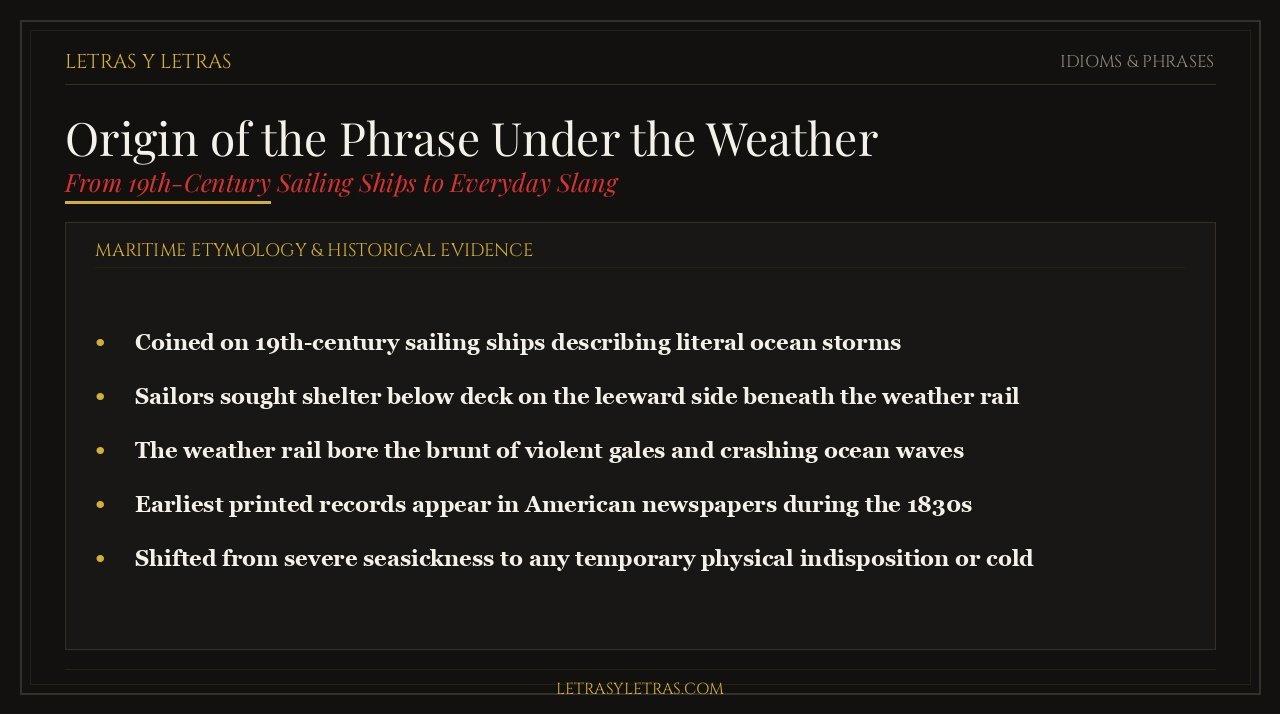
The phrase was forged inside the creaking timber hulls of nineteenth-century sailing vessels. It began as a literal description of violent ocean swells, howling gales, and debilitating seasickness. Sailors used the expression long before city dwellers adopted it.
Quick Answer: Origin of the Phrase Under the Weather
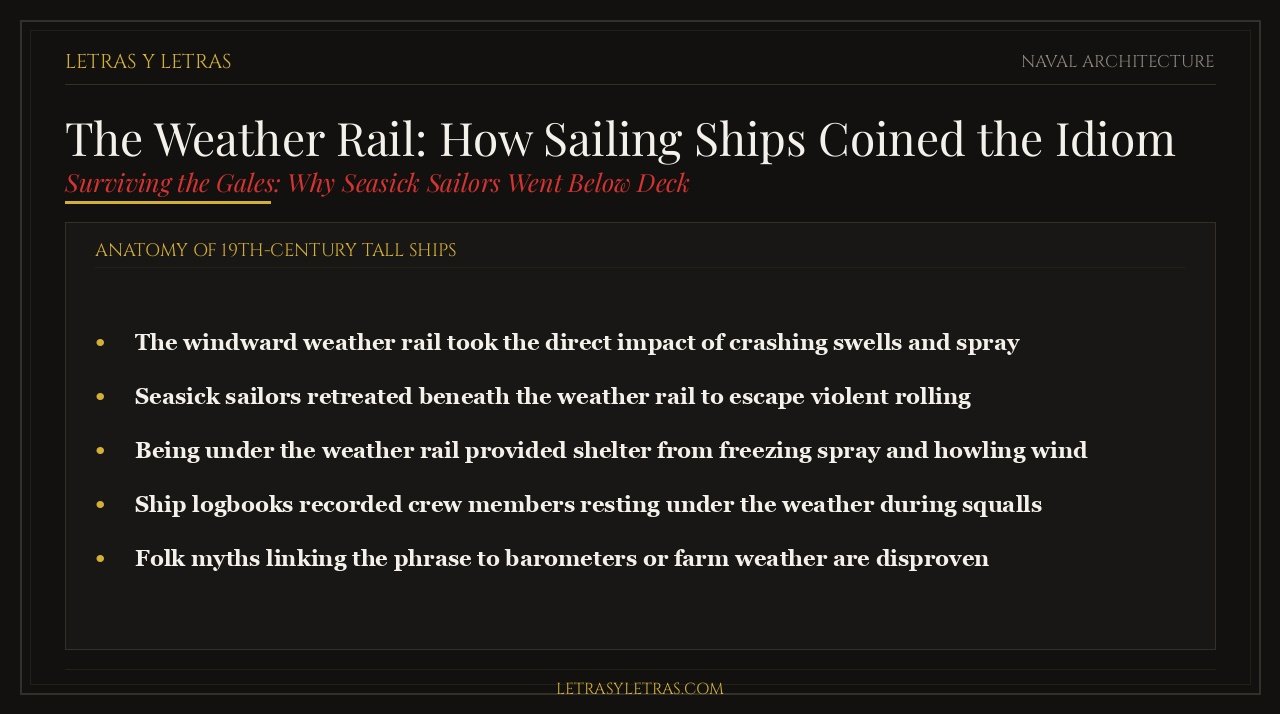
The origin of the phrase under the weather comes from nineteenth-century maritime naval history. On wooden sailing ships, the weather rail was the windward side directly taking the force of incoming storms. When sailors or passengers became violently seasick, officers sent them below deck to the leeward side. This protected lower berth was described as being under the weather rail. Below deck, the ship rolled less violently and shielded sick men from freezing spray. Over decades, the phrase shortened to under the weather and expanded to describe any temporary physical illness.
Key Takeaways
- Originates from nineteenth-century tall sailing ships battling open ocean storms.
- The weather rail was the exposed windward side taking direct waves and spray.
- Seasick sailors sheltered below deck on the leeward side under the weather rail.
- Earliest printed record appeared in the American newspaper Jefferson Republic in 1835.
- Folk theories connecting the expression to barometers or farm soil are demonstrably false.
The Anatomy of Tall Ships: What Was the Weather Rail?
To reconstruct the history of this idiom, we must examine nineteenth-century naval architecture. A square-rigged merchant vessel was a complex machine made of oak planks, iron bolts, and hemp rigging. It sailed at the mercy of unpredictable sea squalls.
Naval architects divided the deck into two distinct halves based on wind direction. The windward side faced directly into the incoming gale. Sailors called this exposed flank the weather side, while its protective boundary was the weather rail.
The opposite side was known as the leeward side. Because wind pressure tilted the ship, the leeward edge leaned closer to the ocean surface. Meanwhile, the weather rail rose high into the air, bearing the brunt of every incoming breaker.
When Atlantic squalls slammed into a ship, the weather rail took enormous physical punishment. Ocean water blasted across the wooden planks with terrifying velocity. Standing on the weather side during an ocean gale required veteran sea legs.
The term weather carried a harsher meaning for sailors than for modern urban pedestrians. Weather did not mean a mild morning drizzle. For mariners, it represented gale-force winds, crushing waves, and freezing temperatures.
Violence on the Deck: How Storms Induced Sea Misery
Ocean travel in the early nineteenth century was grueling and physically exhausting. Passenger liners and cargo brigs routinely crossed the North Atlantic in forty days. Living quarters were cramped, damp, and constantly in motion.
When storm systems developed, tall ships experienced severe corkscrew rolling and pitching. Waves twenty feet high broke over the bow. The constant violent motion wreaked havoc on the human inner ear balance system.
Violent nausea struck seasoned crew members and novice passengers alike. In naval logs, surgeons documented widespread prostration among the crew. Severe seasickness left victims dehydrated, dizzy, and unable to stand upright on tilted decks.
Working the sails while suffering from acute vertigo was hazardous. Sailors could easily fall from high yardarms or get swept overboard by crashing breakers. Ship captains had to remove sick crewmen from duty.
The upper deck offered no relief for an ailing body. Wind howled through the canvas sails, soaking everyone to the bone. A sick sailor exposed to the elements risked severe hypothermia alongside exhaustion.
Shelter Below Deck: The Literal Meaning of Under the Weather
Where did incapacitated sailors go when illness struck during a heavy storm? Ship captains ordered them below deck to the lowest berths. They sought refuge specifically beneath the sheltered leeward side of the vessel.
By climbing down the companionway hatch, sick crewmen escaped the wind. They positioned their canvas hammocks beneath the high protective shelter of the weather rail. In sailors jargon, they were resting under the weather rail.
This location provided two enormous physical benefits for a sick sailor. First, the thick oak timber hull blocked the freezing spray and icy gusts. Second, resting down low reduced the rotational motion of the vessel.
The phrase was initially descriptive and literal. If the boatswain asked about an absent sailor, crewmates replied that he was under the weather rail. Everyone on board understood the shorthand message immediately.
The sick man was safely tucked away below deck, waiting for his stomach to settle. He was sheltered beneath the stormy side of the ship until the squall passed. Over repeated voyages, sailors clipped the noun rail from the phrase.
From Sea to Shore: How Naval Jargon Spread Across Seaports
Maritime trade was the primary engine of global commerce throughout the nineteenth century. Thousands of merchant sailors docked in busy international seaports each week. They packed into local taverns, boarding houses, and dockside markets.
Sailors brought their rich colloquial dialect directly onto dry land. Like ancient Norse fighters in our origin of the word berserk, sailors transformed civilian speech. Port towns quickly absorbed naval vernacular.
When a retired captain felt feverish or exhausted, he announced he was under the weather. Landlubbers adopted the colorful phrase because it vividly captured the feeling of being battered by an unseen force. Sickness felt like an internal storm.
By the 1830s, the phrase was circulating widely in coastal American communities. Merchants, dock workers, and innkeepers used it casually. The phrase began appearing in personal diaries, letters, and regional publications.
Similar linguistic adoptions occurred with expressions like three sheets to the wind and feeling blue. The nautical world served as a fertile greenhouse for English figurative speech. Once a phrase gained popularity on land, its strict maritime boundaries faded.
The Earliest Documented Printed Records in American Newspapers
Linguists rely on historical print archives to date the emergence of idioms. For decades, etymologists searched through early nineteenth-century books and periodicals to locate the first printed instance. The trail leads directly to Missouri in 1835.
The earliest documented appearance in print occurred in the Jefferson Republic on August 15, 1835. An editorial writer used the expression casually in prose, noting that an individual was a little under the weather. The author offered no explanatory definition.
The absence of an explanation is critical evidence for lexicographers. It proves that readers in 1835 already recognized the phrase and understood its meaning. The idiom had clearly circulated orally for decades before appearing in print.
A second early citation appeared in the Boston maritime paper The Sailor’s Magazine in 1838. In this passage, a ship doctor described treating passengers who remained under the weather throughout an Atlantic crossing. Here, the nautical setting remained explicitly visible.
By the 1840s, newspapers across New York, Philadelphia, and Baltimore used the idiom regularly. Editors employed it to describe political candidates missing debates or prominent citizens suffering from seasonal influenza.
Debunking the False Myths: Barometers and Farm Legends
Folk etymology thrives when people forget the physical origins of old expressions. False origin stories often sound plausible because they lean on familiar modern imagery. We confronted similar invented fables in our analysis of the origin of the word sincere.
The most common false myth connects under the weather to mercury barometers. Proponents claim that when atmospheric pressure drops before a storm, humans feel physical joint pain. They assert that people standing under low barometric pressure coined the phrase.
Historical records completely refute the barometer hypothesis. Nineteenth-century sailors and physicians never described barometric readings using the preposition under. Ship officers recorded barometers as falling, low, or depressed, never as under the weather.
Another persistent myth attributes the saying to British agricultural workers. This story claims that laborers caught in heavy rains caught chills and became bedridden under the weather. While picturesque, no historical English farming dialect record supports this theory.
The Online Etymology Dictionary affirms that the phrase stems solely from maritime usage. Documented historical records trace under the weather rail directly, leaving no room for farm folklore.
Semantic Evolution: From Severe Seasickness to the Common Cold
Words and idioms change meaning as they move across generations. In linguistic studies, this process is known as semantic drift or broadening. The phrase under the weather underwent a classic expansion of scope.
Originally, the phrase described a severe, acute physical crisis. A sailor under the weather was vomiting violently, unable to walk, and unfit for manual labor. The condition was dangerous because it threatened the safety of the entire vessel.
As the idiom settled into urban everyday life, its severity softened considerably. Victorian speakers began using it as a polite, discreet euphemism. It was fitting for social situations where discussing bodily symptoms felt improper in polite company.
If an aristocrat had a mild headache, upset stomach, or slight sniffle, she was simply under the weather. The expression concealed the graphic reality of illness behind an elegant metaphor. It allowed people to bow out of commitments gracefully.
During the late nineteenth century, the idiom acquired another colloquial meaning. In American saloons and British pubs, men used it to describe a mild morning hangover. Having drank too much rum, a patron woke up feeling under the weather.
Chronological Milestones in the Evolution of Under the Weather
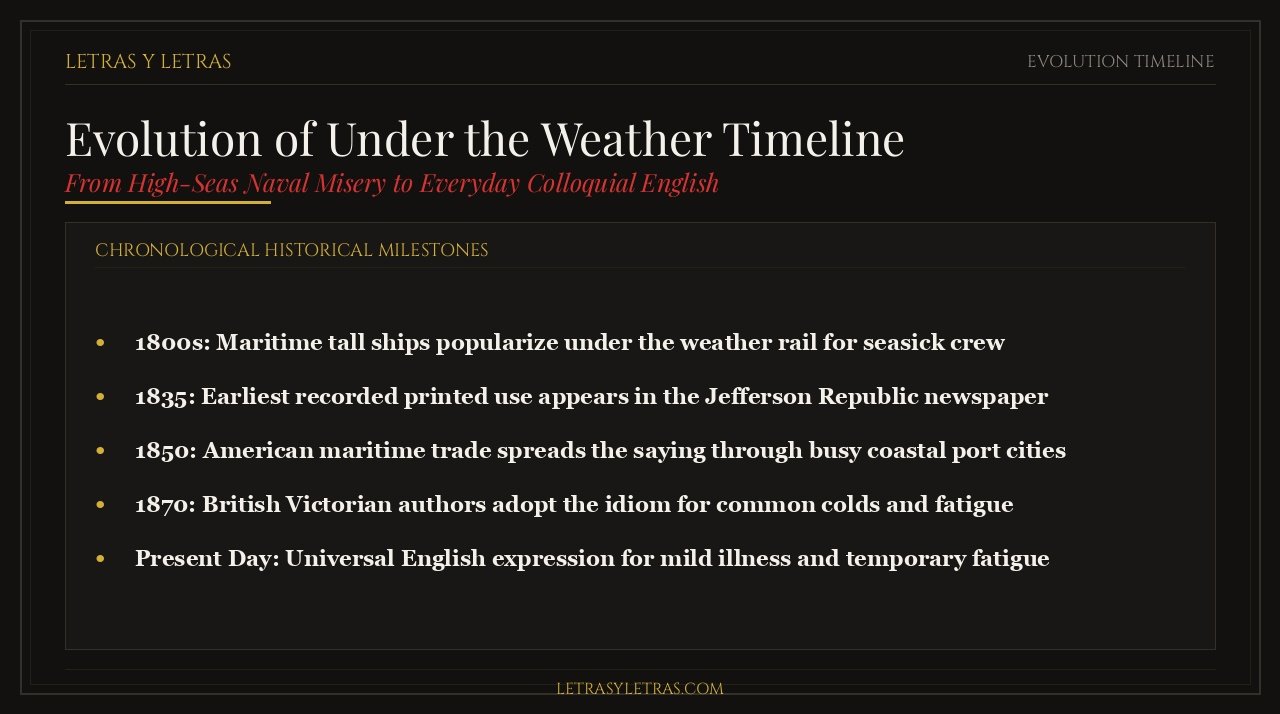
The chronological timeline below outlines the historical path of the idiom from wooden ships to modern global usage:
| Historical Era | Source and Setting | Linguistic Milestone |
|---|---|---|
| Early 1800s | Tall ship sailing crews | Seasick sailors rest below deck under the windward weather rail. |
| 1835 | The Jefferson Republic (Missouri) | First recorded printed use in an American newspaper column. |
| 1838 | The Sailor’s Magazine (Boston) | Naval publication documents passengers suffering below deck. |
| 1850s | American coastal seaports | Idiom spreads through taverns and commercial dock markets. |
| 1870s | Victorian English literature | Adopted as polite social euphemism for colds and fatigue. |
| Present Day | Global English conversation | Universal idiom describing mild physical indisposition or malaise. |
Victorian Literature and Worldwide Diffusion
The British Empire controlled global shipping routes during the nineteenth century. As American and British ships traded across ports in India, Australia, and South Africa, naval slang traveled with them. The phrase quickly became an international staple.
Victorian novelists loved incorporating seafaring expressions into their books. Authors like Charles Dickens and Robert Louis Stevenson frequently used sailor idioms to give color to working-class characters. Literature accelerated the normalization of naval vocabulary.
By the turn of the twentieth century, the original meaning of weather rail had vanished from common memory. Steamships replaced wooden square-riggers, eliminating the physical sails and wooden rails that created the saying. Yet the idiom survived intact.
Language often preserves the ghost of obsolete technology. We dial a telephone number on glass screens and roll up automobile windows with electric buttons. Similarly, we go under the weather without stepping foot aboard a wooden ship.
Lexicographical databases curated by Oxford Reference resources document this cultural diffusion across the English-speaking diaspora. The idiom established permanent residency in American, British, Canadian, and Australian dialects alike.
Other Maritime Expressions Sharing the Same Wooden Decks
Under the weather was not an isolated linguistic invention. The wooden decks of nineteenth-century sailing ships produced dozens of the most common idioms in the English language. Sailors lived in an intense, closed community with specialized vocabulary.
Consider the common expression three sheets to the wind. In naval terminology, a sheet is not a canvas sail, but the rope that controls the sail angle. If three sheets came loose, the sails flapped wildly, and the ship wobbled like a drunken man.
Another famous phrase is learning the ropes. A novice sailor had to memorize miles of running rigging in total darkness before becoming an able seaman. Today, new employees learn the ropes at modern office desks.
We see this nautical lineage across our guide to english idioms and meanings. You can also inspect military expressions in our origin of the phrase spill the beans.
Facing social embarrassment, job training, or mild illness, nautical speech provided concise imagery that resonated with everyday people. Ordinary citizens recognized their own daily challenges in the vivid language of the sea.
Why Physical Metaphors Survive in Language
Why did under the weather outlive the tall sailing ships that created it? Cognitive linguists argue that humans rely on physical spatial metaphors to express abstract internal feelings. When we feel ill, our internal energy drops downward.
We say we are feeling down, coming down with something, or falling sick. The spatial preposition under perfectly matches our physical experience of exhaustion. We feel pressed down by gravity, fever, or mental fatigue.
The image of stormy weather provides an instinctive parallel to bodily sickness. An infection feels like an internal tempest rocking our physical equilibrium. We crave a safe harbor where we can rest until the squall subsides.
By invoking the phrase under the weather, we subconsciously connect our temporary suffering to an ancient maritime ritual. We retreat to our beds, crawl beneath the blankets, and wait for calm seas to return. The phrase endures because human vulnerability remains unchanged.
Frequently Asked Questions
What is the literal origin of the phrase under the weather?
The literal origin comes from nineteenth-century sailing ships. On wooden tall ships, the weather rail took the direct force of ocean storms. Seasick sailors went below deck on the leeward side under the weather rail to rest where ship motion was gentler.
When was under the weather first used in print?
The earliest known printed appearance occurred in the American newspaper Jefferson Republic on August 15, 1835. Journalists used the phrase casually, proving that the expression had circulated orally in American seaports for many years prior.
Does under the weather refer to weather barometers?
No, the barometer theory is a debunked folk etymology. Historical ship logs and medical treatises never described low barometric pressure using the preposition under. The expression refers strictly to naval architecture and the protective weather rail of wooden ships.
Did the phrase originally mean a cold or seasickness?
The phrase originally referred specifically to severe seasickness during ocean storms. Over decades of shore use, the meaning broadened into a general term for temporary ailments like colds or headaches.
What was the difference between windward and leeward on a ship?
The windward side faced directly into the blowing wind and crashing waves, making it dangerous and wet. By contrast, the sheltered leeward side blocked the storm, providing safe haven for ailing crewmen.
Why do people still use the phrase today?
People continue using the phrase because it serves as a polite and universally recognized euphemism for mild illness. It allows someone to step away from social or work responsibilities without sharing private medical symptoms.
Alan Sledge is the lead writer at letrasyletras.com, uncovering the true historical origins behind everyday words.


Alan Sledge is the writer and founder behind Letters & Letters. A lifelong lover of words, Alan has always been drawn to the small mysteries hidden in everyday language, why we say what we say, where our favorite sayings came from and the quotes that manage to put feelings into words better than we ever could ourselves.