
Modern citizens use the term constantly when protesting unethical corporations or oppressive foreign regimes. We participate in consumer boycotts to demand corporate accountability. Nations frequently impose economic boycotts during geopolitical disputes.
Most political terms evolve slowly from ancient Latin roots or medieval French dialects. This famous word followed a completely different path. It sprang directly from the surname of an unpopular nineteenth-century retired British army officer.
The origin of the word boycott began during the bitter Irish Land War of 1880. A rural community united to isolate an unyielding landlord agent without firing a single shot. Within months, his surname became a permanent global verb.
Quick Answer: Origin of the Word Boycott
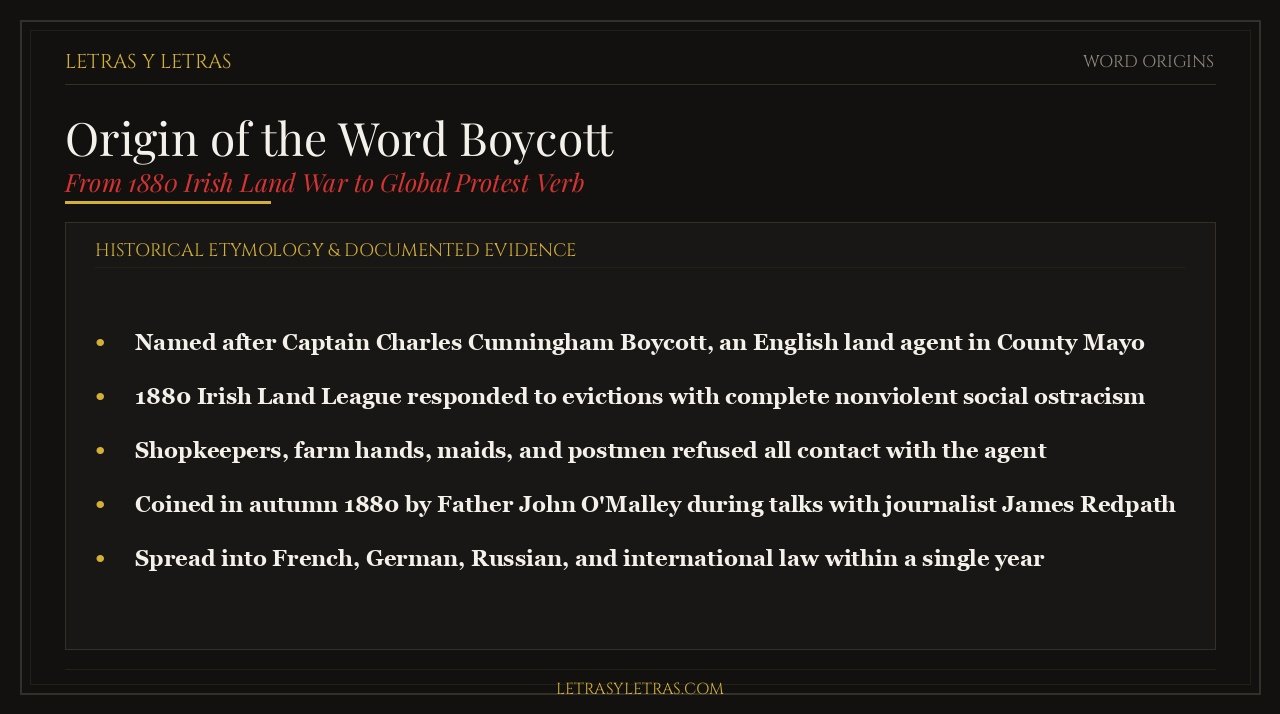
The origin of the word boycott dates to autumn 1880 in County Mayo, Ireland. It is an eponym named after Captain Charles Cunningham Boycott, an English land agent managing estates for the absentee Earl of Erne. When tenant farmers demanded rent reductions following poor harvests, Boycott refused and attempted evictions. In response, the Irish Land League organized complete nonviolent social and commercial isolation against him. Farm hands, domestic maids, village shopkeepers, and mail carriers refused all contact. Local parish priest Father John O’Malley coined the term boycott while discussing the tactic with journalist James Redpath. By November 1880, the London Times published the word, and it rapidly entered international legal vocabulary.
Key Takeaways
- Named after Captain Charles Cunningham Boycott, an English land agent in County Mayo.
- The 1880 Irish Land League responded to evictions with total nonviolent social isolation.
- Shopkeepers, farm laborers, blacksmiths, and postmen completely severed communication.
- Parish priest Father John O’Malley coined the verb during talks with an American reporter.
- Spread across global languages and international law within less than twelve months.
The Irish Land War: Famine, Evictions, and Lord Erne
To understand why this word emerged, we must revisit rural Ireland in 1880. Decades after the Great Famine, Irish tenant farmers remained trapped in poverty. Poor crop harvests and wet weather threatened thousands of families with starvation.
Wealthy Anglo-Irish aristocrats owned vast tracts of fertile land. Most landlords lived lavishly in London, leaving daily estate operations to hired land agents. In County Mayo, the third Earl of Erne employed Captain Charles Cunningham Boycott.
Boycott was a retired British military officer who managed fifteen thousand acres near Lough Mask. Local farmers viewed him as rigid, demanding, and unsympathetic to their plight. When potato crops failed in 1880, tenants requested a twenty-five percent rent reduction.
Lord Erne agreed to an eighteen percent discount, but Boycott refused to compromise further. When impoverished tenants fell behind on payments, Boycott issued formal eviction notices against eleven families. His harsh decision sparked immediate outrage.
Tenant farmers rallied around a clear reform charter known as the Three Fs. They demanded fair rent, fixity of tenure, and free sale of tenancy improvements. When British land agents refused these terms, rural society reached a boiling point.
Irish tenant farmers were no longer defenseless peasants. In 1879, political organizer Michael Davitt founded the Irish National Land League. The Land League gave tenant farmers an organized voice to challenge landlord abuses.
Charles Stewart Parnell: The Doctrine of Moral Isolation
In previous decades, desperate Irish tenant farmers often resorted to nocturnal violence. Armed secret societies burned haystacks, shot cattle, or attacked landlord agents under cover of darkness. British authorities responded with harsh martial law.
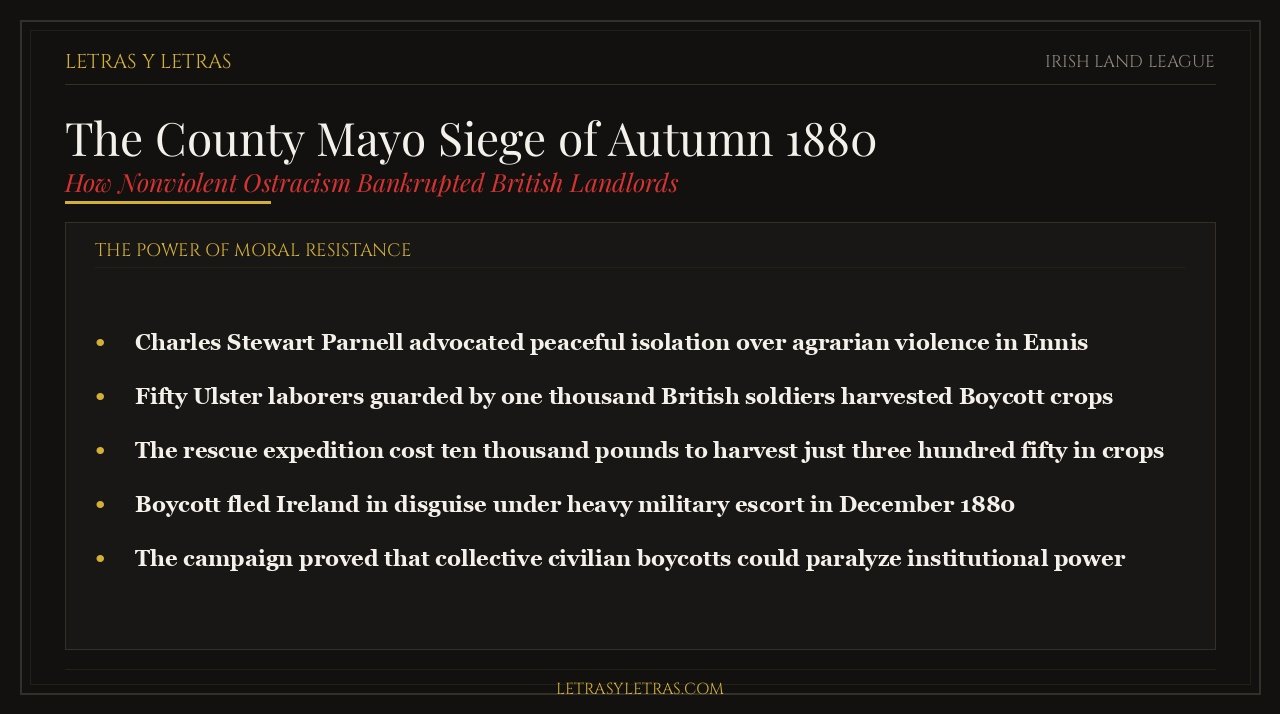
Irish nationalist leader Charles Stewart Parnell recognized that physical violence undermined their political cause. In September 1880, Parnell delivered a historic speech in Ennis, County Clare. Parnell proposed a radically new form of resistance.
Parnell asked the roaring crowd how they should punish a man who took an evicted tenant’s farm. The crowd shouted back violent suggestions. Parnell silenced them and offered a far more devastating moral weapon.
He urged the community to leave the offender severely alone. Villagers should shun him on streets, in shops, at public markets, and inside places of worship. Parnell compared the offender to an ancient leper cast out from society.
The policy avoided criminal violence while exerting immense economic pressure. County Mayo tenants decided to test Parnell’s new strategy against their unpopular land agent. Captain Boycott became the first target of this nonviolent campaign.
The Siege of Lough Mask: Total Social and Commercial Erasure
The local Land League implemented Parnell’s instructions with remarkable discipline and coordination. On September 22, 1880, Boycott’s thirty field laborers dropped their scythes and walked away. The domestic staff inside Lough Mask House departed immediately.
The social ostracism was complete and uncompromising. Village shopkeepers in nearby Ballinrobe refused to sell food, clothing, or oil to Boycott’s family. The local blacksmith refused to shoe Boycott’s carriage horses.
Laundresses refused to wash his clothes. When Boycott walked down village streets, townspeople crossed to the other side without acknowledging his presence. Even the rural letter carrier stopped delivering mail to his front gate.
Captain Boycott and his family attempted to harvest thirty acres of root crops alone. His daughters pulled potatoes in cold autumn rain while soldiers stood guard on the estate perimeter. The exhausting manual labor proved impossible for the small household.
Boycott found himself completely marooned on his vast estate. Tens of thousands of dollars worth of ripe grain and root crops were rotting in autumn mud. No laborer in Mayo would touch his fields for any wage.
Like ancient Romans in our origin of the word sincere, Irish tenants exercised moral solidarity. The community demonstrated that authority collapses when citizens refuse cooperation.
The Lough Mask Relief Expedition: A Costly Public Disaster
Growing desperate, Captain Boycott drafted an appeal to English public opinion. On October 14, 1880, the London Times published his dramatic complaint. Boycott claimed he was living under complete siege in County Mayo.
The letter sparked fury among British conservatives and Protestant landowners. Protestant leaders in northern Ulster organized an armed relief expedition to harvest Boycott’s crops. Fifty volunteer farm laborers traveled south to Lough Mask.
Fearing massive sectarian clashes, the British government deployed massive military force. Over one thousand regular British soldiers, cavalry units, and armed police accompanied the fifty Ulster laborers. Heavy rain turned the roads into swamps.
Irish Land League leaders strictly ordered tenant farmers not to interfere with soldiers. Villagers stood silently beside stone walls as the armed column marched past. The soldiers harvested crops in complete silence, surrounded by invisible resentment.
The expedition was an economic and political humiliation for the British government. Harvesting three hundred fifty pounds worth of crops cost taxpayers over ten thousand pounds. The Land League proved that collective nonviolent shunning was unstoppable.
Father John O’Malley Coins the Global Verb
While British troops harvested wet turnips under armed guard, journalists flocked to County Mayo. Among them was James Redpath, an influential American reporter writing for the New York Tribune. Redpath sought out local organizers.
Redpath struck up a close friendship with Father John O’Malley, the parish priest of Kilmolara. Sitting together in a modest Ballinrobe parlor, the men discussed the unprecedented protest. Redpath searched for an appropriate descriptive term.
Redpath suggested calling the tactic social ostracism. Father O’Malley shook his head in disagreement. O’Malley noted that simple tenant farmers would never use a fancy classical Greek word like ostracism.
The clever priest paused and offered an inspired linguistic alternative. O’Malley asked what Redpath thought of using the agent’s surname. He suggested using the phrase to boycott someone.
Redpath recognized the brilliance of the new term immediately. It was punchy, memorable, and directly rooted in current events. Redpath used the verb in his syndicated dispatches, sending it across the Atlantic Ocean.
Fleet Street and the Global Spread of the New Term
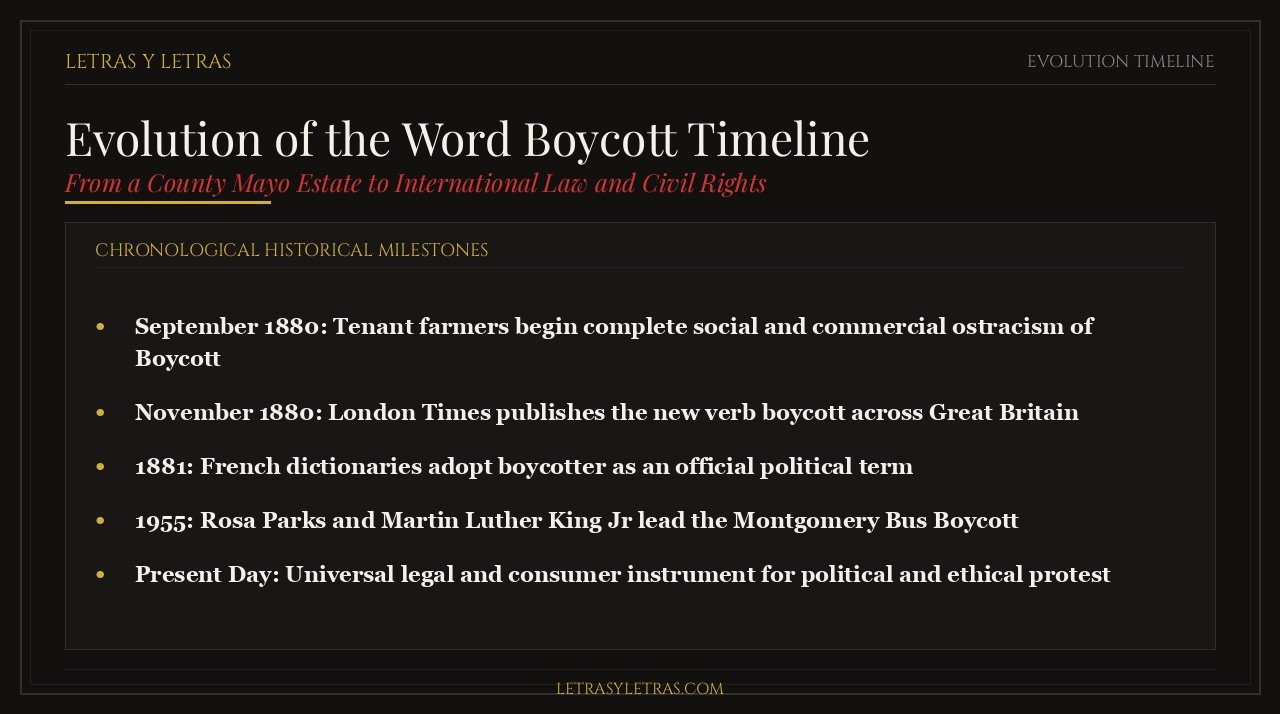
British newspapers picked up Redpath’s reports and adopted the new word eagerly. In November 1880, the London Times used the verb without quotation marks. British columnists realized the word filled a crucial linguistic void.
No existing English word captured organized collective commercial and social refusal. Ostracism was purely social, while embargo belonged to naval blockades. Boycott described a civilian economic weapon.
The political shockwave from Mayo forced the British government to pass the historic 1881 Land Act. Prime Minister William Gladstone introduced legal tribunals to fix judicial rents. The peaceful boycott weapon had reshaped the British legal landscape.
The word spread across international borders with unprecedented velocity. By 1881, French newspapers integrated boycotter into daily political discussions. German writers adopted boykottieren, while Russian journalists used boikot.
International law scholars incorporated the term into treatises on economic warfare. Within twelve months of Father O’Malley’s conversation, the word lived in dictionaries worldwide. A local Irish surname became permanent vocabulary.
We saw similar linguistic shifts when studying the origin of the word hazard. Words often outgrow their physical origins to become universal human concepts.
Captain Boycott’s Final Years: Living as an Eponym
What happened to the real man whose surname was captured by the English language? Captain Boycott realized his position in County Mayo was permanently untenable. On December 1, 1880, Boycott left Lough Mask House forever.
He fled to Dublin hidden inside a covered carriage under military protection. From Ireland, Boycott moved his family to England and eventually settled in Suffolk. He found employment as a land agent on the Flixton estate.
Boycott lived until 1897, enduring seventeen years as a living dictionary entry. When he visited London theaters or seaside resorts, strangers pointed at him in public. Tourists traveled to Suffolk simply to catch a glimpse of the man.
Family members reported that Boycott resented his unexpected linguistic immortality. He considered himself an honest administrator doing his duty under difficult circumstances. History, however, remembered him as a symbol of landlord arrogance.
The Online Etymology Dictionary records that boycott remains one of English’s cleanest eponyms. Few other terms preserve such an exact date, place, and historical inventor.
Chronological Milestones in the Evolution of Boycott
The historical timeline below summarizes the major events that transformed an Irish rent dispute into a global protest verb:
| Historical Date | Key Figures Involved | Milestone in Etymology |
|---|---|---|
| September 1880 | Charles Stewart Parnell | Delivers Ennis speech urging complete social shunning over agrarian violence. |
| September 1880 | Captain Charles Boycott | Refuses rent reduction; thirty field workers and household staff walk out. |
| October 1880 | Father John O’Malley | Coins the verb boycott in conversation with reporter James Redpath. |
| November 1880 | The London Times | Prints the new verb in Fleet Street dispatches, popularizing it across Britain. |
| 1881 to 1882 | European lexicographers | French, German, and Russian dictionaries adopt the verb for legal usage. |
| Present Day | Global civic movements | Universal legal instrument for consumer activism and ethical protest. |
Debunking False Myths: The Boston Tea Party and Ancient Greece
Because political boycotts feel ancient, popular historical writing often misattributes the word. Many amateur historians assume the term existed during the American Revolution. Writers describe colonists holding a tea boycott in Boston in 1773.
While American patriots indeed boycotted British tea, they never used that vocabulary. Eighteenth-century colonists called their agreements non-importation associations. Using the word boycott for 1776 is an anachronism.
Another common myth connects the word to Athenian democracy and ostracism. In ancient Athens, citizens voted to exile dangerous politicians using pottery shards called ostraka. That practice gave us ostracism, not boycott.
Athenian ostracism was an official legal exile voted by the state. An Irish boycott was a voluntary grassroots refusal organized by private citizens. The two concepts represent entirely different political traditions.
Lexicographical databases from Oxford Reference resources affirm the 1880 timeline. Every printed record proves that the word did not exist anywhere prior to autumn 1880.
From Irish Fields to American Civil Rights
The strategy invented in County Mayo became one of the most powerful tools of twentieth-century liberation movements. Leaders worldwide recognized that economic refusal could dismantle entrenched social oppression.
In 1955, Rosa Parks was arrested for refusing to surrender her bus seat in Montgomery, Alabama. Following her courageous arrest, minister Martin Luther King organized the Montgomery Bus Boycott. For 381 days, Black citizens walked rather than ride segregated buses.
The financial pressure crippled the municipal transit system and led to a landmark Supreme Court victory. In California, Cesar Chavez organized grape boycotts to secure basic rights for farm workers. Across South Africa, international economic boycotts hastened the collapse of apartheid.
The nonviolent DNA of the County Mayo Land War lived inside every one of these movements. Ordinary citizens realized they held immense power simply by keeping their hands in their pockets. Refusal remains a formidable democratic weapon.
Other Famous Eponyms in the English Language
Boycott belongs to a fascinating linguistic category known as eponyms. An eponym occurs when a real person’s proper name transforms into an everyday word. English preserves many such names from history.
Consider the word silhouette, named after eighteenth-century French finance minister Etienne de Silhouette. His extreme austerity measures inspired cheap black paper cutouts. Similarly, the sandwich honors John Montagu, fourth Earl of Sandwich, who ate meat between bread while gambling.
We see tactical and historical origins in our study of the origin of the phrase under the weather. You can also explore espionage codes in our guide to the origin of the phrase read between the lines.
Language ensures that historical actions remain immortal. Captain Boycott sought to evict eleven struggling families from their homes. In doing so, he accidentally gave humanity its most famous verb for moral resistance.
Frequently Asked Questions
Who was Captain Boycott in real life?
Captain Charles Cunningham Boycott was an English retired military officer who worked as a land agent in County Mayo, Ireland. In 1880, his refusal to reduce tenant rents provoked the historic protest that made his surname famous.
Who coined the word boycott?
Father John O’Malley coined the verb during an autumn 1880 conversation with American reporter James Redpath. O’Malley suggested using the land agent’s surname instead of the complex word ostracism.
When was the word boycott first printed?
The word first appeared in print in autumn 1880 in newspaper columns by James Redpath. By November 1880, the London Times adopted the verb, cementing its usage across the English-speaking world.
What was the Lough Mask relief expedition?
The relief expedition deployed fifty Ulster laborers guarded by one thousand British soldiers to harvest Boycott’s crops. It cost ten thousand pounds to save three hundred fifty pounds in produce.
Did the word boycott exist before 1880?
No, the word boycott did not exist prior to 1880. Although economic shunning is ancient, the specific English word was created during the 1880 Irish Land War.
How does a boycott differ from an embargo?
A boycott is typically a voluntary refusal organized by private citizens or consumer groups. An embargo is an official legal prohibition enforced by government authorities against trade with a foreign state.
Alan Sledge is the lead writer at letrasyletras.com, uncovering the true historical origins behind everyday words.


Alan Sledge is the writer and founder behind Letters & Letters. A lifelong lover of words, Alan has always been drawn to the small mysteries hidden in everyday language, why we say what we say, where our favorite sayings came from and the quotes that manage to put feelings into words better than we ever could ourselves.