
Morning light filters across porcelain diner counters as steam drifts from thick ceramic mugs. Waitresses refill cups without asking. In office break rooms and bustling cafes, millions of Americans ask for a cup of joe each morning.
We utter the phrase without giving it a second thought. The words feel warm, unpretentious, and completely familiar.
Few drinkers ever pause to consider where this curious label originated. The true origin of phrase cup of joe reveals a battle between popular folklore and forgotten military slang.
Quick Answer: Origin of the Phrase Cup of Joe
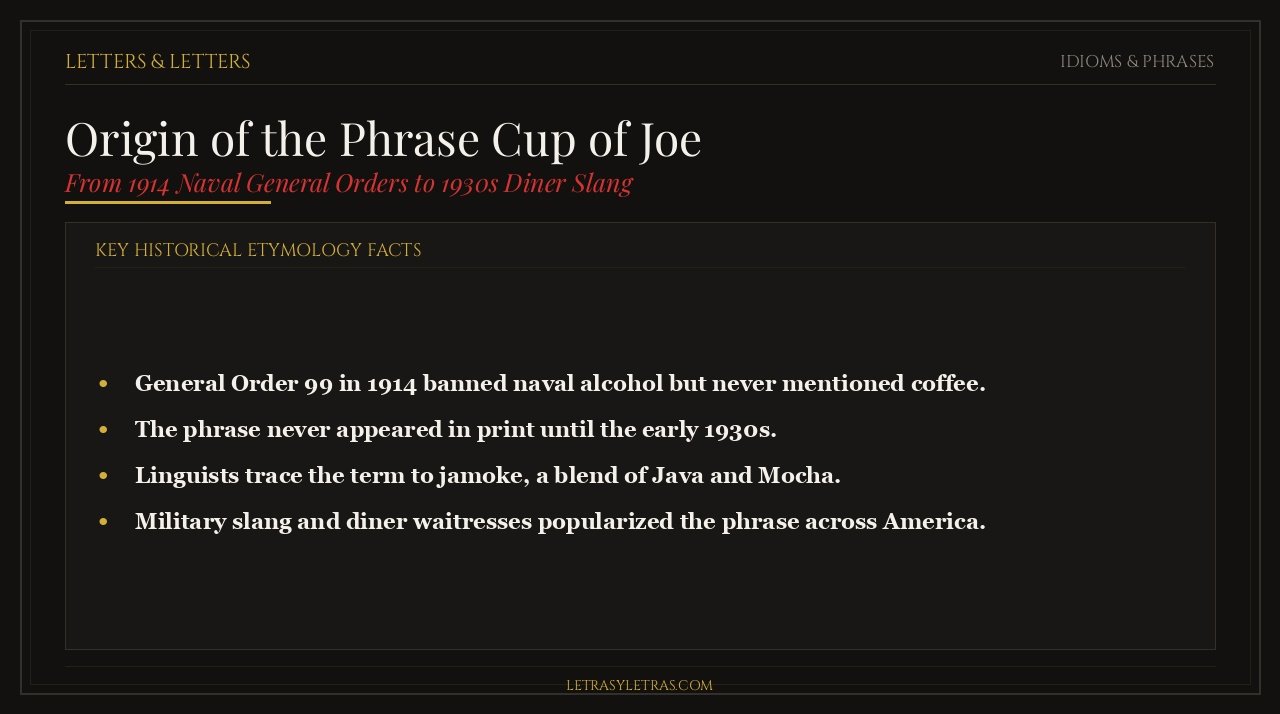
The phrase cup of joe first appeared in American print during the early 1930s. Popular folklore attributes the phrase to Secretary of the Navy Josephus Daniels, who banned shipboard alcohol in 1914. Historical records disprove this legend because the term never appeared in naval documents during World War I. Professional linguists trace the word to jamoke, a late nineteenth century blend of Java and Mocha. American sailors and diner waitresses shortened jamoke to joe. The term quickly became the everyday beverage of the average working man.
Key Takeaways
- General Order 99 prohibited alcohol on naval vessels in 1914 but never mentioned coffee.
- The phrase cup of joe remained absent from print for sixteen years following the naval ban.
- Linguists consider joe a phonetic simplification of jamoke, blending Java and Mocha.
- The term also drew inspiration from Joe as slang for the common working man.
- American Speech first documented the term as military slang in 1931.
The Legend of General Order 99: Josephus Daniels in 1914
Tour guides on historic warships love sharing a tidy legend about morning coffee. The tale centers on Josephus Daniels, a devout Methodist newspaper editor whom President Woodrow Wilson appointed Secretary of the Navy.
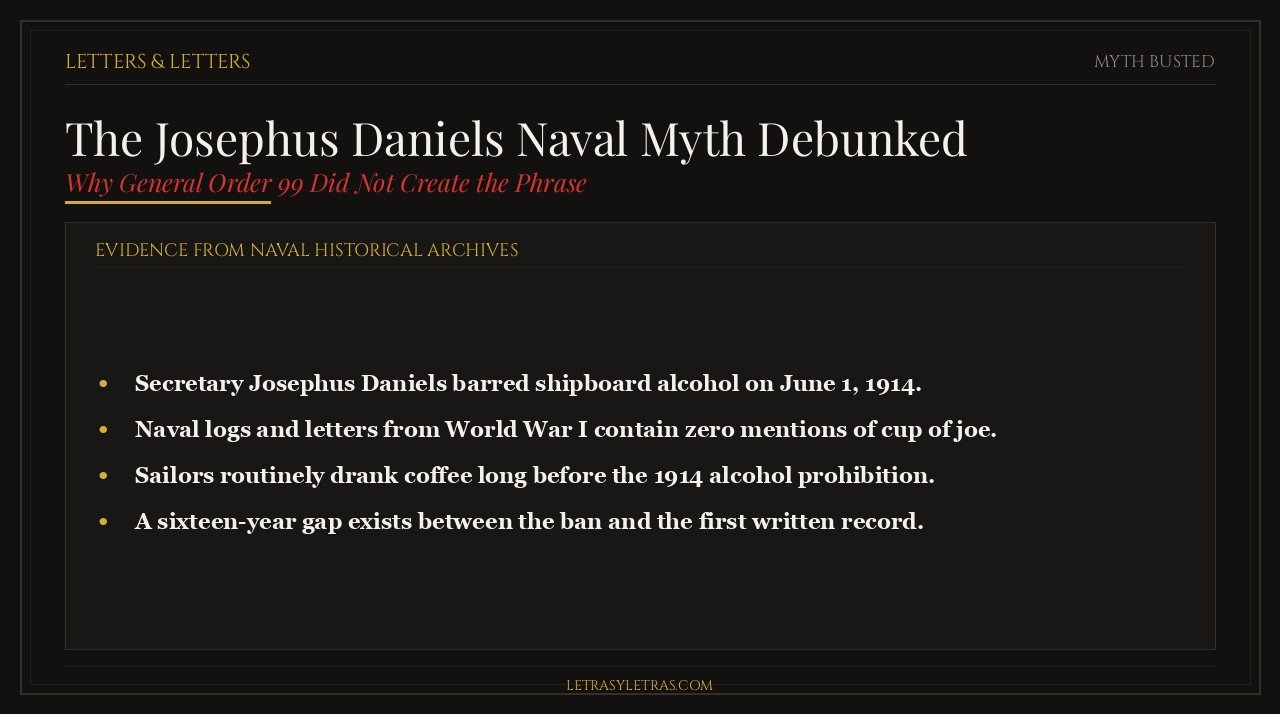
Daniels believed alcohol compromised military discipline and moral integrity. On June 1, 1914, he signed General Order 99, effectively ending centuries of alcoholic tradition across the fleet.
Officers lost their private wine mess privileges aboard naval vessels. According to popular legend, bitter sailors turned to strong black coffee as their sole remaining stimulant.
Sailors supposedly mocked their moralizing secretary by christening their dark brew a cup of Josephus. In folklore versions, this spiteful title quickly shortened to a cup of Joe.
The story appears in countless trivia books, television segments, and corporate coffee blogs. It sounds delightfully authentic, fitting our desire for sharp historical irony.
Archival evidence tells a completely different story. Official records in the naval archives show that the order banned alcohol without mentioning coffee once.
Enlisted sailors had already lost their daily rum rations back in 1862 during the Civil War. Daniels simply extended that prohibition to the wardroom officers.
Sailors had been drinking massive quantities of coffee for decades before 1914. The beverage was already standard naval fuel across the Atlantic and Pacific oceans.
The fatal blow to this theory lies in the chronological paper trail. If disgruntled sailors coined the term in 1914, it should appear in wartime letters, journals, or ship newspapers.
World War I produced millions of letters from sailors and soldiers stationed across European waters. Not a single surviving diary or military publication from that decade mentions a cup of joe.
A full sixteen years passed between General Order 99 and the first documented appearance of the phrase. Slang rarely remains completely invisible in print for over a decade.
We observe identical myths in our study of the origin of the phrase passing with flying colors. People prefer memorable anecdotes over messy linguistic evolution.
The Linguistic Paper Trail: From Jamoke to Joe
If Secretary Daniels did not inspire the phrase, where did the name originate? The most compelling answer comes from phonetic evolution and commercial trading history.
During the nineteenth century, global coffee commerce revolved around two renowned growing regions. One source was Java, the fertile Dutch East Indies island producing dark, earthy beans.
The other primary origin was Mocha, the ancient port city in Yemen known for chocolatey, aromatic harvests. Coffee merchants routinely combined these crops to create balanced morning roasts.
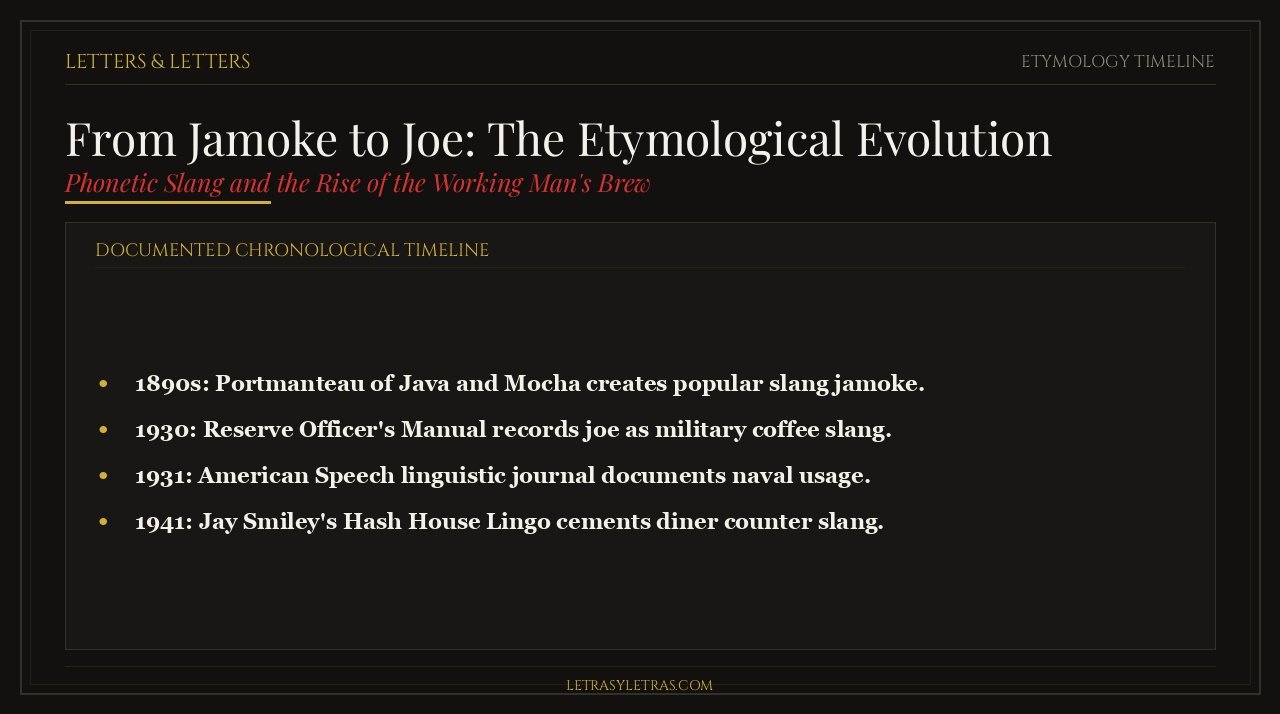
American consumers embraced this classic blend. By the 1890s, popular street slang fused the two geographical names into a single portmanteau word: jamoke.
Hobos, railway workers, and soldiers adopted jamoke as universal slang for coffee. Entries in the etymology dictionary confirm that jamoke spread across urban centers before 1900.
Spoken English continually seeks phonetic shortcuts. Speakers naturally discard awkward consonants and extra syllables to speed up casual conversation.
Just as bicycle became bike, jamoke gradually softened on the tongue. In bustling military galleys, calling for jamoke quickly clipped down to joe.
The earliest verified appearances in print support this phonetic transition. In 1930, naval author Paul Erdman published the Reserve Officer Manual, listing joe as current service slang.
One year later, in 1931, the linguistic quarterly American Speech documented the word. Scholars defined joe as common military argot for hot coffee.
This tight timeline between 1930 and 1931 proves the expression solidified within armed service branches. It emerged as casual phonetic shorthand rather than political satire.
Language lovers frequently discover that words take unexpected phonetic paths. We explore similar sound transformations in our study of the origin of the word sandwich. Everyday terms often simplify long names into punchy monosyllables.
The Average Joe: The Working Man’s Brew
Another linguistic factor helped cement joe in American speech. The name Joe has long functioned as a generic label for the ordinary working man.
Dialect records show that speakers used Joe to denote a common fellow as early as 1846. Everyday culture created expressions like Joe Sixpack, average Joe, and holy Joe.
During the Great Depression of the 1930s, coffee became the ultimate egalitarian beverage. It was affordable, accessible, and essential for laborers enduring long shifts.
Factory workers, shipyard welders, and unemployed citizens queuing at charity stands relied on cheap black coffee. It was truly the drink of the average Joe.
Linguists suggest these two cultural currents merged naturally. The phonetic shortening of jamoke blended smoothly with the social symbolism of the common man.
Ordering a cup of joe was equivalent to asking for an honest, working man’s drink. It lacked pretension, matching the gritty optimism of mid-century industrial America.
Our language frequently uses common personal names to describe ordinary objects. We see this linguistic habit in our historical breakdown of the origin of the word scapegoat. Familiar names provide comfortable metaphors for shared human experiences.
The Martinson Coffee Legend: A New York Marketing Tale
A rival commercial origin story points toward Lower Manhattan. In 1898, a Jewish immigrant named Joe Martinson founded a coffee roasting company on Water Street.
Martinson selected beans by hand and roasted them in small batches. He personally delivered fresh tins to upscale restaurants, hotels, and neighborhood markets from a horse-drawn cart.
According to family lore, grateful restaurant patrons praised the rich dark blend. Customers began demanding coffee from Joe, which supposedly evolved into a cup of Joe.
The Martinson family embraced this narrative enthusiastically. In later decades, the company launched advertising campaigns asserting their founder created the phrase.
Their advertising agency even filed legal trademarks to protect their claim. The story provided delightful marketing copy for a beloved New York roasting institution.
Linguistic historians remain deeply skeptical of this corporate legend. While Martinson Coffee was popular in Manhattan, it remained a localized regional brand until mid-century.
Slang terms rarely migrate from a single neighborhood roaster into nationwide military slang without intermediate regional records. The timeline fails to explain why military bases in California adopted the phrase before East Coast civilians.
Like many brand origin legends, the Martinson story is a charming post-hoc rationalization. It reflects civic pride rather than verifiable etymological history.
The G. Washington Instant Coffee Connection
A lesser-known theory connects the phrase to early twentieth century battlefield innovation. It centers on George Washington, an inventive Belgian-American businessman living in Brooklyn.
In 1909, Washington invented the first commercially viable instant coffee powder. He founded the G. Washington Coffee Refining Company to manufacture his quick-dissolving crystals.
When the United States entered World War I in 1917, military planners faced logistical challenges. Feeding soldiers in muddy frontline trenches required shelf-stable rations that could be prepared without fires.
The War Department purchased every canister of instant coffee Washington could produce. American doughboys received individual packets in their daily combat rations.
Soldiers in French trenches joked about their synthetic morning drink, calling it a cup of George. According to some theorists, soldiers abbreviated the name on ration crates to Geo, which morphed into Joe.
Lexicographers at Merriam-Webster classify this explanation as speculative folklore. While doughboys drank massive quantities of Washington coffee, written letters from trenches never recorded the abbreviation.
Soldiers consistently called their ration coffee mud, battery acid, or jamoke. The George hypothesis remains an amusing curiosity of military ration history.
Chronological Evolution: How Coffee Earned Its Name
Tracing the phrase through print records clarifies how folklore separated from documented history. This chronological table outlines every verified milestone in the phrase’s evolution.
| Year | Historical Milestone | Significance to Coffee History |
|---|---|---|
| 1846 | American Dialect Records | The word joe emerges in print as slang for an ordinary fellow or common man. |
| 1890s | Urban Coffee Houses | Jamoke appears as a slang blend of Java and Mocha beans in American cities. |
| 1914 | General Order 99 | Secretary Josephus Daniels bans naval alcohol, spawning the popular folklore origin legend. |
| 1917 | World War I Rations | Doughboys consume G Washington instant coffee across European trenches. |
| 1930 | Reserve Officer Manual | Earliest verified written recording of joe as military slang for coffee. |
| 1931 | American Speech Journal | Linguists publish the first academic definition of joe as naval coffee slang. |
| 1941 | Hash House Lingo | Jay Smiley documents a cup of joe as standard American diner counter jargon. |
The Diner Era: Slang Behind the Counter
The leap from military galleys to civilian breakfast counters happened during the late 1930s. Economic hardship during the Great Depression stimulated a boom in roadside diners across the country.
Diners offered affordable, unpretentious meals served at high speed. To speed up communication in the noisy kitchen, short-order cooks and waitresses created a colorful counter shorthand.
Eggs sunny side up were called eyes open. Toast was dubbed a shingle, and milk became cow juice.
Within this fast-paced restaurant subculture, coffee required its own punchy nickname. Waitresses adopted the military slang, shouting orders for a cup of joe down the service line.
In 1941, author Jay Smiley codified this subculture in his dictionary Hash House Lingo. He confirmed that diner staff used a cup of joe universally to mean a cup of hot black coffee.
Radio broadcasts and Hollywood motion pictures carried diner slang into millions of American households. Hard-boiled detectives and blue-collar movie heroes ordered cups of joe on the silver screen.
World War II accelerated this cultural spread. Millions of returning soldiers carried service slang into civilian neighborhoods.
By the 1950s, the phrase was entrenched as an American idiom. It no longer belonged to sailors or waitresses alone.
Every morning commute was powered by the same humble cup. The term came to symbolize industriousness, hospitality, and everyday perseverance.
Readers can explore our detailed guide of english idioms and meanings to discover everyday sayings. Exploring idiom origins connects us to the colorful generations of working people who shaped our speech.
We discover similar theatrical origins in our analysis of the origin of the phrase break a leg. Countercultural slang frequently crosses into mainstream culture through sheer expressive energy.
Sayings reflect ancient customs, as shown in our guide to the origin of the phrase bless you. The words we utter every morning carry deep historic roots.
Frequently Asked Questions
Where did the phrase cup of joe come from?
The phrase cup of joe originated as American military slang in the early 1930s. Most linguists consider it a phonetic simplification of jamoke, which blended Java and Mocha coffee beans. The term was reinforced by the slang use of Joe to describe the average working man.
Did Josephus Daniels invent the cup of joe?
No, historical evidence disproves the Josephus Daniels legend. Daniels banned alcohol on naval ships in 1914, but the phrase never appeared in print until 1930. A sixteen year gap separates his alcohol ban from the first written appearance of the phrase.
What does the word jamoke mean?
Jamoke is a slang portmanteau created in the late nineteenth century by combining the words Java and Mocha. Sailors, railroad crews, and hobos used it to refer to strong black coffee. Over time, speakers shortened jamoke to joe.
When was the phrase cup of joe first printed?
The phrase first appeared in print in 1930 in Paul Erdman’s Reserve Officer Manual. In 1931, the academic journal American Speech formally documented joe as current naval slang. By 1941, Jay Smiley’s Hash House Lingo recorded the term in American diner culture.
Why did diner waitresses use coffee slang?
Diner waitresses developed specialized slang during the 1930s to communicate orders rapidly over noisy restaurant counters. Shorthand phrases sped up kitchen service. Radio, cinema, and returning soldiers helped popularize the slang nationwide.
Is cup of joe still used today?
Yes, cup of joe remains one of the most recognized coffee idioms in American English. Modern cafes feature espresso drinks, but a cup of joe still represents an honest cup of coffee.
Alan Sledge is the founder and lead writer at letrasyletras.com, dedicated to uncovering the true etymological histories behind our favorite words and phrases.


Alan Sledge is the writer and founder behind Letters & Letters. A lifelong lover of words, Alan has always been drawn to the small mysteries hidden in everyday language, why we say what we say, where our favorite sayings came from and the quotes that manage to put feelings into words better than we ever could ourselves.