
A piercing acoustic wail cuts through heavy city traffic. Ambulance drivers clear intersections as flashing red lights reflect off towering storefronts. Motorists instinctively yield, responding to the unmistakable call of an emergency siren.
Modern city dwellers hear mechanical sirens daily. We recognize their wailing pitch as an urgent summons to clear roadways and preserve lives.
Most listeners never connect this mechanical device to ancient Greek poetry. The word did not originate in industrial workshops or municipal firehouses. It began nearly three thousand years ago on sunlit Mediterranean reefs littered with bleached bones.
Quick Answer: Origin of the Word Siren
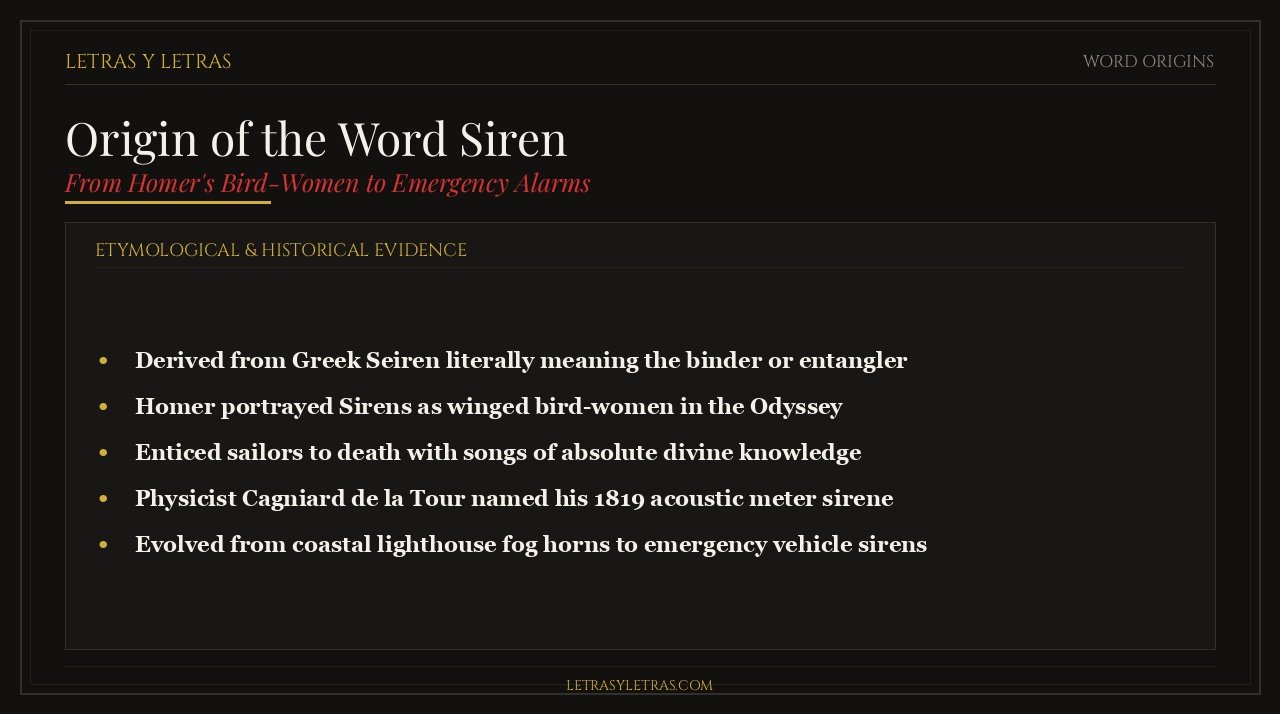
The word siren comes from the ancient Greek Seiren. Homer depicted them as winged bird-women luring sailors onto lethal reefs with song. In 1819, French physicist Charles Cagniard de la Tour named his acoustic instrument sirène.
Key Takeaways
- Derived from the Greek Seiren, likely meaning the binder or entangler of men.
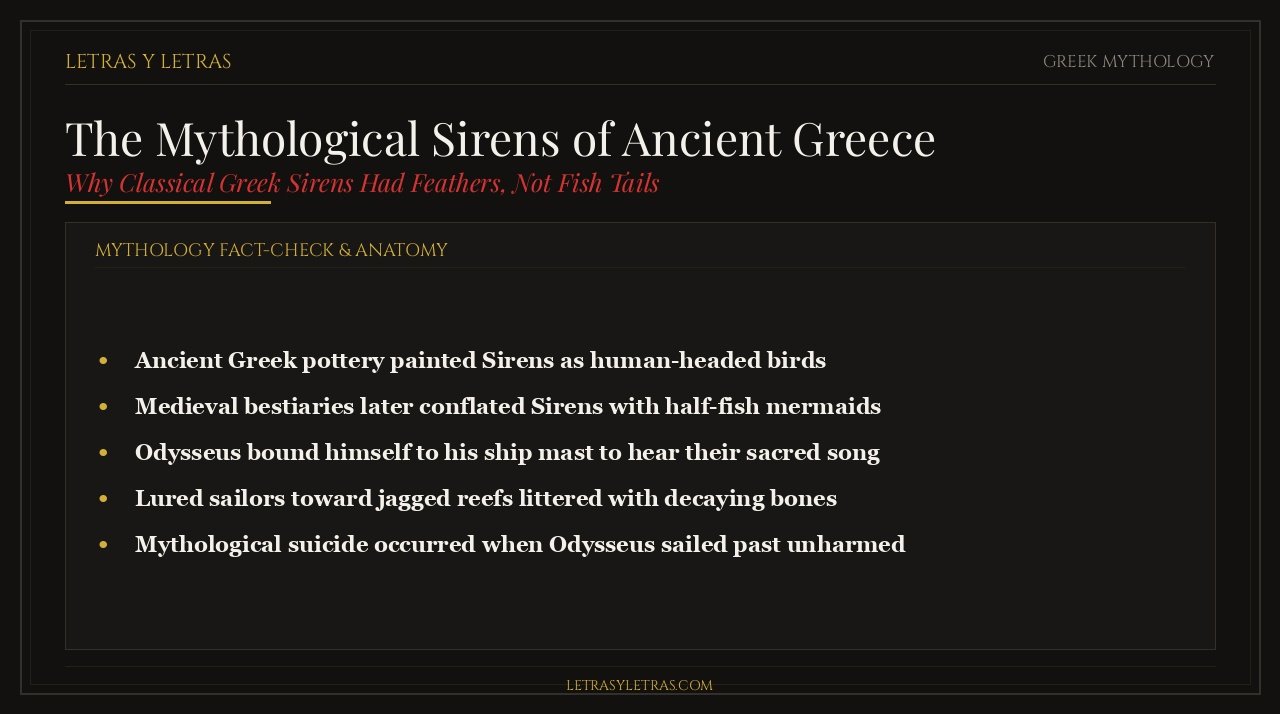
- Ancient Greeks depicted Sirens as winged raptor birds with human female heads.
- Medieval folklore later conflated classical avian Sirens with fish-tailed mermaids.
- Physicist Charles Cagniard de la Tour coined the mechanical name for his 1819 sound meter.
- Coastal lighthouses adopted steam-driven sirens to warn ships away from dangerous reefs.
The Homeric Sirens in the Odyssey
To discover the true origin of the word siren, we must examine Book 12 of Homer’s epic Odyssey. Odysseus prepares to sail past an infamous coastal meadow on his voyage home to Ithaca. The sorceress Circe delivers a grave warning about the perils ahead.
Circe warned that whoever approached the Sirens in ignorance never returned home to his wife and children. The creatures sat amidst green meadows surrounded by rotting heaps of human remains. Skulls and decaying skin littered the rocks, grim proof of their lethal acoustic enchantment.
The Perseus Digital Library classical texts reveal the exact nature of their temptation. Their song was not an invitation to romantic lust. They promised divine, limitless knowledge to any mortal willing to listen.
The Sirens sang that they knew all sufferings endured upon the plains of Troy. They claimed knowledge of everything occurring across the fertile earth. To Greek minds, the promise of cosmic wisdom proved far more seductive than physical pleasure.
Odysseus devised an ingenious defense. He stopped his sailors’ ears with softened beeswax, commanding them to row without pause. Odysseus had himself lashed securely to the mast, ordering crewmen to tighten the ropes if he pleaded.
Feathers, Not Fins: The Ancient Iconography
Ask modern readers to picture a siren, and they will describe a mermaid with shimmering fish scales. Popular culture routinely blends the two mythical figures into one aquatic hybrid. Classical Greek reality was entirely different.
In ancient Greek vase paintings and temple friezes, Sirens possessed feathers, wings, and sharp raptor claws. They were avian creatures with the heads and torsos of human women. Their avian bodies emphasized their soaring musical voices and deadly predatory nature.
Greek mythographers linked their avian form to the goddess Persephone. According to Ovid’s Metamorphoses, the Sirens were handmaidens searching for their abducted mistress. The gods granted them golden wings to search across land and sea.
The transformation into aquatic mermaids occurred centuries later during the European Middle Ages. Medieval bestiaries, such as the eighth-century Liber Monstrorum, merged Greek Sirens with northern European sea sprites. Scribes began drawing Sirens with scaly tails, replacing feathers with fins.
This linguistic and artistic shift demonstrates how myths evolve across cultural borders. We examine similar mythological transformations in our analysis of the origin of the word nemesis. Visual folklore often changes while the core psychological meaning remains intact.
The Etymology: Why the Name Means The Entanglers
Linguists have scrutinized the root of the Greek noun Seirēn for generations. The most established etymology connects the name to the Greek noun seira, meaning a rope, cord, or noose. It links closely to the verb eirō, meaning to tie or fasten together.
Under this linguistic analysis, the name translates literally as the binder or the entangler. The Sirens did not physically touch their victims. Their melodic voices acted as invisible cords that bound a sailor’s will and steered his rudder toward death.
The Online Etymology Dictionary entry for siren details this binding metaphor. Classical Greek poetry frequently described love and desire as acoustic chains. The Sirens embodied acoustic captivity in its purest mythological form.
Another compelling theory proposed by classical philologists links the name to seirios, meaning scorching or hot. This root also produced the name Sirius, the scorching Dog Star of summer. Under this reading, Sirens personified the deadly, breathless midday heat when winds vanished and ships stalled.
Both linguistic roots capture the psychological terror felt by ancient mariners. Bound by eerie calm or trapped by acoustic enchantment, sailors stood helpless against coastal rocks. The name carried an ominous weight throughout antiquity.
The Tragic Demise and the Founding of Naples
Ancient mythology decreed a strict cosmic rule governing the Sirens’ existence. If any mortal mariner heard their song and sailed past unharmed, their power was shattered forever. The creatures were destined to perish upon their first failure.
When Odysseus sailed past their cliffs while lashed to his mast, the prophecy was fulfilled. Unable to lure the hero to his doom, the distraught Sirens cast themselves from high cliffs into the sea. Their physical bodies dissolved into foaming waves or turned to jagged stone reefs.
According to Southern Italian mythology, the corpse of one Siren named Parthenope washed ashore on the Italian coast. Local fishermen recovered her body and entombed her with high civic honors. The settlement built around her tomb took her name, becoming the ancient city of Neapolis, modern Naples.
This legend reflects how ancient Mediterranean coastal cities traced their civic roots to Homeric voyages. We see similar classical geography reflected in our guide to the origin of the word tantalize. Mythic tragedies shaped the names of cities, capes, and waterways across the ancient world.
The Sirens died in myth, but their name gained immortality in European literature. Renaissance poets used siren to describe deceptive worldly pleasures and seductive courtly rhetoric. The word stood poised for an unexpected scientific reinvention.
The Scientific Leap: Charles Cagniard de la Tour (1819)
How did an ancient Greek bird-woman become a mechanical noise generator on emergency vehicles? The transition occurred in Paris in 1819 through the work of French physicist Baron Charles Cagniard de la Tour. He was investigating the mathematical properties of acoustic vibrations.
Cagniard de la Tour constructed an apparatus featuring two perforated brass disks placed closely together. Forcing compressed air through matching holes on rotating disks interrupted the airflow thousands of times each minute. Each interruption produced an audible pressure pulse.
As the rotation speed increased, the pulses blended into a clear musical pitch. By measuring the rotational velocity, Cagniard de la Tour could calculate the exact frequency of any sound wave. His instrument transformed acoustics from guesswork into precise measurement.
Crucially, the French inventor discovered that his machine could operate when immersed in water. When he forced water rather than air through the spinning disks, the apparatus produced a piercing underwater tone. Because the device generated music underwater, Cagniard de la Tour named his invention la sirène.
The Oxford English Dictionary historical records note that English scientists adopted the French term immediately. What began as a delicate acoustic measuring instrument would soon evolve into an industrial powerhouse.
From Coastal Fog Warnings to the London Blitz
During the late nineteenth century, maritime engineers recognized the practical potential of the French invention. Traditional fog bells and cannon shots failed to penetrate dense sea mist along rocky coastlines. Ships continued crashing into submerged reefs with terrible loss of life.
In the 1870s, Scottish lighthouse engineer Thomas Stevenson and American inventors developed steam-driven sirens. Powered by high-pressure boilers, these massive coastal sirens produced a deafening roar audible for ten miles across stormy waters. The mythological irony was striking.
In ancient myth, the Siren’s voice lured sailors onto jagged rocks to be destroyed. In nineteenth-century engineering, the mechanical siren warned sailors away from rocks, preserving their lives. The monster had become the guardian.
During the twentieth century, municipal authorities brought the device ashore to protect civilian populations. During the Battle of Britain in 1940, thousands of electric sirens warned London residents of approaching German bombers. The undulating howl sent citizens rushing toward subway shelters and backyard bunkers.
Following World War II, police departments, fire stations, and emergency hospitals adopted smaller electronic sirens. The piercing acoustic sweep became the universal signal for medical rescue, law enforcement, and disaster warnings. In this way, the ancient Greek word completed its transition from myth to civil protection.
Chronological Evolution: From Homeric Epic to Emergency Vehicles
To trace this remarkable transformation across three millennia, review this chronological timeline. Every entry marks a documented stage in the word’s evolutionary path.
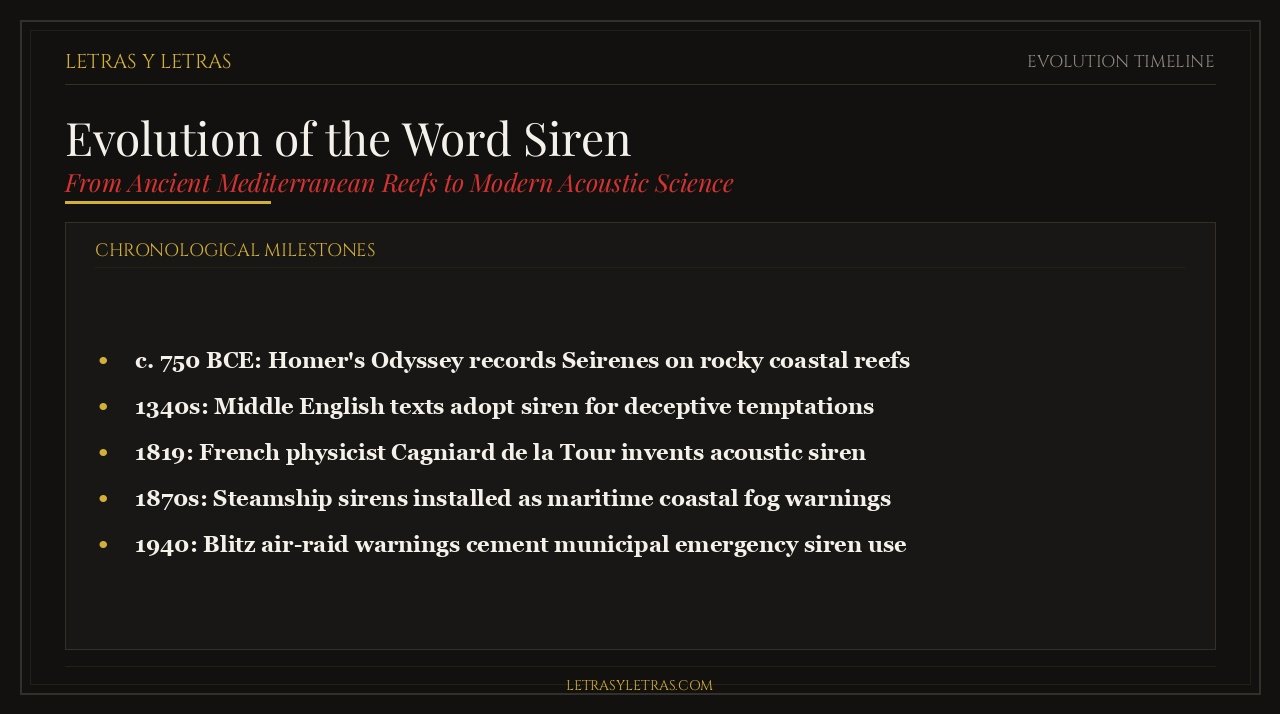
| Historical Period | Cultural Source | Evolutionary Milestone |
|---|---|---|
| c. 750 BCE | Homer’s Odyssey | First recorded literary depiction of Seirenes as winged avian creatures singing on bone-strewn reefs. |
| c. 750 CE | Medieval Bestiaries | The Liber Monstrorum and European folklore conflate classical bird-sirens with fish-tailed mermaids. |
| 1340s | Middle English Poetry | The word siren enters written English as a metaphor for seductive, deceptive spiritual temptation. |
| 1819 | Charles Cagniard de la Tour | French physicist invents acoustic disk instrument that operates underwater, naming it la sirene. |
| 1870s | Maritime Lighthouse Boards | Steam-powered sirens installed on lighthouses and steamships as long-range coastal fog warning horns. |
| 1940 | World War II Air Raids | Civil defense authorities deploy electric sirens across British cities during the London Blitz. |
| 1960s | Emergency Public Safety | Electronic sirens become standard equipment on modern police cars, ambulances, and fire engines. |
The Figurative Legacy: Siren Song and Femme Fatale
Alongside its mechanical usage, siren retained its powerful figurative meaning in literary English. The idiom siren song emerged to describe an appeal that sounds delightful but leads to ruinous consequences. Economists warn against the siren song of reckless market speculation.
During the nineteenth and twentieth centuries, writers adapted the term into popular literature. A seductive, alluring woman who led men into perilous situations was called a siren. Hollywood cinema embraced this trope in film noir, establishing the siren alongside the femme fatale.
This dual existence reveals the richness of the English language. One branch of the word evolved into emergency medical technology, while another branch preserved ancient psychological warnings. Both usages recognize that sound and desire possess hypnotic power over human reason.
We observe similar dualities in our study of the origin of the word cynic. Words born from ancient Greek cultural friction often develop contrasting practical and figurative meanings over centuries. The past remains alive in every syllable we speak.
Grasping these historical layers enriches our perspective on daily life. We realize that our modern world is shaped by ancient poetry. The sirens of Homer still echo through our crowded avenues.
Frequently Asked Questions
Where did the word siren originate?
The word siren originated in ancient Greek mythology, derived from Seiren in Homer’s Odyssey. In 1819, French physicist Charles Cagniard de la Tour named his acoustic instrument sirène, which evolved into emergency sirens.
Were Greek sirens birds or mermaids?
Ancient Greeks depicted Sirens as winged birds with human female heads. Fish-tailed mermaid imagery emerged during the Middle Ages when European scribes merged Greek myth with northern water folklore.
Why are emergency sirens named after Greek sirens?
In 1819, physicist Charles Cagniard de la Tour invented an acoustic device that could produce sound underwater. Because it made sound in water, he named it sirène after the amphibious mythical creatures.
What does the phrase siren song mean?
A siren song is an alluring appeal or temptation that sounds wonderful but leads to catastrophic consequences. The idiom directly references Homer’s mythical creatures luring sailors to shipwreck on rocky reefs.
Who invented the first mechanical siren?
French physicist Baron Charles Cagniard de la Tour invented the modern siren in 1819 as an acoustic measuring device. Scottish engineer John Robison had created an earlier rotary air whistle in 1799.
What does the Greek name Seiren literally mean?
Most etymologists trace Seiren to the Greek word seira, meaning rope or cord. The name literally translates as the binder or the entangler, describing their power to bind sailors through song.
Alan Sledge is the founder and lead writer at letrasyletras.com, dedicated to uncovering the true etymological histories behind our favorite words and phrases.


Alan Sledge is the writer and founder behind Letters & Letters. A lifelong lover of words, Alan has always been drawn to the small mysteries hidden in everyday language, why we say what we say, where our favorite sayings came from and the quotes that manage to put feelings into words better than we ever could ourselves.

Alan Sledge
Alan Sledge is the founder and lead researcher behind Letters & Letters. A lifelong student of linguistic history, he cross-references every word origin, idiom, and quote against primary archival manuscripts, the Oxford English Corpus, and 18th-century print lexicons.