
Few feelings irritate the human mind like unobtainable temptation. A savory scent drifts from a locked kitchen. An elusive career promotion stays permanently dangling one step ahead.
When something desirable remains visible yet just beyond our physical grasp, we describe the sensation as tantalizing. We use the verb daily in casual speech, marketing slogans, and gourmet menus.
Most speakers never consider the grim nightmare behind this familiar verb. The word did not begin as lighthearted flirtation or playful culinary teasing. It originated in the terrifying depths of ancient Greek underworld damnation.
Quick Answer: Origin of the Word Tantalize
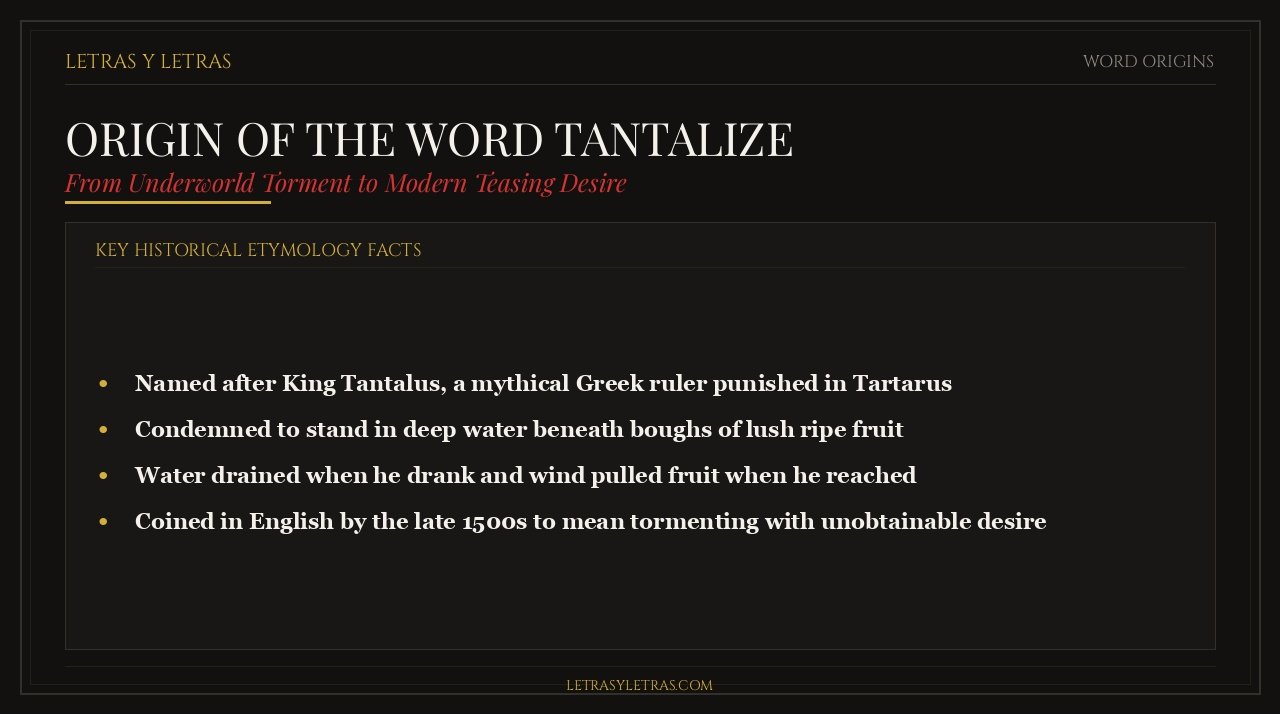
The word tantalize comes from the mythical Greek king Tantalus. Zeus condemned him to stand in deep water beneath lush fruit trees in Tartarus. Food and drink perpetually receded whenever he reached out, creating our verb for teasing desire.
Key Takeaways
- Derived directly from King Tantalus, a legendary ruler of Lydia in Greek myth.
- First recorded in classical western literature in Book 11 of Homer’s Odyssey.
- Tantalus suffered eternal hunger and thirst for abusing the sacred hospitality of Olympus.
- Elizabethan English scholars coined the verb tantalize during the late sixteenth century.
- Inspired the naming of the chemical element tantalum due to its acid resistance.
The Homeric Account: Odysseus in the Underworld
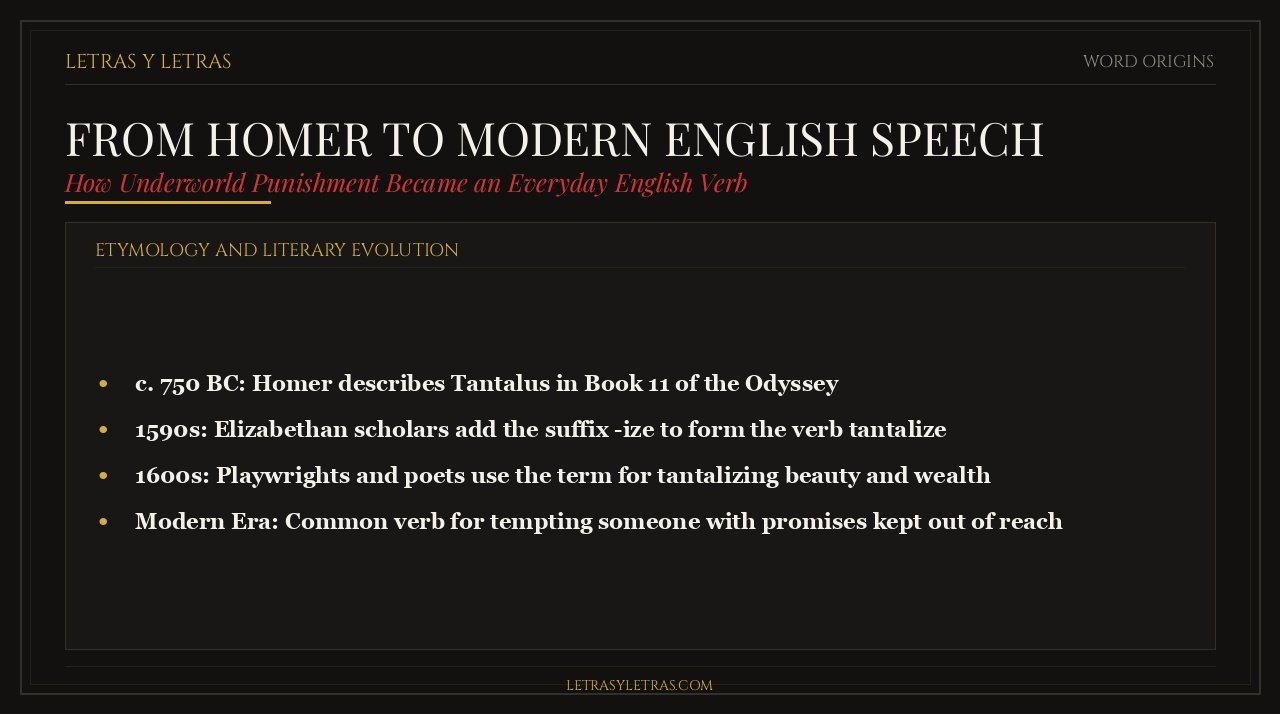
To discover the true origin of the word tantalize, we must travel back nearly three thousand years. The earliest detailed account survives in Book 11 of Homer’s epic poem, the Odyssey. In this passage, Odysseus journeys into the misty underworld of the dead.
Odysseus witnessed the souls of ancient heroes, queens, and weeping shades. Deep within Tartarus, he observed three notorious prisoners enduring special divine punishments. Among those tormented souls stood King Tantalus.
In the Perseus Digital Library Homer translation, the scene contains chilling sensory detail. Tantalus stood immersed in a clear lake with water lapping at his parched chin. He suffered from raging, ceaseless thirst.
Whenever the desperate king bent forward to swallow a mouthful, the water vanished instantly. The pool drained into dry black soil at his feet, swallowed by a dark deity. When he straightened his weary neck, the cold water returned to mock his torment.
Above his head hung lush branches heavy with ripe pomegranates, green figs, sweet pears, and dark olives. When Tantalus reached his withered hands upward, fierce mountain winds tossed the boughs into the clouds. The food remained forever visible yet impossible to taste.
The Crimes of Tantalus: Why the Gods Showed No Mercy
Ancient Greek gods often tolerated human weaknesses. They forgave minor battlefield boastings, passionate romances, and sudden errors in judgment. Why did Zeus impose such ruthless, eternal suffering upon King Tantalus?
Tantalus was not an ordinary mortal monarch. Ancient myth held that he was a favored son of Zeus and the nymph Pluto. He ruled over Sipylos, a fabulously wealthy kingdom in Anatolia blessed with gold mines.
Because of his divine heritage, Olympian gods granted him a rare honor. They welcomed Tantalus to dine at their high heavenly banquets. He sat beside Apollo, Hera, and Athena, enjoying intimate conversation with immortals.
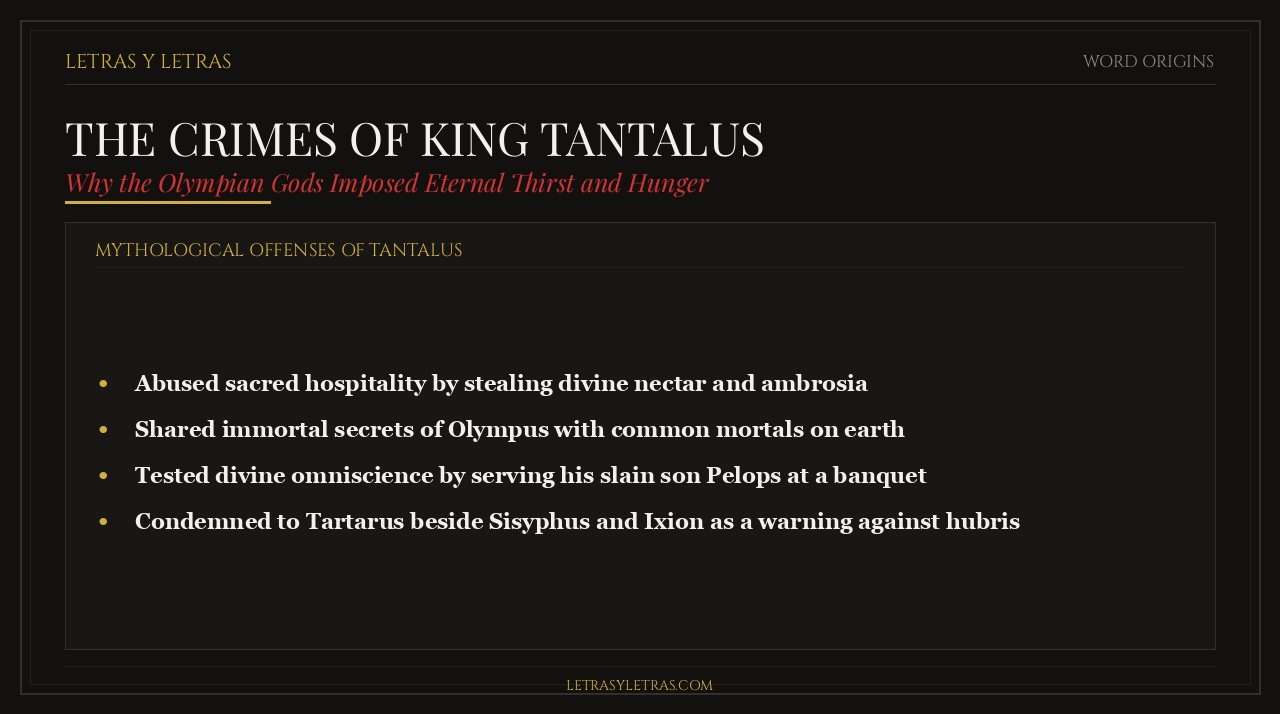
Instead of responding with humble reverence, Tantalus allowed arrogance to corrupt his character. He began stealing divine ambrosia and sweet nectar from the banquet table. The monarch smuggled the sacred food down to earth to impress mortal drinking companions.
He also divulged secret counsels of Zeus, treating divine wisdom like cheap political gossip. In ancient Greek ethics, violating sacred host friendship constituted a grave spiritual betrayal. Tantalus took divine generosity and transformed it into petty vanity.
The Banquet of Atrocities: Testing Divine Omniscience
The final offense committed by Tantalus horrified the entire ancient Mediterranean world. Determined to test if Olympian gods were truly all-knowing, Tantalus devised a monstrous culinary experiment. He invited the Olympian pantheon to a banquet at his royal palace.
To test their divine senses, Tantalus butchered his own young son, Prince Pelops. He boiled the child’s flesh and served the gruesome meat to the assembled deities. The king watched silently, eager to see if gods could detect human deceit.
The Olympian deities instantly recoiled in profound fury and disgust. Only Demeter, distracted by grief over her abducted daughter Persephone, accidentally consumed a piece of the boy’s shoulder. Zeus immediately struck Tantalus down into the underworld with a blazing thunderbolt.
The gods restored young Pelops to life, replacing his missing shoulder with an ivory prosthetic. Tantalus received a permanent sentence in Tartarus suited to his specific crimes. Because he abused food and drink, food and drink became his eternal tormentors.
Classical stories constantly warned mortals against challenging cosmic order. We examine similar lessons on divine retribution in our analysis of the origin of the word nemesis. Arrogance against divine limits carried catastrophic eternal consequences.
Tartarus and the Great Triad of Mortal Hubris
Ancient Greek storytellers frequently grouped Tantalus alongside two other famous underworld sinners. Together, Tantalus, Sisyphus, and Ixion formed an iconic triad of punished human arrogance. Each suffered a penalty directly matching their earthly sins.
King Sisyphus of Corinth tried to outsmart Death itself by chaining Thanatos in a dungeon. For his deceitful trickery, judges condemned him to push a massive boulder up a steep hillside. The stone slipped from his hands at the crest, rolling down forever.
Ixion attempted to seduce Hera, queen of the Olympian gods, during a sacred banquet. Zeus bound him to a winged wheel of fire that spun ceaselessly through the underworld air. His punishment reflected the dizzying folly of unchecked lust.
Tantalus completed the trio as the supreme symbol of unsatisfied physical craving. While Sisyphus represented endless futile labor and Ixion represented burning passion, Tantalus embodied eternal unfulfilled desire. His suffering warned observers that earthly greed leaves the soul perpetually starving.
These cautionary tales also informed Greek views on intellectual arrogance. Readers can observe similar mythic themes in our guide to the meaning of the name prometheus. Ancient philosophy reminded humans that mortal limits must never be violated.
The Elizabethan Birth of the English Verb
How did a horrific Greek myth of cannibalism and underworld torture become an everyday English verb? The linguistic transformation took place during the European Renaissance. English scholars eagerly studied classical Greek and Roman texts in original tongues.
During the late sixteenth century, Elizabethan writers adopted foreign names to coin expressive new vocabulary. They frequently attached the productive verbal suffix -ize to classical proper nouns. This grammatical tool converted historical figures into active human behaviors.
In the Online Etymology Dictionary entry, the verb first appeared in English during the 1590s. Early scholars used it to describe holding desirable prizes near someone while deliberately preventing possession.
By the early seventeenth century, playwrights and poets embraced the fresh verb. In 1600, dramatic texts used tantalize to describe frustrating romantic courtships and unfulfilled financial promises. The ancient underworld pool became a poetic metaphor for modern emotional longing.
English speakers found the word remarkably useful. No native Anglo-Saxon term captured the specific agony of having a reward visible yet unattainable. The myth of Tantalus provided a vivid psychological image for human longing.
The Semantic Shift: Softening Underworld Horrors
Over four hundred years of everyday use, the verb tantalize underwent significant semantic softening. In Homer’s original vision, the punishment was terrifying, visceral, and lethal. The suffering involved genuine physical starvation, agonizing dehydration, and divine wrath.
During the eighteenth and nineteenth centuries, literary usage broadened the verb beyond severe suffering. Romantic novelists began using tantalizing to describe playful flirtation, captivating perfumes, and pleasant anticipation. The horror of Tartarus receded behind attractive social imagery.
By the twentieth century, commercial advertising seized upon the adjective. Food companies described warm pastries and gourmet coffee as tantalizing treats. Travel agencies promised tantalizing tropical beaches and luxurious vacations.
Today, the Merriam-Webster historical dictionary entry defines tantalize as teasing or tormenting by presenting something desirable. Modern speakers rarely think of severed princes or underworld lakes when browsing restaurant menus. The word evolved from cosmic damnation into commercial persuasion.
Similar linguistic softenings occur across ancient languages. We witness identical psychological shifts in our exploration of the origin of the word narcissist. Ancient cautionary tragedies regularly transform into descriptive modern personality traits.
Debunking Common Myths About the Word Tantalize
Because the word sounds similar to several unrelated terms, popular misconceptions circulate widely among language enthusiasts. Exploring real etymological roots allows us to separate historical facts from folk inventions.
The first misconception claims that tantalize connects linguistically to the word tantrum. While both words begin with identical letters, they share zero etymological ancestry. Tantrum emerged in eighteenth-century English slang with unknown origins, completely separate from Greek mythology.
The second misconception suggests a relationship with the formal legal adjective tantamount. Tantamount derives from the Anglo-French phrase tant amounter, meaning to amount to as much. It traces back to Latin roots for quantity rather than King Tantalus.
The third myth asserts that Tantalus was an ancient god of hunger. As classical genealogies confirm, Tantalus was a mortal king who ruled in Anatolia. His mortality made his punishment particularly poignant to ancient Greek audiences.
Examining genuine historical etymologies guards against linguistic myths. We uncover similar folk fallacies in our review of the origin of the word cynic. Clear historical evidence keeps language lovers grounded in real history.
Historical Timeline of the Word Tantalize
| Historical Era | Literary Milestone or Event | Cultural and Linguistic Meaning |
|---|---|---|
| c. 750 BC | Homer’s Odyssey Book 11 | First written account of King Tantalus standing chin-deep in receding water beneath wind-tossed fruit trees. |
| c. 490 BC | Pindar’s Olympian Odes | Greek lyric poetry details the banquet crimes of Tantalus, including the theft of ambrosia and slaying of Pelops. |
| 1590s | Elizabethan England | English scholars append the suffix -ize to Tantalus, creating the verb tantalize to denote tormenting with false hope. |
| 1802 | Discovery of Tantalum | Swedish chemist Anders Ekeberg names chemical element 73 after Tantalus due to its inability to absorb acid. |
| 1800s | Victorian Literature | Semantic softening occurs as writers apply tantalizing to romantic flirtation, attractive aromas, and pleasant anticipation. |
| Present Day | Global Modern English | Universal verb and adjective for teasing desire, widely utilized across everyday conversation, dining, and marketing. |
The Scientific Legacy: Element 73 and Chemistry
The enduring cultural power of King Tantalus extends far beyond poetry and dictionaries. In 1802, the Swedish chemist Anders Gustaf Ekeberg discovered a rare, hard transition metal. He isolated the dense gray element from mineral samples in Sweden and Finland.
When Ekeberg attempted to dissolve the new metal, he encountered extraordinary chemical resistance. Even when fully submerged in powerful mineral acids, the metal refused to absorb liquids or corrode. It stood completely unaffected by surrounding chemical reagents.
Ekeberg was an accomplished classical scholar. He immediately recalled the story of King Tantalus standing submerged in deep water without being able to drink. The chemist named the metal tantalum in honor of that mythological inability to absorb moisture.
Today, element 73 serves as a vital component in modern electronic technology. Manufacturers utilize tantalum to build compact capacitors inside smartphones, laptop computers, and medical implants. Ancient Greek myth literally powers the microchips in our pockets.
Scientific naming conventions frequently immortalize classical literature. Discover more captivating connections between antiquity and modern communication in our guide to english idioms and meanings. Ancient stories continuously shape technical vocabularies.
Frequently Asked Questions
What is the literal meaning of tantalize?
It means to torment or tease someone with the sight of something desirable while keeping it out of reach. The term comes directly from King Tantalus in Greek myth.
What was the punishment of King Tantalus?
Zeus condemned Tantalus to stand in a pool of water in Tartarus beneath ripe fruit trees. Water drained when he drank, and wind blew fruit away when he reached.
Why did Zeus punish Tantalus so severely?
Tantalus abused divine hospitality by stealing sacred ambrosia and sharing divine secrets with mortals. He also slaughtered his young son Pelops to test divine knowledge.
When did tantalize become an English word?
The verb entered the English language in the 1590s during the Elizabethan era. Scholars combined the mythic name Tantalus with the Greek-derived verbal suffix -ize.
Why is the chemical element tantalum named after Tantalus?
Swedish chemist Anders Ekeberg named tantalum in 1802 because the metal cannot absorb acid when submerged. This mirrored Tantalus standing in water unable to drink.
The Lake That Never Quenches Thirst
Nearly three millennia after Homer composed his lines, the plight of Tantalus remains painfully relevant. Human desire possesses an infinite, restless hunger. We chase social status, material possessions, and career achievements only to find satisfaction fleeting.
Modern digital life functions remarkably like the underworld lake of Tartarus. Infinite streams of consumer goods, luxury lifestyles, and curated accomplishments scroll past our eyes daily. We reach out with thirsty ambition, yet fulfillment remains permanently out of reach.
When you use the word tantalize, remember the ruined king of Sipylos. His story reminds us that greed turns every blessing into a curse. True peace requires stepping out of the receding pool and valuing what we already possess.
Etymology reveals the enduring wisdom buried within everyday vocabulary. Explore our rich collection of word origins and cultural histories to deepen your linguistic knowledge. Each ancient syllable offers timeless insight into the human condition.
Alan Sledge is the founder and lead writer at letrasyletras.com, dedicated to uncovering the true etymological histories behind our favorite words and phrases.


Alan Sledge is the writer and founder behind Letters & Letters. A lifelong lover of words, Alan has always been drawn to the small mysteries hidden in everyday language, why we say what we say, where our favorite sayings came from and the quotes that manage to put feelings into words better than we ever could ourselves.

Alan Sledge
Alan Sledge is the founder and lead researcher behind Letters & Letters. A lifelong student of linguistic history, he cross-references every word origin, idiom, and quote against primary archival manuscripts, the Oxford English Corpus, and 18th-century print lexicons.