

Few figures from Greek antiquity command equal dramatic grandeur as the Titan Prometheus. Poets, philosophers, and sculptors have celebrated his defiance for nearly three thousand years. He stole heavenly fire from Mount Olympus and bestowed civilization upon vulnerable humanity.
Behind his legendary defiance lies a name rooted in deliberate intellectual calculation. Most readers recognize Prometheus as the champion of humankind who suffered eternal torment. Yet ancient storytellers chose his name with extraordinary linguistic precision.
The meaning of the name Prometheus reveals the fundamental Ancient Greek philosophy of the human mind. As an etymology researcher at Alan Sledge, I love unearthing the linguistic architecture of ancient myths. When you analyze classical manuscripts, his name emerges as a timeless meditation on foresight and planning.
Quick Answer: What Does the Name Prometheus Mean?
The name Prometheus translates directly from Ancient Greek as forethought or he who thinks beforehand. It combines the prefix pro meaning before with the verb manthano meaning to learn or perceive. Ancient Greeks contrasted his name with his brother Epimetheus, whose name translates as afterthought.
Key Takeaways
- Prometheus derives from Ancient Greek roots meaning forethought and advance calculation.
- Greek myth paired Prometheus with his brother Epimetheus to personify foresight versus regretful hindsight.
- Hesiod recorded the earliest written accounts of Prometheus in the eighth century BC.
- Nineteenth-century linguists explored alternative Sanskrit fire drill roots before reaffirming Greek etymology.
- Modern science honored Prometheus by naming radioactive element 61 Promethium in 1945.
Linguistic Breakdown: Deconstructing the Greek Roots
To understand the name Prometheus, we must examine the building blocks of the Ancient Greek language. Classical names were rarely arbitrary labels chosen for musical sound. Instead, Greek parents and mythological poets constructed compound words that captured an individual’s character.
The name Prometheus divides cleanly into two distinct morphological elements. Its first component is the common Greek preposition and prefix pro. In classical syntax, pro indicates priority in both time and physical space, translating as before or forward.
The second component derives from the Proto-Indo-European root men, meaning to think or perceive. In Greek, this root produced the verb manthano, which means to learn, understand, or ascertain. Attached to the agent suffix eus, the full compound signifies the forethinker.
As documented in Online Etymology Dictionary analyses, this linguistic construction appears across multiple classical disciplines. The related Greek noun prometheia referred to caution, providence, and prudent foresight. To possess prometheia was to anticipate danger before calamity struck.
Plato frequently referenced prometheia in his philosophical dialogues on statecraft and virtue. Athenian citizens considered advance calculation essential for democratic governance and military survival. The Titan stood as the divine patron of this indispensable intellectual trait.
Prometheus vs Epimetheus: The Allegory of Human Thought
The linguistic genius of Greek mythology becomes evident when comparing Prometheus with his Titan brother Epimetheus. Both brothers represent two opposite modes of human cognition. Greek storytellers created their names as complementary philosophical concepts.
While Prometheus bore the prefix pro, his brother received the prefix epi, meaning after. Epimetheus literally translates as afterthought or he who learns only after the event. The two brothers functioned as a living allegory of human decision making.
Prometheus anticipated future consequences through patient calculation and strategic patience. Epimetheus acted impulsively and understood his catastrophic blunders only in hindsight. Their shared narrative illustrates how human progress requires disciplined foresight.
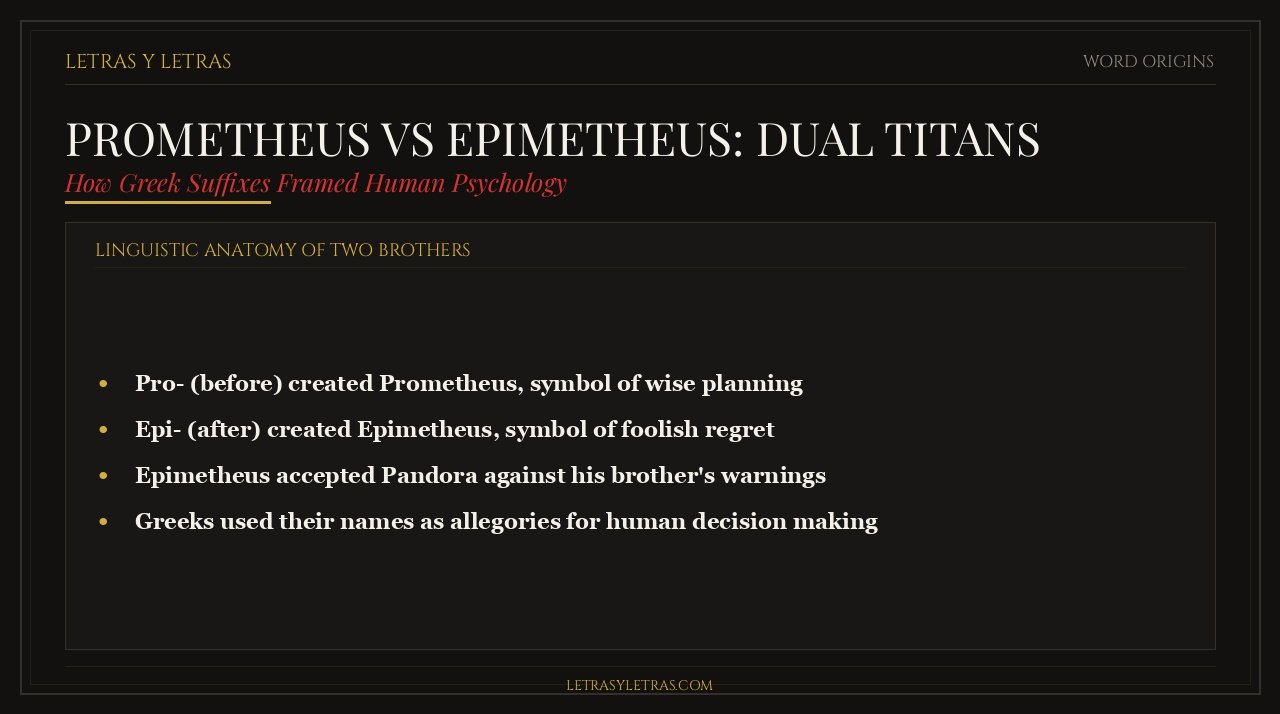
This psychological contrast drives the famous myth of Pandora. Prometheus explicitly warned his brother never to accept gifts from Olympian Zeus. He foresaw that the supreme deity sought vengeance against humanity.
Epimetheus ignored the warning the instant he laid eyes on Pandora’s radiant beauty. He welcomed her into his household without questioning the mysterious storage vessel she carried. Only when she opened the jar did Epimetheus understand his fatal error.
The Greeks recognized that sorrow often stems from failing to exercise prometheia. We see this dynamic in modern psychology and behavioral economics. Humans continually oscillate between the foresight of Prometheus and the regret of Epimetheus.
Hesiod emphasized this moral lesson in his Works and Days for Greek farmers and merchants. A prudent agriculturalist must plan seasons ahead like Prometheus. The foolish worker who procrastinates suffers poverty and resembles Epimetheus.
The Mythological Narrative: From Clay Sculptor to Rebel Titan
Beyond his name, Prometheus occupied a unique theological niche in Greek cosmology. Unlike the Olympian gods who demanded sacrifices, Prometheus actively protected mortal humans. Early myths even credited him with fashioning the first human beings out of river clay.
Pausanias noted that travelers visiting Phocis could inspect ancient clay fragments said to remain from that creation. The Titan breathed living spirit into inert mud, giving mortals dignity and upright posture. Because he crafted humanity, he felt enduring paternal loyalty toward his vulnerable creations.
Hesiod recounts the pivotal turning point at the feast of Mecone in his Theogony. Gods and mortals met to establish how sacrificial animals would be divided. Prometheus saw that humans struggled to survive in a harsh environment.
The cunning Titan devised an ingenious deception to outsmart the king of the gods. He wrapped nourishing edible beef inside an unappealing animal stomach. Beside it, he piled dry beef bones disguised beneath glistening, appetizing animal fat.
Zeus selected the pile of glistening fat and flew into rage upon discovering bare bones. In retaliation, Zeus withheld the divine gift of fire from mortal earth. Humans were left shivering in cold caves, unable to cook meat or forge bronze tools.
Prometheus refused to abandon his mortal creations to darkness and starvation. He climbed Mount Olympus secretly and touched a hollow giant fennel stalk to the sun chariot. Carrying the glowing ember safely inside the plant, he brought fire to mankind.
Fire was not merely a physical tool for cooking and heating cold caves. For the Greeks, fire symbolized technology, metallurgy, ceramic arts, and intellectual enlightenment. That single courageous theft ignited the rise of human civilization.
Aeschylus and the Dramatic Elevation of Prometheus Bound
In the fifth century BC, Athenian dramatist Aeschylus transformed the Titan’s reputation forever. Within his celebrated tragedy Prometheus Bound, the character ceases to be merely a clever folklore trickster. Aeschylus presents Prometheus as the supreme founder of human civilization and progress.
Chained to a barren cliff in the remote Caucasus Mountains, Prometheus addresses the chorus of ocean nymphs. He lists the intellectual gifts he gave to mortals alongside physical fire. Before his intervention, humans lived like aimless insects in subterranean caverns.
Prometheus taught humanity the science of numbers, the alphabet, architecture, agriculture, and astronomy. He introduced herbal medicines to cure wasting diseases and harnessed wild horses to draw chariots. As Aeschylus wrote, all human arts come from Prometheus.
The punishment imposed by Zeus matched the Titan’s enduring immortality. An eagle returned daily to feast upon his liver, which regenerated completely overnight. Ancient Greeks viewed the liver as the anatomical seat of human passion, desire, and life force.
Modern medical science confirms an astonishing biological reality that mirrors the ancient myth. The human liver is the only internal organ capable of full biological regeneration from partial tissue. Heracles eventually shot the tormenting eagle with an arrow and severed the Titan’s chains.
Centuries later, Greek storytellers added that Prometheus wore a ring forged from Caucasian rock as a reminder. Even in reconciliation with Zeus, the Titan preserved a token of his heroic endurance. His steadfast refusal to yield inspired generations of Athenian citizens.
The Sanskrit Fire Drill Hypothesis: Debunking Kuhn’s Etymology
During the nineteenth century, comparative philologists attempted to link Prometheus to older Asian languages. German linguist Adalbert Kuhn suggested that Prometheus derived from Vedic Sanskrit rather than native Greek. Kuhn pointed to the Sanskrit word pramantha.
In ancient Vedic rituals, the pramantha was a wooden friction spindle used to ignite sacred fires. Kuhn argued that the Greeks borrowed the fire-drill tool and anthropomorphized it into a mythical hero. He also compared Prometheus to the Sanskrit root mathnati, meaning to steal or churn.
Modern historical linguists have thoroughly rejected Kuhn’s Sanskrit fire-drill hypothesis. As analyzed in Oxford Classical Dictionary scholarship, Greek phonological laws contradict such borrowing. The morphological connection between pro and manthano is flawless within native Indo-European grammar.
Additionally, the fire-drill theory cannot explain the existence of his brother Epimetheus. Epimetheus makes linguistic sense only as a deliberate Greek wordplay on Prometheus. The pair was clearly constructed within Greek speech to personify foresight and afterthought.
Chronological Evolution of the Promethean Legacy
Tracing the name Prometheus across literature reveals how an ancient Titan became a symbol of intellectual freedom. The concept evolved from an archaic farming myth into a beacon of scientific inquiry.
The table below summarizes the major historical milestones that cemented his cultural and linguistic stature.
| Period | Author / Landmark | Historical Context and Significance |
|---|---|---|
| c. 700 BC | Hesiod (Theogony) | Records earliest written myth of sacrificial trickery and fire theft. |
| c. 460 BC | Aeschylus (Prometheus Bound) | Elevates Prometheus into the heroic patron of science, art, and medicine. |
| 1818 | Mary Shelley | Subtitles Frankenstein as The Modern Prometheus, exploring dangerous scientific ambition. |
| 1820 | Percy Bysshe Shelley | Publishes lyrical drama Prometheus Unbound celebrating liberation from tyranny. |
| 1945 | Oak Ridge Scientists | Name synthetic metallic element 61 Promethium to honor nuclear fire synthesis. |

The Adjective Promethean in Modern English
By the Renaissance, classical scholars had imported the Titan’s name into everyday literary English. The adjective Promethean entered the lexicon to describe daring creativity and heroic defiance. It describes acts that challenge arbitrary limits to advance knowledge.
William Shakespeare used the concept in Loves Labours Lost to describe romantic inspiration. Later, Romantic poets like Lord Byron and Percy Shelley idolized the Titan as the ultimate rebel. For the Romantics, Prometheus stood against religious dogma and political tyranny.
Mary Shelley provided one of the most famous literary uses with her gothic masterpiece Frankenstein. Her subtitle, The Modern Prometheus, offered a cautionary moral exploration. Scientist Victor Frankenstein grasped the spark of life without the moral foresight of the ancient Titan.
Today, writers use Promethean to describe monumental technological breakthroughs. The development of artificial intelligence, gene editing, and space exploration are frequently labeled Promethean endeavors. Each technological advance grants immense power while demanding careful ethical foresight.
Linguistic Connections Across Greek Mythology
Studying the name Prometheus sheds light on how ancient Greeks conceptualized character through language. Many prominent mythological figures bear names that directly predict their fate or personality.
Consider our recent investigation into the origin of the word narcissist. Narcissus carried a name rooted in narke, meaning numbness or stupor, foreshadowing his fatal fixation. Similarly, Prometheus carried forethought in his very syllables.
Classical Greek naming traditions reflect an acute awareness of psychological archetypes. Just as ancient warriors learned to origin of the phrase bite the bullet, mythic heroes embodied universal challenges. Exploring these etymological roots deepens our appreciation for famous quotes and quotations.
The Enduring Power of Forethought in the Modern Age
Why does the name Prometheus continue to resonate across modern global culture? The answer lies in the universal necessity of foresight in an unpredictable world. Power without wisdom leads inevitably to destruction.
As artifacts at The British Museum collections demonstrate, ancient peoples revered the Titan as a civilizing guide. Torches were carried through the streets of Athens in annual relay races celebrating his gift. The runner who kept his flame burning across the finish line earned highest honors.
In our complex technological era, that ancient race remains deeply symbolic. We possess the fire of quantum computing, nuclear power, and synthetic biology. Honoring the true meaning of Prometheus requires ensuring our forethought matches our technological courage.
Frequently Asked Questions
What is the literal meaning of the name Prometheus?
The name Prometheus literally means forethought or he who thinks beforehand in Ancient Greek. It combines the prefix pro meaning before with the verbal root manthano meaning to learn. The name reflects strategic intelligence and planning.
Why was Prometheus punished by Zeus?
Zeus punished Prometheus for stealing sacred fire from Mount Olympus to give to shivering mortals. The Titan also tricked Zeus during a sacrificial feast by disguising bones under glistening fat. Zeus condemned him to be chained to a Caucasian cliff where an eagle ate his regenerating liver.
Who was the brother of Prometheus and what did his name mean?
The brother of Prometheus was Epimetheus, whose name translates as afterthought or he who thinks afterward. Epimetheus was impulsive and foolish. He accepted Pandora as his bride despite explicit warnings never to accept gifts from Zeus.
Why does the liver regenerate in the myth of Prometheus?
Ancient Greeks considered the liver the central seat of human emotion, vitality, and passion. Because Prometheus was an immortal Titan, his liver regenerated overnight to sustain his punishment. Remarkable modern medical discoveries confirm that the human liver can indeed regenerate damaged tissue.
What element was named after Prometheus?
Chemical element 61 was named Promethium in 1947 by American chemists at Oak Ridge National Laboratory. The scientists chose the name to commemorate the first laboratory synthesis of a new element. This discovery symbolized human mastery over nuclear fire.
Alan Sledge is the lead writer at letrasyletras.com. He uncovers the true etymological histories behind our favorite phrases.


Alan Sledge is the writer and founder behind Letters & Letters. A lifelong lover of words, Alan has always been drawn to the small mysteries hidden in everyday language, why we say what we say, where our favorite sayings came from and the quotes that manage to put feelings into words better than we ever could ourselves.

Alan Sledge
Alan Sledge is the founder and lead researcher behind Letters & Letters. A lifelong student of linguistic history, he cross-references every word origin, idiom, and quote against primary archival manuscripts, the Oxford English Corpus, and 18th-century print lexicons.