
Fear is an ancient biological alarm system built into every human nervous system. When sudden danger looms, our heart rate spikes and muscles tighten for immediate survival. Throughout history, ordinary people confronted terrifying moments and refused to flee.
We admire brave soldiers, outspoken reformers, and quiet individuals who endure private grief. True courage does not mean the absence of natural fear. Bravery occurs when someone decides that duty or love matters more than personal comfort.
Curated quotes on courage preserve timeless wisdom from thinkers who tested their beliefs in public arenas. By studying their recorded words, we discover practical principles for mastering our daily anxieties. Ancient history and modern psychology show that bravery is a skill developed through consistent practice.
Quick Answer: Quotes on Courage and Bravery
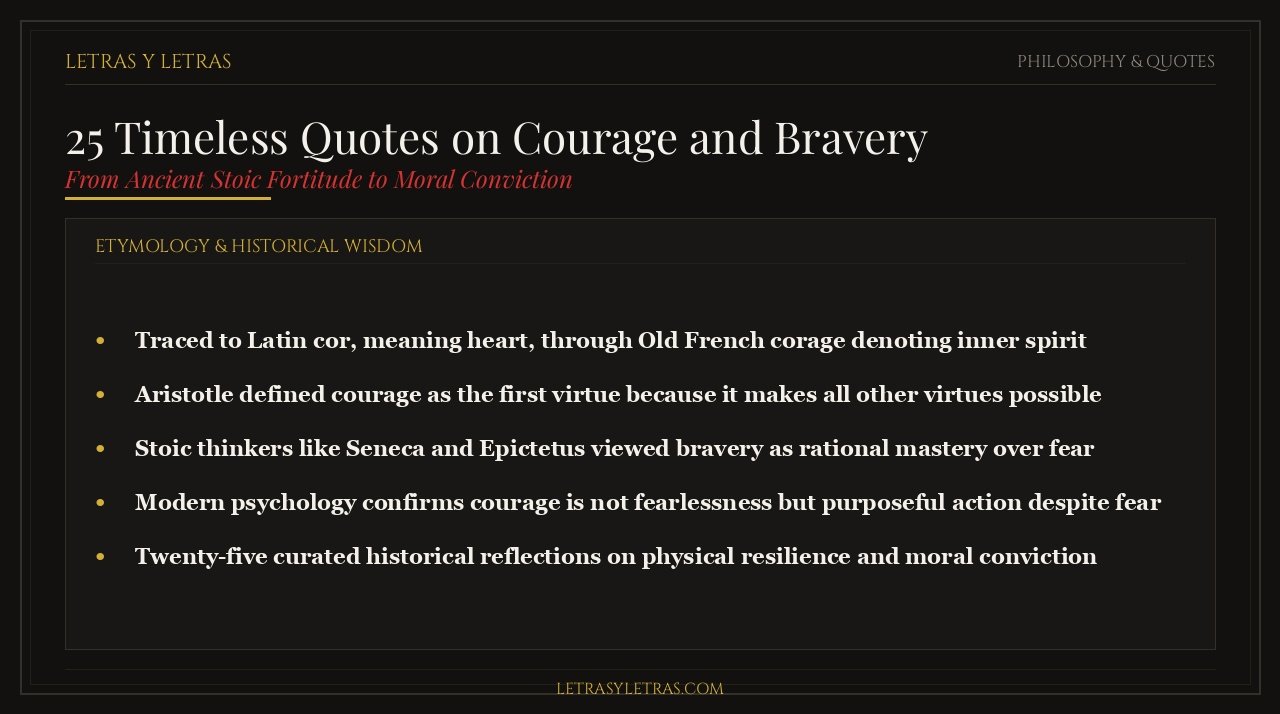
Quotes on courage capture centuries of recorded wisdom on confronting fear and enduring hardship. The English noun traces back to the Latin word cor, meaning heart, through Old French corage. Classical thinkers including Aristotle and Seneca defined bravery as reasoned mastery over fear rather than reckless behavior. Modern cognitive science confirms that courage functions as purposeful action in the presence of fear. Historical leaders highlight five key pillars: moral fortitude, decisive action, quiet daily resilience, standing alone for truth, and creative vulnerability. Rather than an innate trait, courage represents a moral habit strengthened through small daily choices.
Key Takeaways
- Derived from Latin cor, meaning heart, through Old French corage denoting inner spirit.
- Aristotle viewed courage as the golden mean between foolish rashness and cowardly paralysis.
- Stoic philosophers proved that rational self-rule allows individuals to confront terror with dignity.
- True bravery requires acknowledging genuine fear while refusing to surrender moral purpose.
- Everyday quiet perseverance often demands greater strength than dramatic battlefield heroics.
The Classical Etymology of Courage: Heart, Fortitude, and the Golden Mean
The English word courage entered our language through twelfth-century Anglo-Norman French. Speakers used the noun corage to describe spirit, temper, and moral disposition. That medieval term evolved directly from the Latin noun cor, which meant heart.
In ancient anatomical thought, the physical heart served as the seat of deep emotion and will. To act with courage literally meant to speak and act from the core of one heart.
Linguistic research in the Online Etymology Dictionary entry on courage documents this organic connection. Heartiness and bravery shared an identical linguistic origin.
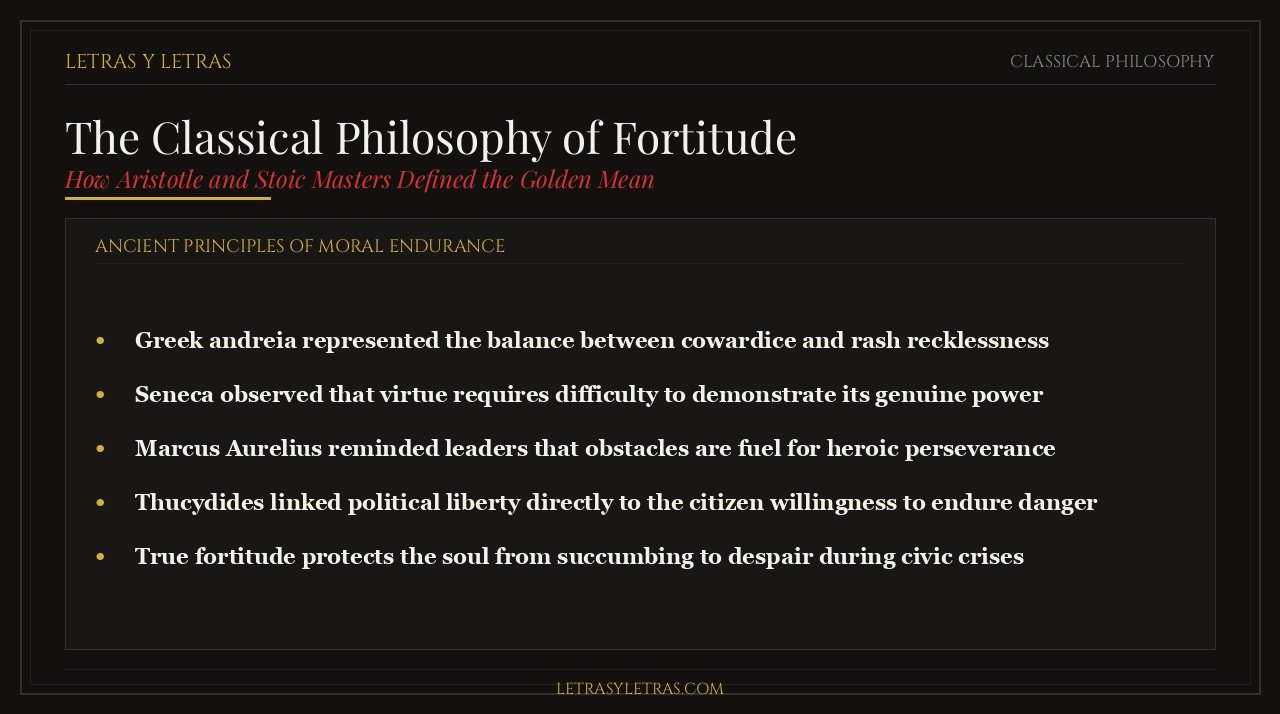
Ancient Greek philosophers explored this concept centuries before Norman scribes arrived in England. In Classical Greece, the primary term was andreia, derived from aner, meaning man. The word originally denoted martial prowess and battlefield ferocity.
Philosopher Aristotle elevated the concept into a universal moral principle in his Nicomachean Ethics. Textual records in the Perseus Digital Library Nicomachean Ethics reveal his famous definition of the Golden Mean. Aristotle argued that courage occupies the virtuous middle ground between two destructive extremes.
One extreme is cowardice, where a person flees from necessary challenges due to excessive terror. The opposite extreme is rashness, where a foolish actor ignores real danger without rational purpose. True courage balances clear perception of danger with resolute moral intention.
Pillar 1: Ancient Stoic Fortitude and Moral Bravery
Stoic philosophers in Greece and Rome treated courage as one of four cardinal virtues. They recognized that external dangers remain outside individual control. How a person responds to peril, however, belongs entirely to inner character.
The following five quotations demonstrate how classical thinkers understood enduring fortitude:
1. Seneca: The Courage to Live
“Sometimes even to live is an act of courage.”
Lucius Annaeus Seneca battled chronic respiratory illness throughout his youth in Rome. As an imperial advisor under Nero, Seneca endured intense political intrigue and exile. He understood that daily survival during deep grief requires immense willpower.
Many people associate bravery with dramatic battlefield charges or public rescues. Seneca reminded his readers that enduring prolonged physical pain or emotional heartbreak is equally heroic. Choosing to wake up and face another difficult morning proves deep inner fortitude.
2. Marcus Aurelius: Weapons of Reason
“Never let the future disturb you. You will face it with the same weapons of reason.”
Roman Emperor Marcus Aurelius wrote these words privately while commanding military outposts along the Danube. Facing devastating Antonine plagues and invading armies, the emperor refused to indulge in panic. He reminded himself that future troubles will not overcome a rational mind.
Anticipating future disaster drains vital energy needed for present tasks. Aurelius taught that human reason remains an invincible internal shield. By trusting our capacity to solve problems tomorrow, we conquer paralyzing dread today.
3. Epictetus: Freedom Through Acceptance
“He is wise who does not grieve for what is missing. Instead, he rejoices for what he possesses.”
Epictetus survived childhood slavery before becoming one of the most respected teachers in Greece. A brutal master crippled his leg, leaving him with a permanent physical limp. Epictetus discovered that physical suffering cannot enslave a person who masters internal desires.
Bravery begins by distinguishing between what we can control and what we cannot. Complaining about external limitations reveals weakness of mind. Focusing on present blessings allows us to confront hostile circumstance with joyful resilience.
4. Thucydides: The Secret to Freedom
“The secret to happiness is freedom, and the secret to freedom is courage.”
Athenian historian Thucydides recorded these timeless words in his account of Pericles funeral oration. Athens was locked in a brutal conflict against the militaristic city state of Sparta. Pericles wanted citizens to remember why free democratic institutions are worth defending.
Democratic self-government cannot survive without brave citizens willing to accept risk. People who surrender principles to buy temporary safety invariably lose both liberty and peace. Civic freedom demands constant vigilance and personal sacrifice.
5. Aristotle: The Foundation of All Virtues
“Courage is the first of human qualities because it is the quality which guarantees the others.”
Aristotle analyzed human character with scientific precision in fourth-century Athens. The philosopher recognized that virtues like honesty, justice, and compassion require courage to practice. An honest person without courage will lie as soon as danger threatens.
A compassionate observer without bravery will abandon friends when danger strikes. Fortitude acts as the steel backbone supporting every other moral conviction. Without bravery, moral ideals crumble under the slightest social pressure.
For additional reflections on foundational virtues, readers can explore our guide to quotes on discipline. Self-control and courage work together to forge reliable human character.
Pillar 2: Overcoming Fear and Taking Action
Waiting for fear to vanish before taking action leads to lifelong regret. Fear is an involuntary physical response that evolutionary biology hardwired into our bodies. Seasoned leaders know that action must proceed despite internal trembling.
These five insights from historical reformers reveal how action breaks the grip of anxiety:
6. Nelson Mandela: The Triumph Over Fear
“I learned that courage was not the absence of fear, but the triumph over it.”
Nelson Mandela spent twenty-seven years confined in tiny prison cells under South African apartheid. During long decades of isolation on Robben Island, Mandela frequently felt intense terror. He understood that revealing panic would demoralize his fellow political prisoners.
Mandela forced himself to stand straight and walk with dignified calm across prison courtyards. His deliberate composure inspired prisoners and prison guards alike. Bravery means feeling cold dread in your chest and continuing forward anyway.
7. Mark Twain: Resistance and Mastery
“Courage is resistance to fear, mastery of fear, not absence of fear.”
American author Mark Twain observed human nature across riverboats, mining camps, and literary salons. Twain had little patience for pompous braggarts who claimed they never felt afraid. Anyone who claims complete fearlessness is either lying or dangerously detached from reality.
True bravery resembles training an unruly animal. An experienced rider feels a horse wild instincts but keeps firm hold of the reins. Mastering terror allows individuals to make clear decisions during chaotic emergencies.
8. Maya Angelou: Developing the Muscle
“One isn’t born with courage. One develops it by doing small courageous things.”
Acclaimed poet Maya Angelou overcame childhood trauma, racism, and poverty to become an international voice. Angelou viewed bravery as a behavioral habit rather than a fixed genetic gift. Every time someone speaks truth in a difficult meeting, they strengthen their moral resolve.
Small daily acts of integrity build confidence for major life crises. If you never practice asserting yourself in small moments, you will falter during severe tests. Bravery grows through incremental daily choices.
9. Winston Churchill: The Courage to Continue
“Success is not final, failure is not fatal: it is the courage to continue that counts.”
Winston Churchill faced staggering military catastrophes before leading Britain through the dark days of 1940. When Nazi armies conquered Europe, Churchill refused to consider surrender. He understood that historical fortunes reverse themselves when people refuse to quit.
Triumphs are temporary, and disasters rarely represent permanent endings. The deciding factor in human affairs is persistent endurance across shifting circumstances. Continuing forward after public defeat proves superior to brief brilliant victories.
10. Franklin D Roosevelt: Assessing Greater Priorities
“Courage is not the absence of fear, but rather the assessment that something else is more important than fear.”
Franklin D Roosevelt governed the United States through the Great Depression and World War II while paralyzed by polio. The president knew that crippling fear threatened national recovery after banking systems collapsed. His famous inaugural speech rallied a desperate public to face reality.
Bravery requires weighing competing values in your mind. When love for family or dedication to justice outweighs personal self-preservation, fear loses its power. Clarity of purpose provides the energy required to conquer anxiety.
Ancient warriors also struggled with fear and fatal vulnerability. Explore our deep historical study on the origin of the phrase achilles heel. Mythological tales demonstrate that even the mightiest heroes possessed vulnerable points.
Pillar 3: Everyday Quiet Resilience and Perseverance
Popular cinema glorifies sudden acts of physical daring on smoke-filled battlefields. Yet the most demanding forms of bravery occur in private rooms without applauding crowds. Quiet perseverance during long illness or economic hardship tests human spirit to its limits.
These five writers celebrate the quiet courage that sustains everyday life:
11. Mary Anne Radmacher: The Quiet Voice
“Courage does not always roar. Sometimes courage is the quiet evening voice saying, ‘I will try again tomorrow.'”
Author Mary Anne Radmacher captured an essential truth about human survival in this beloved aphorism. When plans collapse and exhaustion sets in, roaring with defiance is often impossible. True strength often manifests as a whispered promise to keep going.
Going to sleep with hope after a devastating setback requires immense mental discipline. It acknowledges current defeat while preserving faith in tomorrow opportunities. Gentle determination carries people through seasons of profound sorrow.
12. C S Lewis: Virtue at the Testing Point
“Courage is not simply one of the virtues, but the form of every virtue at the testing point.”
Oxford scholar C S Lewis survived trench warfare in World War I before writing his classic ethical treatises. He observed that virtues remain mere theoretical abstractions until adversity arrives. Kindness is easy when people treat you well, but requires courage when faced with malice.
Patience remains pleasant until you are pushed to extreme exhaustion. Lewis showed that bravery is the operational reality of all goodness under stress. When pressure mounts, courage reveals if your principles are genuine.
13. Ernest Hemingway: Grace Under Pressure
“Courage is grace under pressure.”
Novelist Ernest Hemingway drove ambulances on the Italian front and reported from brutal combat zones. In a famous 1929 interview, Hemingway offered this succinct four-word definition. He admired men and women who maintained dignity while facing mortal peril.
Losing emotional composure rarely improves difficult situations. Grace under pressure means maintaining professional focus and courtesy while chaos swirls around you. Quiet elegance in the face of disaster inspires confidence in everyone nearby.
14. Eleanor Roosevelt: Looking Fear in the Face
“You gain strength, courage and confidence by every experience in which you really stop to look fear in the face.”
Eleanor Roosevelt transformed the role of First Lady by championing civil rights and humanitarian causes worldwide. She faced intense public hostility, death threats, and bitter political opposition. Roosevelt insisted that confronting fear directly destroys its power over the imagination.
When we evade terrifying situations, our internal anxieties grow larger in the dark. Stopping to inspect the danger reveals manageable realities instead of monstrous phantoms. Each survived confrontation builds permanent psychological armor.
15. Victor Hugo: Patience for Small Sorrows
“Have courage for the great sorrows of life and patience for the small ones.”
French author Victor Hugo wrote immortal masterworks like Les Misérables while enduring nineteen years of political exile. Hugo watched political despotism crush democratic reforms in nineteenth-century France. He recognized that human happiness requires two distinct emotional skills.
We need monumental fortitude when facing bereavement, illness, or political upheaval. Equally important is daily patience to endure minor annoyances without bitterness. Balancing heroic bravery with everyday good humor protects the soul from cynicism.
Pillar 4: Standing Alone for Truth and Moral Conviction
Confronting hostile crowds requires a different type of strength than facing physical danger. Humans are social creatures programmed to crave community approval and belong to groups. Standing alone against consensus opinion triggers acute feelings of vulnerability.
These five historical giants modeled moral courage against immense opposition:
16. Martin Luther King Jr: Moments of Controversy
“The ultimate measure of a man is not where he stands in moments of comfort. It is where he stands during controversy.”
Reverend Martin Luther King Jr led the American Civil Rights Movement under constant threat of assassination and jail. King knew that fair-weather allies vanish when social tensions ignite. Character is never measured during peaceful banquets and celebrations.
True integrity appears when speaking truth costs you popularity, financial security, or personal safety. Taking an unpopular stand for human dignity separates authentic leaders from political opportunists. Moral courage transforms societies by exposing unjust laws to public conscience.
17. Ralph Waldo Emerson: Standing Firm Against Doubt
“Whatever you do, you need courage. Whatever course you decide upon, there is always someone to tell you that you are wrong.”
American philosopher Ralph Waldo Emerson championed self-reliance during the rapid industrialization of nineteenth-century New England. Emerson observed that conventional society constantly pressures nonconformists to yield. Whenever an innovator pursues a fresh path, critics predict ruin.
Second-guessing oneself in response to criticism paralyzes noble initiatives. Emerson urged individuals to trust their inner intuition and march forward with conviction. Great accomplishments require tuning out the noisy skepticism of timid spectators.
18. Rosa Parks: When the Mind Is Made Up
“I have learned over the years that when one’s mind is made up, this diminishes fear.”
Rosa Parks sparked the Montgomery Bus Boycott in 1955 by refusing to surrender her seat on a segregated bus. Parks was not physically tired; she was weary of giving in to systemic oppression. Her calm refusal ignited a movement that changed American constitutional history.
Ambivalence and indecision fuel internal terror. When a person settles on an unshakeable moral boundary, fear loses its grip. Deciding that you will no longer tolerate injustice brings sudden mental calm.
19. Socrates: The Unshakable Conscience
“An unexamined life is not worth living, but an unprincipled life is not worth preserving.”
Socrates stood before an Athenian jury in 399 BCE facing false accusations of impiety and corrupting youth. Offered exile or silence to save his life, the philosopher refused to compromise his dialectical pursuit of truth. Socrates drank the poisonous hemlock with serene composure.
Betraying one conscience to extend physical life was, in Socrates view, the ultimate spiritual death. The philosopher taught that no evil can harm a good person in life or after death. Moral integrity remains far more precious than physical breathing.
20. Abraham Lincoln: Stand Firm
“Be sure you put your feet in the right place, then stand firm.”
Abraham Lincoln steered the American republic through a cataclysmic Civil War to preserve the Union and abolish slavery. Beset by hostile generals, divided cabinets, and battlefield defeats, Lincoln stood firm on foundational principles. He listened to diverse counsel but decided course with granite resolve.
Moral firmness must rest on careful ethical reflection. Placing your feet in the right place means verifying that your cause is just and grounded in truth. Once convinced of righteousness, refuse to be swayed by shifting political winds.
Readers exploring historical linguistics can also examine how social values shaped the origin of the word sinister. Classical vocabulary constantly reveals ancient prejudices and moral judgments.
Pillar 5: Vulnerability, Innovation, and Personal Growth
Entering creative arenas or launching bold ventures requires emotional courage. Perfectionists often remain silent because they fear public failure or ridicule. Stepping into the arena demands accepting vulnerability as the necessary price of growth.
These five modern thinkers illuminate how courage unlocks human potential:
21. Brené Brown: Daring to Be Seen
“Courage starts with showing up and letting ourselves be seen.”
Research professor Brené Brown spent two decades studying shame, empathy, and vulnerability in American culture. Brown demonstrated that pretending to be invulnerable is a defense mechanism rooted in fear. True emotional bravery involves sharing authentic feelings without guaranteed outcomes.
Hiding behind emotional armor prevents genuine human connection and creative breakthroughs. When we risk rejection by presenting our honest selves, we open the door to deep relationships. Vulnerability serves as the birthplace of innovation and joy.
22. Theodore Roosevelt: The Man in the Arena
“It is not the critic who counts… The credit belongs to the man who is actually in the arena.”
Theodore Roosevelt delivered this celebrated speech at the Sorbonne in Paris in 1910. The former president had lived as a sickly child who transformed himself into an explorer and statesman. Roosevelt reserved his sharpest scorn for cynical observers who mock active strivers.
Sitting on the sidelines critiquing others is effortless and cowardly. True honor belongs to the creator whose face is marred by dust, sweat, and blood while striving valiantly. Failing while daring greatly surpasses achieving timid safety.
23. Amelia Earhart: The Price of Peace
“Courage is the price that life exacts for granting peace.”
Aviation pioneer Amelia Earhart broke international flight records in an era when women were barred from commercial aviation. Earhart navigated open oceans in primitive aircraft with rudimentary navigational instruments. She knew that pursuing extraordinary dreams requires accepting real hazards.
Inner peace does not result from avoiding danger. Real peace comes from knowing you lived fully and chased your highest potential without flinching. Paying the price of courage frees us from lingering regrets.
24. Anaïs Nin: Expanding in Proportion
“Life shrinks or expands in proportion to one’s courage.”
French-born essayist Anaïs Nin documented personal psychological exploration across decades of intimate diaries. Nin observed that timidity creates a claustrophobic existence filled with artificial boundaries. When you refuse new opportunities out of fear, your world shrinks.
Every courageous decision widens your horizons and expands your circle of influence. Embracing calculated risks exposes you to fresh ideas, diverse cultures, and unexpected friendships. The boundaries of your life match the perimeter of your bravery.
25. Helen Keller: A Daring Adventure
“Security is mostly a superstition. Life is either a daring adventure, or nothing.”
Left deaf and blind in infancy by illness, Helen Keller learned to communicate and graduated with honors from Radcliffe College. Keller became an author and advocate for disability rights and labor reforms. She rejected the idea that absolute safety is possible in an unpredictable universe.
Clinging to false security isolates people from meaningful life experiences. Danger exists everywhere, in familiar shelters or uncharted territory. Choosing to treat life as a daring adventure unlocks boundless enthusiasm and gratitude.
Explore more inspirational literary reflections in our master guide to famous quotes and quotations. Wisdom from across centuries illuminates human life.
Typological Spectrum: The Five Dimensions of Human Courage
Scholars categorize bravery across distinct psychological domains. Examining these dimensions helps individuals identify where their strengths lie and where further practice is needed.
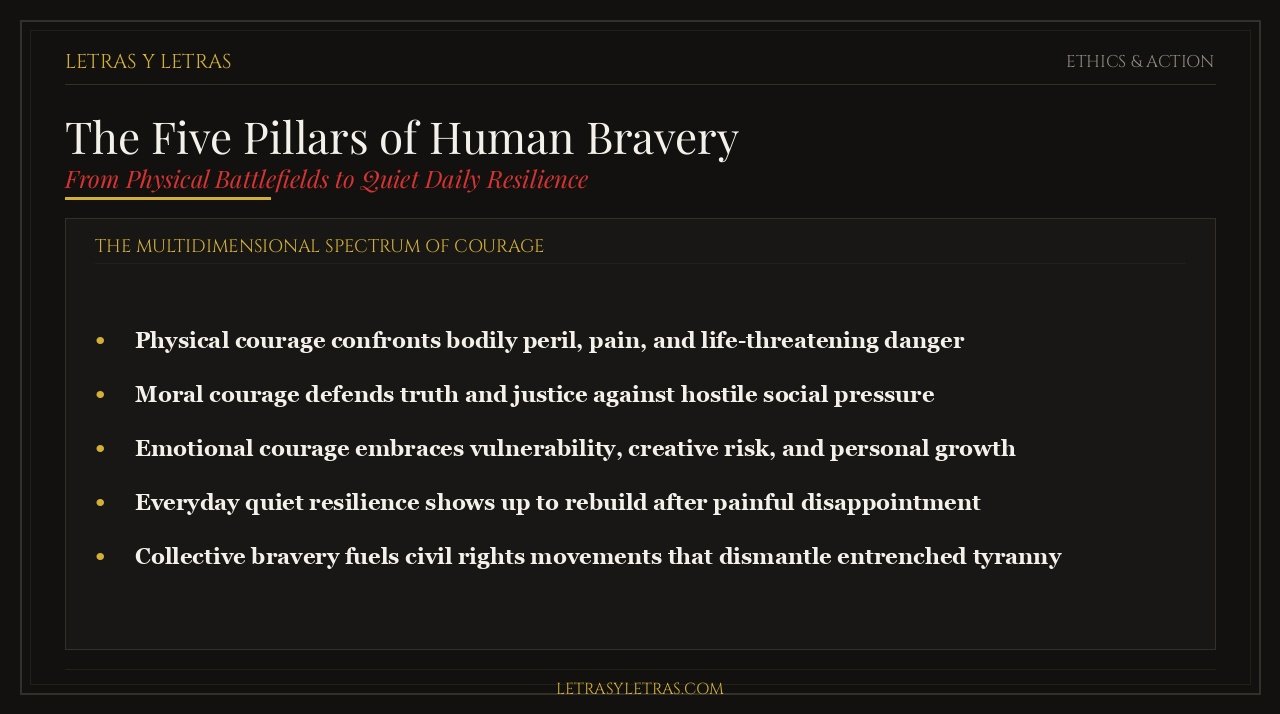
| Dimension of Courage | Core Psychological Challenge | Historical Archetype | Modern Daily Application |
|---|---|---|---|
| Physical Courage | Confronting bodily harm, physical pain, and life-threatening danger. | Spartan hoplites and aviation pioneers like Amelia Earhart. | First responders and citizens intervening during sudden public emergencies. |
| Moral Courage | Defending truth and ethical standards against hostile group consensus. | Rosa Parks and Reverend Martin Luther King Jr. | Blowing the whistle on workplace misconduct or resisting social exclusion. |
| Intellectual Courage | Questioning dogmas and abandoning comfortable falsehoods for reality. | Socrates in Athens and Galileo Galilei in Italy. | Revising cherished opinions when confronted by fresh scientific data. |
| Emotional Courage | Embracing vulnerability, personal grief, and the risk of heartbreak. | Maya Angelou and modern researchers like Brené Brown. | Apologizing sincerely after mistakes and expressing genuine love. |
| Quiet Resilience | Persevering through prolonged obscurity, fatigue, and setbacks. | Mary Anne Radmacher and Nelson Mandela on Robben Island. | Rebuilding businesses or families after financial and medical crises. |
The Neurobiology and Psychology of Courage: How the Mind Conquers Fear
Modern cognitive neuroscience provides fascinating insights into how courageous behavior operates in the human brain. When we encounter potential danger, the amygdala fires rapid survival signals across our autonomic nervous system. Heart rates accelerate, pupils dilate, and stress hormones flood the bloodstream.
In fearful individuals, these physical sensations trigger paralysis or automatic flight. In courageous individuals, the prefrontal cortex intervenes to regulate the amygdala raw signals.
Cognitive analysis in the Stanford Encyclopedia of Philosophy entry on courage explores this rational mediation. Rational purpose dampens irrational panic, allowing executive focus to direct physical movement.
Behavioral psychologists use exposure therapy to train patients out of debilitating phobias. By facing feared objects in controlled increments, the brain learns that anticipated catastrophes do not materialize. Over time, neurological desensitization transforms terrifying obstacles into familiar routines.
This process explains why soldiers, firefighters, and surgeons perform calmly during life-or-death emergencies. Rigorous simulation inoculates the nervous system against panic. Courage is not an unchangeable mystical temperament; it is a neurological habit forged through graduated exposure.
Developing Daily Courage in Modern Life
We rarely face sabertooth tigers or medieval battlements in twenty-first-century life. Yet modern existence presents subtle social, financial, and ethical challenges that demand constant courage. Choosing integrity over convenient lies tests our character every single week.
Building daily bravery begins with small behavioral experiments. Speak up when an innocent coworker is unfairly criticized in a team meeting. Admit your mistakes immediately instead of blaming subordinates or computer systems.
Have the difficult conversation you have delayed for three months with a family member. Enter creative arenas with the humble acceptance that initial efforts might look imperfect. Each small victory over hesitation rewires your identity toward strength.
When anxiety threatens your resolve, repeat the wisdom of Seneca, Mandela, or Roosevelt. Remember that fear is merely a temporary bodily visitor, not your master. Step into the arena, stand firm on righteous ground, and live with an open heart.
Frequently Asked Questions
What is the true definition of courage?
Courage is the ability to confront fear, pain, danger, or uncertainty with reasoned moral purpose. It does not mean being fearless. True bravery involves acknowledging natural fear while choosing to act in accordance with duty and love.
Where does the word courage originate?
The word entered English from twelfth-century Old French corage, meaning spirit or temper. The French term stemmed directly from Latin cor, meaning heart. Historically, having courage meant acting from the center of one heart.
How did Aristotle define courage in philosophy?
Aristotle defined courage as the Golden Mean between cowardice and rashness. Cowards flee from necessary hardships due to excessive fear. In contrast, rash actors rush into danger foolishly while courageous people balance realism with virtue.
What is the difference between physical and moral courage?
Physical courage involves confronting bodily harm, agony, or death in dangerous situations. Moral courage involves defending truth, justice, and human dignity against social pressure or professional ostracism. Such ethical endurance is often considered more difficult to sustain.
Can courage be learned and developed over time?
Yes. Cognitive science confirms that courage functions like a physical muscle. By deliberately taking small principled risks and confronting minor anxieties daily, individuals desensitize their nervous systems and build lasting confidence.
Alan Sledge is the founder and lead writer at letrasyletras.com, dedicated to uncovering the true etymological histories behind our favorite words and phrases.


Alan Sledge is the writer and founder behind Letters & Letters. A lifelong lover of words, Alan has always been drawn to the small mysteries hidden in everyday language, why we say what we say, where our favorite sayings came from and the quotes that manage to put feelings into words better than we ever could ourselves.