
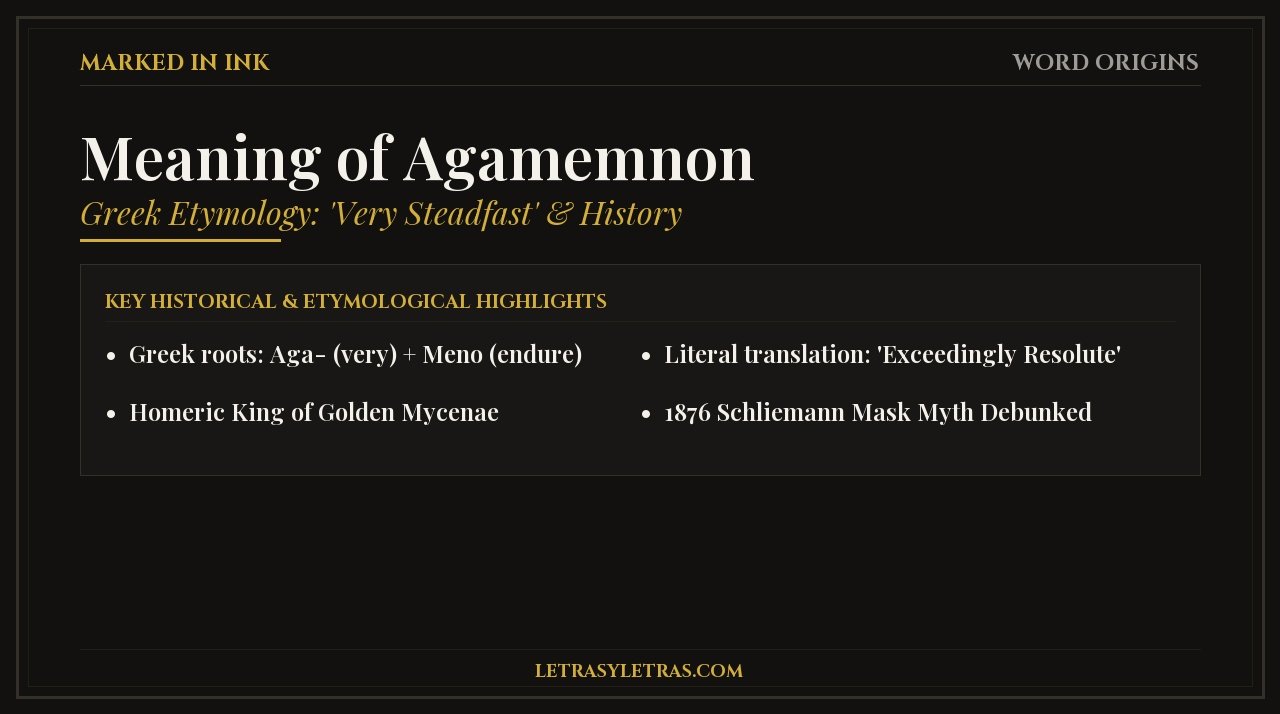
Agamemnon means “very steadfast” or “exceedingly resolute” in Ancient Greek. It combines aga- (“very much”) with ménomai (“to endure”).
By Alan Sledge | Letters & Letters – About the Author
Mention the name Agamemnon and people picture golden burial masks, Trojan ramparts, or tragic royal dynasties. Few classical names carry equal dramatic weight. Beyond Homeric poetry, the linguistic structure reveals an ancient vision of leadership.
Exploring ancient Greek root words opens a clear window into classical character. In this case, the name was not a random label. It was a statement of willpower.
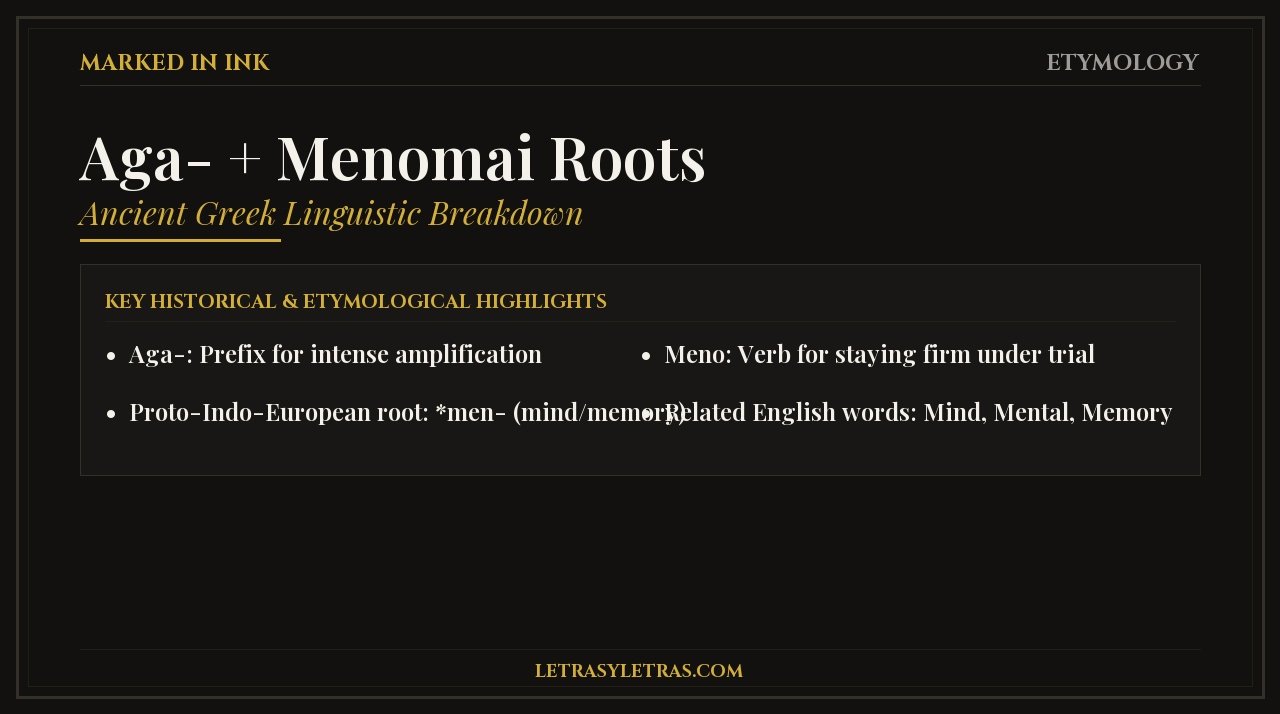
Ancient Greek Etymology of Agamemnon
To learn what Agamemnon means, we look at its Greek roots. The name combines two classical elements:
1. The Prefix “Aga”– (ἄγαν / ἄγα-): This Greek prefix denotes intensity. It translates to “very,” “exceedingly,” or “greatly.”
2. The Root “Ménomai” (μέμονα / μένω): Derived from Proto-Indo-European \men- (to think or remain firm). It means “to hold fast” or “to stand resolute.”
Combined, Aga- and Ménomai yield Agamémnōn (Ἀγαμέμνων). It translates to “the one who stands firm” or “most steadfast.”
The list below compares the ancient root elements:
-
- Intensifier (Aga-): Very much or greatly. Amplifies the root quality.
- Verb Root (Ménō): To stay or endure. Signifies unyielding tenacity.
- Full Name (Agamémnōn): Exceedingly resolute. Symbol of stubborn determination.
The Online Etymology Dictionary notes that \men- also birthed mind and memory. Classical writers viewed staying firm as mental discipline.
Who Was Agamemnon in Greek Mythology?
In myth, Agamemnon was the son of King Atreus of Mycenae. With his brother Menelaus, he belonged to the House of Atreus.
When Paris abducted Helen, Agamemnon gathered Greek kings. He launched a thousand ships toward Asia Minor.
Highlights of Agamemnon in the Trojan War Cycle
-
- King of Mycenae: Commander of unified Achaean forces.
- Sacrifice at Aulis: Offered his daughter Iphigenia to Artemis for sailing winds.
- Quarrel with Achilles: Seized Briseis in Book 1 of the Iliad, driving Achilles away.
- Tragic Return: Murdered at home by Clytemnestra and Aegisthus.
Historians at Encyclopaedia Britannica note that Agamemnon displays regal majesty and pride. His stubborn nature matched his name, though it caused his downfall.
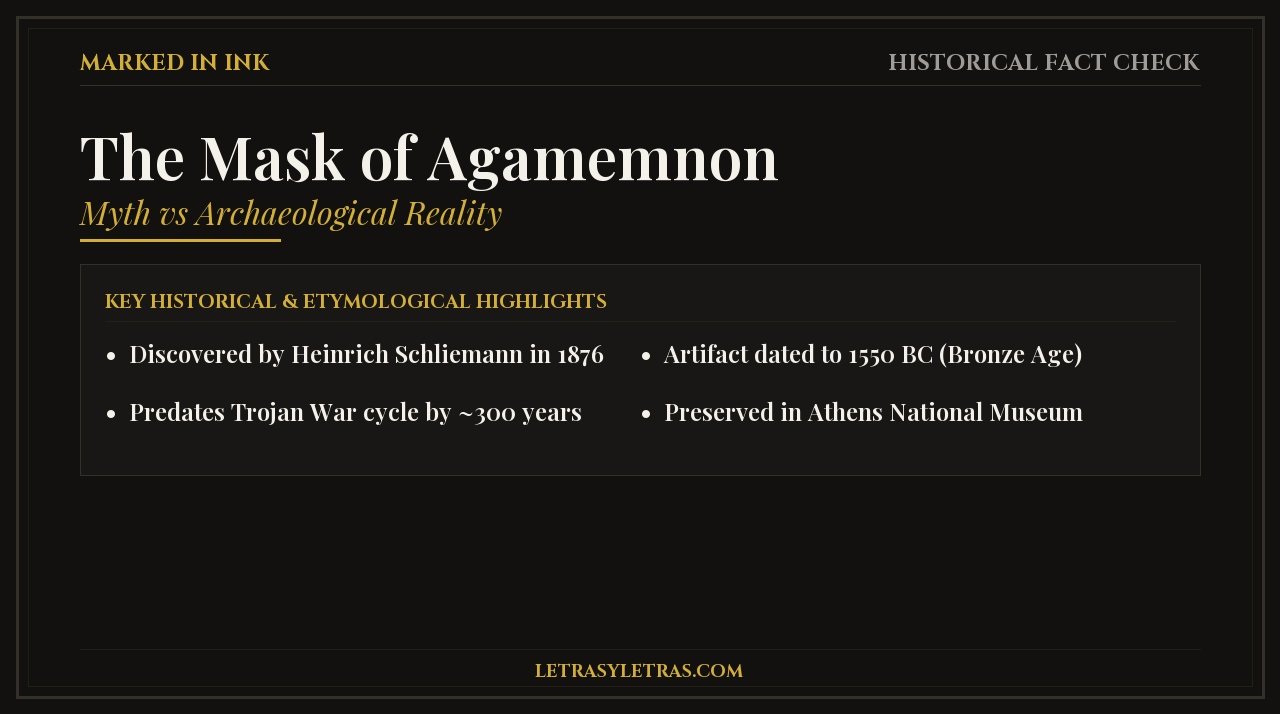
The Mask of Agamemnon: Myth vs Archaeological Fact
Heinrich Schliemann found a gold funeral mask at Mycenae in 1876. He claimed he had seen the face of Agamemnon.
Modern testing proved the artifact predated the Trojan War era.
Mythological King vs Archaeological Artifact
-
- Estimated Date: c. 1550 BC (Artifact) vs c. 1250 BC (Myth).
- Discovery Site: Grave Circle A at Mycenae vs Royal Citadel.
- Mask Origin: Pre-dates Trojan War by 300 years. Symbol of Golden Mycenae.
- Status Today: National Archaeological Museum at Athens. Eternal fixture in literature.
Though from an earlier ruler, the mask remains tied to Agamemnon. Read our guide on the origin of the word sandwich.
Famous Quotes and Classical Citations About Agamemnon
Playwrights used Agamemnon to examine pride, fate, and justice. Here are three quotes from ancient texts:
“Zeus sets humans on the road to wisdom. Learning comes through suffering.”
: Aeschylus, Agamemnon (c. 458 BCE)
“An emperor must bear praise and blame. He must govern with a firm heart.”
: Seneca, Agamemnon (c. 55 CE)
“Agamemnon, king of men, stepped forth in bronze, proudest among the host.”
: Homer, Iliad Book II
Explore our curated collection of famous quotes and quotations.
Frequently Asked Questions
What is the literal meaning of the name Agamemnon?
The name Agamemnon means “very steadfast” or “exceedingly resolute” in Ancient Greek.
Is Agamemnon a real historical person?
Agamemnon is primarily a figure of myth. Yet Bronze Age Mycenaean kings did rule during the era.
Why did Agamemnon sacrifice his daughter Iphigenia?
Myth says calm winds trapped the Greek fleet at Aulis. To secure sailing winds, Agamemnon sacrificed Iphigenia to Artemis.
How does Agamemnon connect to the word memory?
Agamemnon and memory share the Proto-Indo-European root, \men-. It relates to mind and staying firm.
Summary and Key Takeaways
The name Agamemnon carries a rich heritage across three millennia. Its etymology shows how ancient societies built moral values into names.
See more history behind classical terms in quotes about freedom, Editorial Policy, and Etymology Standards.


Alan Sledge is the writer and founder behind Letters & Letters. A lifelong lover of words, Alan has always been drawn to the small mysteries hidden in everyday language, why we say what we say, where our favorite sayings came from and the quotes that manage to put feelings into words better than we ever could ourselves.