
Modern travelers use the word constantly when describing tropical beaches or secluded island resorts. Travel brochures promise sunlit lagoons and untouched coastal beauty. We speak of finding personal peace far away from city noise.
Theologians and poets use the identical term to depict the heavenly afterlife. For centuries, religious traditions have treated paradise as a divine domain of eternal bliss. The word evokes pristine innocence and spiritual perfection.
The true origin of the word paradise surprises most modern readers. Long before it described heaven or tropical coastlines, the word had a tangible physical meaning. It designated an earthen wall built around an ancient Persian orchard.
Quick Answer: Origin of the Word Paradise
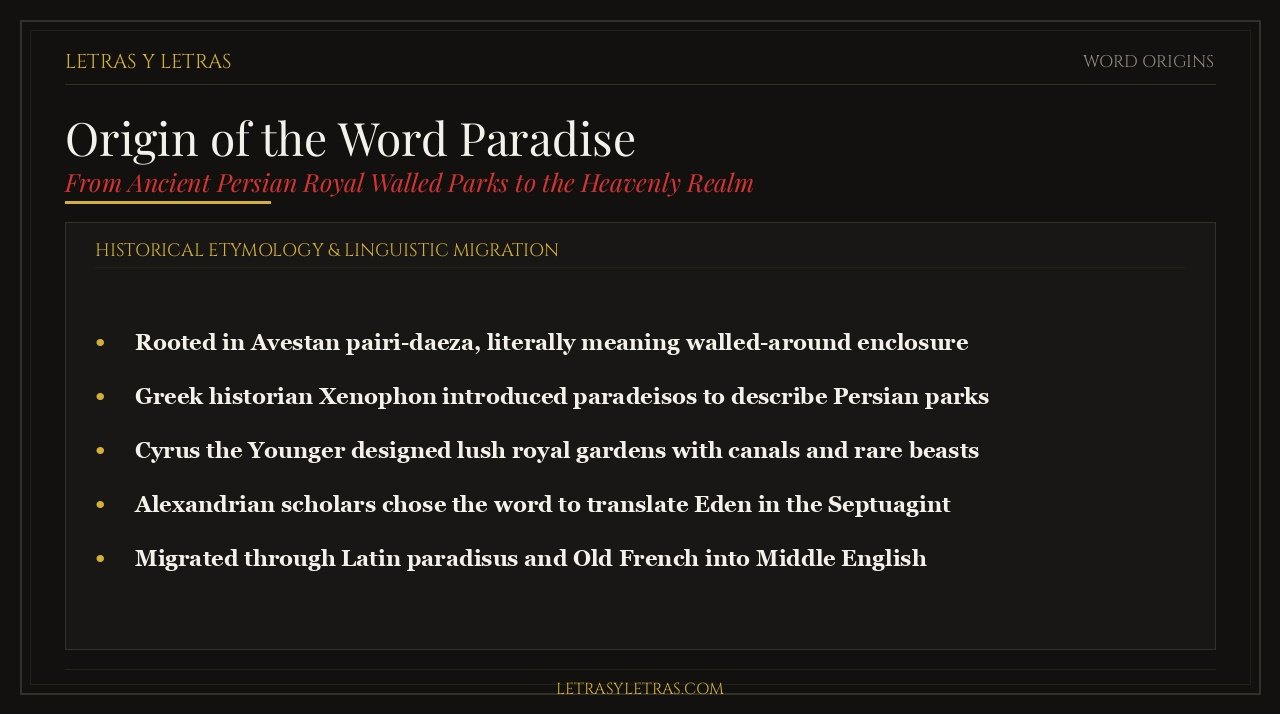
The origin of the word paradise traces to ancient Iranian and Avestan pairi-daeza, literally meaning a walled enclosure. It combined pairi (around) with daeza (wall or clay rampart). In ancient Persia, kings constructed vast irrigated estates with fruit trees to escape arid heat. Greek historian Xenophon recorded the Persian term as paradeisos in the fourth century BCE. In the third century BCE, Alexandrian Jewish scholars chose paradeisos to translate the Hebrew phrase Gan Eden in the Septuagint. The word entered Late Latin as paradisus and Old French. Around 1200, it reached Middle English, shifting from an agricultural park to heaven.
Key Takeaways
- Originates from Avestan pairi-daeza, meaning an enclosure built with clay walls.
- Persian monarchs created lush irrigated parks to escape harsh Iranian desert heat.
- Greek historian Xenophon adopted the term as paradeisos after visiting Sardis in 401 BCE.
- Septuagint translators used paradeisos for the Garden of Eden in third-century Alexandria.
- Evolved from a Persian royal hunting orchard into Christian theological heaven.
The Ancient Iranian Root: Mud Bricks and Walled Sanctuaries
To uncover the etymology of paradise, linguists look back more than two thousand five hundred years. The term belongs to the ancient Iranian language family. Specifically, scholars identify its earliest written ancestor in Old Iranian and Avestan pairi-daeza.
The compound word breaks down into two distinct linguistic components. The prefix pairi- means around or surrounding. It shares a common Indo-European root with the Greek preposition peri-.
The second root element is the noun daeza, which meant a wall, rampart, or molded clay heap. It derived from the Proto-Indo-European verbal root *dheigh-, meaning to knead clay or shape walls. English words like dough and lady share this ancient heritage.
Put together, pairi-daeza meant nothing more spiritual than a walled-around area. It referred to an agricultural estate enclosed by sun-dried brick walls. In the harsh environment of the Iranian plateau, such walls served a vital survival purpose.
The Iranian climate was fiercely arid, dusty, and swept by hot desert winds. Outside the estate walls, dry scrubland stretched across vast horizons. Inside those high barriers, Persian nobility created lush microclimates through ingenious engineering.
Persian Hydraulic Engineering: Creating Life in the Arid Plateau
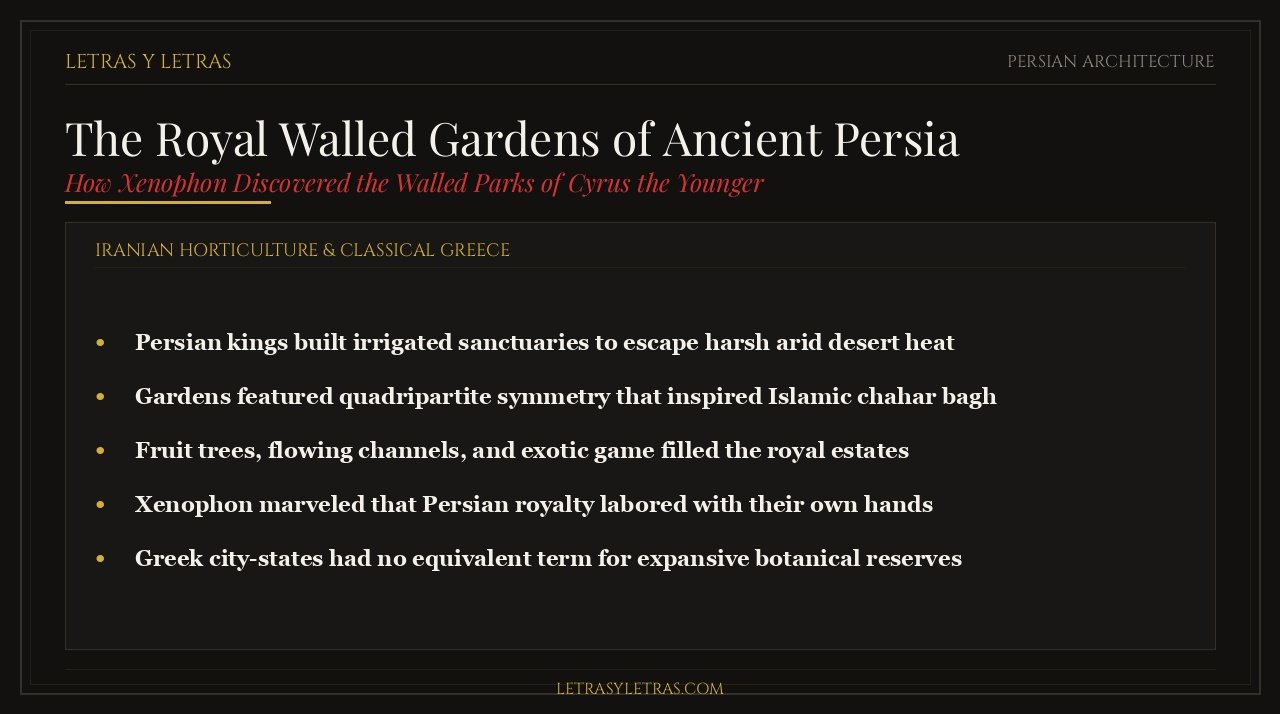
Ancient Persian walled parks were marvels of civil engineering. Persian builders relied on subterranean aqueduct networks known as qanats. These underground channels transported melted mountain snow across dozens of miles without evaporative loss.
Water flowed into royal gardens through stone channels and terraced basins. The moisture nurtured shaded groves of pomegranate, almond, fig, and citrus trees. Fragrant flowering shrubs lined symmetrical pathways.
Archival research in the Encyclopaedia Iranica study on Persian royal gardens details this horticultural mastery. Persian architects developed the four-fold garden layout called chahar bagh. Flowing cross-axial canals divided the garden into four equal quadrants.
The walled perimeter kept desert dust and scavengers outside the sanctuary. It also retained moisture and tempered blistering daytime heat. For dusty travelers arriving from arid plains, passing through those gates felt like stepping into another world.
Persian monarchs stocked their largest reserves with wild boar, gazelles, and exotic birds. Kings retreated to these preserves to practice archery and hunt game. The estate combined an agricultural orchard, a royal resort, and a botanical zoo.
The Greek Encounter: Xenophon Discovers the Persian Royal Parks
Ancient Greeks had extensive civic architecture, but private pleasure parks were alien to their culture. Greek cities featured public gathering squares called agoras, sacred olive groves, and functional olive farms. Expansive private pleasure parks simply did not exist.
That cultural isolation changed during the fifth century BCE through military conflict. In 401 BCE, Athenian soldier and historian Xenophon marched into Asia. Xenophon joined ten thousand Greek mercenaries fighting for Persian Prince Cyrus the Younger.
During his travels through the Persian Empire, Xenophon marveled at the royal estates. In his historical writings, including the Anabasis and Cyropaedia, Xenophon needed a descriptive word. Greek vocabulary lacked an exact equivalent for these magnificent enclosures.
Xenophon borrowed the Persian noun directly and hellenized its pronunciation. He recorded the term as paradeisos (παράδεισος). In classical Greek texts, the word referred exclusively to a Persian royal park or game preserve.
Scholars consulting the Perseus Digital Library classical Greek lexicon note Xenophon specific definition. Xenophon used the noun to describe lush orchards planted by human hands. The word carried zero metaphysical or supernatural implications.
The Royal Gardener: Cyrus the Younger and Spartan General Lysander
One famous episode recorded by Xenophon illustrates the cultural impact of Persian gardens. In his dialogue Oeconomicus, Xenophon describes a meeting at Sardis. Spartan commander Lysander visited Persian Prince Cyrus the Younger to secure military funding.
Cyrus gave the Spartan general a personal tour of his royal park. Lysander stood astonished by the symmetry of the trees, aligned in flawless rows. Sweet scents drifted from blooming fruit blossoms along clean watercourses.
Lysander praised the beauty of the grounds and commended the hired landscape architect. Cyrus smiled and offered an unexpected revelation. The Persian prince announced that he had measured the grounds and planted many trees himself.
Lysander looked at Cyrus rich purple robes, golden necklaces, and perfumed hair in disbelief. The Spartan could not believe that royal royalty would soil their hands with spade and shovel. Cyrus affirmed that Persian kings took pride in agricultural labor.
In Persian royal ideology, gardening was an essential regal virtue. Cultivating abundance from barren desert was seen as an act of divine order. The garden represented peace, prosperity, and righteous imperial rule.
The Great Theological Shift: The Septuagint in Alexandria
For more than a century, paradeisos remained a secular Greek loanword. It described Persian luxury, royal hunting preserves, and foreign botanical wealth. Around 280 BCE, an extraordinary translation project transformed the word forever.
In the cosmopolitan Egyptian city of Alexandria, Ptolemaic rulers sponsored a massive intellectual endeavor. Seventy Jewish scholars translated the Hebrew Scriptures into Koine Greek. This landmark translation became famous as the Septuagint.
When translating the Book of Genesis, scholars reached the second chapter. The original Hebrew text spoke of Gan Eden, meaning the Garden of Delight. Jewish scholars sought a Greek noun that conveyed rich enclosure and divine bounty.
Ordinary Greek words for garden, such as kepos, felt too modest and domestic. A kepos was a standard vegetable patch behind a house. It lacked grandeur, royal abundance, and majestic enclosure.
The translators selected Xenophon Persian loanword. In Genesis chapter two, they wrote ho paradeisos tes tryphes, meaning the paradise of delight. Later in the chapter, they recorded that God planted a paradise toward the east in Eden.
With that single editorial decision, the Persian agricultural term took on cosmic significance. An imperial irrigation park became the primeval garden of human innocence. The word was permanently lifted from earth toward heaven.
The Persian Loanword in Biblical Hebrew: From Pardes to Mysticism
The Persian word traveled along multiple linguistic pathways. It also entered late biblical Hebrew directly as pardes (פַּרְדֵּס). The term appears three times in the post-exilic books of the Hebrew Bible.
In the Book of Nehemiah, the author mentions Asaph, keeper of the royal forest or park. In Ecclesiastes, King Solomon boasts of planting orchards and parks filled with fruit trees. Within the Song of Solomon, the bride is praised as an orchard of pomegranates.
In these Hebrew passages, pardes retained its physical Persian meaning of an orchard or park. In later rabbinic tradition, however, the word underwent a profound mystical transformation. Jewish scholars treated the four consonants of P-R-D-S as an acronym.
The acronym represented the four traditional levels of scriptural interpretation. Peshat stood for the literal meaning. Remez signified allegorical hint, Derash represented homiletic inquiry, and Sod denoted secret mystical wisdom.
Entering the Pardes became a metaphor for ascending into highest contemplation. Just as in Greek, the ancient Persian walled garden evolved into a symbol of spiritual elevation.
The Christian New Testament: From Earthly Garden to Heavenly Haven
By the first century CE, Jewish and early Christian writers used the term with spiritual meaning. The word no longer referred merely to Eden past. It began to describe the future dwelling of righteous souls after death.
This theological shift appears three times in the Greek New Testament. The most famous instance occurs in the Gospel of Luke. While hanging upon the cross, Jesus speaks to the penitent thief beside him.
Jesus promises the dying man that they will be together in paradise that day. In Luke 23:43, paradise clearly signifies an immediate heavenly haven. It represents peace, restoration, and divine fellowship beyond physical mortality.
The apostle Paul uses the word similarly in his Second Epistle to the Corinthians. Paul describes a vision where he was caught up into paradise. In that celestial sanctuary, Paul heard inexpressible words that human speech cannot repeat.
Finally, the Book of Revelation mentions the term in its opening chapters. John of Patmos writes that victorious believers will eat from the tree of life in the paradise of God. The primeval garden of Genesis meets the eternal city of Revelation.
From Rome to London: Latin Vulgate, Old French, and Middle English
During the fourth century CE, Saint Jerome translated the Greek and Hebrew scriptures into Latin. Jerome produced the Latin Vulgate, the standard Bible of medieval Western Europe. The scholar transliterated the Greek term into Late Latin as paradisus.
As Latin evolved into regional Romance languages across Western Europe, the spelling shifted. In medieval France, Latin paradisus softened into Old French paradis. Following the Norman Conquest of 1066, Anglo-Norman French dominated English courts and monasteries.
The Online Etymology Dictionary records that paradise entered English vocabulary around 1200. Early Middle English texts, such as the religious guide Ancrene Wisse, adopted the term eagerly. English monks used it to describe Eden and heavenly glory.
In 1667, English poet John Milton published his monumental epic masterpiece Paradise Lost. Milton traced the biblical fall of humanity through twelve majestic books of blank verse. Four years later, Milton completed the narrative with Paradise Regained.
Milton poetry cemented the word at the absolute center of English literary imagination. For Renaissance readers, paradise stood for ultimate lost innocence and regained divine grace. The Persian mud-brick wall was now fully clothed in epic English poetry.
Chronological Milestones in the History of Paradise
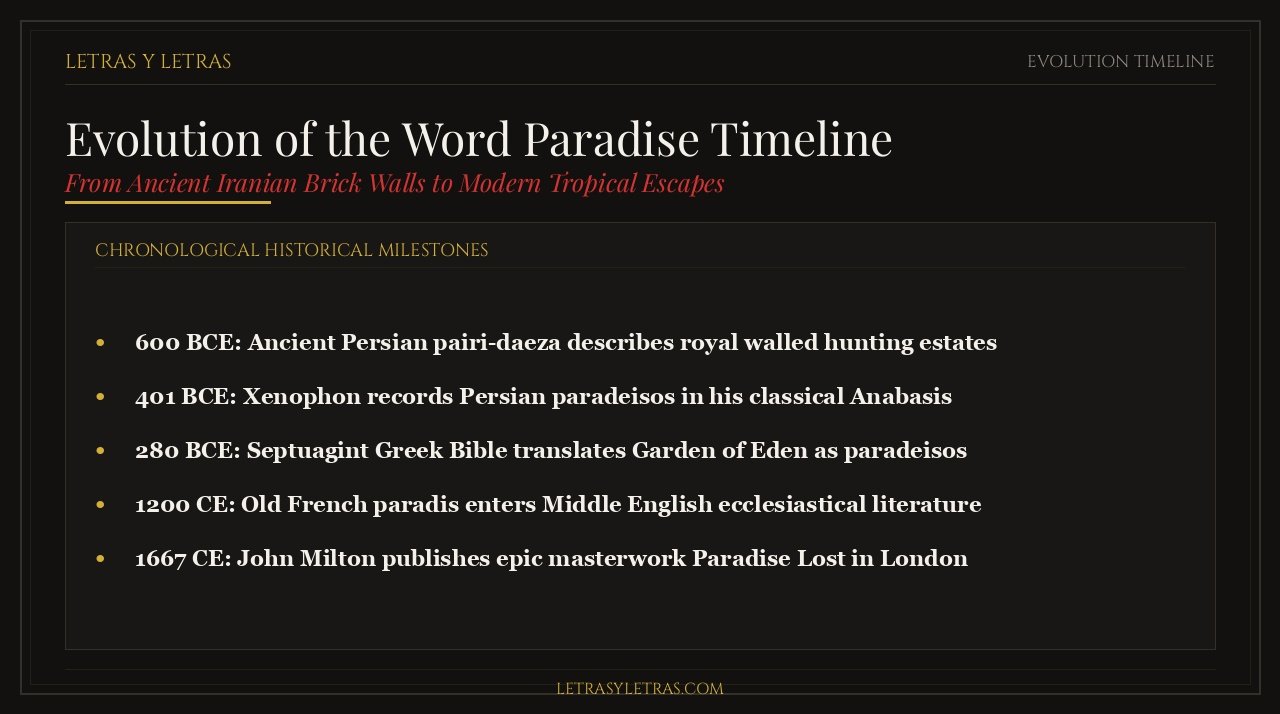
The historical timeline below summarizes the major linguistic milestones that transformed an ancient Persian orchard into a global term:
| Historical Period | Culture and Language | Linguistic Form | Context and Meaning |
|---|---|---|---|
| 600 to 500 BCE | Achaemenid Persia (Old Iranian) | Pairi-daeza | Walled royal fruit orchards, game reserves, and irrigated estate grounds. |
| 401 BCE | Classical Greece (Attic Greek) | Paradeisos | Xenophon records Persian parks in Anabasis after meeting Prince Cyrus. |
| 280 BCE | Hellenistic Alexandria (Koine Greek) | Paradeisos | Septuagint Bible translates Hebrew Gan Eden as the Paradise of Delight. |
| First Century CE | Early Christian Era (Greek) | Paradeisos | New Testament uses term for the heavenly home of the redeemed in Luke. |
| 400 CE | Late Roman Empire (Late Latin) | Paradisus | Jerome Latin Vulgate establishes the word across European Christendom. |
| 1200 CE | Medieval England (Middle English) | Paradis | Enters English religious literature via Anglo-Norman French manuscripts. |
| 1667 CE | Renaissance Britain (Modern English) | Paradise | John Milton publishes epic masterpiece Paradise Lost in London. |
Debunking Common Myths About the Origin of Paradise
Because paradise is deeply intertwined with biblical scripture, numerous folk etymologies circulate in popular culture. Examining documentary evidence dispels these persistent misconceptions:
The most widespread myth claims that paradise is an ancient Greek or Hebrew native word. Many readers assume Greek philosophers coined the term to describe mythology. In reality, neither Greek nor Hebrew owned the word.
Both ancient languages borrowed the noun from Old Iranian neighbours. The word entered Greek through military chronicles and Hebrew through Persian imperial administration. Without Persian landscape engineering, the word would not exist.
A second common myth assumes the word always carried spiritual meaning. People picture ancient prophets dreaming of celestial gardens in clouds. History proves that the term spent centuries as an entirely secular, physical concept.
The original Persian pairi-daeza involved shovels, clay bricks, irrigation ditches, and dung fertilizer. Kings built walls to keep goats from chewing young saplings. Sacred religious meaning was attached much later through translation.
We observed a similar pattern in our origin of the word hazard guide. That word began as an Arabic dice game. Material objects frequently evolve into profound philosophical concepts.
The Modern Secular Shift: Tropical Resorts and Everyday Metaphors
During the eighteenth and nineteenth centuries, European explorers navigated across the Pacific and Indian oceans. Captain James Cook and French navigator Louis Antoine de Bougainville arrived in Tahiti. Travelers encountered lush tropical islands with coconut palms and turquoise water.
Writers immediately described these idyllic Pacific islands as paradise on earth. The theological term completed a full historical circle. It returned to describing physical terrestrial landscapes with shade, fruit, and pleasant breezes.
Today, the word appears everywhere in commercial marketing and everyday speech. Hotel chains advertise Caribbean vacations as tropical paradise. Real estate agents market suburban gated communities with landscaped fountains using similar imagery.
Modern gated communities ironically mirror the ancient Persian prototype. Both feature high protective walls, guarded entrance gates, and artificial water features. Even after two millennia, human desires for secure, green sanctuaries remain unchanged.
Examining linguistic evolution in our origin of the word boycott reveals how human history shapes everyday words. You can also explore ethical language in our guide to the origin of the word sincere.
For reflections on cultivating internal peace, browse our collection of quotes on discipline. Self-mastery creates internal sanctuaries far more durable than brick walls.
Frequently Asked Questions
What is the literal origin of the word paradise?
The word paradise comes from ancient Iranian and Avestan pairi-daeza. It combined pairi (around) with daeza (wall or clay rampart). Its literal original meaning was a walled-around enclosure or orchard.
Who introduced the word paradise into ancient Greek?
Greek soldier and historian Xenophon introduced the word into Greek around 401 BCE. Xenophon encountered lush walled Persian estates during military campaigns and recorded the term as paradeisos in his historical writings.
How did paradise become connected to the Garden of Eden?
In the third century BCE, Jewish translators in Alexandria translated the Hebrew Bible into Greek. They chose paradeisos to translate the Hebrew phrase Gan Eden, cementing the association between the Persian park and primeval paradise.
Does the word paradise appear in the New Testament?
Yes, the word appears three times in the Greek New Testament. Luke 23:43 records Jesus promise to the penitent thief. Paul visits paradise in Second Corinthians, while Revelation mentions the paradise of God.
What was the purpose of an ancient Persian paradise?
Ancient Persian kings built walled estates to escape arid desert heat. The irrigated enclosures featured fruit trees, shaded streams, and game reserves where monarchs could relax and hunt in cool comfort.
When did the word paradise enter the English language?
The word entered Middle English around 1200 CE via Old French paradis following the Norman Conquest. John Milton famous 1667 epic Paradise Lost later solidified its central place in English literature.
Alan Sledge is the lead writer at letrasyletras.com, uncovering historical wisdom and word origins.


Alan Sledge is the writer and founder behind Letters & Letters. A lifelong lover of words, Alan has always been drawn to the small mysteries hidden in everyday language, why we say what we say, where our favorite sayings came from and the quotes that manage to put feelings into words better than we ever could ourselves.

Alan Sledge
Alan Sledge is the founder and lead researcher behind Letters & Letters. A lifelong student of linguistic history, he cross-references every word origin, idiom, and quote against primary archival manuscripts, the Oxford English Corpus, and 18th-century print lexicons.