
Corporate crises erupt across morning headlines after financial fraud is uncovered. Senior executives hold press conferences pointing fingers at a middle manager who is promptly dismissed from duty. Commentators and journalists immediately label the fired worker a classic scapegoat.
We encounter this familiar phenomenon across politics, family dynamics, and international diplomacy. A single individual or minority group absorbs total blame for complex collective failures. The guilty majority breathes a sigh of relief as the chosen victim bears their punishment.
Yet this powerful modern metaphor began as a literal religious ritual in ancient desert sands. In addition, the English word itself was invented by a single heroic scholar in 1530. William Tyndale coined the compound while defying royal execution to translate ancient scripture.
To trace how a sacred Hebrew ceremony became our universal psychological term for unjust blame, we must examine sixteenth-century Europe. The story connects desert Tabernacles, forbidden printing presses, and modern social psychology.
Quick Answer: Origin of the Word Scapegoat
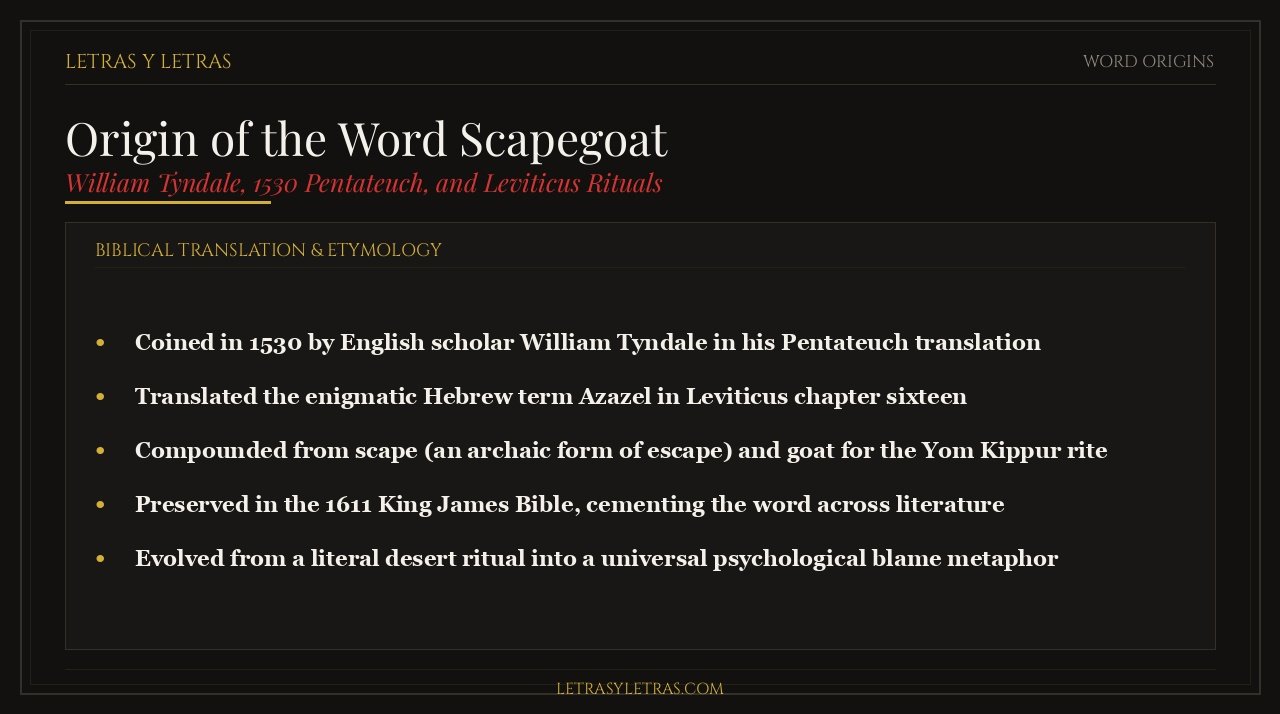
The word scapegoat was coined in 1530 by English Bible scholar William Tyndale in his translation of the Pentateuch. Tyndale was translating the Book of Leviticus, chapter sixteen, which details the ancient Day of Atonement ritual. High Priest Aaron cast lots over two goats. One was sacrificed while the other carried communal sins into the desert. Tyndale translated the enigmatic Hebrew word Azazel as ez (goat) combined with azal (to escape). He combined the archaic verb scape with goat, creating scapegoat. The 1611 King James Bible preserved Tyndale term. By the 1820s, English writers applied the word figuratively to blamed humans.
Key Takeaways
- Invented in 1530 by English scholar William Tyndale in his pioneering Bible translation.
- Created to translate the enigmatic Hebrew biblical term Azazel in Leviticus sixteen.
- Compounded from the archaic English word scape, meaning escape, and the animal goat.
- Described the living Yom Kippur goat sent into wilderness sands bearing communal sins.
- Shifted in the early nineteenth century into a psychological metaphor for unfair human blame.
William Tyndale and the 1530 Pentateuch
The word scapegoat did not exist in the English language before the year 1530. Its creator was William Tyndale, an Oxford-educated linguist and fearless biblical scholar. Tyndale lived as a hunted exile in Antwerp, evading agents sent by King Henry VIII.
English authorities strictly forbade translating the Holy Bible into common spoken English. Violating this ecclesiastical ban was punishable by horrific public execution at the stake. Tyndale believed that ordinary plowboys deserved access to scripture in their native language.
Historical documents in the British Library Tyndale Bible collection highlight his linguistic brilliance. Having printed the first English New Testament in 1526, Tyndale mastered ancient Hebrew. In 1530, he published his monumental English translation of the Pentateuch.
When Tyndale translated Leviticus chapter sixteen, he faced a legendary linguistic obstacle. The Hebrew text described the Day of Atonement, known as Yom Kippur. That sacred narrative contained a strange proper noun that had perplexed translators for centuries.
That mysterious Hebrew word was Azazel. Rather than leaving the term untranslated or importing an obscure foreign noun, Tyndale invented a fresh English compound. His poetic translation gifted our language with an immortal phrase.
The Yom Kippur Ritual in Leviticus 16
To understand Tyndale creative breakthrough, we must examine the ancient sacred ceremony in Leviticus. On the tenth day of the seventh month, ancient Israelites observed their holiest national gathering. High Priest Aaron entered the Tabernacle to cleanse the community from accumulated spiritual transgressions.
The biblical ritual required two healthy male goats from the Israelite assembly. Aaron cast sacred lots over the animals before the altar of the sanctuary. One lot belonged to Yahweh, while the other lot belonged to Azazel.
The first goat was slain as a formal sin offering for the sanctuary. Aaron carried its blood behind the heavy veil, sprinkling it upon the golden mercy seat. That sacrifice provided symbolic cleansing for the tabernacle itself.
However, the second goat was treated with an entirely different ceremonial procedure. Aaron presented the live animal before the congregation. The High Priest placed both hands firmly on the head of the live goat.
Aaron solemnly confessed all iniquities, transgressions, and moral failures of the people over the animal. A designated attendant then led the burdened goat deep into the barren wilderness. The goat carried all their collective guilt into an uninhabited wasteland.
The Linguistic Breakdown: How Tyndale Coined Scape + Goat
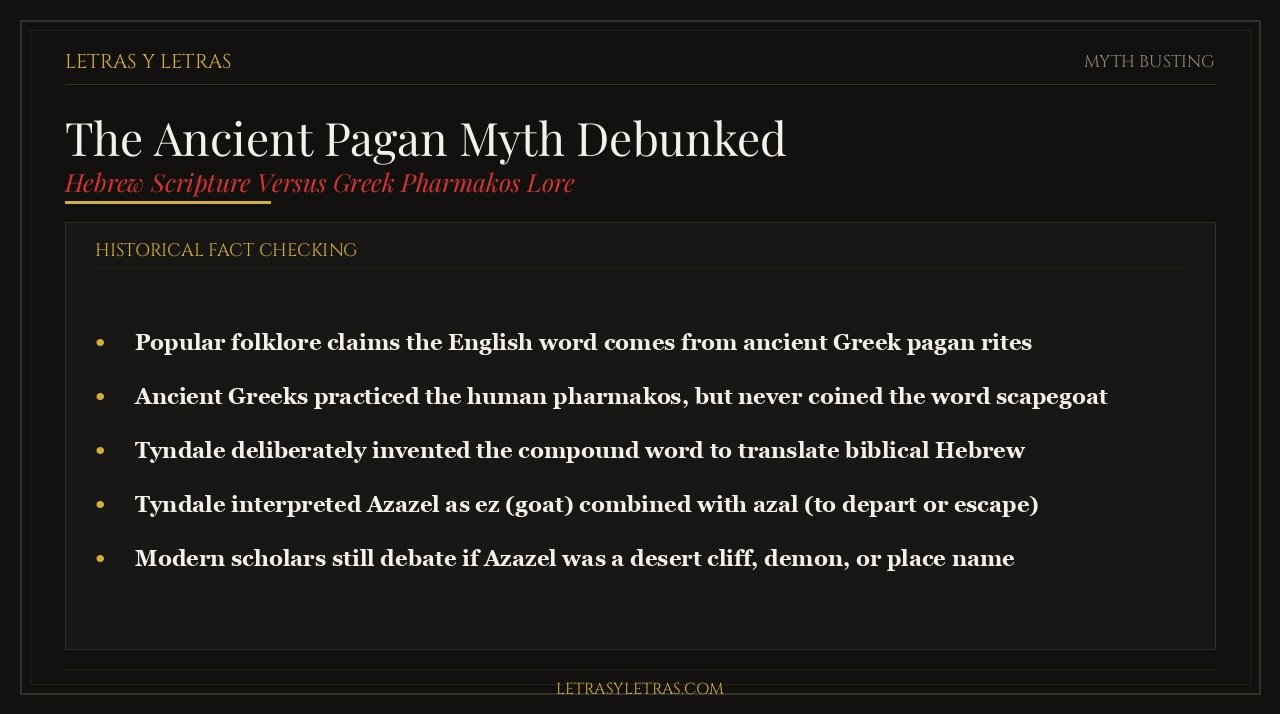
Tyndale analyzed the obscure Hebrew word Azazel with disciplined linguistic care. He broke the ancient word into two distinct Hebrew components: ez, meaning goat, and azal, meaning to depart. Tyndale concluded that Azazel signified the goat that is permitted to escape.
Etymological documentation in the Online Etymology Dictionary entry on scapegoat explains his word creation. In sixteenth-century Early Modern English, scape was the standard shortened form of escape. Contemporary authors frequently spoke of making a narrow scape from mortal peril.
Tyndale translated Leviticus chapter sixteen by writing of the goat on which the lot fell to scape. He quickly merged the verb and noun into a single memorable compound: the scapegoat. The word literally meant the escape-goat.
Modern biblical scholars continue to debate the true ancient meaning of Azazel. Some linguists argue it referred to a rugged desert cliff where the goat was released. Other scholars suggest Azazel was an ancient desert spirit representing chaos and desolation.
Whatever the original Bronze Age author intended, Tyndale English interpretation was brilliant. The word vividly captured the essential physical drama of the ceremony. One goat died on the altar while the other escaped alive into desert sands.
Preservation in the 1611 King James Bible
William Tyndale did not live to see his translation achieve universal acceptance. In 1536, imperial officers betrayed him outside Antwerp and imprisoned him in Vilvoorde Castle. He was strangled and burned at the stake, crying for God to open England eyes.
Yet King Henry VIII soon recognized that English subjects demanded scripture in their own tongue. The Great Bible of 1539 incorporated massive portions of Tyndale translation verbatim. Tyndale words were quietly adopted into royal church liturgy.
In 1611, King James I convened fifty-four leading scholars to create the Authorized Version. The translators relied heavily on Tyndale previous work for the Old Testament books. They retained Tyndale word scapegoat in Leviticus sixteen without alteration.
The King James Bible became the most influential and widely read book in the English language. Generations of school children, pastors, and authors memorized its majestic cadences. Tyndale invented word was etched permanently into English literary memory.
For two hundred years, English speakers understood scapegoat exclusively in its biblical context. It remained a solemn sacred term describing the Levitical ritual. That narrow religious meaning began expanding during the nineteenth century.
The Semantic Shift: From Desert Rite to Human Blame
During the early nineteenth century, British essayists and novelists began using scapegoat metaphorically. Authors noticed that human communities often reenacted the ancient desert ritual with human victims. People routinely transferred collective guilt onto innocent or powerless individuals.
Historical analysis in the Oxford Reference entry on scapegoat traces this transition. The earliest recorded figurative usage appears in British literature around 1824. Writers described political ministers who took public blame for foolish royal policies as scapegoats.
By the 1850s, the figurative meaning had surpassed the literal biblical ritual in everyday conversation. Military officers used the term when a junior captain took the fall for a disastrous battle command. Schoolmasters observed schoolyard bullies selecting vulnerable children to bear blame for group mischief.
The word was transforming from a religious artifact into an essential tool of human psychology. It described a universal flaw in social organization: the evasion of collective responsibility. Humanity had found an enduring label for an ancient moral failing.
Readers fascinated by social hierarchy shaping language can read our study on the origin of the word villain. Both words demonstrate how social and moral judgments corrupt or transform historical vocabulary.

Chronological Timeline: The Evolution of the Word
Tracking the word across three millennia reveals a remarkable conceptual evolution. The chronological timeline below highlights key milestones in the life of the word.
| Year or Era | Historical Source | Context and Linguistic Milestone |
|---|---|---|
| Around 1000 BCE | Book of Leviticus | Ancient Israelite ritual casts lots over two goats during Day of Atonement ceremonies. |
| 1530 | William Tyndale Pentateuch | Tyndale coins the compound noun scapegoat in English print to translate Hebrew Azazel. |
| 1611 | King James Authorized Version | Translators preserve Tyndale coinage in Leviticus sixteen, cementing the word into literature. |
| 1824 | British Periodical Literature | Earliest recorded figurative use describing a human blamed for faults of others. |
| 1982 | René Girard The Scapegoat | Philosophical analysis establishes the scapegoat mechanism as a universal cultural foundation. |
| Present | Global Sociological Speech | Universal psychological concept used in corporate, legal, political, and family analysis. |
The timeline demonstrates how a specialized liturgical phrase transformed into a universal psychological concept. In ancient times, the ritual restored social harmony by sending a physical beast into the wild. Today, the word identifies an unhealthy psychological evasion of guilt.
Similar semantic expansions occurred in naval warfare language. To explore how seventeenth-century warships birthed idioms, read about the origin of the phrase passing with flying colors. Military and religious rites consistently enrich English speech.
Learn how an eighteenth-century title named fast food in our guide to the origin of the word sandwich. Everyday language constantly reflects forgotten historical events.
The Psychology of Scapegoating: René Girard and Modern Science
In the twentieth century, sociologists and philosophers examined why human societies consistently create scapegoats. The most influential scholar on this subject was French literary theorist René Girard. In 1982, Girard published his landmark philosophical work titled The Scapegoat.
Girard proposed a theory of human behavior called mimetic desire. Humans do not desire objects independently; we imitate the desires of our neighbors. When multiple individuals crave the same status or resources, social competition escalates into destructive community crisis.
To prevent total internal warfare, communities unconsciously select an arbitrary target. The entire community unifies its shared aggression against this chosen outsider or minority victim. By expelling or destroying the scapegoat, the community experiences cathartic relief and temporary peace.
Modern social psychology strongly validates Girard insights into collective behavior. Psychologists study scapegoating in dysfunctional family systems where one child carries parental anxiety. Corporate researchers examine workplace cultures where incompetent managers blame junior subordinates for systemic failures.
In political science, demagogues routinely mobilize voting mobs by scapegoating immigrants, religious minorities, or foreign nations. Identifying an external enemy distracts the public from systemic domestic problems. The ancient wilderness ritual continues to repeat itself in modern boardrooms and parliaments.
The Linguistic Genius of William Tyndale
William Tyndale legacy extends far beyond a single word about sacrificial goats. The translator is responsible for coining dozens of the most poetic phrases in the English language. Alongside William Shakespeare, Tyndale did more to shape modern English than any other individual.
Before Tyndale, English was considered a crude, vulgar island tongue unsuitable for serious theology. Scholars wrote in Latin and courtiers spoke French. Tyndale proved that English possessed rhythm, emotional clarity, and dramatic power.
Tyndale coined unforgettable words including passover, atonement, peacemaker, and longsuffering. He crafted iconic idioms like the powers that be, my brother keeper, and a man after his own heart. Tyndale translation was so musical that King James scholars retained over eighty percent of his phrasing.
When Tyndale coined scapegoat, he gave human consciousness a mirror to view its own moral evasions. He provided a precise word to expose the injustice of blaming the innocent. Without his linguistic bravery, our language would lack one of its sharpest moral tools.
You can also review common idioms in our english idioms and meanings reference library. English vocabulary constantly preserves the courage of pioneering scholars.
The Moral Mirror of the Scapegoat
The word scapegoat endures because it describes a universal temptation of the human heart. It is always easier to blame a convenient outsider than to confront our own failings. True moral maturity begins when we refuse to cast our burdens onto innocent shoulders.
In ancient Israel, the ritual was designed to remind worshippers of their shared frailty before God. The goat was not despised; it was treated with solemn reverence as it bore communal sins away. Modern scapegoating has stripped away the reverence, leaving only the cruelty of collective cowardice.
Recognizing the scapegoat mechanism gives us the power to dismantle it in our daily lives. In families, workplaces, and democratic politics, justice requires holding the truly responsible accountable. We must resist the urge to expel a blameless victim to purchase cheap social peace.
The next time you hear someone labeled a scapegoat, remember William Tyndale Antwerp garret. Picture the lone scholar searching ancient Hebrew manuscripts by candlelight. You are speaking a word born of spiritual courage that continues to challenge human conscience.
Frequently Asked Questions
Who first coined the word scapegoat?
English biblical scholar William Tyndale invented the word scapegoat in 1530. He created the compound while translating the Book of Leviticus into English. Tyndale combined the archaic verb scape, meaning escape, with goat to translate the Hebrew word Azazel.
What was the biblical scapegoat ritual?
The ritual was observed on the Day of Atonement, known as Yom Kippur. High Priest Aaron confessed the sins of the Israelite people over a live goat while laying hands upon its head. The goat was then led into the desert wilderness, symbolically carrying away communal guilt.
What does the Hebrew word Azazel mean?
Scholars debate the exact meaning of Azazel in biblical Hebrew. Tyndale translated it as ez (goat) and azal (to depart). Other scholars suggest it meant a rugged precipice or represented an ancient desert spirit of chaos.
When did scapegoat become a metaphor for blamed people?
The word transitioned into a figurative metaphor during the early nineteenth century in British literature. By 1824, writers began describing humans who took unfair blame for the mistakes of others as scapegoats.
Did ancient Greeks coin the word scapegoat?
No. While ancient Greeks practiced a purification ritual using a human victim called a pharmakos, they never coined the word scapegoat. The word was invented exclusively in sixteenth-century English by William Tyndale.
Alan Sledge is the founder and lead writer at letrasyletras.com, dedicated to uncovering the true etymological histories behind our favorite words and phrases.


Alan Sledge is the writer and founder behind Letters & Letters. A lifelong lover of words, Alan has always been drawn to the small mysteries hidden in everyday language, why we say what we say, where our favorite sayings came from and the quotes that manage to put feelings into words better than we ever could ourselves.

Alan Sledge
Alan Sledge is the founder and lead researcher behind Letters & Letters. A lifelong student of linguistic history, he cross-references every word origin, idiom, and quote against primary archival manuscripts, the Oxford English Corpus, and 18th-century print lexicons.