
Moviegoers sit in darkened theaters waiting for the antagonist to appear on screen. The character steps from shadows wearing a sinister grin and plotting ruthless destruction against the hero. Across global cinema and classic literature, audiences immediately recognize the villain.
We use this familiar term to describe wicked criminals, treacherous schemers, and malicious sociopaths. The word carries an air of irredeemable moral corruption. It represents the ultimate opposite of virtue, honor, and courage.
Yet the original word had nothing to do with cruelty, crime, murder, or wickedness. The noun began as an ordinary description of a humble agricultural laborer tilling countryside soil. To discover how a peaceful farmer became an icon of evil, we must explore ancient Rome.
Centuries of aristocratic prejudice systematically transformed agricultural poverty into a synonym for malice. Examining linguistic history exposes the class bias that permanently shaped our modern vocabulary.
Quick Answer: Origin of the Word Villain
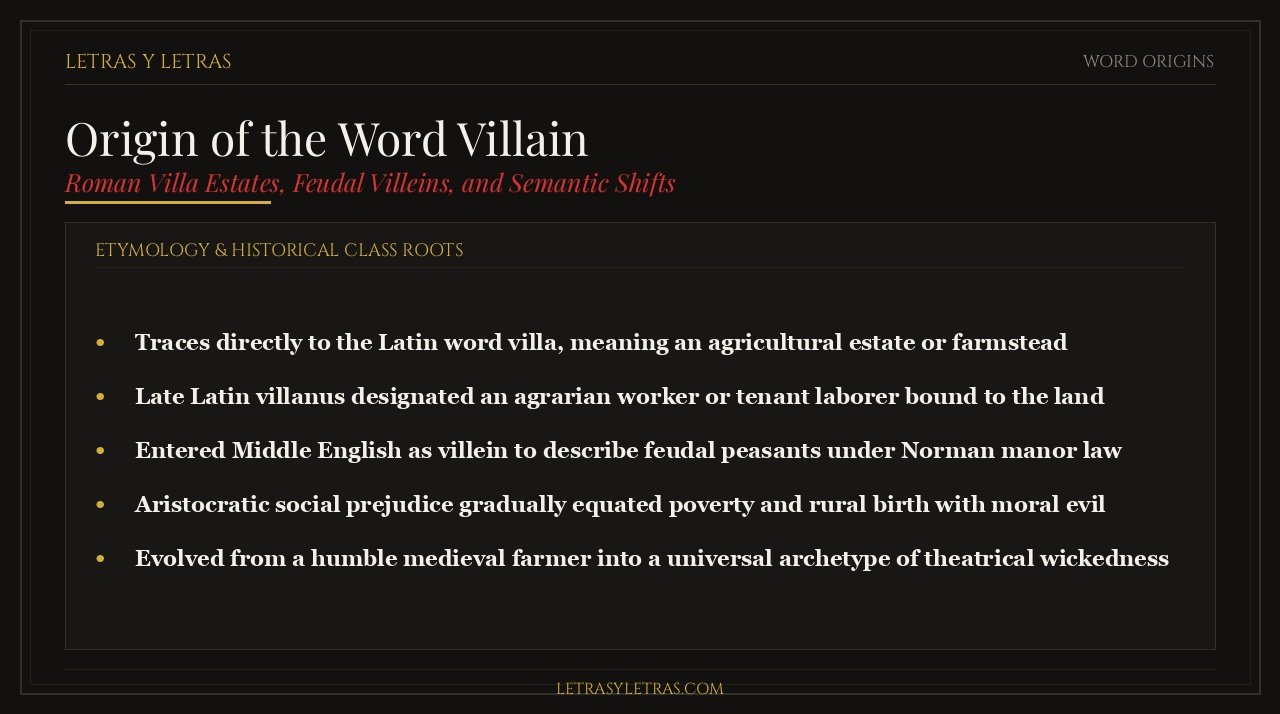
The word villain originated from the Latin noun villa, meaning a country house or rural farm estate. In Late Latin, a villanus was simply an agricultural laborer or farmhand attached to a country estate. After the 1066 Norman Conquest, Middle English villein designated a feudal tenant farmer bound to manor land. Norman French nobility looked down on rural peasants, viewing manual field labor as coarse, uneducated, and morally inferior. Through a linguistic process known as pejoration, the social class label gradually shifted into a moral insult. By the fourteenth century, writers contrasted noble court manners with base peasant villainy.
Key Takeaways
- Derived from the Latin noun villa, meaning an agricultural estate or country farmstead.
- Late Latin villanus described a peaceful agricultural laborer with zero moral judgment.
- Norman French feudalism codified the villein as an unfree peasant tenant farmer.
- Aristocratic prejudice gradually equated rural poverty and field work with wicked behavior.
- Parallel terms like churl, boor, and knave underwent identical linguistic pejoration.
The Latin Agricultural Root: From Villa to Villanus
The etymological foundation of the word rests in ancient Roman agriculture. In classical Latin, a villa was a country estate, rural farmstead, or productive agricultural plantation. Wealthy Roman citizens built country villas to escape crowded city noise and supervise crop yields.
These vast agricultural operations required dozens of dedicated laborers to plow furrows and tend livestock. In Late Latin, estate owners created the noun villanus. The word designated a tenant farmer or agricultural hand attached to a country villa.
Etymological documentation in the Online Etymology Dictionary entry on villain confirms these peaceful farming origins. The term villanus carried zero ethical or moral criticism in Roman society. A villanus was simply someone who lived and worked on countryside land rather than in an urban center.
Roman legal codes used the word as a purely functional occupational designation. The farmhand grew wheat, pressed olive oil, and harvested vineyard grapes. Nothing about the Latin word implied criminal intent or malicious conduct.
As the Roman Empire fragmented, the Latin language evolved into regional Romance dialects. In early medieval France, villanus transformed into the Old French noun vilain. The word continued to describe a rural villager or peasant farm laborer.
The Norman Conquest and the Feudal Villein
The decisive turning point in the history of the word occurred in 1066. Duke William of Normandy defeated King Harold at Hastings, conquering Anglo-Saxon England. Norman knights established a rigid feudal landholding hierarchy across the British countryside.
Historical records in the British Library archives on the feudal system detail this social structure. The Norman legal administration imported the French term into English as villein. In feudal law, a villein was a tenant farmer legally bound to the manor of a feudal lord.
The monumental 1086 Domesday Book classified thousands of rural English families as villeins. Villeins formed the primary economic engine of medieval agricultural England. They cultivated the lord fields, paid agricultural taxes, and provided obligatory manual services.
A villein occupied a legal status between a freeholder and an enslaved laborer. They held land rights and personal possessions under customary manor law. However, villeins were legally unfree, meaning they could not depart the estate without the lord consent.
Feudal courts enforced this territorial attachment with uncompromising legal strictness. A villein belonged to the estate land on which they were born. Their entire social identity was defined by agricultural labor under an aristocratic master.
Semantic Pejoration: How Class Hatred Corrupted the Word
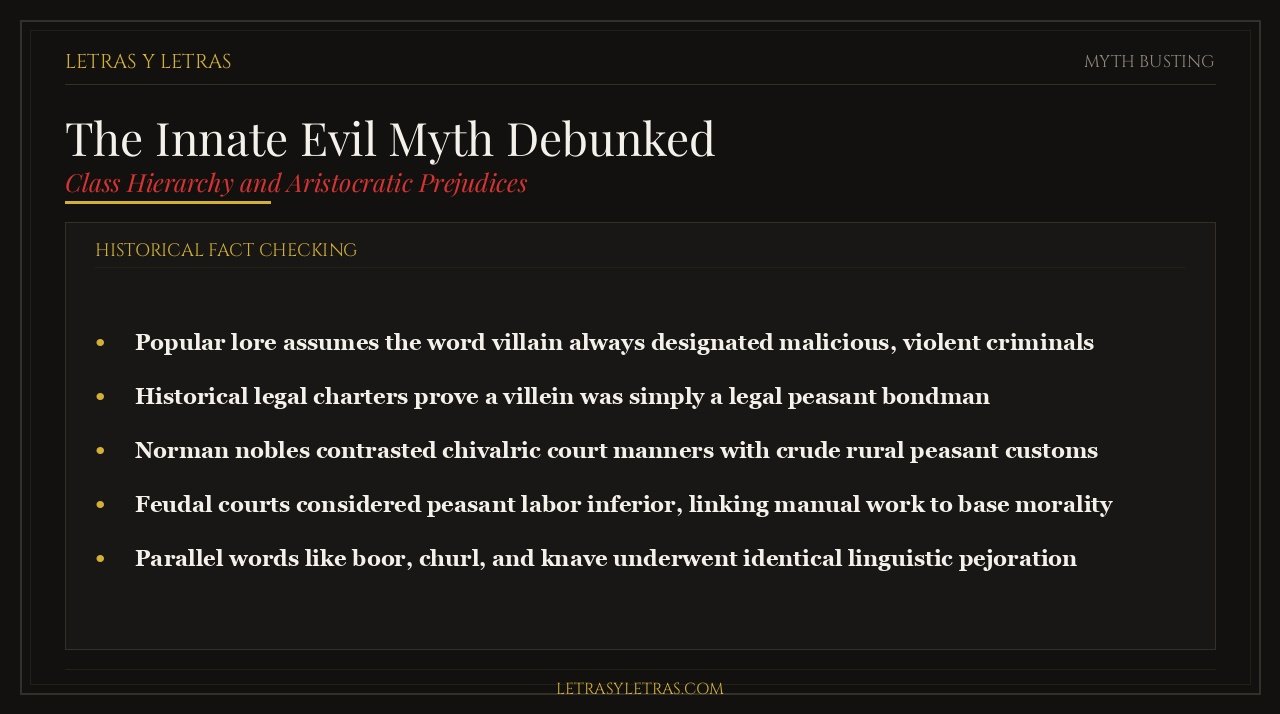
Linguists use the term semantic pejoration to describe words that degenerate over time. Pejoration occurs when a neutral or positive word acquires an intensely negative meaning. The transformation of villain represents the most dramatic instance of pejoration in the English language.
The catalyst behind this linguistic decay was aristocratic social snobbery. The ruling Norman conquerors spoke Anglo-Norman French while conquered English peasants spoke Old English. Norman nobles viewed the native farming population with profound cultural disdain.
Aristocrats believed that noble birth naturally produced refined manners, bravery, and chivalry. They labeled this courtly standard gentilesse, linking high birth directly to moral virtue. Conversely, nobles assumed that common peasant blood bred cowardice, coarseness, and deceit.
Noblemen mocked rural peasants for wearing coarse wool garments and smelling of livestock manure. Feudal lords claimed that manual laborers lacked honor, refined speech, and basic education. Soon, courtiers used villein as an insult to describe anyone displaying rustic, uncourtly manners.
By the thirteenth century, the word had begun detaching from legal peasant status. To call a gentleman a villein was to accuse him of acting like a crude peasant. Over generations, bad manners gradually merged into bad morals.
Parallel Victims of Classist Pejoration: Churl, Boor, Knave
The linguistic fall of the word villain was not an isolated historical accident. English aristocratic culture systematically degraded multiple terms that originally described honest working people. Examining these parallel words reveals the pervasive nature of feudal class bias.
Consider the modern English word churl and its adjective churlish. In Anglo-Saxon society, a ceorl was an honorable, free peasant farmer of independent standing. Under Norman rule, nobles degraded the term until churlish came to mean rude, ill-mannered, and selfish.
Similarly, the modern insult boor shares an identical agricultural pedigree. In Dutch and Old English, a boer or gebur was simply a rural farmer working livestock. Today, calling someone boorish implies that they are crude, insensitive, and socially uncivilized.
The word knave followed the exact same downward linguistic path. In Old English, a cnafa was an ordinary boy, youth, or male domestic servant. Centuries of aristocratic condescension transformed knave into a synonym for a deceitful scoundrel or thief.
Even the word clown originated as an informal Germanic term for a clumsy country peasant. Aristocratic theater audiences laughed at country bumpkins, turning rural laborers into comedic fools. The ruling elite consistently transformed working-class labels into insults.
Medieval and Renaissance Literature: Chaucer to Shakespeare
Medieval literature vividly illustrates the shifting meaning of the word during the fourteenth century. Poet Geoffrey Chaucer explored the tension between noble birth and actual moral character. Chaucer frequently contrasted true gentilesse with shameful peasant villainy.
In his famous work The Canterbury Tales, Chaucer argued that true nobility comes from virtuous actions. The poet declared that a person who commits wicked deeds is the real villain. Chaucer urged readers to evaluate moral conduct rather than relying on ancestral titles.
Literary analysis in the Oxford Reference entry on villain documents this literary shift. By the time of the Renaissance, the word was completing its moral transformation. Playwright William Shakespeare frequently played with both the social and moral definitions.
In his pastoral comedy As You Like It, Orlando confronts his hostile older brother Oliver. Oliver insults Orlando by calling him a villain, using the word as a social sneer. Orlando angrily retorts that he is a gentleman son, turning the insult back on his brother.
In his historical tragedy Richard III, Shakespeare fully embraced the modern moral definition. The villainous Duke of Gloucester famously announces his intention to prove a villain. That dramatic scene completed the shift from agricultural worker to sinister conspirator.
Chronological Timeline: The Evolution of the Word
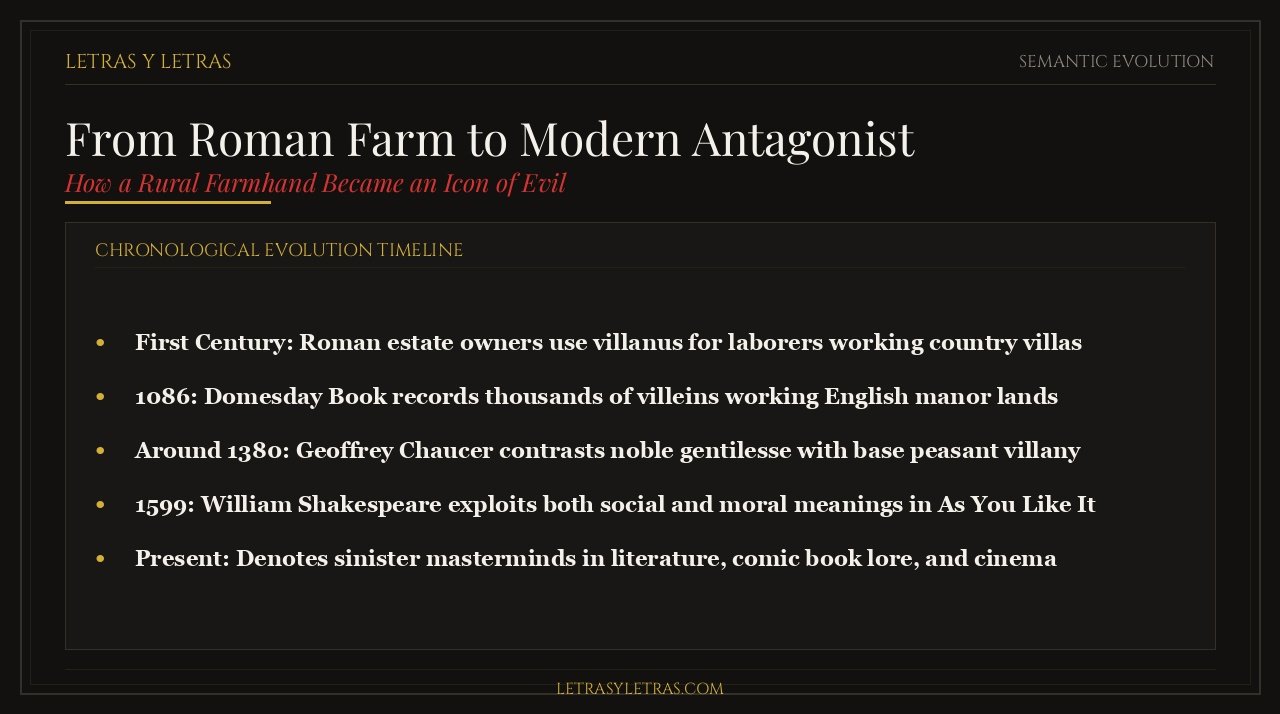
Tracking the word across two millennia demonstrates how social hierarchies corrupt vocabulary. The chronological timeline below highlights key milestones in the transformation of the word.
| Year or Era | Historical Source | Context and Linguistic Milestone |
|---|---|---|
| First Century CE | Classical Roman Law | Latin villanus designates an agricultural laborer cultivating a rural villa estate. |
| 1086 | Domesday Book Survey | Norman administrators classify thousands of English manor tenant farmers as villeins. |
| Around 1380 | Geoffrey Chaucer | Contrasts noble courtly gentilesse with base peasant villany in The Canterbury Tales. |
| 1599 | William Shakespeare | Exploits both feudal class status and rising moral wickedness in As You Like It. |
| 1850s | Victorian Melodrama | Stage plays establish the cape-wearing theatrical villain as a universal dramatic stock archetype. |
| Present | Global Pop Culture | Universal noun describing sinister masterminds, evil antagonists, and criminal characters. |
The timeline reveals a striking linguistic inversion across several centuries. In classical Rome, a villanus was an essential agricultural producer who sustained imperial food supplies. By Victorian times, the word described the exact opposite of an honest working citizen.
Similar social shifts shaped other English words across history. To see how naval battles birthed idioms, read about the origin of the phrase passing with flying colors. Everyday idioms frequently preserve military and social struggles.
Learn how a noble title named fast food in our guide to the origin of the word sandwich. Aristocrats and peasants constantly traded linguistic space.
Victorian Melodrama and the Birth of the Theatrical Villain
During the nineteenth century, popular entertainment codified the villain into a permanent dramatic archetype. Working-class theaters in London and New York pioneered the genre of stage melodrama. These affordable productions attracted massive audiences eager for clear moral conflict.
Melodramas relied on formulaic stock characters that required zero explanation. Audiences cheered the innocent heroine and applauded the virtuous working-class hero. They hissed and booed the moment the sinister stage villain walked onto the boards.
The stage villain possessed an iconic visual uniform. The character wore a tall black silk top hat, dark gloves, and an elegant velvet cape. He twirled a dark waxed mustache while plotting foreclosure on the family homestead.
Ironically, Victorian theater inverted the ancient medieval class dynamic. In medieval times, aristocrats labeled poor peasants as villains. During Victorian stage melodramas, the villain was frequently a corrupt aristocrat or ruthless landlord exploiting poor workers.
This theatrical archetype transitioned seamlessly into early twentieth-century cinema. Silent films inherited the exaggerated physical mannerisms of stage melodramas. Early motion pictures cemented the villain as the indispensable driver of narrative tension.
The Modern Psychological Antagonist
In contemporary storytelling, the concept of the villain continues to undergo fascinating artistic evolution. Twentieth-century comic books expanded the archetype into colorful supervillains. Characters like the Joker, Lex Luthor, and Magneto challenged traditional heroes on an epic scale.
Modern audiences increasingly reject simplistic, one-dimensional caricatures of pure evil. Contemporary novelists, screenwriters, and dramatists craft morally complex antagonists with sympathetic backstories. Today viewers analyze why characters choose destructive paths rather than simply condemning them.
Writers explore tragic anti-villains who believe their extreme actions serve noble goals. These characters act out of grief, ideological obsession, or perceived historical injustice. Yet despite these sophisticated narrative nuances, we still call them villains.
Modern English speakers never think of medieval wheat fields when uttering the word. The agricultural serf has been completely erased by centuries of storytelling. To explore how political resistance created another famous verb, read about the origin of the word boycott.
You can also explore dozens of fascinating etymologies in our english idioms and meanings reference library. Words carry the hidden footprints of forgotten social revolutions.
The Lessons of Semantic Pejoration
The history of the word villain offers a sobering lesson in how language reflects power. Words do not evolve in isolated academic vacuums. Human vocabulary is shaped by the prejudices, conflicts, and anxieties of the people who hold authority.
When a dominant social class controls courts, literature, and formal education, they dictate meaning. Medieval Norman aristocrats wielded language as an instrument of social control. They redefined honest farm labor as base wickedness to justify their own political dominance.
Yet language also possesses a remarkable capacity for democratic reclamation. The peasant villein who grew rye in medieval Kent has vanished from common memory. In their place stands a testament to how easily prejudice can corrupt human vocabulary.
Every time we use the word villain, we speak a forgotten fragment of feudal class struggle. Remembering the humble farmhand beneath the theatrical scoundrel restores historical truth. True villainy lies not in rural birth, but in the injustice that distorted the word.
Frequently Asked Questions
What was the original meaning of the word villain?
The word villain originally meant an agricultural farmhand or peasant laborer attached to a country villa. In classical and Late Latin, the term carried zero negative or moral judgment. It was purely an occupational description for someone who farmed countryside land.
How did villain come to mean an evil person?
The word changed meaning through a linguistic process called pejoration. Following the 1066 Norman Conquest, French-speaking nobles looked down on native English peasant farmers. Aristocrats equated rural poverty with bad manners, dishonesty, and moral baseness over several centuries.
What was a feudal villein in medieval England?
In medieval feudal law, a villein was a tenant farmer legally bound to a lord’s manor estate. Villeins were unfree peasants who could not leave the land without permission. They farmed land for themselves while providing compulsory manual labor for their feudal lord.
What other English words were degraded by class bias?
Several English insults originally described honest rural working people. Words like churl, boor, and knave all began as neutral terms for free farmers, countrymen, and young servants. Aristocratic prejudice gradually converted all of these words into insults.
When did the word villain become common in theater?
The word became an established theatrical term during nineteenth-century Victorian melodramas. Playwrights created stock stage villains with black capes and top hats to oppose virtuous heroes. This dramatic trope transitioned directly into twentieth-century cinema and comic books.
Alan Sledge is the founder and lead writer at letrasyletras.com, dedicated to uncovering the true etymological histories behind our favorite words and phrases.


Alan Sledge is the writer and founder behind Letters & Letters. A lifelong lover of words, Alan has always been drawn to the small mysteries hidden in everyday language, why we say what we say, where our favorite sayings came from and the quotes that manage to put feelings into words better than we ever could ourselves.

Alan Sledge
Alan Sledge is the founder and lead researcher behind Letters & Letters. A lifelong student of linguistic history, he cross-references every word origin, idiom, and quote against primary archival manuscripts, the Oxford English Corpus, and 18th-century print lexicons.