
A sudden cold sensation grips the chest without warning. The heart thumps violently against the ribs. Breath shortens, muscles freeze, and an overpowering urge to flee overtakes rational thought.
We call this intense physiological experience panic. We use the noun to describe frantic stock markets, crowded stadium rushes, and midnight anxiety attacks.
Modern neuroscience describes this reaction as an ancient survival mechanism. Yet our linguistic label does not come from modern biology laboratories. It traces back thousands of years to a horned Greek deity dwelling in wild mountain caves.
Quick Answer: Origin of the Word Panic
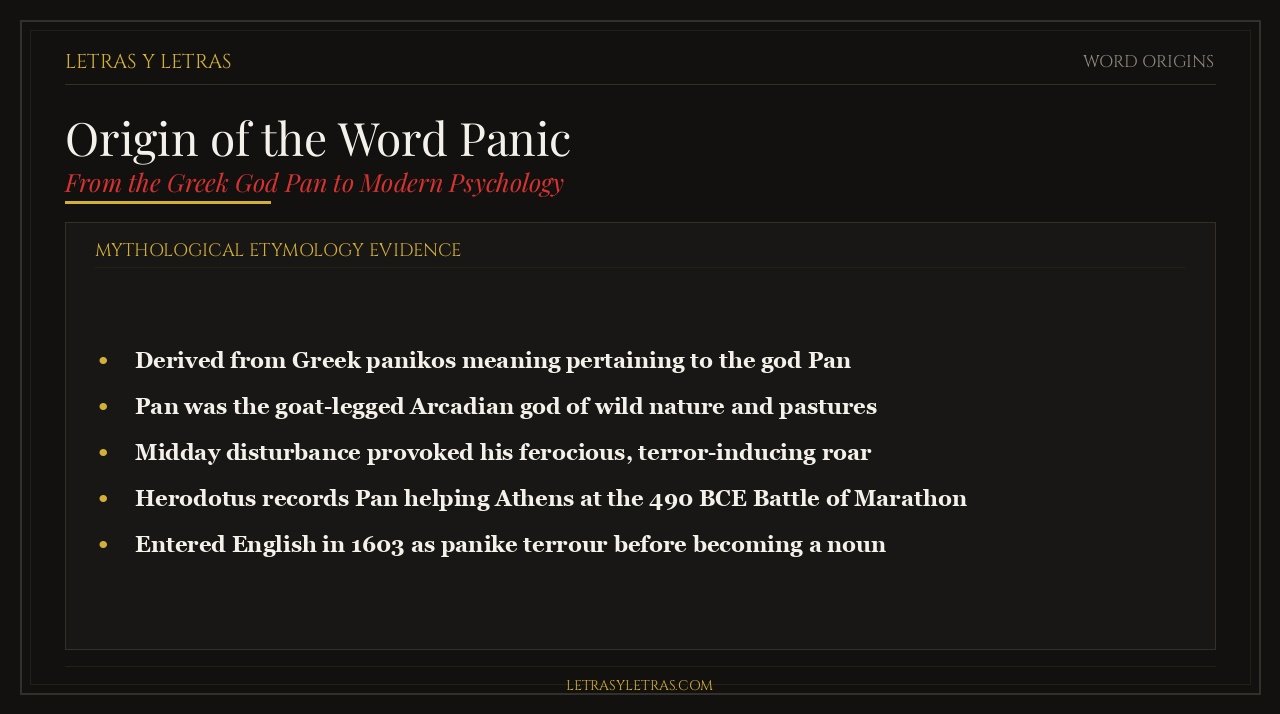
The word panic derives from the ancient Greek god Pan. He was the goat-legged Arcadian deity of wild nature. Greeks believed Pan caused sudden, unreasoning terror in remote forests, inspiring the Greek word panikos.
Key Takeaways
- Derived from the Greek god Pan, ruler of wild pastures, flocks, and rustic forests.
- Ancient Greeks called sudden irrational fright panikon deima, meaning Pan-inspired terror.
- Greek lore warned travelers that waking Pan from midday sleep provoked a terrifying roar.
- Pan allegedly routed Persian invaders at Marathon in 490 BCE through psychological dread.
- Entered the English language in 1603 as panike terrour before becoming a standalone noun.
Pan of Arcadia: Lord of the Untamed Wilderness
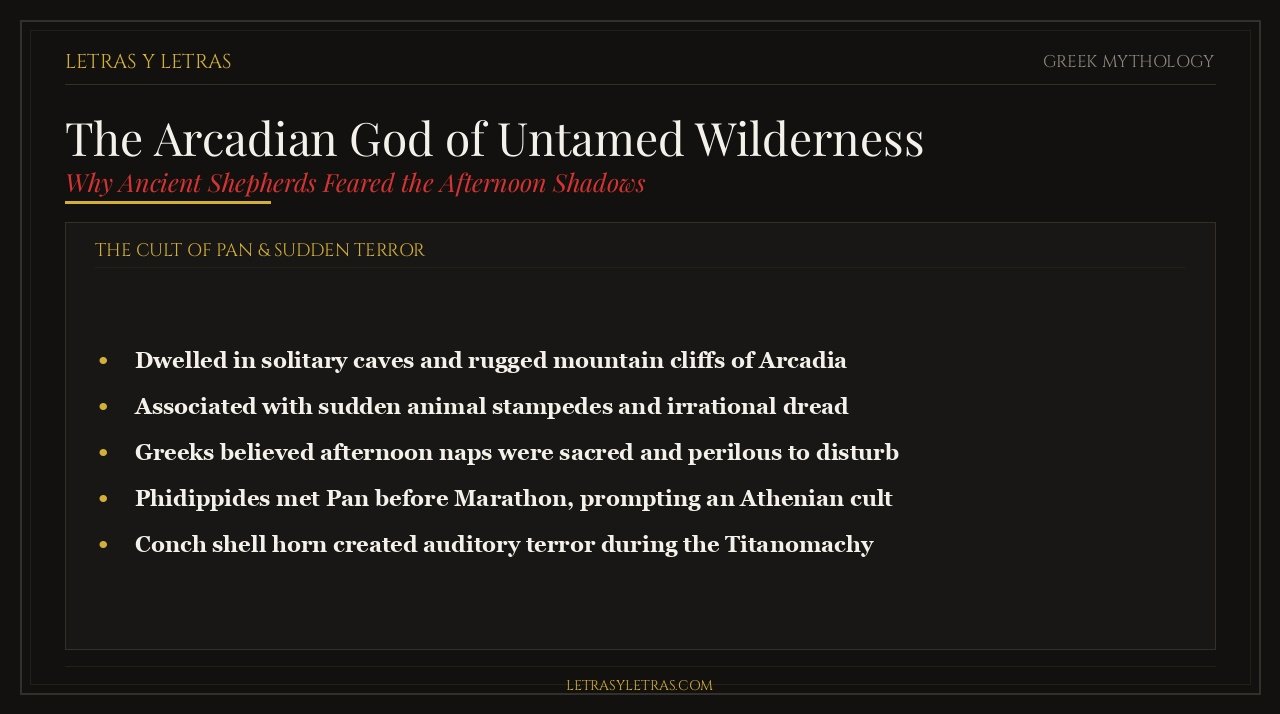
To discover the true origin of the word panic, we must travel to ancient Arcadia. This mountainous region of the central Peloponnese was isolated from polished coastal cities. While Athens built marble temples and philosophy schools, Arcadian shepherds tended flocks along rocky ravines.
In this rustic landscape, mortals worshipped a unique deity. Pan was not a handsome Olympian god residing upon golden clouds. He possessed the furry legs, cloven hooves, and curved horns of a mountain goat.
His bearded face featured pointed ears, sharp features, and a mischievous grin. As the god of shepherds, hunters, and wild pastures, Pan avoided civilized settlements. He preferred shadowy oak groves, solitary mountain ridges, and echoing limestone caverns.
Classical mythology often explored divine figures existing on boundaries of nature and human culture. Readers can see similar themes in our examination of the meaning of the name prometheus. While Prometheus brought civilized fire, Pan represented raw, untamed instinct.
Pan spent his days chasing woodland nymphs and playing the syrinx, a rustic set of panpipes. He guarded the natural fertility of livestock and protected isolated mountain trails. Yet beneath his pastoral charm lay an unpredictable, terrifying power.
The Sacred Midday Nap and the Monstrous Roar
Ancient Greek pastoral poetry captured the strange psychological tension of Mediterranean wilderness. In midday heat, mountain winds suddenly died down. The landscape fell into heavy, suffocating silence.
Theocritus, the famous Hellenistic pastoral poet, recorded this rustic superstition in his Idylls. Shepherds dared not play their reed pipes during noon hours. They believed Pan slept at midday after exhausting woodland hunts.
Waking the resting god risked catastrophic divine anger. Pan possessed a notoriously short temper when startled from peaceful slumber. If disturbed, the deity unleashed a ferocious, earth-shaking shout across the silent valley.
The sound was described in ancient Greek as a terrifying bellow. Upon hearing it, grazing herds of goats and sheep went completely mad. Animals bolted wildly into thorny ravines, leaping off sheer cliffs to their deaths.
Solitary travelers traversing lonely mountain passes experienced identical dread. In dense forests without visible threats, travelers felt sudden, overwhelming terror. They fled blindly through briars, convinced an invisible monster pursued them.
Panikon Deima: The Birth of a Greek Term
Because this sudden fright lacked visible causes, Greeks sought a mythological explanation. They did not attribute the sensation to natural cowardice or ordinary caution. Instead, observers concluded that the wild god himself had seized the victim’s spirit.
Ancient Greek physicians and writers coined the phrase panikon deima, meaning Pan-like fright. In classical texts, the adjective panikos described anything belonging to Pan. Paired with nouns for fear, it described sudden, groundless terror.
Greek historians observed that this emotional seizure was intensely contagious. When one sheep bolted, the entire flock followed without knowing why. If a single soldier abandoned his shield in the battle line, fear rippled instantly through thousands.
The Perseus Digital Library classical archives record multiple references to this psychological phenomenon. Philosophers noted that ordinary fear possessed an identifiable object, such as a charging lion. Pan-inspired terror struck without physical evidence, overwhelming logic through phantom dread.
This psychological insight reveals how ancient Greeks observed the human mind. They recognized that emotional contagion could destroy disciplined social structures in seconds. A single invisible whisper could dismantle an army faster than enemy spears.
The Battle of Marathon and the Acropolis Shrine
Pan remained a regional Arcadian deity for centuries until a world-shaping military crisis. In 490 BCE, the mighty Persian Empire launched an amphibious invasion of mainland Greece. The Persian fleet landed at the Bay of Marathon, threatening Athens with destruction.
Desperate for reinforcements, Athenian generals dispatched a famous professional runner named Philippides. He ran from Athens to Sparta across rugged mountain ranges to request military aid. While crossing Mount Parthenion above Tegea, Philippides experienced a miraculous divine encounter.
The historian Herodotus recorded this legendary meeting in Book 6 of his Histories. Pan appeared to the exhausted runner and called him by name. The god asked why Athenians completely neglected him, despite his warm goodwill toward their city.
Pan promised to fight alongside Athenian soldiers if they pledged to honor his cult. Philippides delivered the divine message to his fellow citizens upon returning from Sparta. Encouraged by divine support, Athenian hoplites charged across the Marathon plain against Persian archers.
During the clash, Persian ranks broke into sudden, inexplicable chaos. Soldiers dropped their bows and fled screaming toward their transport ships in total disarray. Athenians credited Pan with striking their invaders with overwhelming mental confusion.
After the victory, grateful Athenians fulfilled their sacred vow. They dedicated a sacred grotto shrine to Pan on the northwest slope of the Acropolis. Citizens instituted annual sacrifices and nocturnal torch races in his eternal honor.
The Cosmic Conch: Pan in the War Against Titans
Marathon was not the only battlefield where Pan demonstrated his mastery of psychological terror. An older mythological tradition credited Pan with assisting Zeus during the epic Titanomachy. In this cosmic war, the young Olympian gods fought older Titans for supremacy.
According to ancient mythographer Hyginus, Pan discovered a spiral conch shell along the seashore. He modified the marine shell into an acoustic battle horn. When blown with divine force, the instrument produced a bizarre, deafening screech.
The strange acoustic blast echoed across the cosmic battlefield. Believing a colossal marine monster approached from the depths, the Titans panicked and scattered. Zeus seized the tactical opening to strike down Kronos with thunderbolts.
Greek myth understood that sudden sensory shock disrupts rational military discipline. We explore similar themes of divine justice in our guide to the origin of the word nemesis. Mythological storytellers recognized that fear often defeated warriors before physical weapons made contact.
In reward for his battlefield trick, the gods placed Pan’s likeness among the stars. He became associated with Capricorn, the goat-fish constellation honoring his marine trickery. The rustic god had conquered both earthly ravines and celestial skies.

From French Scholars to Elizabethan England
How did the Greek god’s name transition into our modern vocabulary? The linguistic path passed through classical Latin and Renaissance European scholarship. Roman writers adopted the Greek concept as terror panicus.
During the sixteenth century, French humanists revived classical texts during the European Renaissance. French scholars began writing about terreur panique to describe irrational collective fright. English scholars traveling in France encountered the expression in Continental medical treatises.
The Oxford English Dictionary historical records date the earliest English appearance to 1603. Translator John Florio published his famous English version of Michel de Montaigne’s Essays. In that work, Florio translated the French phrase as panike terrour.
A decade later, Sir Walter Raleigh used the term in his monumental 1614 work The History of the World. Raleigh described military commanders who fell victim to sudden panick terrours during campaigns. By the mid-seventeenth century, English writers dropped the secondary noun terror.
Panic began standing alone as an independent noun and active verb. Poet John Milton utilized the word in Paradise Lost to describe celestial warfare. By 1700, English speakers used panic exactly as we use it today.
Chronological Evolution: From Arcadian Caves to Modern Dictionaries
To appreciate how deeply this ancient myth influenced modern language, examine this documented timeline. It charts how a rustic Greek deity evolved into an essential clinical term.
| Historical Period | Source or Cultural Milestone | Evolutionary Significance |
|---|---|---|
| c. 700 BCE | Arcadian Pastoral Lore | Shepherds attribute sudden livestock stampedes and forest terror to Pan’s midday roar. |
| 490 BCE | Battle of Marathon | Herodotus records Pan helping Athens route Persian invaders, prompting an Athenian shrine. |
| c. 350 BCE | Classical Greek Treatises | Philosophers formalize panikon deima as unreasoned, contagious collective dread. |
| 1603 | John Florio’s Montaigne | First known print record in English introduces panike terrour into literary prose. |
| 1614 | Sir Walter Raleigh | History of the World uses panick terrours to describe sudden battlefield retreats. |
| 1837 | American Financial Press | The term expands to economics to describe bank runs during the Panic of 1837. |
| 1980 | Clinical Psychiatry (DSM-III) | Medical diagnostics formally codify panic attack and panic disorder in healthcare. |
From Military Lines to Stock Market Crashes
As human society shifted from agricultural battlefields to industrial economies, the word adapted effortlessly. In the nineteenth century, commercial markets experienced sudden, contagious financial collapses. Depositors rushed banks to withdraw savings, driven by rumors of impending bankruptcy.
Journalists immediately recognized the psychological resemblance to ancient animal stampedes. Financial writers in New York and London began calling these market runs panics. The Panic of 1837, Panic of 1873, and Panic of 1907 destroyed fortunes overnight.
Just like ancient sheep in Arcadian hills, investors reacted to emotion rather than audited balance sheets. When one firm sold assets, others followed blindly in hysterical imitation. The ancient god’s phantom presence had simply moved from misty woods to Wall Street trading floors.
We observe similar linguistic migrations in our study of the origin of the word cynic. Words originating in Greek philosophy and religion regularly transform into modern economic and social terms. Language preserves ancient psychological truths under modern disguises.
This linguistic adaptability proves that human nature remains remarkably consistent across centuries. We build computers, skyscraper cities, and complex financial systems. Yet our primitive instincts react to perceived danger with the exact same frantic rush.
Modern Neuroscience and the God of the Amygdala
Modern medical science has verified what ancient Greek myth understood through intuitive observation. When a person experiences a clinical panic attack, rational brain centers shut down. The amygdala, an almond-shaped cluster in the temporal lobes, triggers an emergency alarm.
Adrenaline surges through the bloodstream within milliseconds. Blood rushes away from digestive organs into large leg muscles, preparing the body to run. The rational prefrontal cortex cannot interrupt this ancient biological reflex.
Ancient Greeks lacked knowledge of neurotransmitters and brain scans. However, they observed the identical physical phenomenon with striking precision. They recognized that this terror was involuntary, irrational, and completely disconnected from conscious choice.
By attributing the reaction to Pan, they acknowledged that wild nature lives inside human biology. We like to picture ourselves as cool, calculating intellects. Yet beneath our civilized manners lies a prehistoric creature capable of sudden flight.
This psychological insight connects to other classic linguistic histories. Readers can compare these ideas in our investigation of the origin of the word tantalize. Both words remind us that physical cravings and terror operate beyond conscious willpower.
The Cultural Legacy of Pan in English
Pan holds a unique distinction among Greek mythological figures. Most Olympian gods lent their names only to rare scholarly terms or planetary bodies. Aphrodite gave us aphrodisiac, and Ares gave us martial.
Yet Pan gave English one of its most frequently used verbs and nouns. Millions of people say they panicked during a job interview or exam. They rarely realize they are invoking an ancient Arcadian deity with goat hooves.
The enduring vitality of the word demonstrates the genius of Greek metaphorical thinking. The Greeks personified complex psychological forces as gods and monsters. By naming their terrors, they made inexplicable human feelings understandable.
The Online Etymology Dictionary overview of panic illustrates how seamlessly this classical root survived. While temples fell and ancient empires dissolved, the Arcadian god’s shadow remained carved into human speech. Language preserved his terrifying roar across thirty centuries.
The next time your heart races unexpectedly in a quiet hallway, remember ancient Arcadia. You are not experiencing a modern malfunction. Rather, you are hearing the distant, playful echo of Pan’s afternoon horn.
Frequently Asked Questions
Where did the word panic come from?
The word panic originated from the ancient Greek god Pan, the deity of pastures and wild nature. Greeks believed Pan caused sudden, unexplainable fright in lonely forests, which they called panikos.
Who was the Greek god Pan?
Pan was the Arcadian god of wild nature, shepherds, flocks, and rustic music. He was depicted with goat legs, curved horns, pointed ears, and a mischievous, unpredictable personality.
Why did the god Pan cause panic?
Greeks believed Pan loved peaceful afternoon naps and grew furious when startled. If disturbed, he released a deafening roar that caused livestock stampedes and struck travelers with irrational terror.
How did Pan help Athens at the Battle of Marathon?
Herodotus recorded that Pan promised to assist Athens against Persian invaders. During the 490 BCE battle, Pan allegedly struck Persian ranks with sudden mental terror, causing them to retreat in chaos.
When did panic become an English word?
The word entered English in 1603 when translator John Florio used panike terrour in Montaigne’s essays. By the mid-seventeenth century, panic became an independent noun and verb in English literature.
What is the difference between ordinary fear and panic?
Ordinary fear responds to a clear, visible threat with deliberate caution. In contrast, panic is an overwhelming, irrational, and contagious terror that bypasses logic and causes frantic flight.
Alan Sledge is the founder and lead writer at letrasyletras.com, dedicated to uncovering the true etymological histories behind our favorite words and phrases.


Alan Sledge is the writer and founder behind Letters & Letters. A lifelong lover of words, Alan has always been drawn to the small mysteries hidden in everyday language, why we say what we say, where our favorite sayings came from and the quotes that manage to put feelings into words better than we ever could ourselves.