
A well-meaning coworker accidentally reveals a surprise birthday celebration during morning office coffee. Gasps echo across the breakroom as the birthday girl looks up in total astonishment. The blushing colleague covers their mouth, realizing they just let the cat out of the bag.
Modern society uses this lively expression whenever confidential information is disclosed prematurely or by accident. We invoke it during election campaigns, movie plot spoilers, and whispered neighborhood gossip. The phrase captures the sudden impossibility of concealing an exposed truth.
Yet the true origin of the phrase let the cat out of the bag has confused amateur historians for generations. Popular folklore blames eighteenth-century Royal Navy whips and canvas flogging bags. Historical evidence reveals a far earthier swindle rooted in medieval livestock markets.
Quick Answer: Origin of the Phrase Let the Cat Out of the Bag
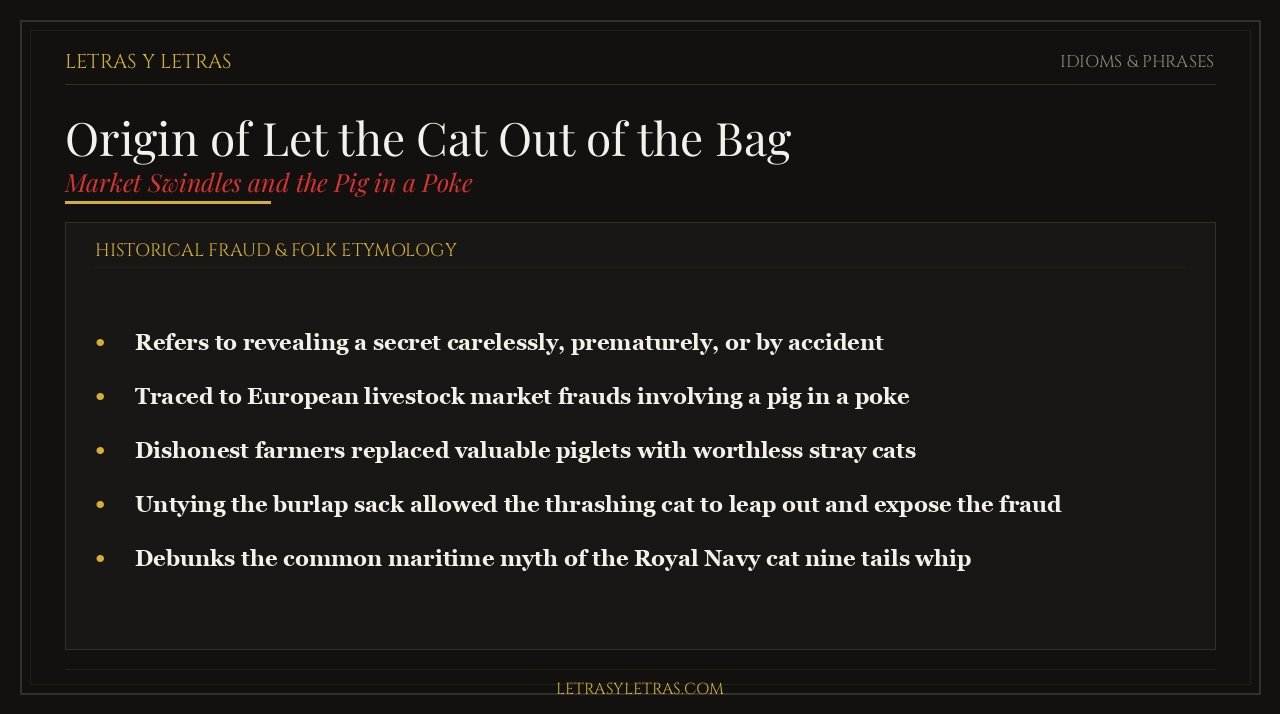
The phrase let the cat out of the bag means revealing a secret, usually by accident. It originates from European livestock market swindles connected to the idiom buying a pig in a poke. Dishonest merchants placed a worthless stray cat into a burlap sack, pretending it was a suckling piglet. If a buyer untied the sack to inspect the purchase before paying, the furious feline sprang free. That sudden escape instantly exposed the seller secret scam to everyone nearby. Popular stories linking the idiom to Royal Navy whips are debunked folk etymologies with zero historical basis.
Key Takeaways
- Means disclosing confidential information prematurely or without conscious intent.
- Traces directly to medieval European market frauds involving buying a pig in a poke.
- Untying the sack exposed the fraud when a swapped alley cat leaped into the open air.
- The Royal Navy cat-o-nine-tails whip theory is completely rejected by maritime historians.
- First recorded in English print in 1760 within The London Magazine.
The Modern Idiom: Premature Spoilers and Blabbed Secrets
Modern conversation relies heavily on let the cat out of the bag to describe blundered secrecy. Movie reviewers use the phrase when critics reveal unexpected plot twists before theatrical releases. Corporate executives employ it when confidential quarterly merger negotiations leak to financial journalists.
We admire the idiom because it perfectly conveys the irreversible chaos of exposed information. Once you loosen the drawstring on a secret, you cannot stuff the truth back inside. Words spread with explosive speed across social circles, defying all containment.
The mental image is kinetic, noisy, and slightly comical. A trapped animal erupts into daylight with flying claws, knocking over market stalls and startling passersby. The phrase turns an abstract betrayal of confidence into an athletic spectacle.
Lexical documentation in the Merriam-Webster dictionary defines the idiom as disclosing a secret. The authority notes that the expression represents an irreversible act of revelation. Modern dictionaries reflect centuries of European market folklore.
Before examining historical livestock fairs, however, we must address a widespread myth that misleads thousands of readers. The internet is flooded with maritime explanations that sound convincing but collapse under scrutiny. Unraveling the true story begins with debunking the naval whip legend.
The Seductive Naval Myth: The Cat-o’-Nine-Tails in a Canvas Bag
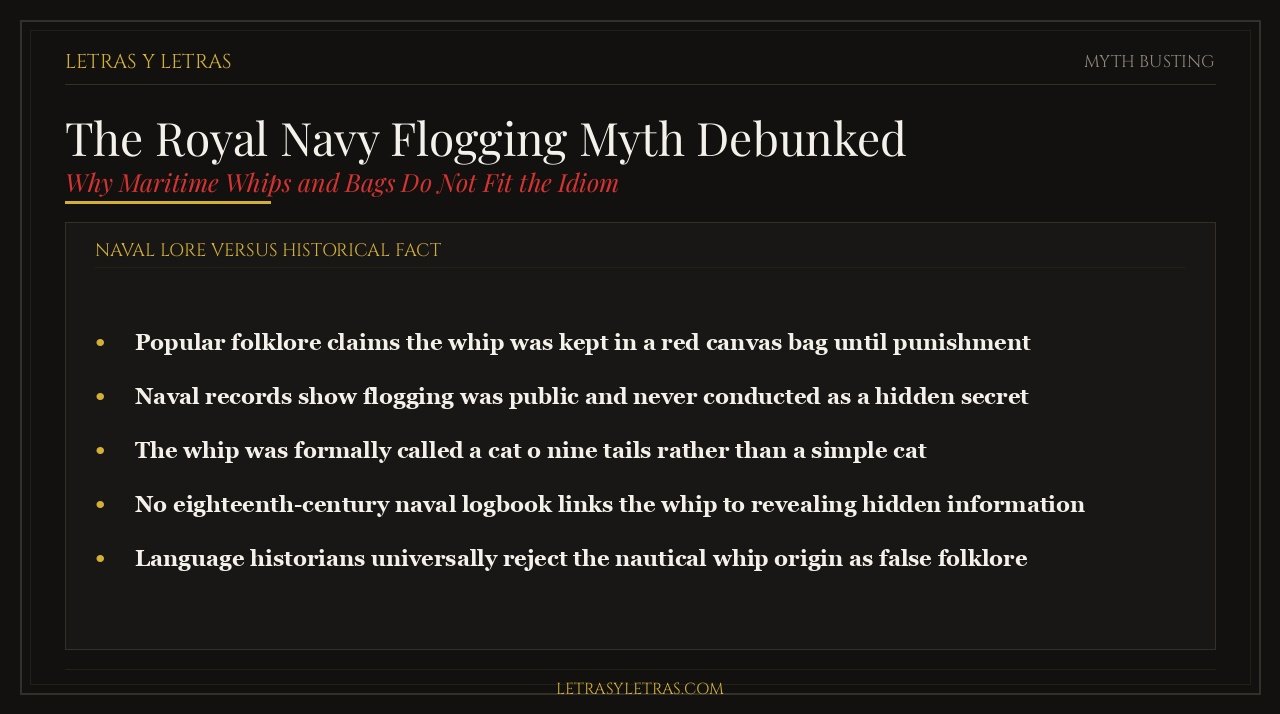
Tour guides and popular websites frequently claim the phrase began aboard British naval warships. During the eighteenth century, Royal Navy officers maintained iron discipline using a whip called the cat-o-nine-tails. This cruel instrument featured nine knotted hemp cords designed to tear skin.
According to this folklore story, the whip was stored in a red baize canvas bag between punishments. Mythmakers claim sailors kept the whip hidden below deck to protect the ropes from salty ocean air. When a sailor broke ship rules, the boatswain supposedly took the whip out on deck.
The myth concludes that bringing out the whip revealed a sailor secret crime to the crew. On the surface, the story seems plausible to anyone who loves naval adventure fiction. It connects an obscure domestic animal with dramatic seafaring history.
Linguistic research in the Encyclopedia Britannica idiom overview cautions against romantic folk etymologies. People love attributing common expressions to famous historical institutions like the British navy. Yet professional historians find zero documentary evidence supporting this maritime tale.
A careful examination of eighteenth-century naval logs and punishment registers destroys the whip hypothesis completely. The details of shipboard flogging contradict the linguistic metaphor at every level. This nautical story is pure invention.
Why Naval Historians Debunk the Flogging Whip Theory
Naval historians offer three definitive reasons why the cat-o-nine-tails could not inspire the phrase. First, shipboard punishments were never conducted in secret. Flogging was a mandatory public spectacle held on the open quarterdeck before the assembled ship company.
Second, drawing the whip out of a canvas bag did not expose hidden information. Every sailor standing in formation already knew who was accused and what crime had been committed. The captain read the formal Articles of War aloud before a single lash was struck.
Third, sailors never referred to the cat-o-nine-tails simply as a cat in a bag. When officers ordered punishment, they commanded the boatswain to assemble the cat. Eighteenth-century maritime journals contain hundreds of naval slang phrases, but this idiom never appears among them.
The timeline of written citations disproves the naval connection entirely. Literary periodicals printed the idiom long before writers linked it to seafaring. Nautical enthusiasts invented the whip explanation during the twentieth century to satisfy curious tourists.
With the naval myth discarded, the true historical origin emerges in rural commerce. The idiom was born in agricultural marketplaces where country folk traded food to survive. Its real roots lie in the ancient swindle of the pig in a poke.
The True Origin: A Pig in a Poke at Country Livestock Fairs
To understand the escaped cat, one must examine its companion idiom, buying a pig in a poke. The word poke is an ancient Germanic and Norman French noun meaning a small sack or bag. English speakers preserved the word for centuries before modern shopping bags appeared.
Historical analysis in the Online Etymology Dictionary confirms that poke meant sack or pouch. The diminutive form gave the English language words like pocket and poker. In medieval villages, a poke was an ordinary burlap or linen bag used for transporting grain.
At bustling weekly market fairs, farmers sold suckling pigs to town residents and tavern keepers. A healthy young piglet was a valuable domestic asset that provided fatty meat for winter larders. Because live piglets were squirming, slippery creatures, sellers carried them in tied burlap pokes.
Buyers paid for piglets by estimated weight and general appearance. Honest farmers allowed purchasers to inspect the squealing animal before concluding the financial transaction. Dishonest traders, however, saw an easy opportunity to fleece gullible buyers.
A proverb warning against buying a pig in a poke appeared in English print by 1530. The phrase warned shoppers never to purchase goods without opening the sack first. Our companion phrase of letting the cat out soon followed.
The Burlap Sack Swindle: Replacing Piglets with Alley Cats
The market swindle was deceptively simple and remarkably effective in crowded fairgrounds. A crooked farmer captured a large stray alley cat or wild barn feline before entering town. The vendor bundled the thrashing animal into a coarse burlap poke and tied the cord tightly.
At the market, the seller offered the squirming bundle at an attractive discounted price. The trader claimed the bag contained a plump, lively suckling pig ready for roasting. Dishonest vendors discouraged buyers from opening the sack, warning that the energetic piglet would escape into the crowd.
In a dark, noisy marketplace, a frantic cat clawing inside a rough bag felt surprisingly like a piglet. Both animals weighed between five and ten pounds and thrashed violently against confining cloth. Squeals muffled through coarse burlap could easily deceive an inexperienced town dweller.
If the buyer was careless or intoxicated, he handed over his hard-earned silver coins without looking. The victim carried the poke home, anticipating a savory family feast. Only upon untying the cord in his kitchen did the furious feline spring out.
Crooked swindlers gained valuable silver coins while ridding their barns of unwanted stray cats. Victimized buyers walked away with empty pockets, shredded arms, and zero meat for dinner. This cunning trick became legendary across European trade culture.
When the Sack Untied: The Shocking Moment of Discovery
The idiom specifically commemorates the moment when the fraudulent scheme fell apart in public. Shrewd buyers knew country tricksters operated across every market square. A cautious customer refused to hand over coins without loosening the drawstring first.
When the suspicious buyer peeked inside or untied the cord, disaster struck the dishonest merchant. A terrified, furious cat did not wait politely for someone to examine its snout. The animal burst out of the burlap opening like a flying demon.
With claws flared and fur bristling, the feline scrambled up market awnings or bolted between spectator legs. The sudden appearance of a hissing cat proved instantly that the vendor was a liar and a thief. That merchant hidden crime was broadcast to the entire market square.
Bystanders shouted in laughter and outrage, surrounding the exposed fraudster before he could flee. The swindler lost his sale, his reputation, and often his liberty under town constable scrutiny. Once the cat escaped, the truth stood naked before the community.
This vivid public scene etched itself into popular imagination. Letting the cat out became the universal shorthand for an unmasking that could not be reversed. The physical market disaster transformed into a psychological proverb.

European Cousins: Cats and Sacks Across Germany, France, and Spain
The livestock swindle was not unique to English countryside fairs. Identical frauds occurred across medieval continental Europe, giving birth to matching idioms in multiple languages. Comparing these linguistic cognates confirms the market origin beyond any scholarly doubt.
In German, speakers say die Katze im Sack kaufen, meaning to buy a cat in a sack. To reveal a secret, Germans say die Katze aus dem Sack lassen. The German expression matches the English idiom word for word, preserving the sack and the feline.
French speakers preserve the equivalent phrase acheter chat en poche, meaning to buy a cat in a poke. The Norman French word poche clearly provided the ancestor for English poke. French proverbs have documented this identical market trick since the fourteenth century.
Spanish culture developed a humorous culinary variation of the same fraudulent practice. In Spain, people say dar gato por liebre, which translates literally to giving a cat for a hare. Dishonest tavern cooks sometimes served skinned domestic cats disguised as expensive wild rabbits.
These pan-European linguistic parallels demonstrate that the metaphor crossed borders along trade routes. Merchants everywhere swapped worthless felines for valuable livestock. The shared human experience of getting swindled united European languages.
Chronological Milestones in the History of the Phrase
The table below outlines key milestones in the development of the idiom from medieval livestock markets to modern vernacular speech:
| Historical Era | Cultural Event | Commercial Practice | Impact on English Language |
|---|---|---|---|
| 1300s to 1500s | Medieval European Fairs | Pig in a poke swindles | Establishes the foundational market tradition of replacing piglets with cats in burlap sacks. |
| 1760 | The London Magazine | Literary periodical review | Earliest confirmed appearance of let the cat out of the bag in printed English prose. |
| 1796 | The English Review | Dramatic book criticism | Reviewers criticize clumsy novelists for letting the cat out of the bag before the plot climax. |
| 1800s | Victorian Literature | Mainstream British fiction | Naturalizes the idiom across international English speakers as a universal secret-telling metaphor. |
| Mid-1900s | Naval Folk Etymology | Maritime museum lore | Spurious cat-o-nine-tails whip story emerges and spreads through popular nautical folklore. |
| 20th Century to Present | Global Vernacular | Everyday English idioms | Universal phrase for inadvertent disclosures, confidential leaks, and premature spoilers. |
Debunking Common Myths About the Phrase
Because folk etymology loves colorful drama, several persistent misconceptions surround the expression. Examining linguistic archives allows us to dispel three common historical errors:
The primary myth claims the cat refers to a cat-o-nine-tails whip used in naval floggings. Maritime historians confirm naval discipline was never secret, and the whip was never called simply a cat in a bag. This naval story is a twentieth-century fabrication.
A second myth asserts that people kept living cats inside bags to test domestic mousing ability before purchasing them. Country farmers had no reason to transport working barn cats in tied pokes. Cats were captured only to stage fraudulent substitutions for piglets.
A third myth claims the expression originated in American political backrooms during nineteenth-century elections. While American newspapers frequently used the idiom, written records date back to eighteenth-century London. The phrase crossed the Atlantic with British settlers long before American political conventions existed.
We observed similar mythological tales corrected in our origin of the phrase bury the hatchet analysis. Popular memory regularly swaps humble domestic realities for romantic historical legends.
The Psychology of Secrecy, Exposure, and Social Trust
Why does letting the cat out of the bag retain such permanent appeal in human conversation? The answer lies in the psychological burden of holding confidential information. Keeping a secret requires constant mental vigilance, while revealing it offers sudden emotional release.
When a secret escapes, the social dynamic shifts irrevocably between all participating parties. Concealed motives stand exposed, forcing people to confront reality without protective masks. Managing this exposure requires emotional maturity, integrity, and personal accountability.
Maintaining personal discipline and guarding one speech during moments of excitement is vital. Explore timeless reflections on mental resolve in our curated quotes on discipline collection. Governing personal speech prevents embarrassing social blunders.
Uncompromising honesty remains the true foundation of commercial and personal partnerships. Discover classical definitions of truth in our origin of the word sincere investigation. Genuine enterprise demands pure, unadulterated integrity.
Commercial dishonesty and counterfeit goods have invited public retribution across world history. Discover how medieval bread statutes created a buffer loaf in our origin of the phrase baker dozen guide. Honest weights preserve public harmony.
Communities throughout history established strict administrative limits to prevent chaos and deception. Discover medieval evening safety decrees and curfew bells in our origin of the word curfew investigation. Clear social boundaries preserve civilization.
Decisive strategic choices often require cutting off all possibility of retreat. Learn how ancient military commanders commanded desperate courage in our origin of the phrase burning bridges guide. Bold commitment shapes human history.
Public health defenses also required collective sacrifice and strict border isolation across centuries. Trace Venetian plague galleys and forty days of isolation in our origin of the word quarantine study. Organized community defenses protect human life.
Catastrophic crises have repeatedly tested human resilience and economic systems across history. Examine celestial omens and astrological grief in our origin of the word disaster reflection. Facing unexpected trials demands steady wisdom.
Bodily vitality and physical resilience inspired rich anatomical vocabulary across the ancient world. Explore classical Roman anatomy and rodent metaphors in our origin of the word muscle analysis. Physical strength must always serve social harmony.
Sudden illness and biological vulnerability also remind us of fragile human mortality. Examine maritime naval history and seasickness in our origin of the phrase under the weather reflection. Weathering hardship requires patient endurance.
Overcoming destructive physical dependencies often requires swift, unhesitating willpower. Discover how withdrawal medicine forged a universal idiom in our origin of the phrase cold turkey guide. Enduring adversity leads toward renewal.
Human beings possess delicate vulnerabilities beneath outward facades of strength. Examine anatomical vulnerability in our analysis of the origin of the phrase Achilles heel. Recognizing mortality prevents tragic hubris.
Superstition and historical biases also shaped European linguistic perceptions of human action. Examine Roman augury and directional omens in our origin of the word sinister review. Words carry surprising shadows from antiquity.
Unpredictable risks and speculative gambles carried lasting consequences across medieval Europe. Trace medieval dice games and Crusader history in our origin of the word hazard investigation. Prudent calculation shields merchants from disaster.
Social recreation and festive tavern culture also produced vibrant colloquial expressions over time. Trace equestrian horse racing and cocktail recipes in our origin of the word cocktail history. Communal traditions reflect complex human rituals.
Serene sanctuaries offer the ultimate antidote to worldly conflict and deceptive swindles. Explore ancient Persian walled gardens in our origin of the word paradise reflection. The human spirit continually seeks honesty, safety, and peace.
Frequently Asked Questions
What is the literal meaning of let the cat out of the bag?
Let the cat out of the bag means revealing a secret or confidential fact, usually by accident.
Does the phrase come from a naval whip?
No, the Royal Navy cat-o-nine-tails whip theory is a debunked folk etymology with zero historical evidence.
How does the phrase relate to a pig in a poke?
Dishonest sellers replaced piglets with cats inside burlap pokes, and opening the sack revealed the fraud.
What did poke mean in medieval England?
Poke was an ancient word for a sack or bag, which also gave English the word pocket.
When was the phrase first recorded in English print?
The phrase first appeared in print in 1760 within an article published in The London Magazine.
Do other languages have this idiom?
Yes, German and French feature identical idioms about cats in sacks, proving a shared European market origin.
Alan Sledge is the lead writer at letrasyletras.com, uncovering historical wisdom and word origins.


Alan Sledge is the writer and founder behind Letters & Letters. A lifelong lover of words, Alan has always been drawn to the small mysteries hidden in everyday language, why we say what we say, where our favorite sayings came from and the quotes that manage to put feelings into words better than we ever could ourselves.