
Every detective following a clue is unknowingly re-enacting a scene from ancient Greek mythology. The origin of the word clue is one of the most fascinating linguistic stories in the English language. A detective working a crime scene might look for fingerprints, muddy footprints, or a discarded weapon.
However, the primary tool for solving early puzzles was a simple ball of yarn. To see how a physical ball of thread became abstract evidence, we must look to Old English. We also need to visit the mythical island of Crete.
Quick Answer: Origin of the Word Clue
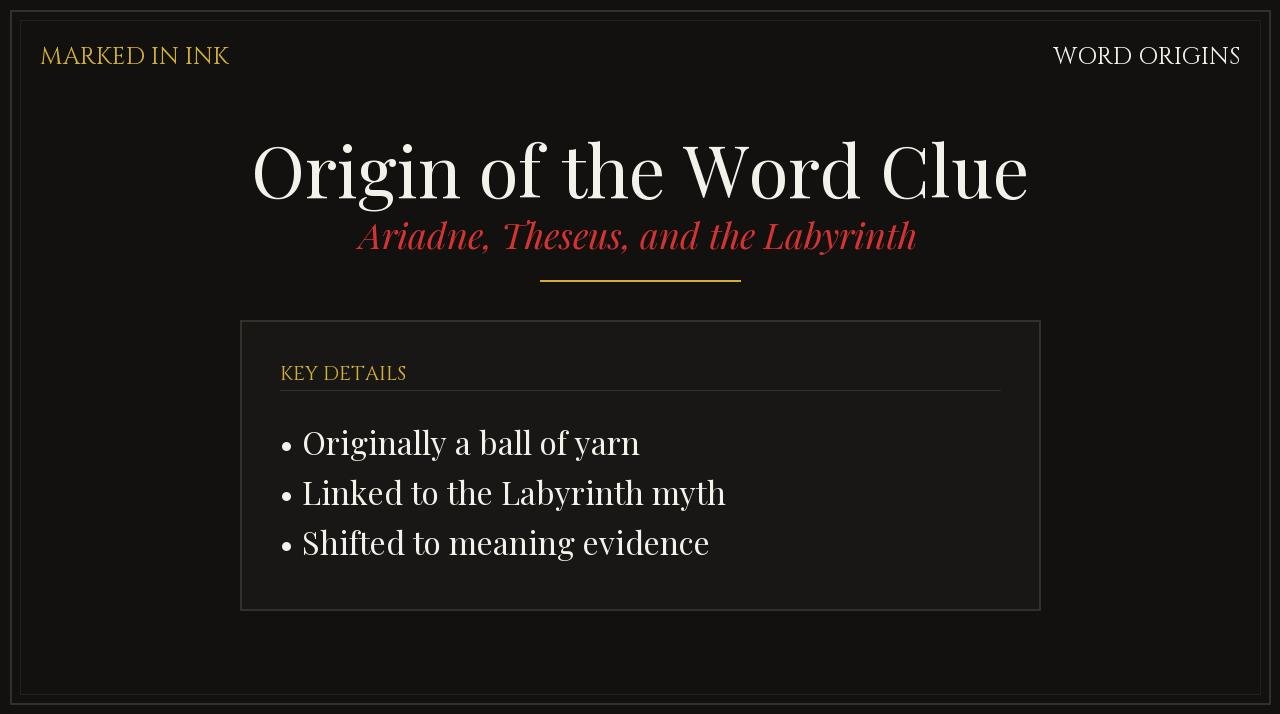
The earliest form is the Old English word cliwen, which meant a literal ball of thread or yarn. The modern meaning comes from the Greek myth of Theseus and the Minotaur. In the story, Ariadne gave Theseus a clew of thread to help him find his way out of the Labyrinth. Over centuries, the spelling shifted from clew to clue. The definition also evolved from a physical ball of yarn used as a guide to any abstract piece of evidence that helps solve a puzzle.
Key Takeaways
- The word originally referred to a literal ball of yarn or thread.
- The modern meaning was inspired by the myth of Theseus and the Labyrinth.
- The spelling transitioned from clew to clue starting in the 15th century.
- The earliest recorded figurative use of the word dates to the 1590s.
- Sailors still use the original spelling to refer to the corner of a sail.
The Old English Roots of Clew
The earliest form is the Old English word cliwen. Back then, this word meant a rounded mass or ball of thread. There was no connection to crime scenes.
The term was entirely practical and used mostly by weavers or spinners. People in medieval England would buy a “clew” of yarn to make clothing. According to Etymonline, the physical meaning remained completely unchanged for hundreds of years.
If you dropped your clew on the floor, it would unroll. This physical action eventually inspired a massive linguistic shift. The idea of following an unrolled string is a powerful visual image.
This visual perfectly connected the everyday English word with a popular classical myth. You can see similar metaphorical leaps in the origin of the phrase break a leg.
Theseus, Ariadne, and the Labyrinth
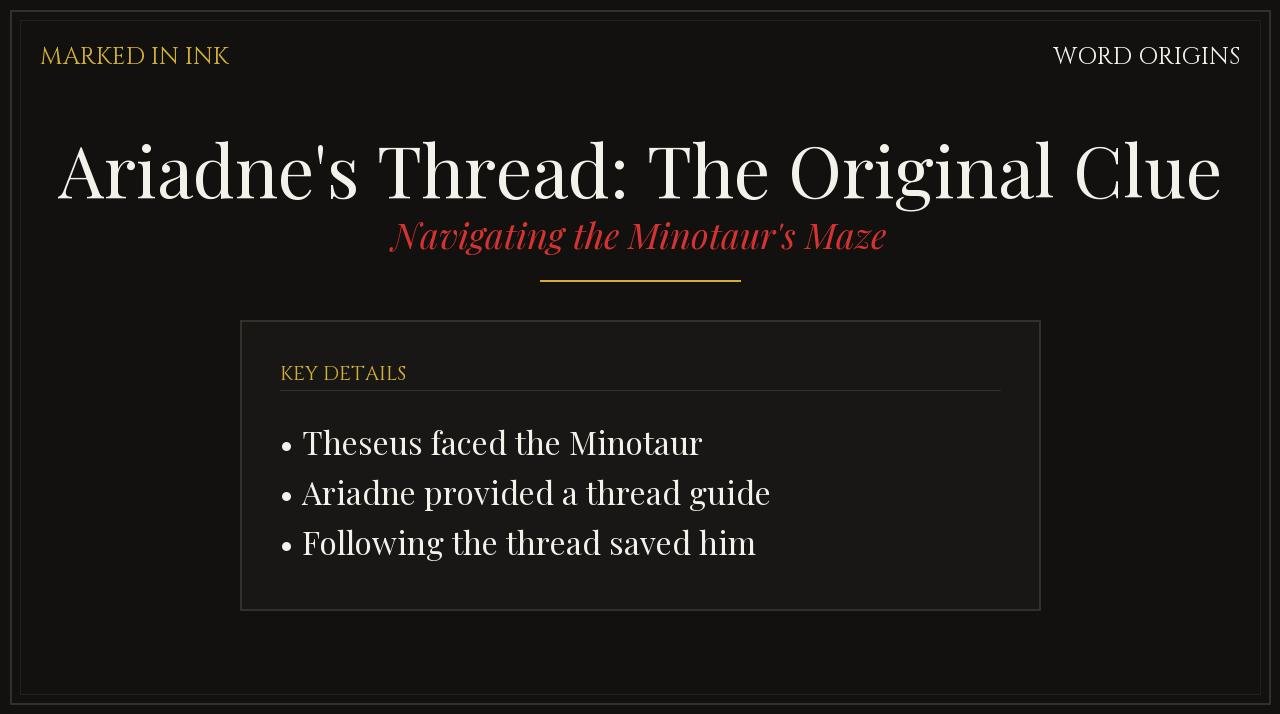
To see how a ball of yarn became evidence, we must look at Greek mythology. The story of Theseus and the Minotaur provides the missing link. King Minos of Crete built a massive maze called the Labyrinth.
He kept a monstrous half-man, half-bull creature inside it. Theseus volunteered to enter the maze and slay the beast. However, killing the Minotaur was only half the problem.
Finding the way back out of the twisting corridors was nearly impossible. Ariadne, the daughter of King Minos, fell in love with Theseus and helped him. She gave him a simple tool to ensure his survival.
Before entering the maze, she handed him a ball of thread. Theseus tied one end to the door and let the ball unroll. He walked deeper into the darkness with it.
After defeating the monster, he simply followed the thread back to safety.
The Metaphor of Following a Thread
The English public loved classical mythology. When writers retold the story of Theseus, they used the word “clew” to describe Ariadne’s thread. Because the thread guided Theseus through confusion, the word took on a figurative meaning.
A clew was no longer just yarn. It became anything that points the way out of a difficult maze. The Merriam-Webster dictionary notes that this figurative shift began around the 1590s.
Writers started using the word to describe abstract guides or hints. Having a difficult problem meant you needed a “clew” to guide you to the solution. The phrase “following a thread” became a common way to describe solving a mystery.
This evolution is similar to the origin of the phrase caught red handed. Both terms moved from literal physical actions to abstract concepts. By the 1620s, the figurative use was well established in English literature.
The Shift From Clew to Clue
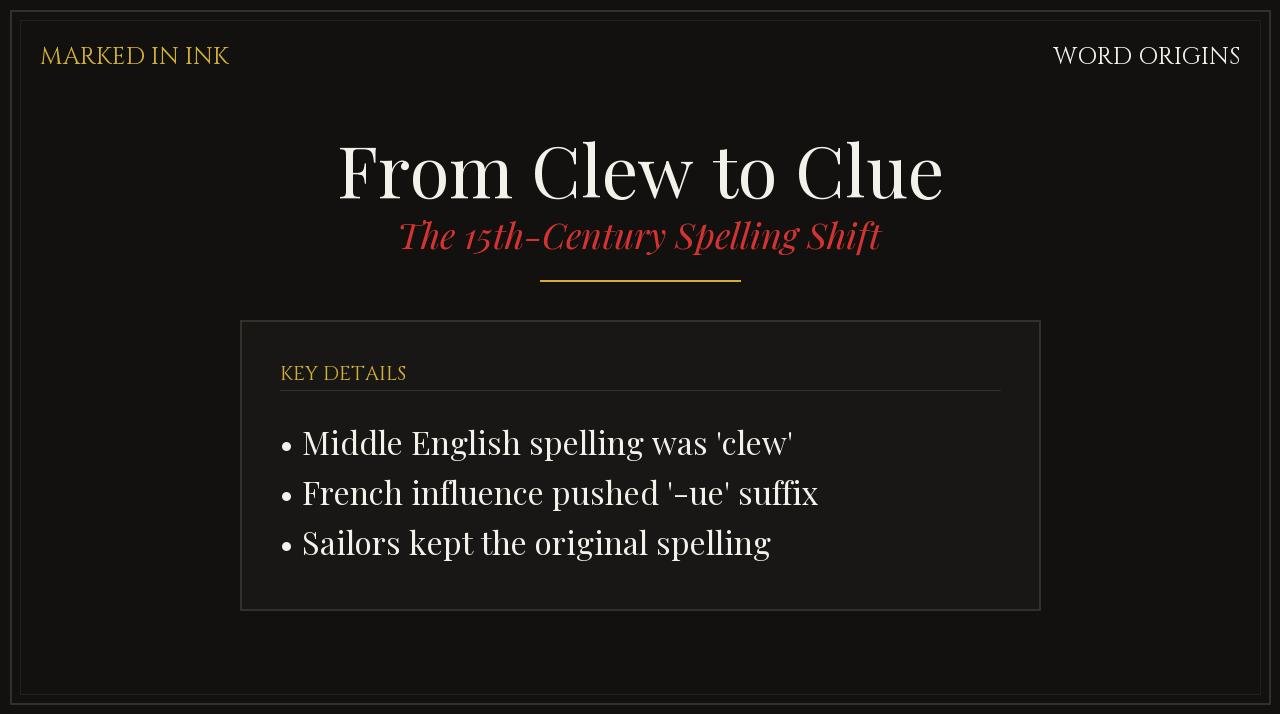
Language constantly changes, and English spelling was highly inconsistent for centuries. During the Middle English period, many words ending in “-ew” began to shift. The spelling reformed to “-ue” to match French influences.
For example, “blew” became “blue.” The word “clew” followed this exact same pattern. This new spelling “clue” started appearing in the mid-15th century.
For a long time, both spellings were used interchangeably. A writer might use “clew” for yarn and “clue” for evidence. The rules were not strict.
Eventually, the spellings split based on their specific definitions. Modern writers associate the spelling “clue” entirely with mysteries, detectives, and evidence. By the time detective fiction became popular in the 19th century, the spelling was permanently locked.
If you enjoy historical oddities like this, check out the origin of the word berserk.
Sailors and the Original Spelling
While land dwellers adopted the new spelling, sailors are notoriously stubborn about traditions. In the nautical world, the original spelling “clew” survives to this day. A clew on a sailboat is the lower corner of a square sail.
When a ship is caught in high winds, the crew might roll up the sails. This action is called “clewing up.” That term directly descends from the Old English word for rolling yarn.
The nautical use completely ignored the mythological and detective connections. That split leaves us with a fascinating linguistic divide. If you are on a boat, you use the older spelling.
When reading a mystery novel, you use the modernized version. It is an interesting parallel to the origin of the phrase kick the bucket.
The Rise of Detective Fiction
The modern conception of the word is deeply tied to the rise of police work. As professional police forces formed in the 19th century, writers created a new genre. Detective fiction required a specific vocabulary to describe solving crimes.
Authors needed a word to describe the physical hints left by criminals. They adopted the word “clue” because investigations felt like walking through a labyrinth. When Arthur Conan Doyle began writing Sherlock Holmes stories, the term became universally understood.
A bloody footprint was no longer just a stain. It was a thread leading directly to the culprit. This widespread cultural adoption cemented the word in the public consciousness.
The same kind of cultural sticking power applies to the famous quotes and quotations we still use today.
Frequently Asked Questions
When was the word clue first used to mean evidence?
The first recorded use meaning a figurative guide was in the 1590s. By the 1620s, writers frequently used it to describe hints for solving problems. It became the standard term for police evidence in the 19th century.
Did the word clue always mean a hint?
No. For hundreds of years, it purely meant a ball of thread or yarn. The transition to meaning a hint only happened because of the Greek myth of the Labyrinth.
How is the word clue connected to sailing?
The lower corner of a sail is called a clew. Sailors kept the original spelling and the original physical concept. When sailors roll up a sail, they are “clewing up,” which mimics rolling up yarn.
What does Ariadne’s thread have to do with clues?
Ariadne gave Theseus a ball of thread to help him escape the Labyrinth. English writers started calling her thread a “clew.” The metaphorical idea of following a thread out of a maze eventually created the modern definition.
Why did the spelling change from clew to clue?
The change was part of a larger spelling shift in the English language. Many words ending in “-ew” were changed to “-ue” to match French styles. The spelling split eventually separated the physical yarn from the abstract evidence.
You will find similar surprises hiding in the english idioms and meanings we use every day. Investigating these histories is like following your own ball of thread. Keep exploring the past to discover exactly why we speak the way we do.
Read about the origin of the phrase bite the bullet. You can also explore the origin of the word salary. Finish by reading the origin of the word sandwich.


Alan Sledge is the writer and founder behind Letters & Letters. A lifelong lover of words, Alan has always been drawn to the small mysteries hidden in everyday language, why we say what we say, where our favorite sayings came from and the quotes that manage to put feelings into words better than we ever could ourselves.

Alan Sledge
Alan Sledge is the founder and lead researcher behind Letters & Letters. A lifelong student of linguistic history, he cross-references every word origin, idiom, and quote against primary archival manuscripts, the Oxford English Corpus, and 18th-century print lexicons.