
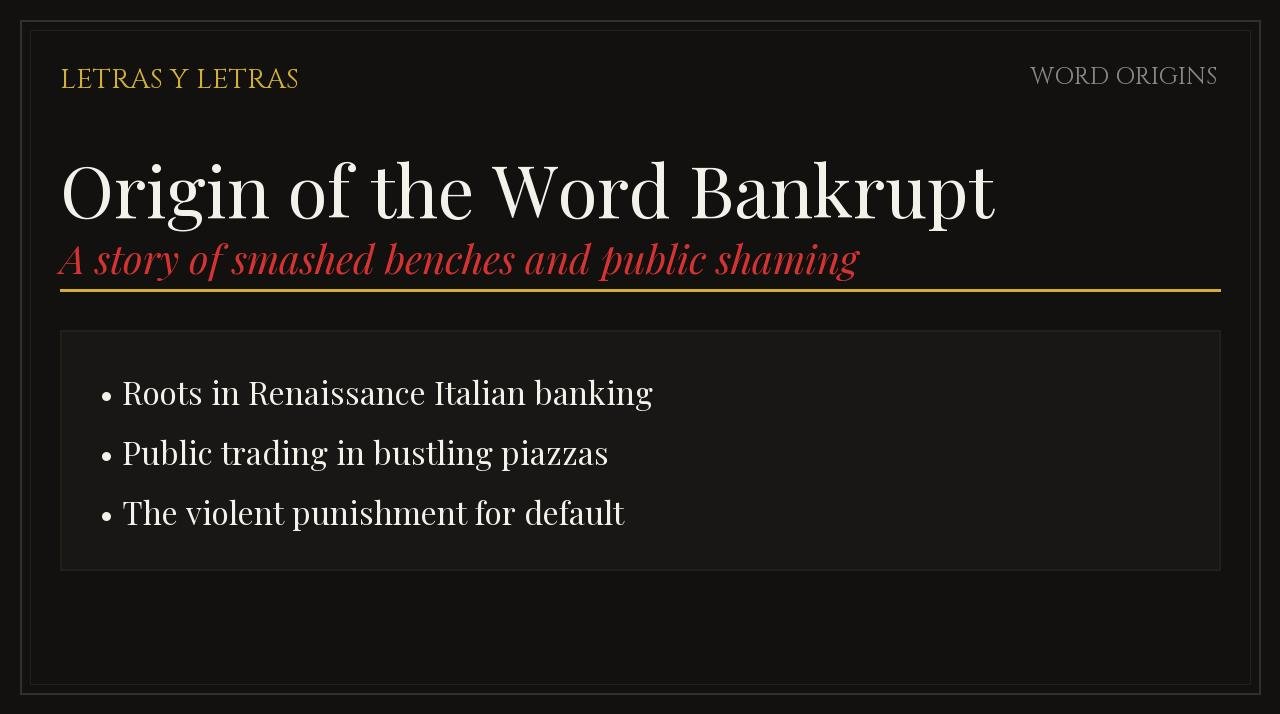
Money runs the modern economy. But what happens when the money runs out? The answer lies in the origin of the word bankrupt.
This story takes us back hundreds of years. It involves angry mobs and public shaming. You might picture modern courtrooms when you hear this word.
The true history is much more violent. We will explore the Italian piazzas where banking was born. You will learn how wooden benches became symbols of ruin.
Quick Answer: Origin of the Word Bankrupt
The origin of the word bankrupt traces back to Renaissance Italy. Early bankers conducted their business in open public squares. They used wooden benches or counters called a ‘banca’ to trade money. If a banker failed to pay his debts, authorities took severe action. Angry creditors would publicly smash his trading bench into splinters. This act was known in Italian as ‘banca rotta’, translating to ‘broken bench’. The smashed bench served as a physical declaration. It meant the banker was stripped of his trading license. Over time, ‘banca rotta’ entered French as ‘banqueroute’. It finally entered English in the 16th century as ‘bankrupte’.
Key Takeaways
- The word bankrupt comes from the Italian phrase ‘banca rotta’.
- ‘Banca’ means bench and ‘rotta’ means broken.
- Renaissance bankers traded money on wooden benches in public piazzas.
- Authorities smashed the bench of any banker who defaulted on debts.
- The word first appeared in English law under King Henry VIII in 1542.
The Golden Age of Renaissance Banking
The origin of the word bankrupt begins in Italy. During the Renaissance, cities like Florence and Venice grew wealthy. Trade flourished across the Mediterranean Sea.
Merchants needed reliable ways to exchange different currencies. This need created the first modern banking system. Early bankers did not work in grand buildings.
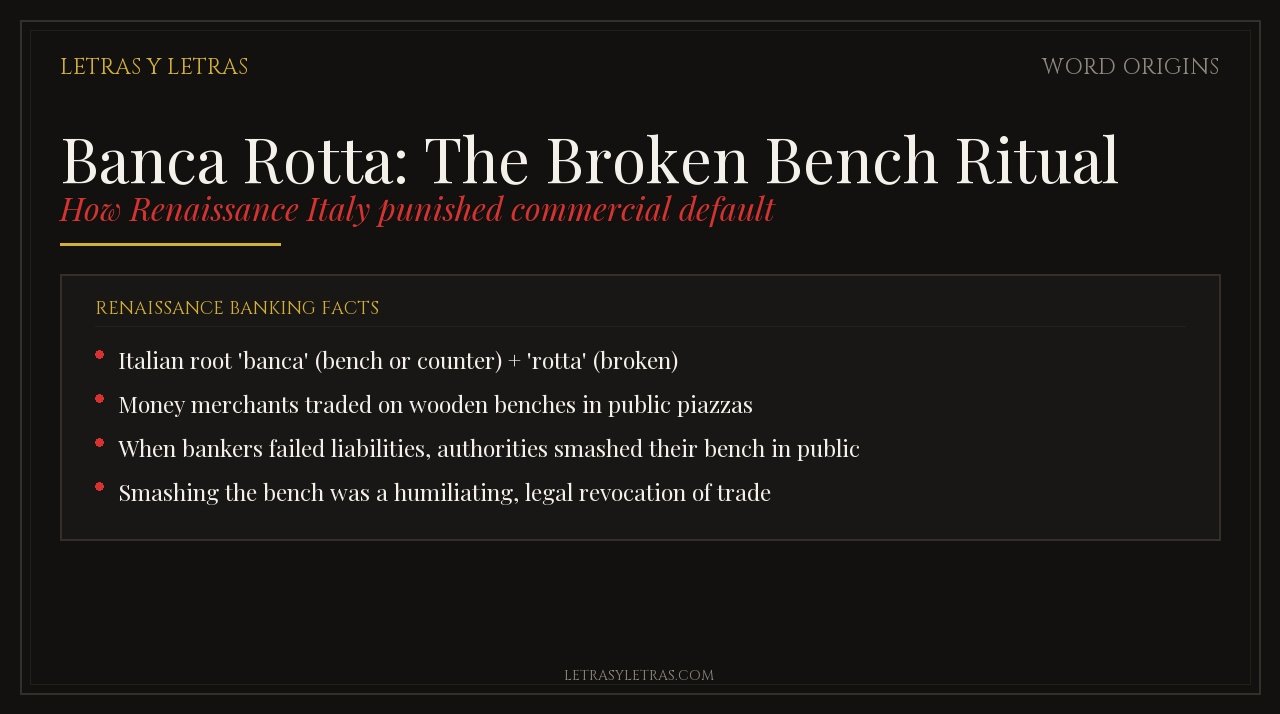
Instead, they set up shop in bustling public squares. These financial pioneers sat behind simple wooden tables. Such tables were known in Italian as a ‘banca’.
A ‘banca’ served as a counter or bench for sorting coins. This is exactly how the modern word ‘bank’ came to exist.
According to the Merriam-Webster dictionary, banking terms share deep linguistic roots. Bankers were highly respected members of society. They held the economic power of their cities.
But this power came with immense risk. When crops failed or ships sank, loans went unpaid. This often led to financial disaster.
The Brutal Act of Banca Rotta
What happened when a banker ran out of money? The consequences were severe and very public. Authorities did not rely on quiet legal paperwork.
They enacted a physical punishment. Officers marched into the town square and approached the failing banker.
The crowd would violently destroy his wooden trading bench. People smashed it into pieces in front of everyone. This act was called ‘banca rotta’ in Italian.
The word ‘rotta’ derives from the Latin verb ‘rumpere’. This Latin root simply means to break or shatter. You can find more details in the Online Etymology Dictionary.
The broken bench was a powerful symbol. It visually demonstrated that the banker’s business was over. He lost his license to trade in the city.
The shame was immense. His livelihood was literally shattered before his eyes. This dramatic ritual birthed the term we use today.
From Italy to the Rest of Europe
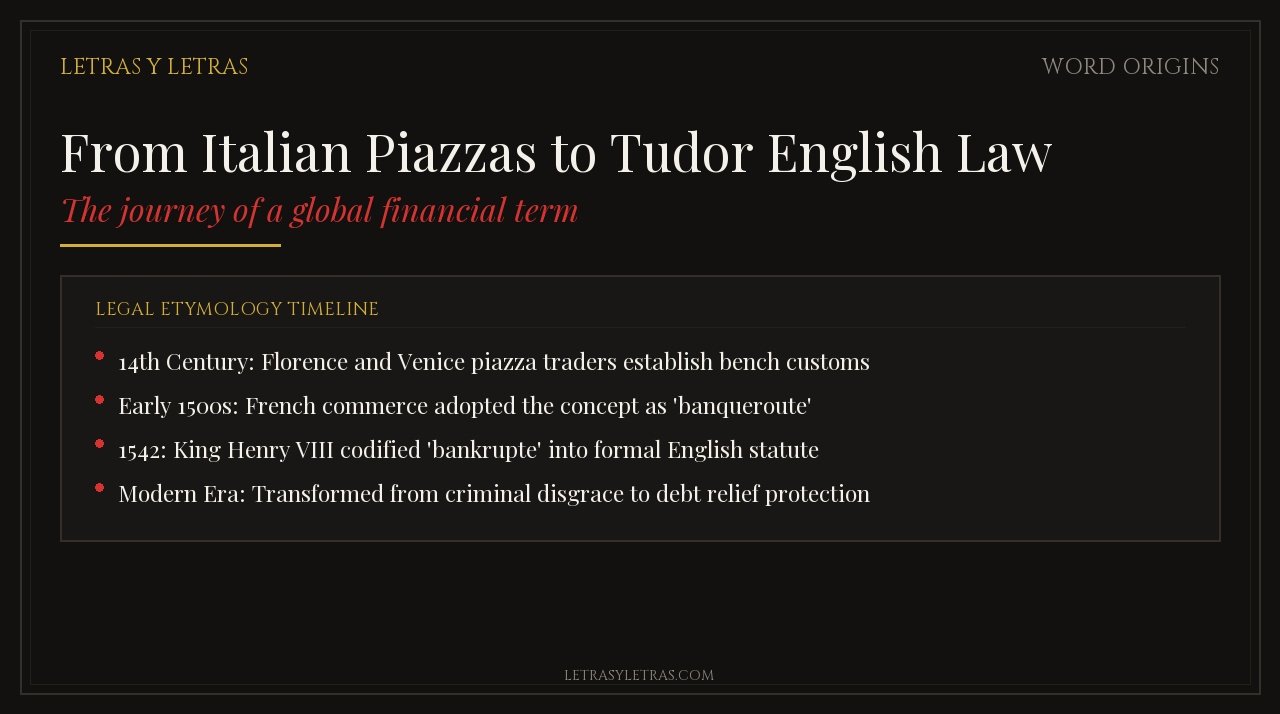
The concept of ‘banca rotta’ spread rapidly. As Italian banking practices influenced Europe, their terminology followed. The French adopted the term as ‘banqueroute’.
It described the same financial failure. French merchants carried the concept across the English Channel.
England was developing its own complex financial markets. Lawmakers needed vocabulary to describe insolvent merchants. The origin of the word bankrupt involves this cultural exchange.
By the 1500s, the term reached English shores. It evolved to fit the local tongue.
The spelling changed slightly as it adapted to English rules. People started saying ‘bankrupte’ instead of the French version. It became a recognized legal concept.
This transition shows how language adapts to economic realities. It is a fascinating linguistic shift.
King Henry VIII and English Law
The word officially entered English law in 1542. King Henry VIII signed the first English bankruptcy statute. This law targeted merchants who fled their debts.
It called them ‘bankruptes’ in the official text. This statute aimed to protect creditors from fraud.
It allowed authorities to seize the assets of the debtor. They would then divide the assets among the unpaid creditors. The law was harsh by modern standards.
Debtors could face imprisonment or worse. The origin of the word bankrupt was tied to criminality.
Financial failure was seen as a moral failing. You were a criminal if you could not pay. This perspective persisted for centuries.
The concept of a fresh financial start did not exist yet. You carried the stain of failure forever.
How the Meaning Has Evolved
Today, the word bankrupt has lost its violent associations. No one is smashing desks on Wall Street. The legal process is now bureaucratic and highly structured.
It focuses on reorganization rather than public humiliation. Debtors have legal protections that did not exist before.
However, the stigma of financial failure remains. The word still carries a heavy emotional weight. It signifies the end of a dream or a business.
The origin of the word bankrupt still echoes in our culture. It reminds us of the precarious nature of wealth.
We can see similar patterns in other terms. For instance, the origin of the word salary shows Roman roots. The origin of the phrase kick the bucket has dark undertones.
The origin of the word berserk also involves violent history. Language preserves the strange history of human behavior.
Examining Related Financial Phrases
Many financial idioms have literal physical origins. When you read about english idioms and meanings, this pattern is clear. People used tangible objects to explain abstract ideas.
A broken bench was easy to understand. It meant the money was gone.
You might also wonder about the origin of the phrase bite the bullet. That term also involves physical hardship. Or perhaps the origin of the phrase caught red handed.
Both show how vivid imagery creates lasting vocabulary. People remember strong visual concepts.
The English language is full of these historical relics. We use them daily without knowing their bloody past. Next time you read the financial news, remember the Italian piazzas.
The legacy of the smashed bench lives on. It is hidden in plain sight.
The Cultural Impact of the Broken Bench
The story of the broken bench is more than trivia. It illustrates how early societies managed trust and credit. Trust was the only currency that mattered.
When trust was broken, the bench was broken. This was a direct and undeniable consequence.
Modern finance hides behind digital screens. We rarely see the physical reality of a default. A blinking red number on a monitor lacks impact.
The origin of the word bankrupt provides a visceral contrast. It was a sensory experience of failure.
You could hear the wood splintering. Observers could see the angry crowd gathering. This public spectacle served as a warning to others.
It kept the early financial system functioning. Fear of the broken bench kept bankers honest.
Finding Connections in Modern Language
Language evolution is a continuous process. Every word carries a fossil record of human activity. The famous quotes and quotations of history rely on these words.
They build upon the foundations laid centuries ago.
Consider the origin of the phrase break a leg. It shows how language can flip meaning entirely. The origin of the word sandwich reveals how habits create nouns.
The origin of the phrase bless you traces back to plagues.
Each etymological discovery enriches our vocabulary. The origin of the word bankrupt is an excellent example. It connects modern economics to medieval street drama.
This connection makes history feel alive and relevant.
Frequently Asked Questions
What language does bankrupt come from?
The word comes from the Italian language. Specifically, it derives from the phrase ‘banca rotta’. The French later adapted it as ‘banqueroute’ before it entered English.
What does ‘banca rotta’ literally translate to?
It translates directly to ‘broken bench’ or ‘broken board’. ‘Banca’ means bench or counter. ‘Rotta’ means broken or shattered.
Why did they break the benches?
Authorities broke the benches to publicly shame bankers who defaulted. It was a physical sign that their trading license was revoked. The broken bench meant they could no longer conduct business.
When was the word first used in English?
It first appeared in English legal texts in 1542. King Henry VIII enacted the first bankruptcy statute. The text referred to debtors as ‘bankruptes’.
Did Roman laws influence this practice?
Roman law had severe penalties for debt. However, the specific practice of smashing a trading bench originated in Renaissance Italy. It was unique to their public banking system.
A Final Thought on Financial History
The origin of the word bankrupt reveals the dramatic nature of early finance. It reminds us that modern economic terms often hide violent pasts. A simple piece of wooden furniture gave birth to a global legal concept.
Language preserves these fascinating stories for us. Next time you hear about a corporate failure, picture the Italian town square. The splintered wood still echoes through our vocabulary today.
Keep exploring the origins of words to uncover the hidden history of human civilization.


Alan Sledge is the writer and founder behind Letters & Letters. A lifelong lover of words, Alan has always been drawn to the small mysteries hidden in everyday language, why we say what we say, where our favorite sayings came from and the quotes that manage to put feelings into words better than we ever could ourselves.

Alan Sledge
Alan Sledge is the founder and lead researcher behind Letters & Letters. A lifelong student of linguistic history, he cross-references every word origin, idiom, and quote against primary archival manuscripts, the Oxford English Corpus, and 18th-century print lexicons.