
Modern elections feel very chaotic. Political races are full of twists. You might wonder where this terminology started.
The origin of the word candidate is quite fascinating. This term goes back to ancient Roman politics. Politicians in Rome pulled off massive public stunts.
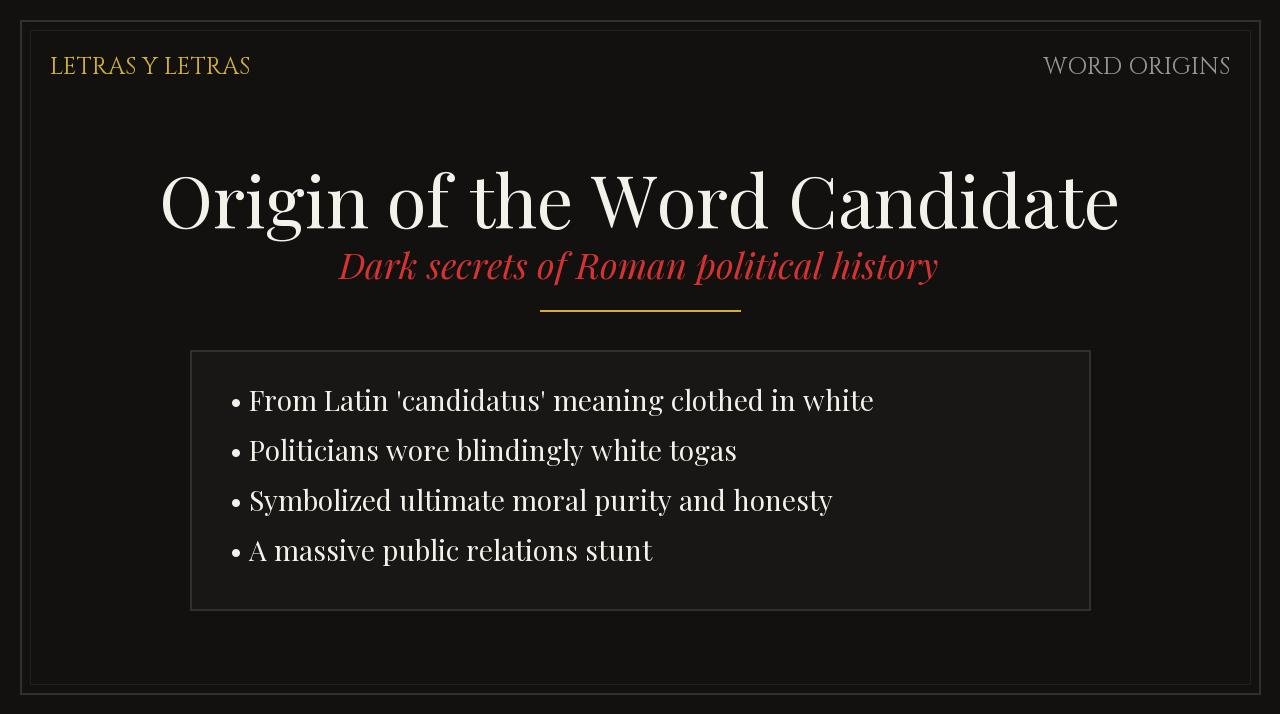
They wanted to look perfectly honest to voters. These men wore special clothing to create an illusion. This clothing was blindingly white in the sun.
Quick Answer: Origin of the Word Candidate
The origin of the word candidate traces to ancient Rome. Roman politicians seeking office wore a special white garment. This garment was called the toga candida.
The Latin root word candidus means bright and shining white. Politicians rubbed togas with chalk to make them gleam. This bright white clothing symbolized pure honesty and integrity.
Citizens expected their leaders to be free from corruption. A man wearing the toga candida was called a candidatus. That term candidatus eventually evolved into our English word candidate.
This ancient political stunt forever shaped our modern election vocabulary.
Key Takeaways
- The word candidate comes from the Latin word candidatus.
- Ancient Roman politicians wore bright white togas called toga candida.
- White color symbolized moral purity and total honesty.
- Politicians rubbed chalk into the fabric to make it brighter.
- The Latin root candidus gives us words like candid.
The Latin Roots of Political Vocabulary
We must look closely at Latin to find answers. Finding the word candidus sits at the center. Candidus translates to shining white or brilliant white.
Romans had different words for different shades of white. Albus meant a flat or dull white color. Candidus specifically meant a gleaming and glowing white.
You can see how this root shaped English. Our english idioms and meanings share deep connections today. Roman society placed heavy importance on strong visual symbols.
Clothing signaled a person’s exact rank in society. It showed their wealth and political ambitions too.
Becoming a Candidatus in Ancient Rome
A Roman citizen seeking office needed to stand out. He became a candidatus to run for a position. The candidatus was literally the person clothed in white.
This was a highly visible declaration of his intentions. That ambitious man did not wear an ordinary toga. He wore a specially treated garment to catch eyes.
The toga candida was essential for any serious campaign.
The Role of the Toga Candida
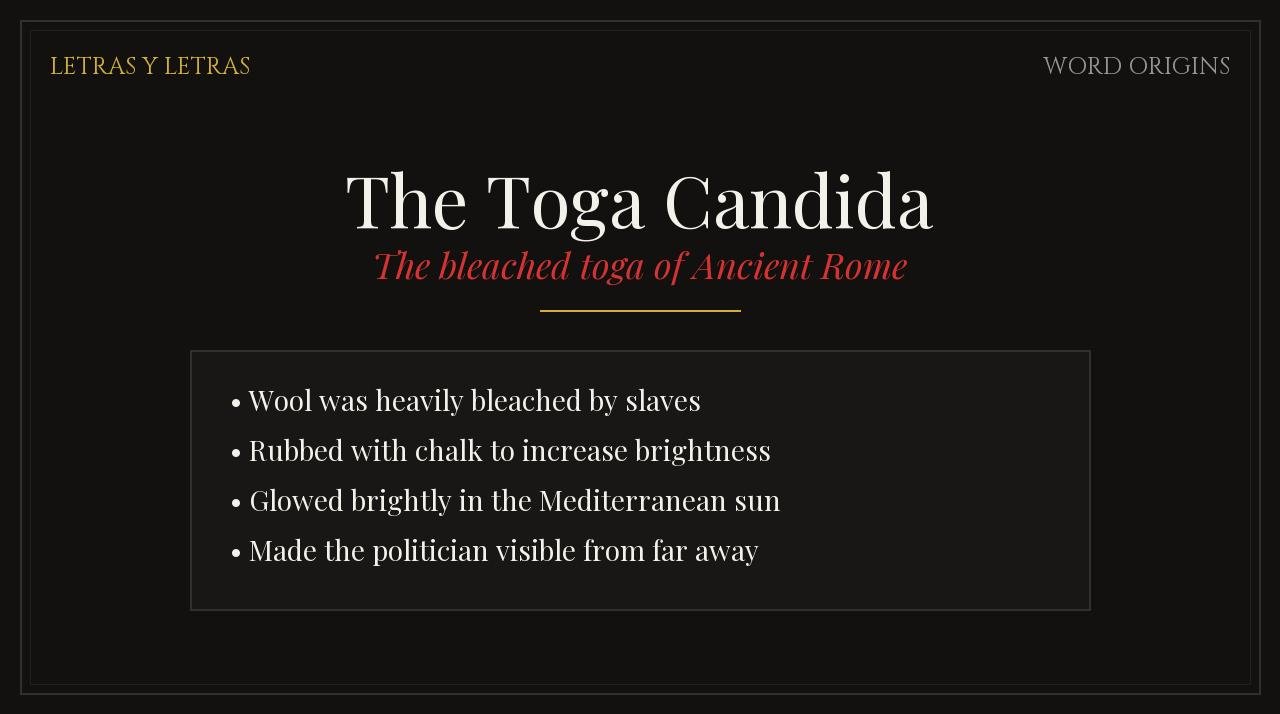
This toga candida was not just clean fabric. Slaves worked hard to bleach the wool thoroughly. They often rubbed pipe clay into the heavy cloth.
Chalk was another common additive to increase the brightness. The resulting toga practically glowed in the bright sun. This visual impact was a crucial campaign tool.
Voters could see the politician from very far away.
The Symbolism of the Glowing White Toga
The bright white toga carried immense symbolic weight. White represented ultimate purity and strict moral cleanliness. A politician wearing white claimed to be completely honest.
He signaled that he was free from dark corruption. The origin of the phrase caught red handed shows guilt. White defined complete innocence and pure intentions instead.
Honesty and Incorruptibility on Display
Visual messages were simple but incredibly powerful. A clean toga meant a spotless moral character. Voters were supposed to trust the shining white figure.
They believed this man was free from bribery. Bright fabric represented a completely transparent public life. It was early political branding at its most effective.
The Reality of Roman Political Bribery
Symbolism of purity was often a total lie. Roman elections were famously corrupt and chaotic affairs. Bribery was actually rampant throughout the Roman Republic.
Politicians spent massive fortunes to buy necessary votes. The origin of the word salary reminds us how money moved. Those brilliant white togas hid a lot of dirty money.
The Candidus Word Family in English
Our Latin root candidus gave English several important words. The most obvious relative is the word candid. A candid person speaks with complete honesty and frankness.
They do not hide their true thoughts or feelings. That noun form is candor, meaning open honesty. We value candor in our personal and professional relationships.
Words Connected to Light and Heat
Connections to bright light are still visible today. A candle produces a glowing light in the dark. That word candle comes directly from this exact root.
Incandescent is another fascinating word in this linguistic family. An incandescent light bulb glows white with intense heat. The root always relates back to a glowing brightness.

Exploring Other Linguistic Relatives
We can trace this root across other European languages. Romance languages maintain similar words for candidates and whiteness. You can explore the Merriam-Webster dictionary for more examples.
Language evolution reveals how words travel through time. The origin of the word berserk is another great example. Words shift in meaning but retain their ancient core.
From Rome to the English Language
This word candidate entered English around the year 1600. It arrived as both a noun and an adjective. At first, it maintained a strong academic and religious flavor.
A candidate was someone preparing for holy baptism. It also meant a student preparing for university degrees. The political meaning became dominant slightly later in history.
The Oxford English Dictionary Citations
Early citations show the word taking hold rapidly. Writers used it to describe eager office seekers. The Online Etymology Dictionary tracks this gradual shift carefully.
By the late 1700s, the modern political meaning was standard. It lost the literal connection to white clothing entirely. The term simply meant anyone seeking a specific public position.
Modern Usage and Political Campaigns
Today, we use the word candidate constantly. We hear it during every single election cycle. People use it for job interviews and academic awards too.
The origin of the phrase bite the bullet shows war influences. Politics shapes language just as powerfully. That ancient Roman PR stunt permanently altered our vocabulary.
Uncovering More Etymology Myths
Many people believe incorrect stories about word origins. Some claim candidate relates to a candelabra or wax. This is false, though they share the Latin root.
Our strict connection to the toga candida is factual history. The origin of the phrase break a leg has similar myths. We must rely on historical texts for true accuracy.
Historical Accuracy in Word Origins
Historians rely on texts by authors like Cicero. These ancient writers documented the toga candida thoroughly. They described the chaotic voting practices in extreme detail.
We know exactly how candidates acted in the forum. They shook hands and made grand political promises. Their white togas made them visible to every citizen.
The Connection to Famous Quotations
Politicians throughout history have used language carefully. They craft speeches to inspire and persuade voters. You can read famous quotes and quotations to see this skill.
Words have immense power in the political arena. A simple word like candidate carries centuries of history. It connects a modern mayor to an ancient Roman senator.
FAQ: Origin of the Word Candidate
Where does the word candidate come from?
The word candidate comes from the Latin word candidatus. This meant a person clothed in white. Ancient Roman politicians wore specially whitened togas when seeking office.
What does the Latin root candidus mean?
The Latin root candidus translates to shining or brilliant white. It is distinct from albus, which meant a dull white. Candidus referred to a bright, glowing, and pure white color.
Why did Roman politicians wear white togas?
Roman politicians wore bright white togas to symbolize moral purity. The white color suggested they were completely honest and uncorrupted. It was a visual promise of a clean political career.
What other words come from the root candidus?
Several English words share this bright Latin root. These include candid, candor, candle, and incandescent. They all relate to concepts of bright light or pure honesty.
When did the word candidate enter the English language?
The word candidate entered English around the year 1600. It originally applied to people seeking religious or academic positions. The strict political meaning became dominant later in the seventeenth century.
The Lasting Legacy of the Toga Candida
Our language holds hidden stories from ancient times. A politician today wears a dark blue suit instead. They no longer rub chalk into heavy wool garments.
Yet, we still call them candidates in every election. The ghost of the ancient Roman toga remains alive. It is a reminder of how politics rarely changes.
People universally desire their leaders to appear honest. The origin of the phrase bless you shows how habits endure. This origin of the word candidate is exactly the same.
We carry ancient history in our mouths every single day.
More Details on Roman Elections
Roman elections required immense planning and preparation. Politicians spent months gathering support from wealthy citizens. The voting process was complicated and highly structured.
Different assemblies voted on different types of laws. Those candidates had to navigate this complex system carefully. Their white clothing helped them stand out instantly.
The Voting Assemblies of Rome
This Comitia Centuriata elected the highest magistrates. Those rulers included the consuls and the praetors. Wealthy classes had significantly more voting power here.
Ambitious candidates focused their attention on these wealthy elites. They needed their financial support to win elections. The toga candida proved they were serious contenders.
Campaigning in the Roman Forum
That Roman Forum was the heart of political life. Candidates spent their days shaking hands and making speeches. They traveled with large groups of supporters and clients.
This entourage demonstrated their immense power and influence. A large crowd meant a popular and successful politician. The glowing white toga served as a beacon.
The Evolution of the Word Candidate
This word candidate evolved slowly over many centuries. Medieval Latin kept the word alive in written texts. It described anyone nominated for a specific role.
The connection to white clothing faded away completely. People forgot about the toga candida and its chalk. This modern meaning focuses entirely on the political pursuit.
Early Usage in English Literature
Early English writers loved adopting Latin words. They used candidate to sound educated and formal. Shakespeare and his contemporaries played with classical references.
This word slowly became part of everyday language. It lost its academic and elitist associations entirely. The term became a practical word for a practical purpose.
The Modern Political Campaign
A modern campaign shares traits with Roman elections. Politicians still rely heavily on strong public relations. They craft visual images to project honesty and competence.
Candidates use television and social media instead of clothing. The origin of the word sandwich shows culinary history. That word candidate shows the deep history of human ambition.
The Power of Etymology
Etymology helps us comprehend the ancient human mind. Words are fossils of past cultures and strange habits. We learn how people lived by studying their vocabulary.
This story of the candidate is especially revealing. It proves that human nature remains remarkably consistent. We still demand pure honesty from our flawed leaders.
Discovering History Through Language
Every word in the dictionary has a unique story. Some words come from ancient military battles. Others come from simple farming tools or cooking methods.
The origin of the phrase kick the bucket reveals dark humor. That word candidate reveals bright political theater. Exploring these stories is always a rewarding pursuit.
The Enduring Impact of Latin
Latin shapes English more than we often realize. Thousands of English words trace back to Rome. We use them daily without thinking about their origins.
Citizens can thank the Romans for our political language. They invented the systems we still use today. Those ancient people also invented words to describe those systems.


Alan Sledge is the writer and founder behind Letters & Letters. A lifelong lover of words, Alan has always been drawn to the small mysteries hidden in everyday language, why we say what we say, where our favorite sayings came from and the quotes that manage to put feelings into words better than we ever could ourselves.

Alan Sledge
Alan Sledge is the founder and lead researcher behind Letters & Letters. A lifelong student of linguistic history, he cross-references every word origin, idiom, and quote against primary archival manuscripts, the Oxford English Corpus, and 18th-century print lexicons.