

Every ambitious life eventually runs out of easy momentum. You wake up on an ordinary Tuesday, and the initial excitement has vanished. In that quiet hollow, only stamina remains.
Most popular advice praises raw talent or sudden inspiration. History tells a radically different story. The writers, leaders, and philosophers who shaped our world survived long seasons of neglect and doubt.
They understood that endurance is an acquired craft. As an essayist studying historical manuscripts at Alan Sledge, I often encounter these hard-won truths. Our archive of famous quotes and quotations reveals a universal lesson across centuries.
Quick Answer: What Are the Most Powerful Quotes on Perseverance?
The most profound quotes on perseverance come from historical thinkers who survived severe adversity. Leaders like Marcus Aurelius and Frederick Douglass defined endurance as deliberate moral discipline. Their verified sayings prove that quiet daily stamina outlasts brief emotional excitement.
Key Takeaways
- Perseverance is deliberate habit, not erratic emotional excitement.
- Stoic philosophers viewed resistance as fuel for spiritual growth.
- Historical leaders separated productive stamina from blind stubbornness.
- Small daily actions accumulate into monumental lifetime achievements.
- True grit requires accepting temporary defeat without surrender.
True perseverance is rarely loud. It is the steady refusal to abandon your post. Here are twenty-five verified sayings that illuminate what it means to stay the course.
Pillar 1: Ancient Stoicism and Inner Fortitude
The ancient Stoics lived through political purges, devastating plagues, and brutal exiles. Hardship was not an unfair interruption. Adversity was their primary training ground for character.
1. Marcus Aurelius
“The impediment to action advances action. What stands in the way becomes the way.”
Marcus wrote these words in private military journals while commanding legions along the frozen Danube. The Roman emperor ruled during the Antonine Plague. External barriers could not defeat an obedient mind.
When an obstacle blocks your original plan, that barrier forces you to practice patience, courage, and resourcefulness. The impediment itself becomes your teacher.
As documented in the Stanford Encyclopedia of Philosophy, this Stoic principle treats adversity as raw fuel for virtue. Hardship cannot touch the ruling center of the soul.
2. Seneca the Younger
“Difficulties strengthen the mind, as labor does the body.”
Seneca wrote extensively on endurance in his moral epistles to Lucilius. The Roman statesman spent eight years exiled on Corsica. Physical muscles grow only through heavy strain.
Mental fortitude operates by the identical law. If you shield yourself from friction, your mind remains soft and fragile. Welcome the strain as necessary exercise.
3. Epictetus
“He is a wise man who does not grieve for the things which he has not, but rejoices for those which he has.”
Epictetus spent his youth as an enslaved man in Rome. His master beat him so severely that he walked with a permanent limp. He never allowed physical hardship to poison his spirit.
Perseverance begins with radical acceptance. When you stop raging against unfair losses, you preserve energy for immediate action.
4. Confucius
“It does not matter how slowly you go as long as you do not stop.”
Confucius spent decades traveling through warring Chinese states seeking an ethical ruler. The philosopher was repeatedly ignored and impoverished. Despite poverty, he never abandoned his moral teachings.
Speed is an illusion created by modern vanity. Consistent tiny movements forward conquer distances that sudden sprints can never bridge.
5. Lao Tzu
“A thousand-mile walk begins with a single step.”
Found in chapter sixty-four of the classic Tao Te Ching, this ancient observation remains timeless. Huge undertakings easily paralyze our imagination. The human mind trembles when staring at vast horizons.
Wise practitioners shrink the task down to the immediate moment. You do not conquer the whole mountain today. One deliberate step begins the advance.
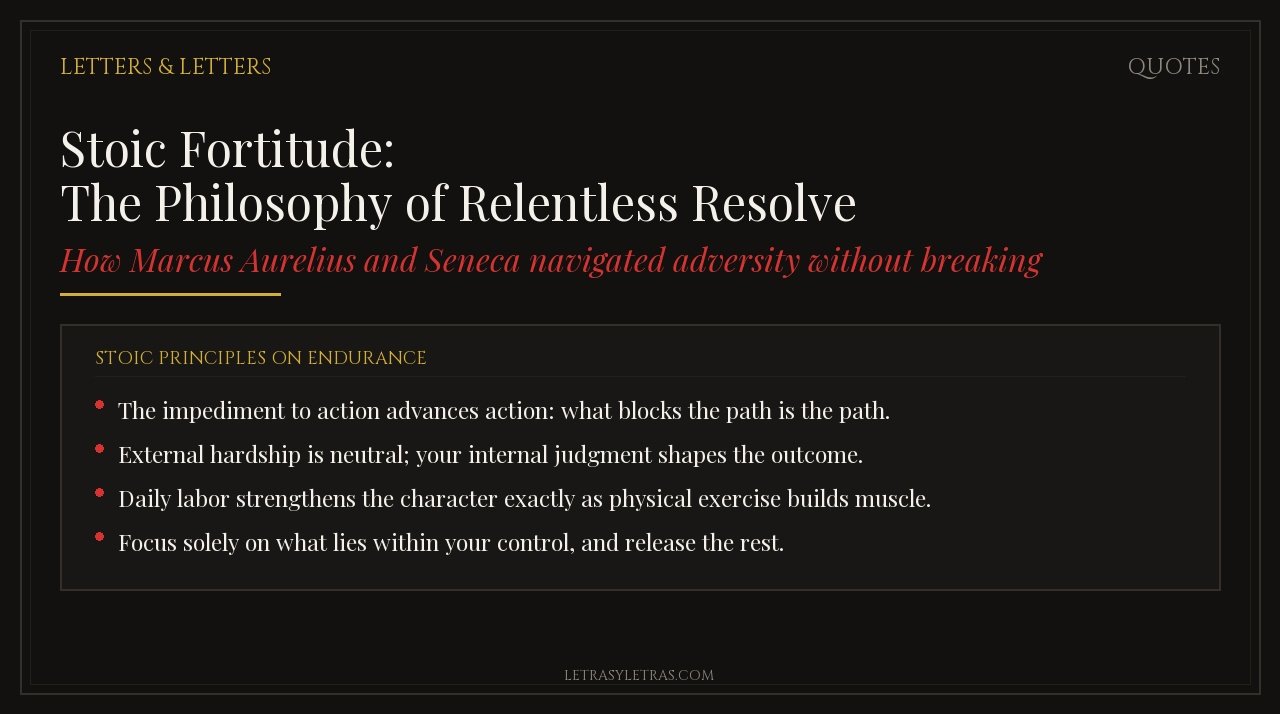
Stoic philosophy teaches that external obstacles furnish raw material for character.
Pillar 2: Pushing Past Failure and Defeat
Defeat feels permanent while it is happening. The second pillar gathers thinkers who transformed public failures into profound breakthroughs.
6. Winston Churchill
“Success is not final, failure is not fatal: it is the courage to continue that counts.”
Churchill suffered catastrophic political disasters throughout his long career, including the disastrous Gallipoli campaign in 1915. He was banished to political wilderness for an entire decade. Yet he returned to lead Britain through its darkest hour.
His insight warns against pride during victory and despair during collapse. Both conditions are temporary. The only enduring metric is your willingness to step back onto the field.
7. Thomas Edison
“Our greatest weakness lies in giving up. The most certain way to succeed is always to try just one more time.”
Edison tested thousands of failed filament materials before perfecting the commercial incandescent bulb. While assistants grew weary, Edison treated every failure as elimination of an error.
Most projects collapse yards before the finish line. People quit because fatigue distorts their perception of progress. One more honest attempt often dissolves the final barrier.
8. Samuel Beckett
“Ever tried. Ever failed. No matter. Try again. Fail again. Fail better.”
Published in his 1983 prose piece Worstward Ho, Beckett captured the creative struggle with brutal precision. The Irish author stripped away artificial optimism. Human art, he recognized, cannot achieve absolute perfection.
Failing better means extracting wisdom from each misstep. It reframes artistic labor as an endless refinement rather than a single flawless performance.
9. Theodore Roosevelt
“It is not the critic who counts… The credit belongs to the man who is actually in the arena, whose face is marred by dust and sweat and blood.”
Roosevelt delivered this address at the Sorbonne in Paris in 1910. The former president despised passive spectators who mocked brave doers. Throughout life, he charged into vigorous physical and political battles.
Those who build meaningful things will inevitably stumble publicly. That dust on your forehead is an emblem of honor, not shame.
10. Nelson Mandela
“The greatest glory in living lies not in never falling, but in rising every time we fall.”
Mandela spent twenty-seven years imprisoned on Robben Island and in Pollsmoor. The anti-apartheid leader performed hard labor in a lime quarry while keeping his dignity. Later, he emerged without bitterness to unite a fractured nation.
Falling is an inescapable condition of mortal existence. Your dignity resides entirely in the physical act of getting back up.
Pillar 3: Quiet Grit and Daily Stamina
Public spectacles celebrate heroic moments, but everyday survival demands quiet stamina. These thinkers honor the private commitment to show up when nobody watches.
11. Mary Anne Radmacher
“Courage does not always roar. Sometimes courage is the quiet voice at nightfall saying, ‘I will try again tomorrow.'”
Radmacher wrote this reflection in her 1993 collection. It provides profound relief to exhausted strivers. Many people equate bravery with loud battlefield speeches and theatrical gestures.
Sometimes bravery is simply closing your eyes after a bruising defeat and choosing to wake up ready to labor again. That quiet choice sustains the world.
12. Maya Angelou
“You may encounter many defeats, but you must not be defeated.”
Angelou endured horrific childhood trauma, mutism, and systemic racial hostility. She transformed suffering into breathtaking literature and poetry. Her words make a vital distinction between external events and internal surrender.
Defeats are events that occur in the physical world. Surrender is a spiritual choice that happens in the heart. Never grant external events permission to conquer your resolve.
13. Harriet Beecher Stowe
“When you get into a tight place and everything goes against you, never give up then, for that is just the place and time that the tide will turn.”
Stowe wrote amidst severe financial strain and personal bereavement while raising seven children. The exhausted author completed Uncle Tom’s Cabin under relentless pressure. From lived experience, she understood when human strength falters.
Despair peaks right before a systemic shift occurs. If you hold fast through the final grueling hour, the tide inevitably shifts in your favor.
14. Henry Wadsworth Longfellow
“Perseverance is a great element of success. If you only knock long enough and loud enough at the gate, you are sure to wake up somebody.”
Longfellow, the celebrated nineteenth-century American poet, understood the psychology of stubborn insistence. Gates do not yield to single polite taps. They open under persistent, rhythmic knocking.
Opportunity often ignores casual inquiries. It responds to applicants who refuse to pack up and walk away.
15. Viktor Frankl
“When we are no longer able to change a situation, we are challenged to change ourselves.”
Frankl survived the horrors of Auschwitz and Dachau. He watched prisoners who clung to external circumstances wither away. Those who found an inner purpose maintained the spiritual will to endure unspeakable deprivation.
When external conditions refuse to bend to your desires, true perseverance shifts inward. You adapt, reframe your mission, and endure with unbroken inner freedom.
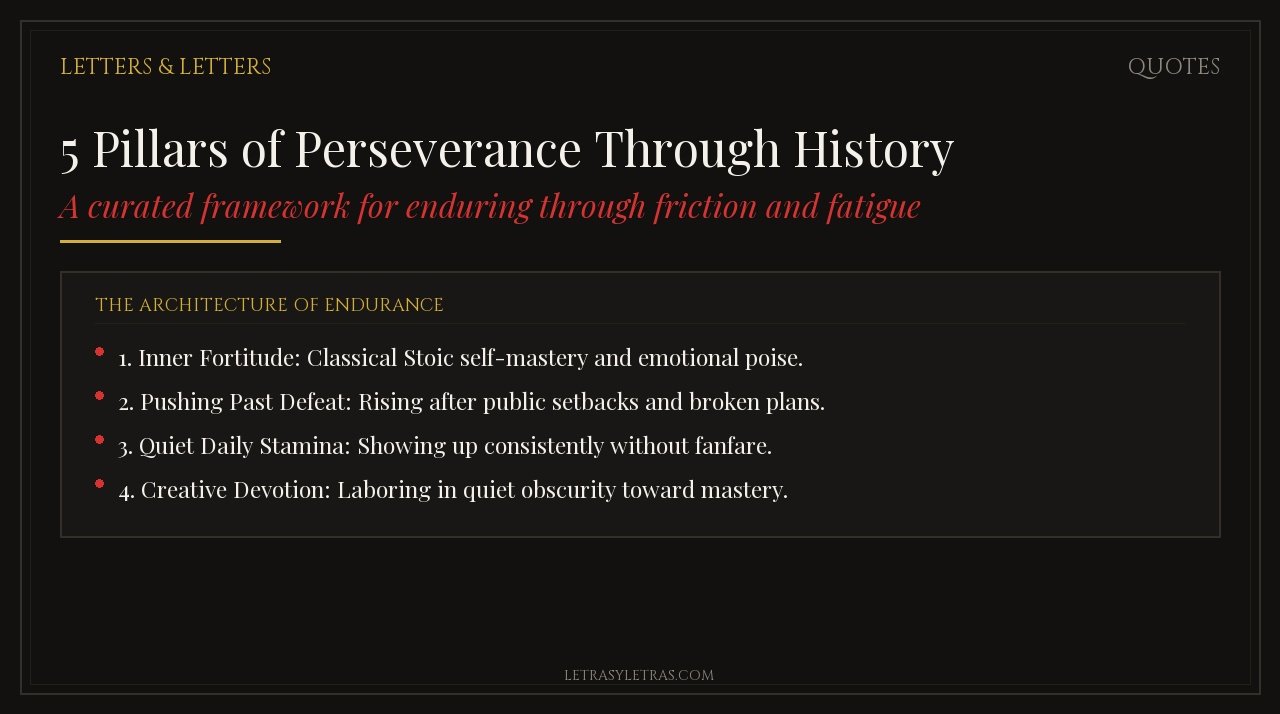
A historical framework outlining the five essential pillars of human endurance.
Pillar 4: Endurance in Solitude and Labor
Mastery requires years of silent, unglamorous toil. These creators proved that enduring solitary labor produces work that outlives empires.
16. Vincent van Gogh
“Great things are done by a series of small things brought together.”
Van Gogh sold only one known painting during his tragic lifetime. The Dutch master painted obsessively in heat, wind, and mental torment. Every masterpiece canvas, he understood, is built from patient individual brushstrokes.
Do not obsess over massive outcomes. Dedicate yourself to placing one honest stroke onto the canvas today. Small faithful acts accumulate into lasting greatness.
17. Leonardo da Vinci
“Obstacles cannot crush me; every obstacle yields to stern resolve.”
Leonardo filled thousands of notebook pages with anatomical dissections, engineering sketches, and philosophical mottos. He struggled with fickle patrons and unfinished commissions throughout Italy. His personal notebook records an unshakeable devotion to rigorous inquiry.
When resolve is stern, obstacles cease to be threats. They become mechanical puzzles waiting for patient dismantling.
18. Charles Dickens
“My advice is, to have faith in the future, and to stand by your work.”
As a twelve-year-old child, Dickens worked in a rat-infested blacking warehouse. The young boy labored while his father sat in debtors’ prison. Later in life, he wrote novels with furious industry.
Standing by your work means honoring your craftsmanship when public reception is cold. Faith in the craft sustains you until the world catches up.
19. Robert Frost
“The best way out is always through.”
Frost wrote this line in his 1914 poem A Servant to Servants. The New England poet farmed for twenty years before publishing his first volume. Having buried children and known deep poverty, he understood grief.
You cannot bypass painful realities through clever shortcuts. Evasion only prolongs agony. Step directly into the difficult work, and walk until you emerge on the other side.
20. Helen Keller
“We can do anything we want to if we stick to it long enough.”
Deprived of sight and hearing before age two, Keller broke through sensory darkness through agonizing tactile training with Anne Sullivan. She mastered speech, graduated with honors from Radcliffe College, and authored numerous books.
Her life stands as definitive proof of human persistence. Severe physical limitations collapse before relentless application of will.
Pillar 5: Historic Resolve and Moral Purpose
When perseverance attaches to a moral cause, it changes human history. These leaders proved that righteous conviction can outlast tyrannical opposition.
21. Abraham Lincoln
“I am a slow walker, but I never walk back.”
Lincoln endured personal bereavement, clinical melancholy, and staggering battlefield losses during the American Civil War. Opponents mocked his crude manners, while cabinet secretaries second-guessed his military strategies. Yet his slow advance never reversed.
Speed is secondary to direction. If your compass points toward truth, advancing an inch each day guarantees final arrival.
22. Frederick Douglass
“If there is no struggle, there is no progress.”
Douglass escaped chattel slavery to become a premier orator and statesman. In his 1857 West India Emancipation speech, he dismantled naive hopes for peaceful moral change. Power concedes nothing without demand.
Growth demands friction. Those who expect ease while striving for justice or personal excellence deceive themselves. Embrace the struggle as the price of progress.
23. Martin Luther King Jr.
“If you cannot fly then run, if you cannot run then walk, if you cannot walk then crawl, but whatever you do you have to keep moving forward.”
Delivered to students at Spelman College in 1960, King outlined the fundamental duty of moral action. Violence, bombings, and arrests could not halt the civil rights movement. When resources diminish, the speed adjusts, but the direction remains fixed.
Do not demand flawless circumstances before acting. If strength permits only crawling today, crawl forward with pride.
24. Japanese Proverb
“Fall seven times, stand up eight.”
Known in Japanese as Nana korobi, ya oki, this proverb reflects centuries of cultural resilience. It is immortalized in Daruma dolls, weighted paper mâché figures that right themselves when knocked down.
The mathematics of endurance is simple. As long as the number of risings exceeds the number of falls by one, you remain undefeated.
25. Albert Einstein
“It is not that I am so smart, it is just that I stay with problems longer.”
Einstein spent a decade wrestling with the mathematics of general relativity. The theoretical physicist often hit dead ends and revised complex equations in Bern. Later, he attributed his discoveries to stubborn curiosity.
Genius is often mistaken for rapid intuition. In truth, genius is the capacity to endure confusion without walking away.
Historical Comparison of Core Lessons
To grasp how these thinkers approached endurance, we can compare their primary methods across historical eras. Each tradition offered unique intellectual weapons against despair.
| Tradition | Key Figures | Core Philosophy | Primary Practical Method |
|---|---|---|---|
| Ancient Stoicism | Marcus Aurelius, Seneca | Obstacles provide raw material for character. | Reframe external friction as mental exercise. |
| Creative Solitude | Van Gogh, Leonardo, Beckett | Mastery is accumulated small faithful actions. | Accept failure and refine technique in silence. |
| Moral Leadership | Lincoln, Douglass, King | Righteous purpose outlasts armed tyranny. | Maintain forward direction despite slow speed. |
| Quiet Daily Grit | Radmacher, Angelou, Stowe | Courage is deciding to try again tomorrow. | Separate external defeat from inner surrender. |
Debunking Famous Misattributed Perseverance Sayings
Language history is filled with fabricated quotations. Popular folklore frequently invents dramatic speeches that never occurred in reality.
Our work at Letters & Letters prioritizes archival accuracy. Here are two famous perseverance sayings that are routinely misattributed in modern culture.
The Winston Churchill Three-Word Myth
A widespread urban legend claims that Churchill gave a commencement address consisting of only three words. Folklore says he walked to the lectern, growled “Never give up,” and sat down.
Archival records from the Churchill Archives Centre debunk this tale completely. His real address occurred at Harrow School on October 29, 1941. He gave a detailed nine-minute speech.
His actual famous line was far more nuanced. Churchill told the schoolboys to never give in except to convictions of honor and good sense. He never advocated mindless obstinacy.
The Albert Einstein Insanity Quote
Social media frequently attributes a famous definition to Einstein. The quote states that insanity is doing the same thing repeatedly and expecting different results.
Scholars at the Einstein Papers Project have searched his entire collected writings and correspondence. Einstein never wrote or spoke this sentence.
The phrasing first appeared in print during the early 1980s in twelve-step recovery literature. Attributing it to Einstein creates an illusion of scientific authority where none exists.
The Difference Between Perseverance and Stubbornness
Many people mistake stubbornness for perseverance. While both look similar from a distance, their inner mechanisms are opposites.
Stubbornness is emotional attachment to a specific method. When that method fails, the stubborn person charges into the wall again. That behavior creates exhaustion without progress.
Perseverance is fidelity to the ultimate goal paired with flexibility of method. As scholars note in Oxford Reference historical analyses, great innovators constantly adjust their tactics.
If a door is locked, do not shatter your shoulder against the oak. Search for an unlatched window. True stamina preserves its energy for productive action.
Frequently Asked Questions
What is the single best quote on perseverance?
Marcus Aurelius provides the deepest definition in his Meditations. He stated that what stands in the way becomes the way. That insight turns every obstacle into spiritual progress.
What did Winston Churchill actually say about never giving up?
Churchill spoke at Harrow School in 1941. The British prime minister urged students to never give in. Real surrender, he insisted, should occur only for honor and good sense.
What is a short strong quote on perseverance?
Robert Frost wrote that the best way out is always through. This famous advice reminds strivers that dodging trials only prolongs hardship.
How does perseverance differ from persistence?
Persistence often describes continuing an action despite short-term resistance. Perseverance carries a deeper moral dimension. It implies enduring long hardship with patience, character, and vision.
What did the ancient Stoics teach about enduring hardship?
The Stoics taught that external events are neutral. Only your internal reaction matters. As documented in archives at the Library of Congress, they treated adversity as an essential gymnasium for character.
Alan Sledge is the lead writer at letrasyletras.com. He uncovers the authentic histories behind our favorite words and sayings.


Alan Sledge is the writer and founder behind Letters & Letters. A lifelong lover of words, Alan has always been drawn to the small mysteries hidden in everyday language, why we say what we say, where our favorite sayings came from and the quotes that manage to put feelings into words better than we ever could ourselves.