

Have you ever accused someone of making an incorrect assumption? You probably told them they were barking up the wrong tree.
Today, the idiom is a familiar figure of speech. We use it when someone pursues a mistaken theory or accuses the wrong person. It also applies when seeking help from someone powerless to assist.
Yet two hundred years ago, this phrase was not a playful metaphor. It described a frustrating, midnight hunting blunder in the dense forests of the early American frontier.
Quick Answer: Origin of the Phrase Barking Up the Wrong Tree
The phrase barking up the wrong tree originated in early nineteenth-century America from the practice of night hunting raccoons with trained hunting dogs known as coonhounds. In pitch-black frontier forests, hunters relied on the baying of their dogs to locate nocturnal game. When cornered, raccoons scramble up trees to escape. However, agile raccoons frequently leap across interlocking upper branches into neighboring trees, or double back into the dark without touching the ground. Inexperienced or overexcited hounds continued barking furiously at the base of the original, empty tree. When hunters arrived with pine torches and rifles, they realized the animal had fled, making their effort completely useless. By the 1830s, American frontier writers and legendary folk hero Davy Crockett adopted the hunting term into literature as a metaphor for pursuing a false lead or making a misguided assumption.
Key Takeaways
- The phrase originated in early 1800s American raccoon hunting with coonhounds.
- Nocturnal raccoons escaped by jumping across connecting tree canopies.
- Dogs were fooled into barking at empty trunks while the quarry escaped.
- Frontier legend Davy Crockett popularized the idiom in published books in 1836.
- By the 1850s, the phrase migrated across British newspapers and politics.
The American Wilderness: Midnight Raccoon Hunting
To understand the origin of the phrase barking up the wrong tree, we must visit the early nineteenth-century American frontier. In states like Kentucky, Tennessee, and Ohio, settlers depended on hunting for survival.
Raccoon hunting was a common pursuit. Raccoon meat provided valuable protein for families during winter months. Their warm, thick pelts served as clothing or currency in frontier trade.
Because raccoons are nocturnal creatures, hunting took place in total darkness. Settlers ventured into dense hardwood forests and tangled river swamps late at night.
Hunters could not see their quarry in the dark. Instead, they relied completely on specialized dogs. These hunting hounds later evolved into famous breeds like the Black and Tan Coonhound.
These dogs possessed extraordinary olfactory senses. They trailed the scent of raccoons across brush, creek beds, and muddy gullies.
When a dog caught the scent, it tracked the animal until the raccoon sought refuge off the forest floor. In frontier parlance, the dog had successfully ‘treed’ its quarry.
The Canopy Escape: How the Raccoon Tricked the Hound
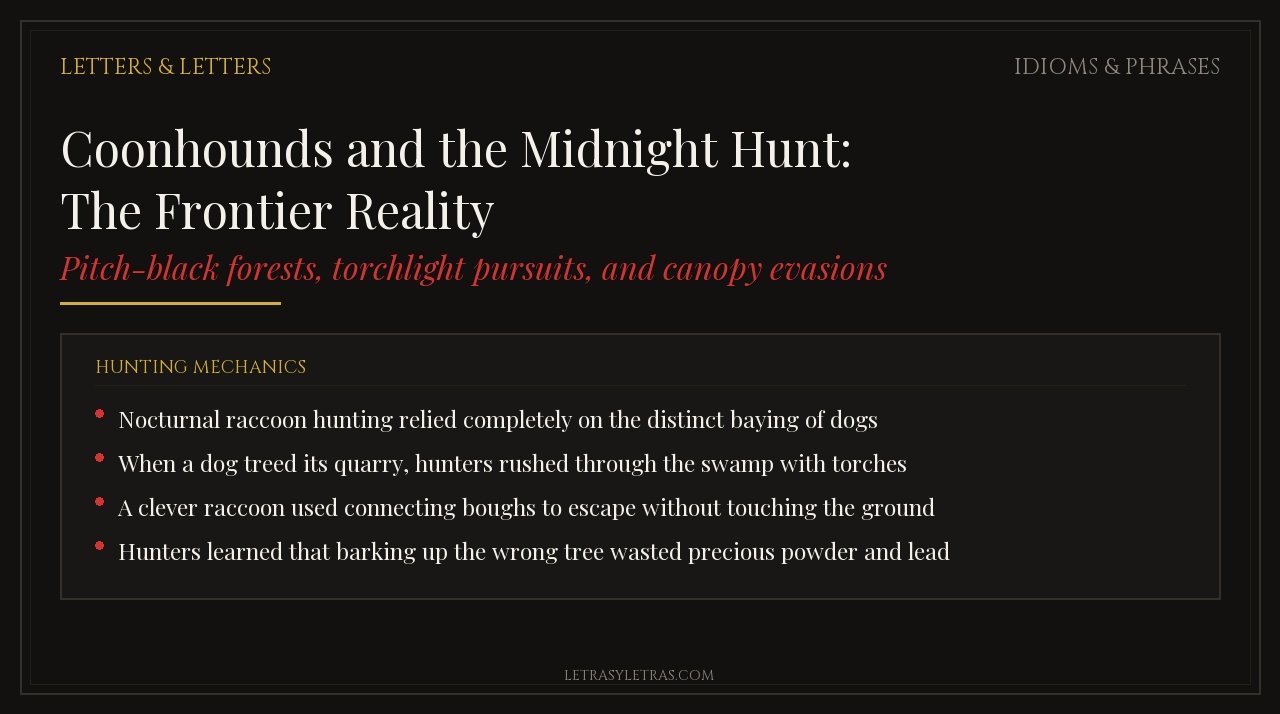
Once a raccoon climbed a tree, the hunting dog sat or stood at the base of the trunk. The dog barked and bayed continuously into the canopy.
This distinct vocalization alerted the hunter. Guided by the dog’s baying, the hunter hurried through briars and swamps with flickering pine torches and a flintlock rifle.
However, the raccoon is an exceptionally intelligent and agile climber. In virgin American forests, the crowns of towering oaks and beeches formed dense, interlocking canopies.
A trapped raccoon did not simply wait to be shot. When it reached the upper branches, it scampered across connecting boughs into an adjacent tree.
Sometimes the animal crossed three or four trees before descending quietly down the far trunk. It vanished into the night without leaving a ground scent for the dog.
Young, impatient, or inexperienced hunting dogs failed to notice the escape. Focused on the original scent on the bark, the dog continued baying loudly at the base of the abandoned trunk.
Wasted Gunpowder and Frontier Ridicule
When the exhausted hunter finally caught up with his hound, he faced great frustration. He lifted his pine torch and squinted into the high branches.
On cold winter nights, identifying a small animal hidden fifty feet above in dense Spanish moss or leaves was difficult. Sometimes hunters fired shots into the foliage, hoping to dislodge their prey.
Firing into an empty tree wasted expensive lead balls and precious black powder. If daylight revealed the tree was empty, the hunter returned home empty-handed.
On the frontier, having a dog that barked up the wrong tree was a source of public embarrassment. Neighbors teased hunters whose hounds could be so easily deceived by a cunning critter.
Settlers used the phrase to describe anyone who demonstrated poor judgment, chased false evidence, or was completely fooled by appearances.
Records in the Library of Congress American frontier archives show the phrase spread rapidly. Frontiersmen quickly adopted the idiom into daily colloquial speech across western settlements.
Davy Crockett and the Literary Breakthrough
By the 1830s, the phrase crossed over from backwoods oral humor into written American literature. The man most responsible for popularizing the expression nationwide was David Crockett.
Davy Crockett was a legendary frontiersman, bear hunter, and United States congressman from Tennessee. His colorful frontier humor and tall tales enchanted urban readers on the East Coast.
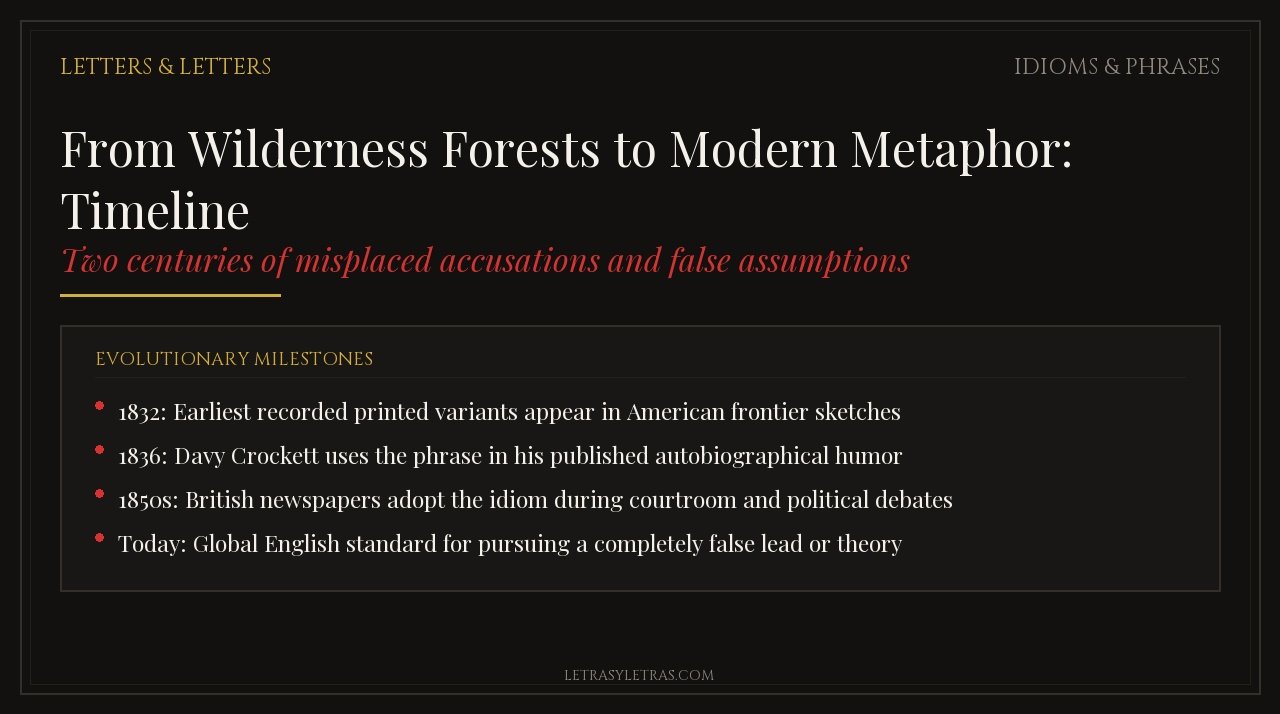
The earliest print appearance dates to 1832 in American newspapers. In 1833, the Western Monthly Magazine recorded: ‘He is barking up the wrong tree.’
Crockett solidified the idiom’s place in American culture in his 1836 book, An Account of Col. Crockett’s Tour to the North and Down East.
Describing a political conversation, Crockett wrote: ‘I told him he was barking up the wrong tree entirely.’
Archives at the Smithsonian Institution American cultural history records confirm Crockett’s national influence. His immense popularity cemented the expression into everyday American vernacular.
Crossing the Atlantic: Victorian Britain Adopts the Idiom
During the nineteenth century, British critics often looked down upon American idioms. London literary journals dismissed frontier expressions as vulgar and uncouth.
Yet American frontier expressions possessed a vivid, punchy imagery that British speakers found irresistible. Like our look at the origin of the phrase steal someone’s thunder, theatrical and political discourse welcomed colorful speech.
According to citations in the Oxford English Dictionary historical citations, British newspapers began using the phrase in the 1850s.
British journalists used the phrase during parliamentary debates. They mocked politicians who attacked the wrong legislation or blamed the wrong cabinet minister.
By the late nineteenth century, the idiom had shed its provincial frontier reputation. It became standard idiomatic English throughout the United Kingdom, Canada, and Australia.
| Year / Era | Setting & Source | Dominant Meaning | Historical Context |
|---|---|---|---|
| Early 1800s | American Frontier Wilderness | Literal raccoon hunting error. | Hounds bay at empty trees after raccoons escape through canopies. |
| 1832 | American Frontier Press | Misguided political or personal claims. | Earliest recorded print variants appear in frontier newspapers. |
| 1836 | Davy Crockett’s Memoirs | Directing efforts to the wrong person. | Crockett popularizes the exact phrasing in his published writings. |
| 1850s | Victorian British Periodicals | Pursuing a false lead or theory. | British press adopts the idiom during parliamentary debates. |
| Modern Era | Global Everyday English | Universal metaphor for flawed assumptions. | Widely used in legal, medical, corporate, and social contexts. |
The Modern Psychology of Misdirected Effort
Why has barking up the wrong tree survived for over two centuries? Language scholars argue that the metaphor captures a universal human cognitive error.
Articles indexed in Encyclopaedia Britannica language and idiom entries explain how idioms survive when they describe complex behavioral patterns simply.
In modern life, people frequently bark up the wrong tree in four distinct domains.
First, in medical diagnoses, patients often treat symptoms rather than the root cause of an illness. A doctor might remind a patient that taking pain relievers for a fractured bone is barking up the wrong tree.
Second, in criminal investigations, detectives can become fixated on a plausible suspect despite conflicting evidence. When true forensic clues point elsewhere, detectives realize they spent weeks barking up the wrong tree.
Third, in corporate strategy, businesses often pour millions into marketing campaigns targeting demographics that have zero interest in the product.
Finally, in interpersonal relationships, someone might demand favors from a colleague who lacks the administrative authority to approve them.
Like the origin of the phrase across the board, this idiom offers practical wisdom. It reminds us to verify our target before expending valuable energy.
Folk Etymology Myths Debunked
Because the imagery involves hunting dogs, several false origins have circulated in popular culture. Understanding word histories requires distinguishing historical records from convenient myths.
Here are two common misconceptions regarding the origin of barking up the wrong tree that historians have debunked.
Myth 1: Medieval English Fox Hunting
One common myth claims the phrase originated during medieval English fox hunting. According to this story, British foxhounds chased foxes into coppices and barked at trees.
This claim is historically inaccurate. Red foxes rarely climb trees. English foxhounds followed scent trails across open pastures rather than treeing game.
Myth 2: European Ship Building Timber
Another bizarre theory claims the phrase referred to seventeenth-century shipwrights barking trees to harvest naval timber. Supporters claim workers stripped the wrong oak trees in royal forests.
This explanation confuses the verb ‘to bark’ (stripping tree bark) with the canine vocalization. The idiom has always referred to baying hunting hounds on the American frontier.
Frequently Asked Questions
What does barking up the wrong tree mean?
To bark up the wrong tree means pursuing a mistaken line of thought. It describes accusing the wrong person or directing effort toward a fruitless goal.
Where did barking up the wrong tree come from?
The phrase came from early nineteenth-century American raccoon hunting. Coonhounds tracked nocturnal raccoons into trees, but clever raccoons escaped into adjacent branches, leaving the dogs barking at empty trunks.
Did Davy Crockett invent the phrase?
No, frontier hunters coined the expression through oral tradition. However, Davy Crockett helped popularize the phrase across America by using it in his widely read 1836 published writings.
What kind of dogs barked up the wrong tree?
American frontier hunters used treeing hounds, particularly early ancestors of the Black and Tan Coonhound and Treeing Walker Coonhound. These breeds possessed specialized instincts for tracking and treeing game.
Can you use barking up the wrong tree in formal writing?
While the idiom is universally understood, it is an informal colloquial expression. In formal academic or legal writing, phrases like pursuing a false lead or making a misplaced assumption are preferred.


Alan Sledge is the writer and founder behind Letters & Letters. A lifelong lover of words, Alan has always been drawn to the small mysteries hidden in everyday language, why we say what we say, where our favorite sayings came from and the quotes that manage to put feelings into words better than we ever could ourselves.