
When you feel nostalgic today, you might listen to an old song or browse childhood photographs. The emotion feels bittersweet, gentle, and warm.
You probably think of nostalgia as a harmless psychological reflection. You view it as a peaceful yearning for simpler times that have passed.
Yet three hundred years ago, a diagnosis of nostalgia was terrifying. European doctors did not treat it as an emotion. They treated it as a literal, physical disease that could kill you.
Quick Answer: Origin of the Word Nostalgia
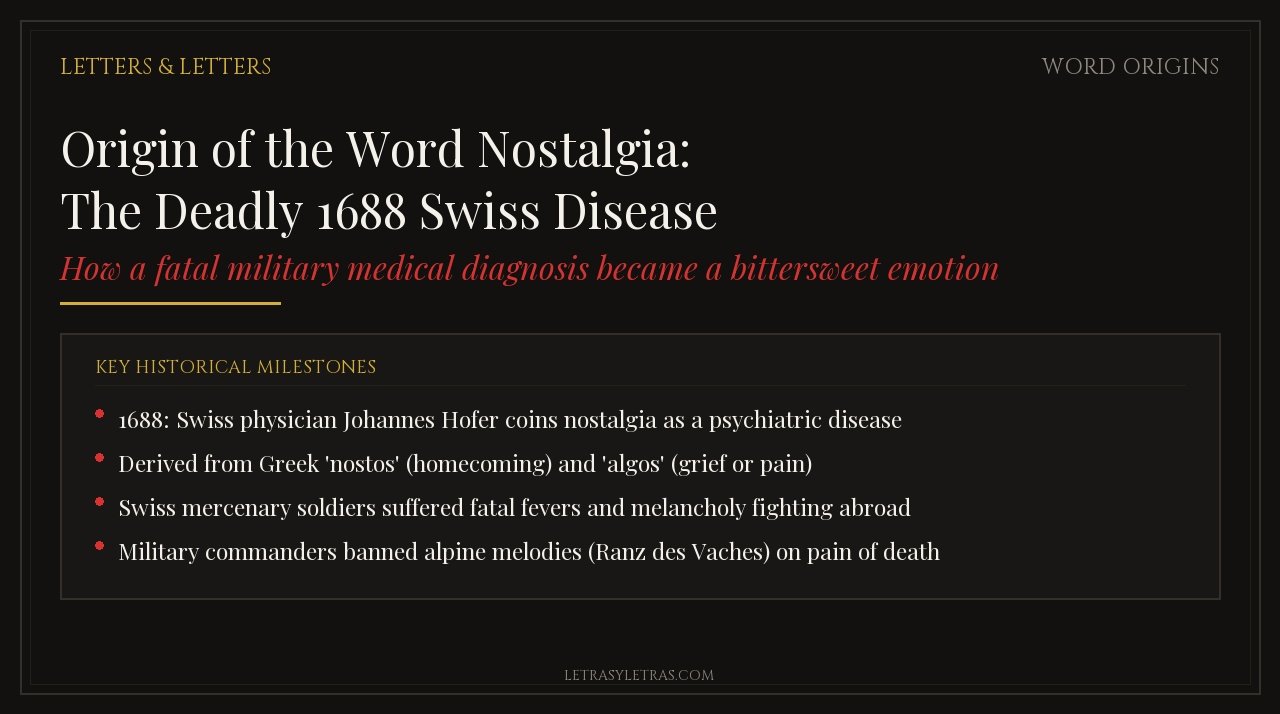
The word nostalgia was coined in 1688 by nineteen-year-old Swiss medical student Johannes Hofer in his doctoral thesis at the University of Basel. Hofer combined two classical Greek roots: nostos, meaning a return home or homecoming, and algos, meaning pain, grief, or physical distress. Rather than describing a sentimental mood, Hofer defined nostalgia as a severe cerebral disease affecting Swiss mercenary soldiers fighting in foreign lands. Symptoms included relentless weeping, unremitting fever, cardiac palpitations, severe emaciation, and death. For two centuries, European and American military physicians classified nostalgia as a major battlefield epidemic. The condition was thought to be triggered by hearing traditional Swiss alpine herding melodies, known as the Ranz des Vaches. Only during the early twentieth century did modern psychology redefine nostalgia from a deadly physical disease into a normal, healthy emotional experience.
Key Takeaways
- Swiss physician Johannes Hofer invented the medical term nostalgia in 1688.
- The word joins Greek nostos (homecoming) and algos (pain or ache).
- Early physicians treated nostalgia as a physical neurological disorder of the brain.
- Military commanders banned alpine songs because they triggered fatal illness.
- Twentieth-century psychologists transformed the clinical diagnosis into an emotion.
Basel 1688: A Young Doctor Names a Killer
To uncover the origin of the word nostalgia, we must travel to seventeenth-century Switzerland. In 1688, a brilliant young medical student named Johannes Hofer submitted his doctoral dissertation at the University of Basel.
Hofer was fascinated by a strange malady devastating young Swiss men sent abroad. Swiss soldiers were famous throughout Europe for their discipline and ferocity as mercenary fighters.
They served in the armies of France, Spain, and the Italian city-states. Yet far from their alpine valleys, many of these seasoned fighters collapsed into physical despair.
They stopped eating, ran burning fevers, and lay motionless in their barracks. Many died in military hospitals without showing wounds or obvious infections.
Swiss locals called this condition Heimweh, meaning homesickness. German speakers referred to it as das Heimweh, while the French called it la maladie du pays.
Hofer believed these folk terms were crude and unscientific. As an educated scholar, he wanted a formal medical diagnosis derived from classical antiquity.
Greek Roots: Nostos and Algos
Hofer turned to the ancient Greek tongue to construct his clinical term. He joined two evocative words that had never been combined before.
The first component was nostos, meaning a return home to native soil. This concept was central to Homer’s epic poem The Odyssey.
The entire Greek epic recounts Odysseus’s desperate, decade-long struggle to achieve his nostos to the island of Ithaca. For ancient Greeks, returning home was a sacred human triumph.
The second component was algos, meaning physical pain, sharp ache, or deep grief. We still recognize this root in modern medical terms like analgesic and neuralgia.
By combining these roots, Hofer coined nostalgia. Literally, it meant the physical agony caused by longing for home.
Records at the National Library of Medicine historical archives show Hofer’s dissertation spread rapidly. European universities translated the text. Physicians quickly adopted the term into clinical lexicons.
The Physiology of a Seventeenth-Century Disease
Modern readers might assume Hofer considered nostalgia an emotional problem. Nothing could be further from seventeenth-century medical reality.
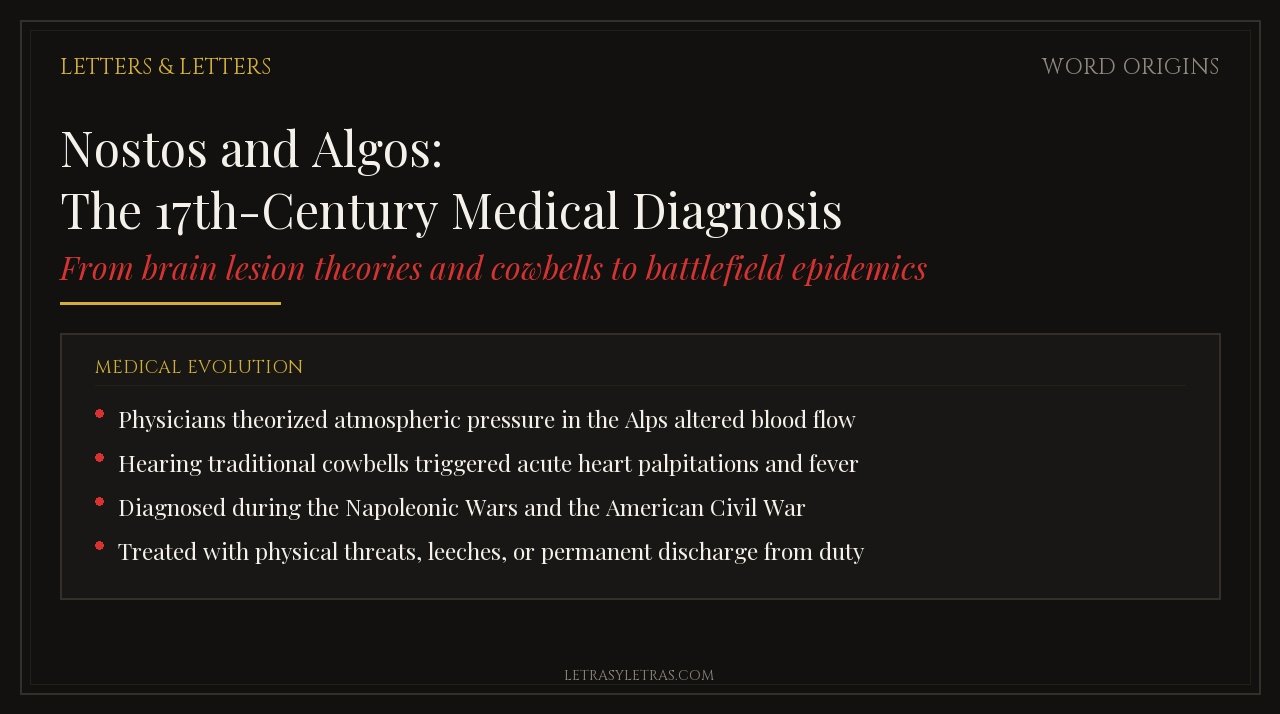
Medical science in 1688 still operated under mechanical and humoral theories of human anatomy. Hofer classified nostalgia as a physical neurological pathology of the human brain.
Hofer argued that homesick thoughts agitated middle brain fibers. This repeated mental vibration supposedly damaged delicate cerebral tissue.
The physical damage supposedly disrupted healthy blood circulation. The lungs became congested, heart rates surged erratically, and digestive organs shut down.
Other contemporary physicians offered alternative physical explanations. Some Swiss doctors claimed the high atmospheric pressure of low-altitude European plains crushed the delicate lungs of mountain dwellers.
Another theory blamed alpine cowbells. Doctors claimed constant ringing damaged ear canals. They believed this auditory trauma triggered nervous collapse abroad.
The Forbidden Song: Ranz des Vaches
The most famous chapter in the medical history of nostalgia involves music. Eighteenth-century military doctors discovered that certain sensory triggers could induce immediate, acute illness in vulnerable soldiers.
The most dangerous trigger was an ancient pastoral melody known as the Ranz des Vaches. Swiss cowherds sang this simple song to call their cattle from mountain pastures.
When Swiss mercenary regiments heard the horn melodies or vocal refrains of this rustic song, soldiers broke into uncontrollable sobs. Men collapsed to their knees in agony, unable to hold their muskets.
Within days, soldiers exposed to the song developed severe fevers and refused food. Entire companies were rendered unfit for combat operations.
The crisis became so severe that French and Swiss military commanders issued severe martial decrees. Performing the Ranz des Vaches on pipes, bugles, or voices was banned on pain of death.
Philosopher Jean-Jacques Rousseau discussed this phenomenon in his 1768 Dictionnaire de Musique. Rousseau noted that the song itself held no musical magic, but acted as a devastating mnemonic trigger of lost homes.
Battlefield Epidemics: From Napoleon to the Civil War
During the eighteenth and nineteenth centuries, nostalgia became a recognized military epidemic across western armies. Large conscript forces suffered catastrophic casualty numbers from homesickness.
During the Napoleonic Wars, French army surgeons reported thousands of soldiers incapacitated by acute nostalgia. Young recruits from rural provinces withered away in military hospitals across Spain and Russia.
Doctors attempted brutal treatments to cure the disorder. French surgeons subjected nostalgic soldiers to public humiliation, threats of execution, and painful blistering of the scalp.
The affliction proved widespread during the American Civil War. Documents in the Library of Congress military medical records list over 5,200 clinical cases among Union troops.
At least seventy-four Union soldiers died with nostalgia listed as the direct cause of death. Military surgeons noted that young farm boys from rural counties were particularly susceptible to fatal melancholy.
Civil War doctors prescribed vigorous physical exercise, harsh discipline, and bullying to shame victims. Yet surgeons admitted that only one reliable cure existed: granting the soldier an honorable furlough home.
The Great Semantic Shift: From Disease to Emotion
How did a fatal medical pathology transform into a cozy sentimental feeling? Linguists and cultural historians track this massive semantic shift across the late nineteenth and early twentieth centuries.
Like the origin of the word gossip, this evolution reflected changing social attitudes toward mental health.
The first major catalyst was the rise of germ theory in the late 1800s. As Louis Pasteur and Robert Koch proved that bacteria caused fevers, doctors stopped blaming mental longing for physical disease.
Soldiers who died in nineteenth-century hospitals were actually succumbing to typhus, dysentery, tuberculosis, or severe clinical depression. Nostalgia was gradually stripped of its pathological status.
The second catalyst was global urbanization and rapid technological change. As millions of people moved from rural farmlands to noisy industrial cities, longing for the past became a universal experience.
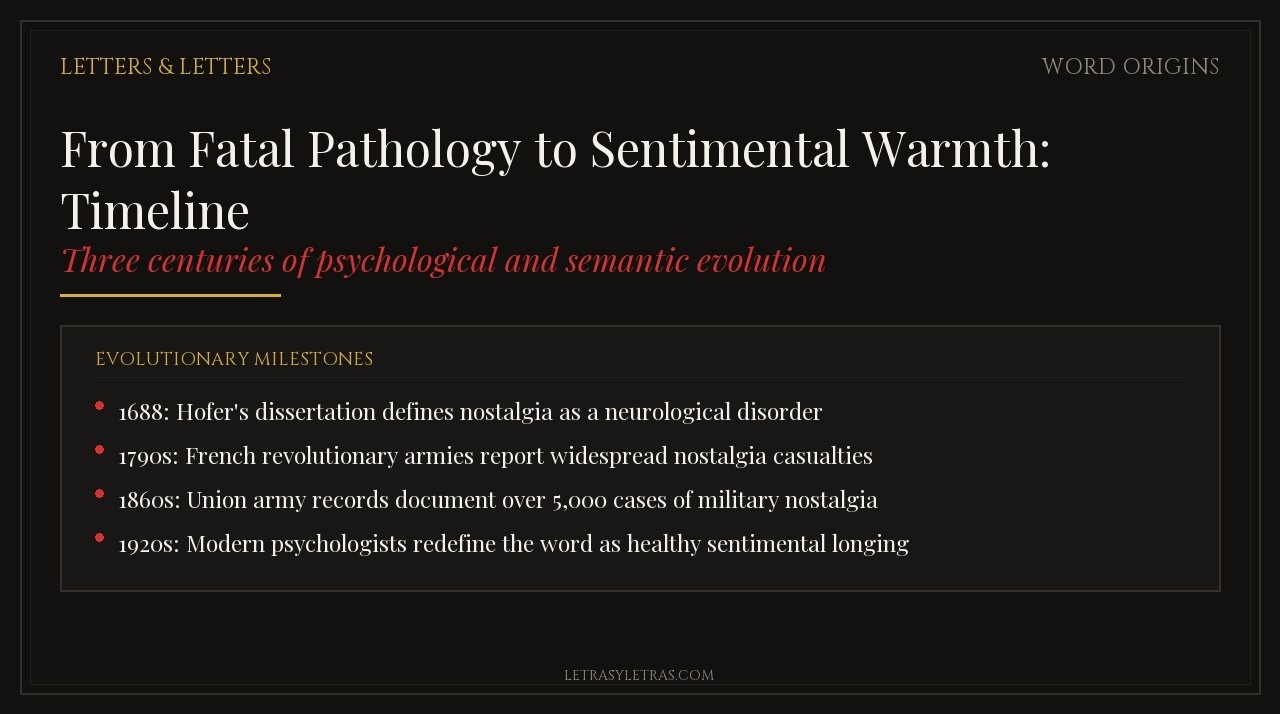
Citations in the Oxford English Dictionary etymological entries highlight this transition. By the 1920s, writers used nostalgia to describe longing for past eras.
By the mid-twentieth century, nostalgia completed its transition. It left clinical pathology behind to become a familiar, universal emotion.
| Time Period | Primary Context | Dominant Definition | Key Historical Milestones |
|---|---|---|---|
| 1688 | University of Basel | Fatal neurological brain disorder. | Johannes Hofer coins the term in his medical thesis. |
| 1700s | European Armies | Physical epidemic among Swiss mercenaries. | Commanders ban Ranz des Vaches under penalty of execution. |
| 1860s | American Civil War | Debilitating military illness. | Union army documents 5,200 cases and 74 direct fatalities. |
| 1890s | Modern Medicine | Psychological melancholia or homesickness. | Germ theory displaces nostalgia as a cause of physical fever. |
| 1920s to Present | Everyday English | Bittersweet sentimental longing for the past. | Psychology confirms nostalgia strengthens identity and social bonds. |
Modern Psychology: The Healing Power of Nostalgia
Today, psychological science views nostalgia in a completely different light. Far from being a deadly affliction, nostalgia is now recognized as a healthy psychological resource.
Research cited in Encyclopaedia Britannica psychological history entries confirms nostalgia lifts mood. Reflecting on warm memories combats loneliness and strengthens emotional resilience.
When individuals face periods of rapid transition, uncertainty, or personal distress, nostalgia serves as an emotional stabilizer. It reminds people of their enduring identities and meaningful connections to loved ones.
Rather than freezing people in the past, healthy nostalgia helps individuals step forward with renewed confidence and inner strength.
Like the origin of the word silhouette, this history shows how society reshapes language for modern emotional needs.
Frequently Asked Questions
What does the word nostalgia mean in Greek?
Nostalgia derives from two Greek roots: nostos (homecoming) and algos (pain or ache). Together, they literally signify the agony of longing for home.
Who coined the word nostalgia?
Nineteen-year-old Swiss medical student Johannes Hofer coined the word in 1688 in his doctoral dissertation at the University of Basel. He invented the term to describe a severe medical condition affecting Swiss mercenary soldiers.
Why was nostalgia considered a disease?
Seventeenth-century physicians believed intense homesickness damaged brain tissue and disrupted blood circulation. Doctors observed soldiers suffering genuine physical symptoms, including fever, heart palpitations, and extreme wasting.
What song was banned because of nostalgia?
Military commanders banned the Swiss pastoral cow-calling melody Ranz des Vaches. Playing or singing the song provoked severe emotional collapse and debilitating illness among Swiss soldiers stationed abroad.
How did nostalgia become an emotion?
During the late nineteenth century, germ theory proved that physical fevers were caused by microbes rather than mental longing. Over the twentieth century, writers and psychologists repurposed the word to describe sentimental fondness for past times.


Alan Sledge is the writer and founder behind Letters & Letters. A lifelong lover of words, Alan has always been drawn to the small mysteries hidden in everyday language, why we say what we say, where our favorite sayings came from and the quotes that manage to put feelings into words better than we ever could ourselves.