
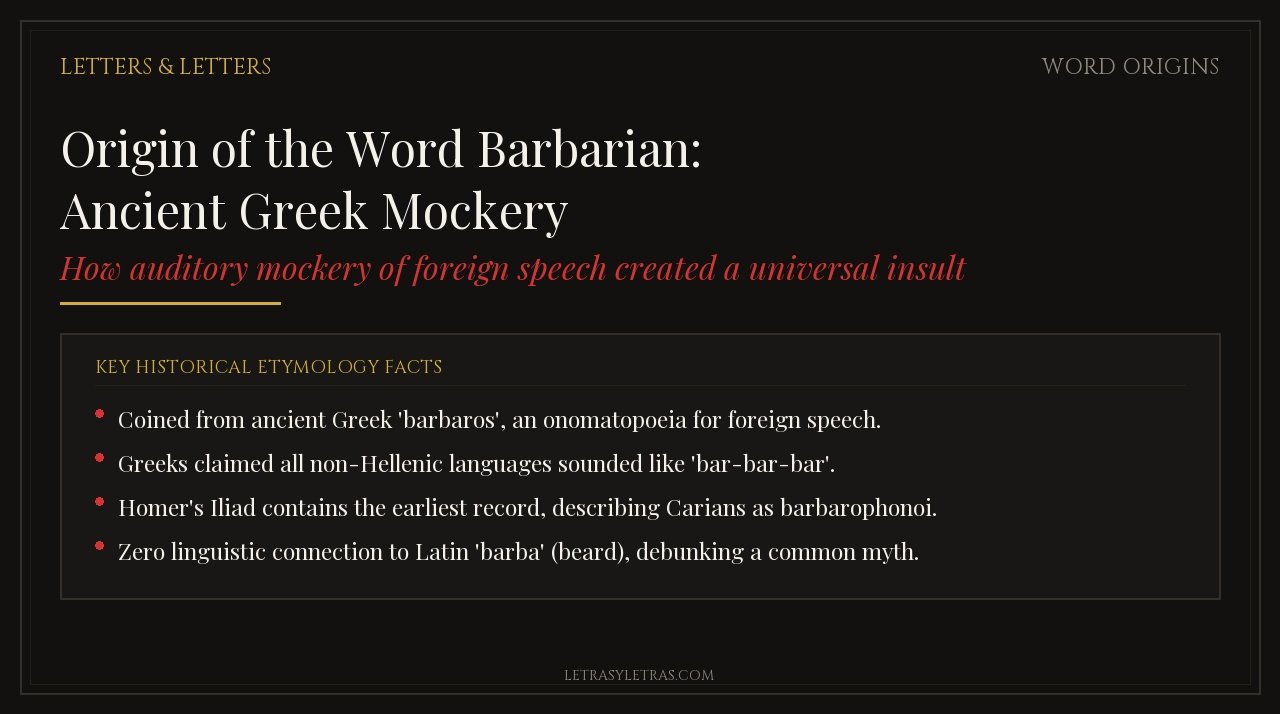
When you hear the word barbarian today, vivid pictures fill your imagination. You likely picture horned helmets, screaming hordes, and sacked ancient cities.
Modern movies portray barbarians as violent savages devoid of culture. We use the term to describe ruthless behavior or unprovoked cruelty. Yet the origin of the word barbarian has nothing to do with violence.
The label began as ancient playground mockery. It was an auditory insult directed at unfamiliar foreign accents. As an essayist studying classical linguistics at Alan Sledge, I find this linguistic transformation striking.
Quick Answer: What Is the Origin of the Word Barbarian?
The word barbarian originated in ancient Greece from the Greek word barbaros. It was an onomatopoeic word imitating how foreign languages sounded to Greek ears as repetitive syllables like bar-bar-bar. Over centuries, Roman conquerors and medieval writers transformed this linguistic mockery into a universal label for uncivilized cruelty.
Key Takeaways
- Barbarian began as Greek auditory mimicry of foreign languages.
- The phrase has zero etymological link to Latin barba or facial hair.
- Homer first recorded the root around 750 BCE in the Iliad.
- The Persian Wars shifted the term from language to cultural arrogance.
- Romans adopted the insult to brand all outsiders beyond imperial frontiers.
The Greek Playground: Mimicking Foreign Tongues
To trace the authentic history, we must travel to Archaic Greece around the eighth century BCE. Ancient Greeks were surrounded by diverse Mediterranean civilizations.
They traded with Phoenicians, Egyptians, Thracians, and Persians. Greek sailors encountered dozens of regional dialects across maritime trade routes. Hellenic culture held its own language in immense esteem.
When Greeks heard foreign traders speak, the unfamiliar phonetics sounded like repetitive babble. They reduced foreign speech to repetitive syllables like bar-bar-bar.
From that phonetic mimicry came the Greek adjective barbaros. The word meant someone who stammers, babbles, or speaks an unintelligible tongue. English words like babble share an identical onomatopoeic root.
In its earliest usage, the word carried little moral condemnation. It merely noted a linguistic barrier between trading partners. If you did not speak Greek, you were simply a babbler.
Homer and the Earliest Written Evidence
The oldest documented appearance of the root survives in Homer’s epic poem, the Iliad. Composed around 750 BCE, the text describes the legendary Trojan War.
In Book Two, Homer cataloged the Trojan allies who assembled before Ilium. He described the Carians of southwestern Asia Minor as barbarophonoi. The compound joins barbaros with phone, meaning voice or speech.
Classical texts archived in the Perseus Digital Library at Tufts University confirm this translation. Homer used the term descriptively. He meant the Carians spoke a harsh, foreign dialect.
Homer never insulted Carian morals or battlefield courage. He described their golden armor with great poetic admiration. The designation remained strictly linguistic.
Early Hellenic travelers used the label without hatred. It served as a geographic marker for non-Greek communities. Nobody considered foreign speech a crime.
Herodotus and the Egyptian Counterpart
As Greek maritime trade flourished, historians began documenting foreign civilizations with intense curiosity. Herodotus of Halicarnassus traveled across Egypt, Persia, and Scythia during the fifth century BCE.
In his second book of Histories, Herodotus made a surprising observation about Egyptian culture. He noted that Egyptians applied an identical linguistic standard to outsiders.
Egyptians called anyone who did not speak Egyptian a barbarian. To Egyptian scribes, Greek merchants babbler nonsense. Cultural snobbery was a two-way street.
Herodotus admired Egyptian antiquity, architecture, and religious traditions. He recorded their customs with scrupulous fairness. His writings prove that early Greek thinkers respected foreign achievements.
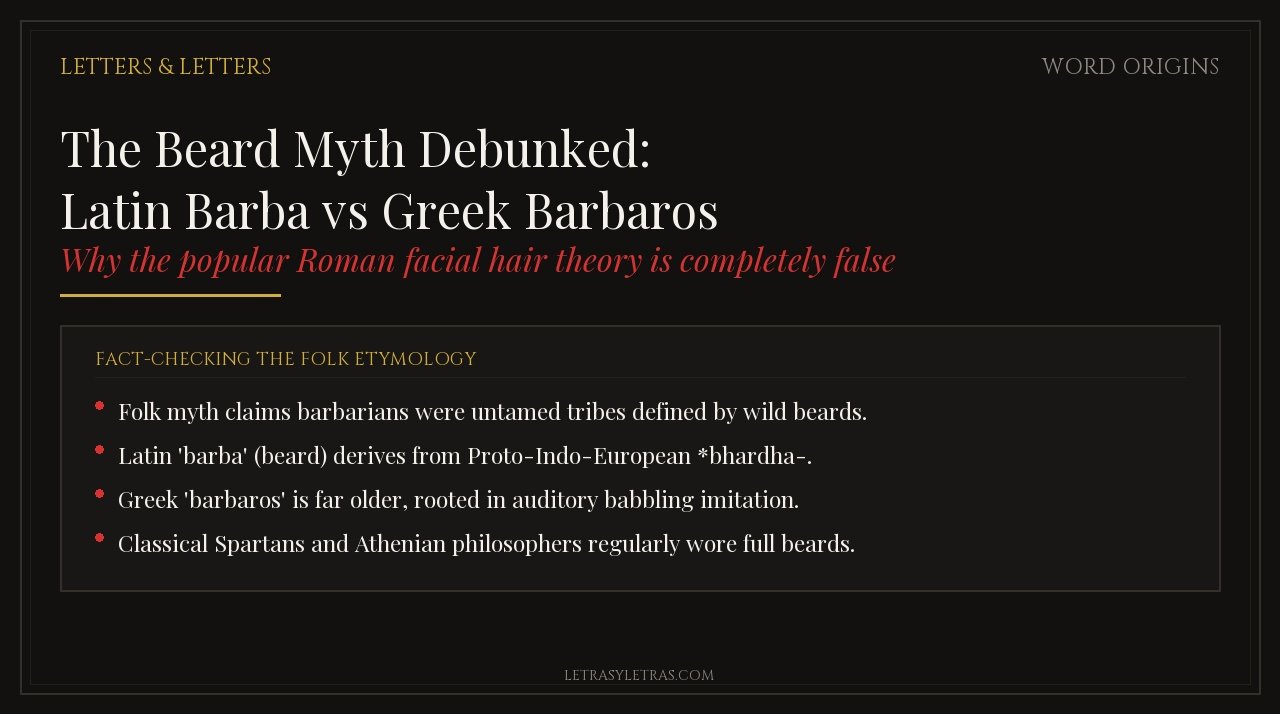
Debunking the widespread folk myth connecting barbarian to Latin facial hair.
Debunking the Famous Roman Beard Myth
Many modern readers assume barbarian comes from the Latin word for beard, barba. Tour guides often repeat this colorful tale in historic European ruins.
The myth claims clean-shaven Roman legionaries called wild northern tribesmen barbarians because of their unkempt facial hair. While the story sounds logical, it is completely false.
Historical linguists trace Latin barba to the Proto-Indo-European root *bhardha-. That root gave English words like beard. Greek barbaros has an entirely distinct linguistic heritage.
Greek onomatopoeia existed centuries before Romans fought Germanic tribes. In addition, classical Greek heroes and Athenian philosophers proudly wore full beards. Shaving was not even customary in early Greece.
Confusing the two words is a classic folk etymology. The similarity in sound between barba and barbaros is purely coincidental. Facial hair played no part in naming barbarians.
Sanskrit and Global Babble Cognates
Linguistic mimicry of stammering speech is not unique to ancient Greece. Comparative philologists discover parallel onomatopoeic words across Indo-European tongues.
In ancient Sanskrit texts, scholars find the adjective barbara. Ancient Indian grammarians used the term to denote stammering, stuttering, or non-Aryan speech. The Vedic root mimics identical repetitive sounds.
Latin developed the adjective balbus, meaning someone who stutters or speaks haltingly. The Roman family name Balbus derived directly from this speech impediment.
These global cognates reveal a universal human tendency. Ancient communities across continents mocked unfamiliar tongues as childish babble. The human ear rejected sounds it could not organize.
The Persian Wars: How Politics Corrupted the Word
If barbarian began as a neutral linguistic label, what turned it into a weapon? The turning point arrived with the fifth-century BCE Greco-Persian Wars.
In 480 BCE, King Xerxes led an enormous Persian invasion into mainland Greece. City-states like Athens and Sparta put aside bitter rivalries to defend their independence.
Against formidable odds, the allied Greek navies defeated the Persians at Salamis and Plataea. That unexpected victory generated fierce cultural pride across Greek city-states.
Athenian playwrights like Aeschylus began portraying Persians as emotional, luxurious, and tyrannical. In works like The Persians, the word barbaros gained sharp political venom.
Greeks began equating Hellenic language with reason, democracy, and self-restraint. Non-Greeks were framed as naturally servile and culturally inferior.
Philosopher Aristotle codified this prejudice in his Politics. He claimed non-Greeks were slaves by nature. A linguistic observation had hardened into cultural supremacy.
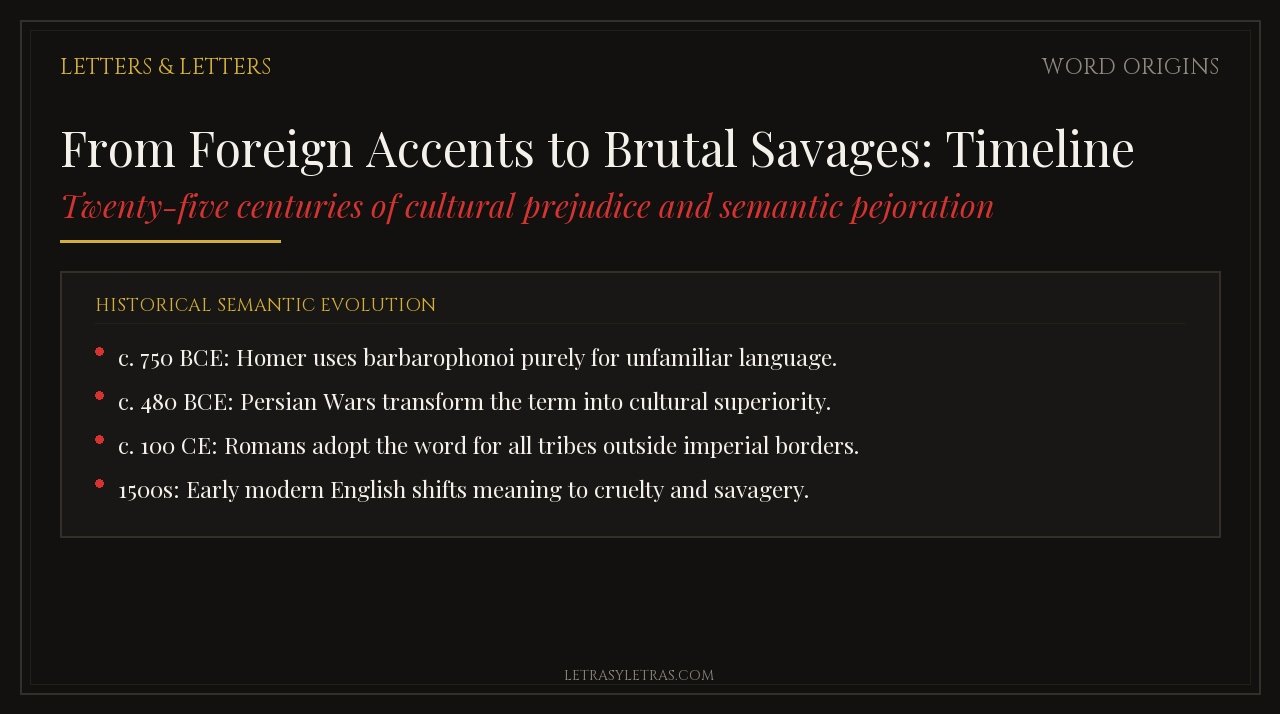
The evolutionary timeline tracing barbarian across twenty-five centuries of history.
The Roman Frontier: Drawing Lines in the Sand
When the Roman Republic expanded across the Mediterranean, it absorbed Greek literature and philosophy. Romans adopted the Greek term, transliterating it into Latin as barbarus.
At first, Greeks considered the Romans themselves to be barbarians. Romans spoke Latin rather than Greek. Educated Roman aristocrats worked hard to overcome that stigma.
Romans mastered Greek rhetoric and philosophy. Roman writers then redefined the boundary between civilization and barbarism.
In the Roman mind, civilized society meant living under Roman law, paying taxes, and inhabiting stone cities. Anyone beyond the imperial frontier fortifications was branded a barbarian.
Roman historians applied the label to Celtic tribes in Gaul and Germanic warriors along the Rhine. The term described people who resisted Roman imperial order.
Much like our examination of the origin of the word villain, an innocent descriptive label became an aristocratic insult. Political power decided who was refined and who was crude.
The Germanic Migrations and the Fall of Rome
During the late imperial period, the relationship between Romans and barbarians grew complex. Millions of Germanic warriors enlisted in Roman legions as federated troops.
Germanic generals attained senior military rank in Italy and Gaul. Many spoke fluent Latin and converted to Christianity. Yet traditional Roman aristocrats continued viewing them with suspicion.
In 410 CE, Visigoth leader Alaric sacked the city of Rome. The traumatic event shocked the ancient Mediterranean world. Roman elites viewed the sack as the triumph of savagery over civilization.
Christian scholar Saint Jerome wept in his monastic cell in Bethlehem. He lamented that the city which conquered the world was now conquered by barbarians.
Writings from this era fixed the word barbarian to physical ruin. It became synonymous with the destruction of libraries, aqueducts, and legal courts.
From Latin to English: The Shift Toward Savagery
The collapse of the Western Roman Empire solidified the word’s negative connotations. During the Middle Ages, European chroniclers used the term for pagan invaders.
Viking raiders and Mongol armies were routinely labeled barbarians by monastic scribes. The word became linked with anti-Christian hostility and violence.
By the time the word entered Middle English during the fourteenth century via Old French barbare, its definition had darkened. It no longer meant an unfamiliar accent.
As documented in the Online Etymology Dictionary, English writers used barbarian for wild, uncultivated persons. By the sixteenth century, the term implied physical savagery and cruelty.
Elizabethan dramatists used the adjective to describe bloodthirsty tyrants. The linguistic joke about babbling speech had transformed into an indictment of human character.
Chronological Timeline of the Word Barbarian
To grasp the complete evolution of the term, we can trace key historical milestones. The table below outlines how twenty-five centuries altered its definition.
| Historical Era | Key Source / Milestone | Dominant Meaning |
|---|---|---|
| c. 750 BCE | Homer’s Iliad (barbarophonoi) | Speaking an unfamiliar, foreign dialect. |
| c. 480 BCE | Greco-Persian Wars and Athenian Drama | Cultural and political inferiority to Greek democracy. |
| c. 100 BCE | Roman Republic Imperial Expansion | Tribes living outside Roman law and stone cities. |
| 410 CE | Visigoth Sack of Rome under Alaric | Destruction of classical urban civilization. |
| c. 1380 CE | Middle English Literature via Old French | A foreigner devoid of Christian European customs. |
| 1600s to Present | Early Modern English Literature | A brutal, uncultured, or merciless individual. |
The Psychology of Linguistic Othering
The evolutionary path of barbarian illustrates a common psychological pattern known as linguistic othering. Humans naturally distrust sounds they cannot immediately decipher.
When unfamiliar speech sounds chaotic, people assume the speaker lacks sophisticated thought. Similar patterns appear across global history.
For example, Slavic peoples called their Germanic neighbors Nemtsy, derived from nemy, meaning mute. Because Germans could not speak Slavic tongues, Slavs described them as unable to speak.
Language frequently builds walls before armies march. Just as in our study of the origin of the word scapegoat, societies project anxieties onto outsiders.
Studying the true etymology reminds us that words often conceal historical arrogance. What started as ear fatigue among Greek sailors ended as a justification for empire.
Modern Usage and Ethical Nuance
Today, the word barbarian survives in historical studies, fantasy literature, and everyday speech. We speak of barbaric acts when condemning horrific violence.
Historians and anthropologists urge caution when applying the term to ancient cultures. Archaeological discoveries show that so-called barbarian tribes possessed sophisticated metalwork, trade networks, and oral laws.
Celtic goldsmiths created jewelry that rivaled Roman artisans. Germanic legal codes emphasized restitution rather than physical execution.
Calling these peoples uncivilized reflects ancient Roman propaganda rather than historical reality. As scholars note in Oxford Reference historical publications, history is written by the literate conqueror.
Remembering the term’s origin helps us question historical labels. It reminds us that every empire views foreign neighbors as clumsy babblers.
Frequently Asked Questions
Did the word barbarian originally mean bearded?
No, the word has no connection to facial hair. Latin for beard is barba, but Greek barbaros is an older onomatopoeia mimicking foreign speech. Classical Greek thinkers wore beards proudly.
Who first coined the word barbarian?
Ancient Greek speakers coined the term during the Archaic period. The earliest written record appears in Homer’s Iliad around 750 BCE. Homer referred to Carians as barbarophonoi.
What does barbaros literally mean in Greek?
The word literally imitates the sound of foreign babble, like bar-bar-bar. It originally described anyone who did not speak the Greek language.
Why did Romans call northern tribes barbarians?
Romans borrowed the word from Greece to label anyone outside Roman law and imperial borders. The term justified military conquests and imperial expansion.
How did barbarian come to mean violent?
After migrating tribes sacked Roman cities in the fifth century, Christian writers equated outsiders with destruction. By the Renaissance, English writers used the word to describe savagery.
Alan Sledge is the lead writer at letrasyletras.com. He uncovers the authentic histories behind our favorite words and sayings.


Alan Sledge is the writer and founder behind Letters & Letters. A lifelong lover of words, Alan has always been drawn to the small mysteries hidden in everyday language, why we say what we say, where our favorite sayings came from and the quotes that manage to put feelings into words better than we ever could ourselves.