
Have you ever reached the absolute limit of your endurance on a difficult project? You probably admitted defeat and threw in the towel.
Today, the idiom is universally recognized across workplaces, athletic arenas, and everyday conversations. We use it when admitting defeat or abandoning an impossible struggle. Yet the phrase originated in bloody nineteenth-century prize fights.
Throwing a piece of cloth into the dirt was once a matter of life and death. As an essayist investigating historical idioms at Alan Sledge, I find this athletic ritual fascinating. Our guide to english idioms and meanings documents how ring combat permanently shaped our language.
Quick Answer: What Is the Origin of the Phrase Throw in the Towel?
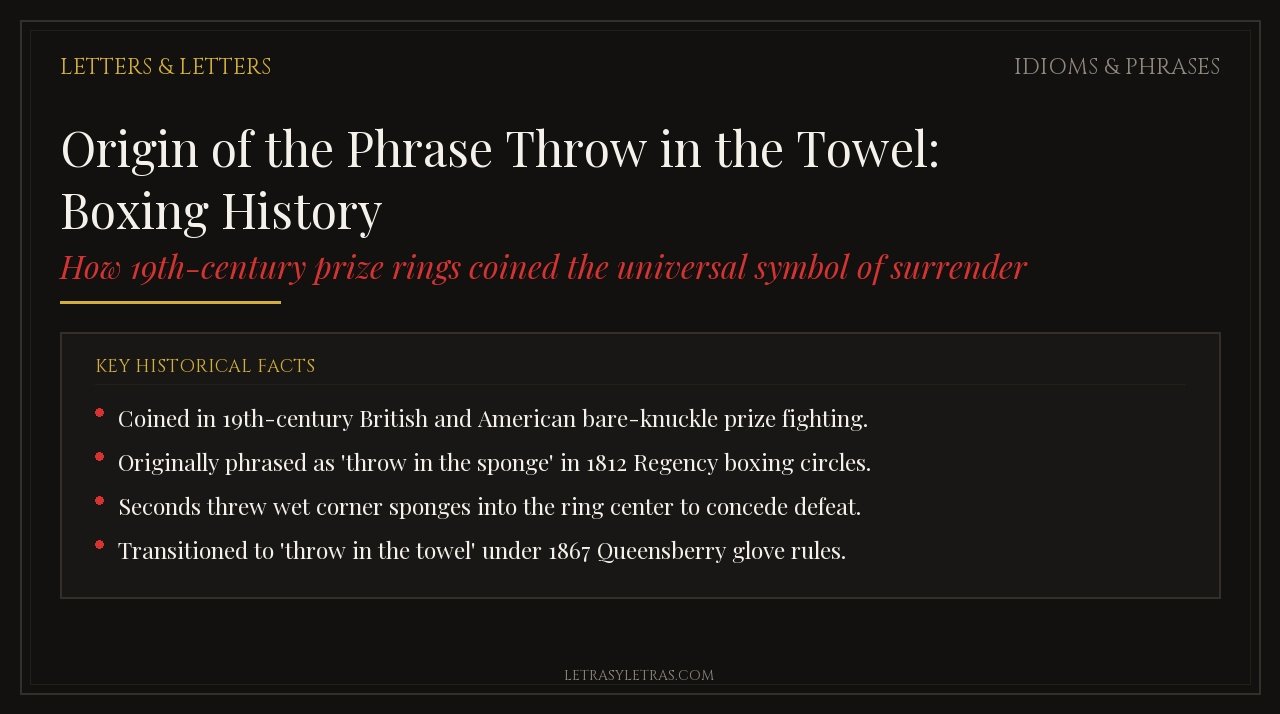
The phrase throw in the towel originated in nineteenth-century bare-knuckle prize fighting. Corner seconds threw a wet sponge into the ring center to concede defeat when a boxer was severely battered. When Victorian boxing adopted padded gloves in the late 1800s, towels replaced sponges in corner ringside equipment.
Key Takeaways
- Originated in 19th-century British and American bare-knuckle boxing.
- The original idiom was ‘throw in the sponge’, first recorded in 1812.
- Corner seconds used sponges to clean blood and revive injured fighters.
- Heaving the sponge into the ring center officially stopped the bout.
- By the 1890s, towels replaced sponges in corner ringside equipment.
The London Prize Ring: Brutal Bare-Knuckle Combat
To discover the authentic origin of the phrase throw in the towel, we must visit Regency England. In the early 1800s, boxing was vastly different from modern Olympic sport.
Men fought without padded leather gloves or timed three-minute rounds. Bouts were governed by Broughton’s Rules of 1743 and later the London Prize Ring Rules of 1838. Fights took place on grass turf inside a wooden staked ring.
Rounds did not end according to a bell or stopwatch. A round concluded only when one combatant was knocked down or thrown to the earth. Contests regularly lasted fifty, seventy, or over one hundred rounds.
Fighters traded ferocious blows until one man collapsed from sheer exhaustion or severe concussion. The sport was illegal yet wildly popular among aristocrats and working-class gamblers.
Because fighters risked fatal skull fractures, corner personnel carried heavy responsibility. Each pugilist was attended by two trusted men known as seconds.
Jack Broughton and the Birth of Boxing Rules
Before the mid-eighteenth century, English prize fighting was virtually lawless. Combatants gouged eyes, bit fingers, and struck downed opponents with heavy boots.
The turning point arrived in 1741 when champion Jack Broughton faced challenger George Stevenson. Broughton struck Stevenson with a devastating body blow that proved fatal days later.
Devastated by his rival’s death, Broughton drafted the first written code of boxing in 1743. His seven rules prohibited striking a downed man and outlawed eye-gouging.
Broughton also formalized the position of seconds and ring umpires. He sought to transform brutal brawls into structured sporting exhibitions.
His regulations established that only corner handlers had authority to surrender on a fighter’s behalf. That legal principle laid the foundation for ringside surrenders.
The Heavy Duties of the Ringside Second
Seconds were experienced veteran pugilists who coached, advised, and physically cared for the active fighter. Between grueling rounds, seconds had exactly thirty seconds to revive their battered man.
They washed swelling eyes with cold river water and cleaned blood from nostrils and mouths. Their primary tool was a large natural sea sponge kept in a wooden bucket.
The second used the wet sponge to squeeze cold water over the fighter’s neck and temples. Cold water shocked the nervous system and cleared blurred vision.
When the thirty-second rest elapsed, the referee called time. The fighter had eight additional seconds to march unassisted to the center of the ring.
In the ring center lay a line scratched into the dirt. Reaching that line was called coming up to scratch in boxing parlance. If a man failed to reach the scratch line, he lost the bout.
From Sponges to Dirt: The First Surrender Ritual
During brutal slugfests, fighters often suffered severe facial swelling, broken ribs, and neurological trauma. A proud pugilist rarely admitted personal defeat in front of screaming spectators.
The fighter often wanted to continue swinging blindly despite losing consciousness on his feet. Trainers had to intervene to save comrades from permanent brain injury or death.
To stop the slaughter, the second made an unmistakable physical gesture. He snatched the water-soaked sponge from the bucket and hurled it high into the center of the ring.
Throwing the sponge between the two men broke the combat. The referee saw the sponge splash into the dust and immediately declared the contest over.
Sporting chronicler Pierce Egan documented this exact practice in his famous 1812 history Boxiana. Egan recorded that a corner threw up the sponge to preserve a defeated champion.
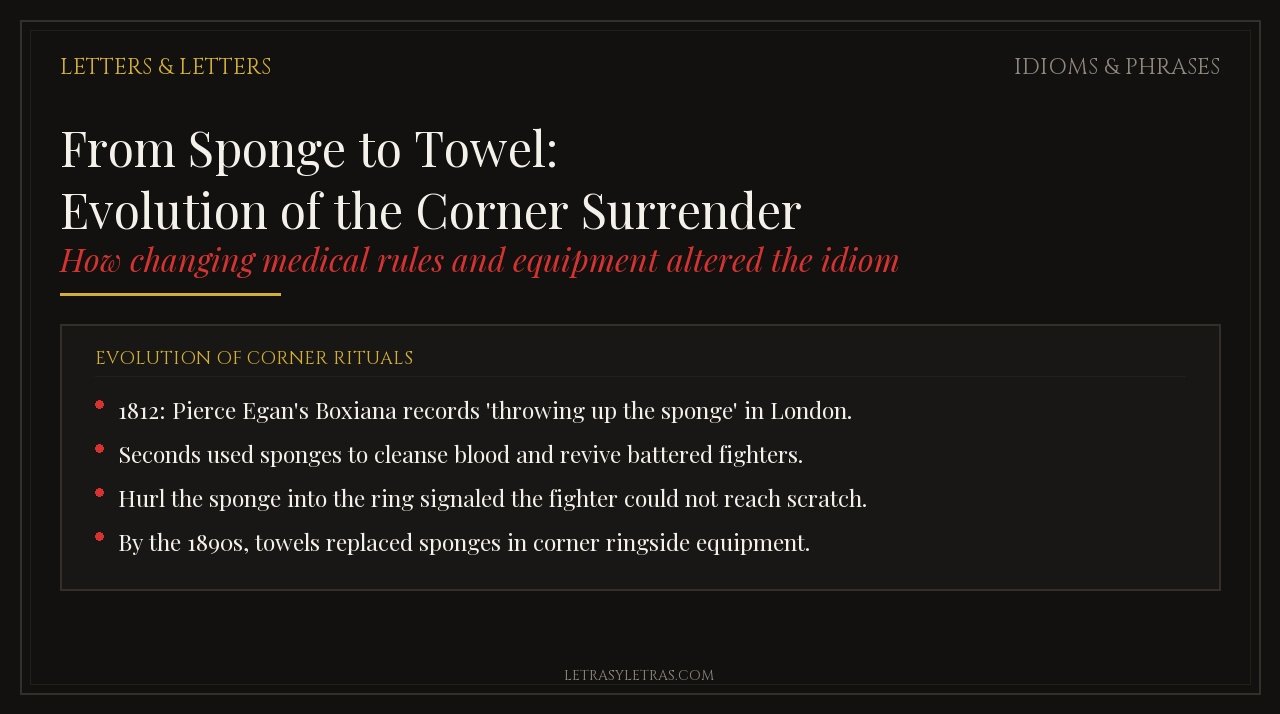
The evolution of corner surrender rituals from Regency sponges to modern towels.
The 1860 Championship: Sayers Versus Heenan
The dramatic power of the ringside surrender was demonstrated during the historic 1860 world championship bout. English champion Tom Sayers fought American challenger John Carmel Heenan in Hampshire.
The match lasted forty-two ferocious rounds over two hours and twenty minutes. Sayers suffered a fractured right arm early in the bout, fighting thirty rounds using only his left fist.
Heenan suffered immense facial swelling that closed both eyes completely. Spectators watched in horror as both men bled into the turf.
When police arrived to break up the illegal spectacle, chaos erupted around the ring ropes. A corner second threw a sponge into the center, but partisans threw it back out.
The controversial draw dominated international headlines for months across London and New York. This brutal contest proved that clear, unquestioned surrender signals were vital for athlete safety.
The Marquess of Queensberry and the Transition to Towels
Why did everyday English trade sponges for towels? The answer lies in the dramatic modernization of boxing during the late Victorian era.
Bare-knuckle prize fighting faced intense police crackdowns and moral outrage. Fatalities in clandestine matches provoked public condemnation across Britain and America.
In 1867, John Graham Chambers drafted historic new sporting regulations under the patronage of the Marquess of Queensberry. These rules mandated padded leather gloves, timed three-minute rounds, and raised canvas ring platforms.
The Queensberry reforms transformed the corner kit. Along with buckets and ice, seconds carried heavy cotton towels. They dried sweat from arms and wiped greasy canvas floors.
Seconds used towels to fan fresh air into exhausted lungs during one-minute rest intervals. The towel became the most visible piece of cloth in the corner.
When a fighter took excessive punishment against the ropes, the second threw the towel over the ropes. The towel was larger, fluttered dramatically in the air, and caught the referee’s attention instantly.
Earliest Documented Print Appearances
For several decades, both expressions circulated side by side in sporting gazettes. British journalists tended to favor the traditional sponge, while American and Australian writers embraced the towel.
Archival sporting records cataloged at the British Library newspaper collections show the gradual linguistic shift. By the 1880s, Australian sporting papers frequently referenced throwing in the towel.
In 1893, an Australian news account described a championship bout where the trainer threw the towel into the ring. The American press adopted the phrase with immense enthusiasm during the 1890s.
In 1902, the Fort Wayne Sentinel in Indiana described a political candidate who threw in the towel after election losses. The phrase had broken out of the sporting arena into general civic discourse.
Historical archives at the Library of Congress chronicling America records document hundreds of political uses by 1915. The idiom had become a permanent part of American slang.
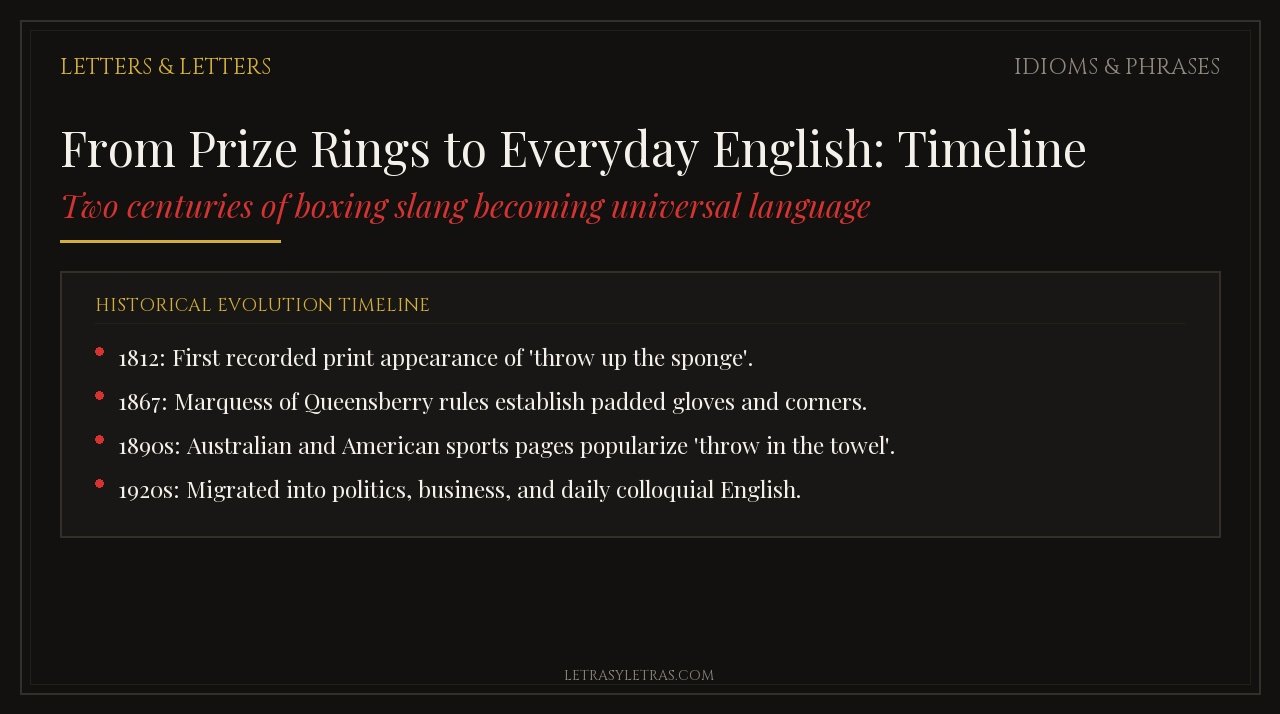
The two-century timeline tracing the phrase from London prize rings to daily speech.
Chronological Timeline of the Surrender Idiom
To trace how the physical action became our universal idiom, we can examine historical milestones. The table below outlines two centuries of linguistic evolution.
| Year | Historical Source | Milestone and Context |
|---|---|---|
| 1743 | Broughton’s Rules of the Ring | First written rules assigning corner seconds exclusive surrender authority. |
| 1812 | Pierce Egan’s Boxiana | First recorded print usage of throwing up the sponge in London. |
| 1860 | Sayers vs Heenan World Championship | Famous bare-knuckle match where corner surrender sparked international debate. |
| 1867 | Marquess of Queensberry Rules | Introduction of padded gloves and cotton towels into ringside corners. |
| 1893 | Australian Sporting Press | Earliest verified print appearances of throwing in the towel. |
| 1915 to Present | American Business and Political Press | Complete migration into general English as an idiom for surrender. |
Debunking Common Myths About the Phrase
Because the idiom is so widespread, folklore often invents colorful backstories. Popular culture sometimes attributes the phrase to Roman baths or medieval surrenders.
One common myth claims Roman bathhouse attendants threw towels onto hot stones to signal closing time. Roman bathers used strigils to scrape oil, not terrycloth towels. The story is anachronistic fantasy.
Another myth connects the phrase to medieval kitchen maids throwing cleaning towels down in frustration. Domestic records show no evidence for this usage before the boxing era.
As linguistic historians at Oxford Reference historical publications confirm, the idiom is exclusively pugilistic. It belongs entirely to the history of prize fighting.
Like our study of the origin of the phrase barking up the wrong tree, prize fights enriched language. Combat gave English unforgettable metaphors.
The Family of Boxing Metaphors in English
Throwing in the towel is part of a rich family of boxing idioms. English speakers use pugilistic phrases daily without realizing their origins.
When someone forces you to face reality, you toe the scratch. That saying comes from the chalk line drawn on the tavern floor.
When you take unfair advantage of a rival, you hit below the belt. That idiom reflects Broughton’s 1743 rule banning strikes below the waistband.
When someone recovers from near failure, they are saved by the bell. Pugilism provided our language with vivid expressions for physical and moral stamina.
The Psychology of Knowing When to Quit
Throwing in the towel carries profound psychological resonance. In popular culture, quitting is often branded as moral failure or cowardice.
Yet in the prize ring, throwing in the towel was an act of profound mercy and intelligence. It was the second’s duty to protect a courageous fighter from pointless destruction.
Continuing to absorb skull-rattling punishment when victory is impossible is not bravery. Reckless vanity ends athletic careers prematurely.
In modern life, recognizing an unproductive endeavor is an essential skill. When market conditions collapse or projects fail, persisting blindly creates catastrophic waste.
Much like our study of the origin of the phrase bite the bullet, endurance must be paired with realism. True courage includes knowing when to save your strength for another battle.
Frequently Asked Questions
What is the difference between throwing in the towel and throwing in the sponge?
Both expressions mean conceding defeat. Throwing in the sponge is the older nineteenth-century phrase from bare-knuckle boxing. The towel variant emerged in the 1890s when gloves became universal.
Who first coined the phrase throw in the towel?
The phrase evolved naturally among boxing seconds and sporting journalists during the late nineteenth century. Early print appearances date to the 1890s in Australian and American sporting newspapers.
Can a boxer throw in the towel himself?
In modern boxing regulations, only the corner trainer or chief second can throw the towel into the ring. The referee can ignore the towel, but almost always stops the match to protect the fighter.
Why did boxing seconds use sponges instead of towels?
In the early 1800s, fighters suffered open cuts and eye swelling on bare knuckles. Large sea sponges held immense water, making them well suited for washing wounds and reviving dazed fighters quickly.
Is throwing in the towel considered a legal surrender in modern boxing?
Yes, tossing a towel onto the canvas notifies the referee that the corner is stopping the bout. The referee officially rules the contest a technical knockout in favor of the opponent.
Alan Sledge is the lead writer at letrasyletras.com. He uncovers the authentic histories behind our favorite words and sayings.


Alan Sledge is the writer and founder behind Letters & Letters. A lifelong lover of words, Alan has always been drawn to the small mysteries hidden in everyday language, why we say what we say, where our favorite sayings came from and the quotes that manage to put feelings into words better than we ever could ourselves.