
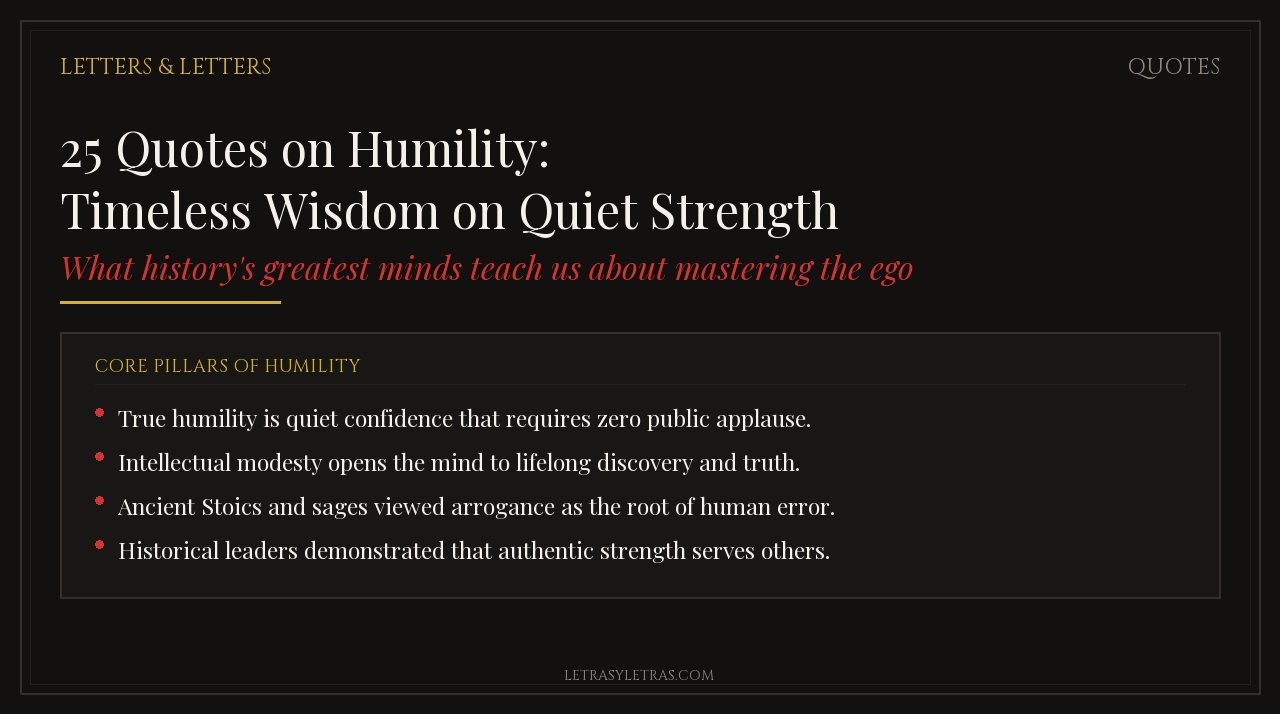
We live in a culture that constantly demands self-promotion. Social platforms reward relentless boasting, loud self-assertion, and manufactured certainty.
Yet the most formidable figures in human history chose the opposite path. They recognized that loud pride conceals fragile insecurity. In that quiet space of self-possession, genuine strength thrives.
True humility is not self-abasement or weakness. It is honest self-assessment free from the tyranny of ego. As an essayist at Alan Sledge, our archive of famous quotes and quotations offers timeless clarity on this virtue.
Quick Answer: What Are the Most Powerful Quotes on Humility?
The most profound quotes on humility come from thinkers who achieved supreme mastery in philosophy, science, and governance. Leaders like Socrates, Isaac Newton, and CS Lewis defined humility as honest self-assessment rather than self-hatred. Their verified words prove that genuine intellectual greatness begins by acknowledging personal limits.
Key Takeaways
- Humility is quiet self-mastery, not self-deprecation or timid weakness.
- Socrates identified awareness of ignorance as the foundation of wisdom.
- Pioneering scientists viewed cosmic scale as an antidote to arrogance.
- Great statesmen demonstrated that moral authority serves without vanity.
- Ego blinds judgment, while modest reflection invites continuous learning.
When you master the ego, you gain unshakeable freedom. Here are twenty-five verified sayings from history’s deepest thinkers on the quiet power of humility.
Pillar 1: Ancient Wisdom and Intellectual Modesty
Ancient sages recognized that certainty kills curiosity. The moment you believe you possess all answers, growth terminates immediately.
1. Socrates
“I know that I am intelligent, because I know that I know nothing.”
Recorded by Plato in the Apology, this Socratic paradox established Western philosophy. When the Oracle at Delphi declared Socrates the wisest man in Athens, he was stunned.
Socrates tested politicians, poets, and craftsmen across the Athenian agora. He discovered that experts mistook narrow technical skill for universal wisdom.
His wisdom lay entirely in recognizing his limitations. As scholars note in the Stanford Encyclopedia of Philosophy, Socratic ignorance remains the supreme starting point for honest inquiry.
2. Lao Tzu
“He who knows does not speak; he who speaks does not know.”
Found in chapter fifty-six of the classic Tao Te Ching, this ancient Chinese observation pierces empty intellectual pretension. True comprehension requires calm stillness.
Those who shout loudly in public forums frequently compensate for inner emptiness. The sage observes quietly and acts without demanding acclaim.
3. Confucius
“Real knowledge is to know the extent of one’s ignorance.”
Confucius delivered this lesson to his disciple Zilu in the Analects. He warned that pretending to understand unverified matters poisons moral character.
Admitting what you do not know preserves intellectual integrity. Pretending otherwise builds castles upon quicksand.
4. Epictetus
“It is impossible for a man to learn what he thinks he already knows.”
Epictetus observed wealthy Roman students arriving at his academy with swollen vanity. They wanted prestigious philosophical titles without undergoing rigorous mental correction.
A full vessel cannot receive fresh wine. If your mind is stuffed with dogmatic opinions, truth cannot enter.
5. Marcus Aurelius
“Always remember how small a part of the boundless ocean of time is assigned to every man.”
Marcus ruled the Roman world from the Scottish border to the Persian Gulf. Yet his private journal recorded continuous meditations on human insignificance.
Imperial thrones crumble into dust. Remembering cosmic scale cures mortal vanity faster than any philosopher’s lecture.

Socratic philosophy teaches that admitting ignorance unlocks genuine intellectual discovery.
Pillar 2: Literary and Philosophical Truths
Great essayists and novelists possessed acute psychological insight. They dissected human self-deception with clinical honesty.
6. CS Lewis
“Humility is not thinking less of yourself, it is thinking of yourself less.”
In his 1952 theological work Mere Christianity, Lewis clarified the nature of ego. Many mistake humility for declaring themselves worthless.
Lewis argued that true humility liberates you from self-absorption entirely. You cease worrying about your image and focus outward on others.
7. Michel de Montaigne
“On the highest throne in the world, we still sit only on our own bottom.”
Montaigne retreated to his stone library tower during the bloody French Wars of Religion. His personal motto was Que sais-je? meaning what do I know.
Crowns and velvet robes disguise mortal frailty. Strip away social rank, and every monarch remains an ordinary human being.
8. Leo Tolstoy
“The more a man knows, the more he forgives.”
Tolstoy wrestled with immense aristocratic privilege and moral torment. In novels like War and Peace, he showed how arrogant men blunder into disaster.
Broad knowledge reveals human fallibility. When you comprehend how easily humans stumble, arrogant judgment softens into patient empathy.
9. Ralph Waldo Emerson
“Every man I meet is my superior in some way. In that, I learn of him.”
Emerson championed radical self-reliance without ever endorsing personal arrogance. He walked through Concord greeting farmers, carpenters, and scholars with equal deference.
Every person you pass on the street possesses knowledge you lack. Approach strangers as teachers, and the entire globe becomes your academy.
10. Blaise Pascal
“Do you wish people to speak well of you? Then never speak well of yourself.”
The seventeenth-century French mathematician recorded these piercing fragments in his Pensées. Pascal understood that boasting repels human affection.
When you broadcast your virtues, listeners search instinctively for flaws. Silence regarding your achievements allows your work to speak for itself.

A historical framework organizing the five core dimensions of genuine humility.
Pillar 3: Scientific Wonder and Cosmic Scale
The greatest scientific pioneers approached nature with profound reverence. Investigating cosmic mechanics shattered human self-importance.
11. Isaac Newton
“I seem to have been only like a boy playing on the seashore, while the great ocean of truth lay all undiscovered before me.”
Newton formulated the laws of motion and universal gravitation. Yet shortly before his death, he reflected upon his life’s work with striking modesty.
Human scientific breakthroughs resemble finding smooth pebbles along a shoreline. The infinite ocean of reality stretches far beyond our instruments.
12. Albert Einstein
“The more I learn, the more I realize how much I do not know.”
Einstein overturned Newtonian physics with his general theory of relativity. Despite global fame, he lived simply and rejected idolization.
Expanding the circle of knowledge simultaneously expands the perimeter of surrounding mystery. Real genius bows before the unknown.
13. Carl Sagan
“Our planet is a lonely speck in the great enveloping cosmic dark.”
Reflecting on Voyager 1’s photograph of Earth as a pale blue dot, Sagan pleaded for human modesty. He noted every king and conqueror lived upon a dust mote.
Nationalist conceits and personal pride collapse when viewed against cosmic scale. Humility becomes the only rational response to astronomical truth.
14. Richard Feynman
“I would rather have questions that cannot be answered than answers that cannot be questioned.”
The Nobel-winning physicist celebrated intellectual doubt. Feynman despised authoritative dogmatism in science and education.
Holding questions loosely keeps the mind agile. Certainty creates intellectual rigor mortis.
15. Charles Darwin
“Ignorance more frequently begets confidence than does knowledge.”
In his 1871 book The Descent of Man, Darwin identified what modern psychologists call the Dunning-Kruger effect. Unskilled individuals overestimate their abilities.
Deep expertise brings awareness of complexity. Those who know the least assert conclusions with the loudest certainty.
Pillar 4: Leadership and Service
Consequential historical leaders demonstrated that authority draws strength from service. They commanded nations without succumbing to pomp.
16. Abraham Lincoln
“Do I not destroy my enemies when I make them my friends?”
Lincoln appointed bitter political rivals like William H. Seward and Edwin Stanton to his cabinet. He cared nothing for personal slights or wounded vanity.
Historical papers at the Library of Congress Lincoln archives prove his immense emotional restraint. He subordinated ego entirely to the preservation of the American union.
17. Nelson Mandela
“You can never have an impact on society if you have not changed yourself.”
Mandela survived twenty-seven years of brutal imprisonment without developing bitter hatred. He used his time in prison to study Afrikaans and understand his oppressors.
Leading others requires mastering internal passions first. Humility begins with the courage to reform your own spirit.
18. Mahatma Gandhi
“I claim to be a simple individual liable to err like any other fellow mortal.”
Gandhi mobilized hundreds of millions against the British Empire while wearing simple homespun cloth. He repeatedly confessed his tactical errors in public autobiographical writings.
Moral authority does not demand a posture of infallibility. It earns trust through transparent, unvarnished honesty.
19. Eleanor Roosevelt
“No one can make you feel inferior without your consent.”
Roosevelt championed human rights across international assemblies. She recognized that social slights wound only those whose self-worth depends on outside approval.
True humility frees you from public praise and criticism alike. When you seek no pedestal, nobody can knock you down.
20. George Washington
“Associate with men of good quality if you esteem your own reputation.”
Washington stunned monarchical Europe in 1783 by resigning his military commission after defeating Britain. King George III remarked that Washington was the greatest man in the world for stepping down.
Giving up absolute power was an act of historic humility. He chose republican citizenship over royal despotism.
Pillar 5: Daily Character and Emotional Poise
Humility shows itself most clearly in everyday conduct. These thinkers examine how modesty softens interpersonal friction.
21. Kahlil Gibran
“Generosity is giving more than you can, and pride is taking less than you need.”
In his poetic writings, the Lebanese author diagnosed the toxic nature of defensive pride. We often refuse assistance out of stubborn vanity.
Accepting help from others is an essential act of modesty. It honors our common human interdependence.
22. Benjamin Franklin
“There is perhaps no one of our natural passions so hard to subdue as pride.”
Franklin included humility as the thirteenth virtue in his famous moral catalog. His rule was simple: imitate Jesus and Socrates.
Even when Franklin thought he had conquered pride, he noted he would probably be proud of his humility. Ego is a cunning opponent.
23. Ernest Hemingway
“True nobility is being superior to your former self.”
Hemingway warned against measuring personal worth by looking down upon rivals. Comparing yourself to others breeds toxic envy or hollow arrogance.
The only worthy competition is internal. Focus on growing wiser and kinder than you were yesterday.
24. Maya Angelou
“Humility comes from the inside out.”
Angelou rejected theatrical displays of false modesty. Performative humility is merely pride in disguise.
Authentic modesty springs from quiet inner security. It does not advertise its presence to the crowd.
25. Thomas Merton
“Pride makes us artificial and humility makes us real.”
The Trappist monk wrote extensively on spiritual psychology from his Kentucky hermitage. Merton observed that pride demands constant stage performance.
Maintaining a false image of perfection exhausts human vitality. Humility allows you to drop the mask and live honestly.
Historical Comparison of Core Lessons
To grasp how different traditions approached this virtue, we can compare their core philosophies across eras. The table below outlines major historical frameworks.
| Tradition | Key Figures | Core Philosophy | Primary Practical Benefit |
|---|---|---|---|
| Classical Socratic | Socrates, Epictetus | True wisdom starts by admitting ignorance. | Eliminates dogma and invites lifelong inquiry. |
| Scientific Wonder | Newton, Einstein, Sagan | Cosmic scale shrinks human pretension. | Cultivates awe and intellectual curiosity. |
| Moral Leadership | Lincoln, Mandela, Gandhi | Authority earns trust through selfless service. | Unites fractured communities through empathy. |
| Literary Insight | Lewis, Montaigne, Emerson | Honest self-awareness frees us from self-absorption. | Removes toxic anxiety and social comparison. |
Debunking Famous Misattributed Humility Quotes
Because humility is a celebrated virtue, folklore frequently invents memorable attributions. Here are two famous sayings that are routinely misattributed in popular culture.
The CS Lewis Paraphrase Debate
Millions of online posts cite Lewis for a famous line. They claim he defined humility as thinking of yourself less.
Lewis wrote something very close in Mere Christianity, describing a humble man who will not think about humility at all. The crisp phrasing was popularized by author Rick Warren in 2002.
Warren captured Lewis’s theology accurately. However, the exact ten-word quotation is a modern polish of Lewis’s longer prose discussion.
The Golda Meir Wit
Folklore often claims Winston Churchill told a boasting rival: “Do not be so humble, you are not that great.”
Archival records documented by Oxford Reference historical dictionaries confirm Israeli Prime Minister Golda Meir actually delivered the famous line. She directed the witty retort to a self-effacing diplomat.
Attributing every witty political insult to Churchill is a lazy folklore habit. The line belongs to Meir’s sharp diplomatic wit.
Frequently Asked Questions
What is the true definition of humility?
Humility is accurate self-awareness without inflated pride or false self-abasement. It means evaluating your strengths and flaws honestly while focusing your energy on serving others.
What did Socrates mean by knowing nothing?
Socrates meant that human knowledge is microscopic compared to ultimate cosmic truth. Recognizing your ignorance frees you from unverified dogmatism and inspires genuine learning.
Why is humility considered a leadership superpower?
Humble leaders listen attentively, share credit willingly, and admit errors quickly. That behavior builds immense loyalty and psychological safety across organizations.
How does humility differ from low self-esteem?
Low self-esteem is self-absorption focused on perceived inferiority. Humility is freedom from self-absorption entirely, allowing you to appreciate your gifts without vanity.
What did Albert Einstein say about humility in science?
Einstein stated that expanding scientific knowledge reveals the vastness of surrounding mystery. Real discovery inspires reverent awe before natural harmony.
Alan Sledge is the lead writer at letrasyletras.com. He uncovers the authentic histories behind our favorite words and sayings.


Alan Sledge is the writer and founder behind Letters & Letters. A lifelong lover of words, Alan has always been drawn to the small mysteries hidden in everyday language, why we say what we say, where our favorite sayings came from and the quotes that manage to put feelings into words better than we ever could ourselves.