
When you hear the word tragedy today, solemn thoughts immediately surface. You think of devastating disasters, sudden deaths, or heartbreaking Shakespearean stage plays.
We use the word to describe personal ruin or painful misfortune. News broadcasts label train crashes and natural catastrophes as national tragedies. Yet the origin of the word tragedy has an astonishing, earthy secret.
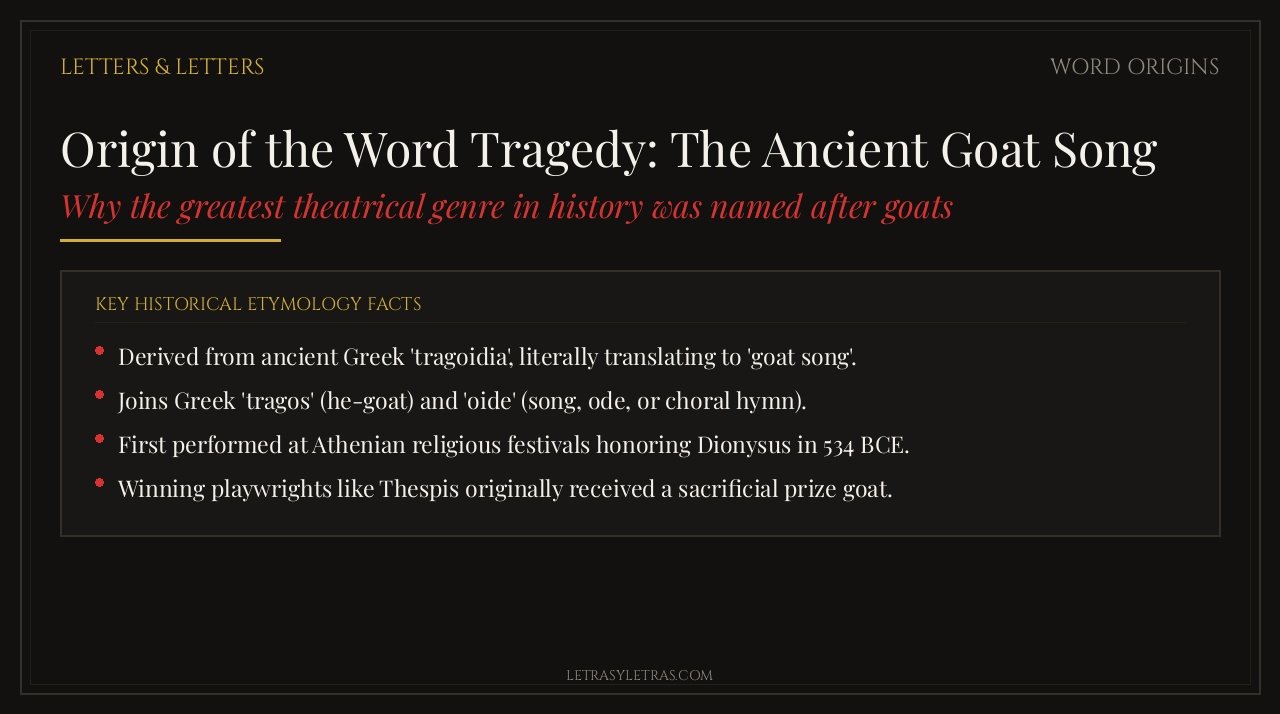
In ancient Greek, the word literally means goat song. As an essayist exploring classical literature at Alan Sledge, I find this etymological paradox endlessly fascinating. How did farm animals give birth to the highest genre of world literature?
Quick Answer: What Is the Origin of the Word Tragedy?
The word tragedy originated in ancient Greece from the compound tragoidia. Combining tragos meaning he-goat and oide meaning song, it originally described choral hymns at Dionysian festivals. Over centuries, Athenian playwrights and Aristotle transformed this rustic goat festival into serious dramatic theater.
Key Takeaways
- Tragedy translates literally from classical Greek as ‘goat song’.
- Joins Greek tragos (he-goat) and oide (song, ode, or poem).
- Originated in religious dithyramb hymns honoring the god Dionysus.
- Thespis introduced the first solo actor at the City Dionysia in 534 BCE.
- Chaucer and Shakespeare shifted the word from theater to human sorrow.
The Greek Roots: Tragos and Oide
To trace the authentic history, we must travel to sixth-century BCE Greece. The ancient word tragoidia was built from two ordinary, functional nouns.
The first element is tragos, the ancient Greek word for a he-goat. Greek oide provided the second element, meaning a song, ode, or choral hymn.
When combined, the compound literally formed goat-song. For modern readers accustomed to gloomy theatrical curtains, the pairing sounds comical. To an Athenian citizen, the connection was sacred and immediate.
The word was not born in quiet libraries. It arose in sun-drenched stone amphitheaters filled with incense, wine, and dancing crowds. Goats were central to rural Mediterranean religious life.
Like our study of the origin of the word barbarian, an earthy observation evolved. The physical reality preceded the abstract art.
The Three Theories: Why Was It Named After Goats?
Classical philologists have debated the precise connection between goats and drama for over two millennia. Three primary historical theories explain why tragedy received its peculiar title.
The first theory focuses on the festival prize. In early Athenian choral competitions, the winning poet was awarded a live he-goat. The goat was considered a prized sacrificial animal of high economic value.
The second theory points to the ritual sacrifice itself. Choral hymns were sung around a stone altar while priests prepared a goat for sacrifice to Dionysus. Singing accompanied the sacrificial rite.
The third theory highlights the performers’ costumes. Early chorus members may have dressed in shaggy goatskins to represent satyrs, mythical half-man, half-goat companions of Dionysus.
Classical records preserved in the Perseus Digital Library at Tufts University document these competing explanations. All three theories share deep roots in rural Athenian religion.
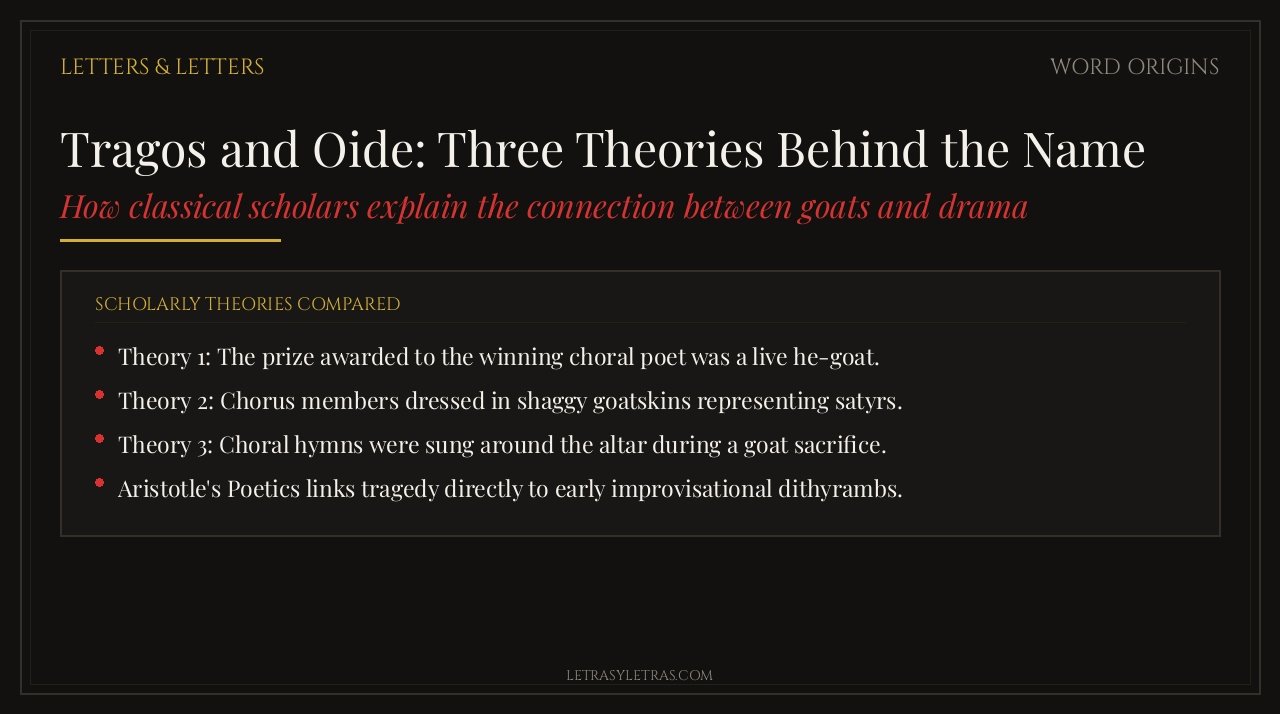
Scholarly theories explaining the fascinating historical link between goats and tragic drama.
The City Dionysia: Wine, Ecstasy, and Sacred Song
The institutional home of Greek tragedy was the City Dionysia, a massive annual festival held in Athens each spring. Citizens gathered to honor Dionysus, the patron deity of wine, rebirth, and theater.
Before plays existed, Greek men performed the dithyramb. This was a wild, passionate choral hymn recounting mythological legends through song and dance.
Dithyrambic choruses consisted of fifty men or boys moving in circular patterns around an altar. The mood was ecstatic, emotional, and intensely musical.
The Athenian tyrant Peisistratus reorganized the festival around 534 BCE into a civic competition. He invited choral poets from across Attica to compete for state honors.
This civic transformation turned religious ritual into public spectacle. Athens funded playwrights, paid chorus trainers, and provided free admission for impoverished citizens.
Thespis: The First Actor Steps Out
According to ancient tradition, the breakthrough that created drama occurred in 534 BCE. A choral director named Thespis of Icaria introduced a startling artistic innovation.
Instead of remaining within the choral group, Thespis stepped forward onto a raised wooden platform. He donned a linen mask and spoke in the first-person voice of a mythological character.
By engaging in dialogue with the chorus leader, Thespis invented the actor. His name gave English the word thespian, meaning an actor or theatrical performer.
This dialogue between an individual character and the community chorus formed the dramatic engine of tragedy. The goat song had evolved into theatrical storytelling.
Subsequent masters expanded this format rapidly. Aeschylus added a second actor, while Sophocles introduced a third actor and painted scenic backdrops.
The Tragic Trilogy and the Satyr Play
Athenian dramatic contests demanded staggering stamina from playwrights. Each competing tragic poet submitted four plays: three serious tragedies followed by one satyr play.
The three tragedies formed an interconnected or thematic trilogy. Playwrights explored generational curses, war guilt, and the harsh boundaries between mortals and Olympian gods.
After three emotionally exhausting tragedies, the audience needed release. The playwright then presented a bawdy, comic satyr play featuring choruses dressed in goatskins and tails.
These comic goat choruses reminded citizens that tragedy emerged from rustic revelry. Sacred ritual and broad humor coexisted within the same religious festival.
Aeschylus, Sophocles, and Euripides: The Three Masters
During the fifth century BCE, three Athenian dramatists perfected the genre. Aeschylus introduced grandiose choral poetry and moral majesty in masterworks like the Oresteia.
Sophocles shifted attention toward individual psychological suffering. In plays like Oedipus Rex and Antigone, characters struggle against cruel ironies of fate.
Euripides brought radical realism and skepticism to the Athenian stage. He examined the grim realities of war, female suffering, and divine cruelty in The Trojan Women.
Together, these three masters produced hundreds of dramas. Only thirty-three survive today, preserved in precious Byzantine manuscripts.
Aristotle’s Poetics: Catharsis and Fatal Flaws
Around 335 BCE, philosopher Aristotle wrote the Poetics, the first systematic treatise on dramatic theory. Aristotle looked back on two centuries of Athenian tragedy to explain its psychological power.
Aristotle confirmed that tragedy developed out of improvisational dithyrambs. He defined tragedy as an imitation of a serious, complete action that produces fear and pity in the audience.
This emotional purification was called catharsis. By witnessing noble characters suffer catastrophic reversals of fortune, spectators purged their own suppressed anxieties.
Aristotle argued that tragic protagonists do not suffer from pure wickedness. Instead, their downfall stems from hamartia, an error in judgment or fatal personal flaw.
When King Oedipus stubbornly pursues truth, his noble curiosity causes his ruin. The goat song had become an inquiry into fate, justice, and human limitation.
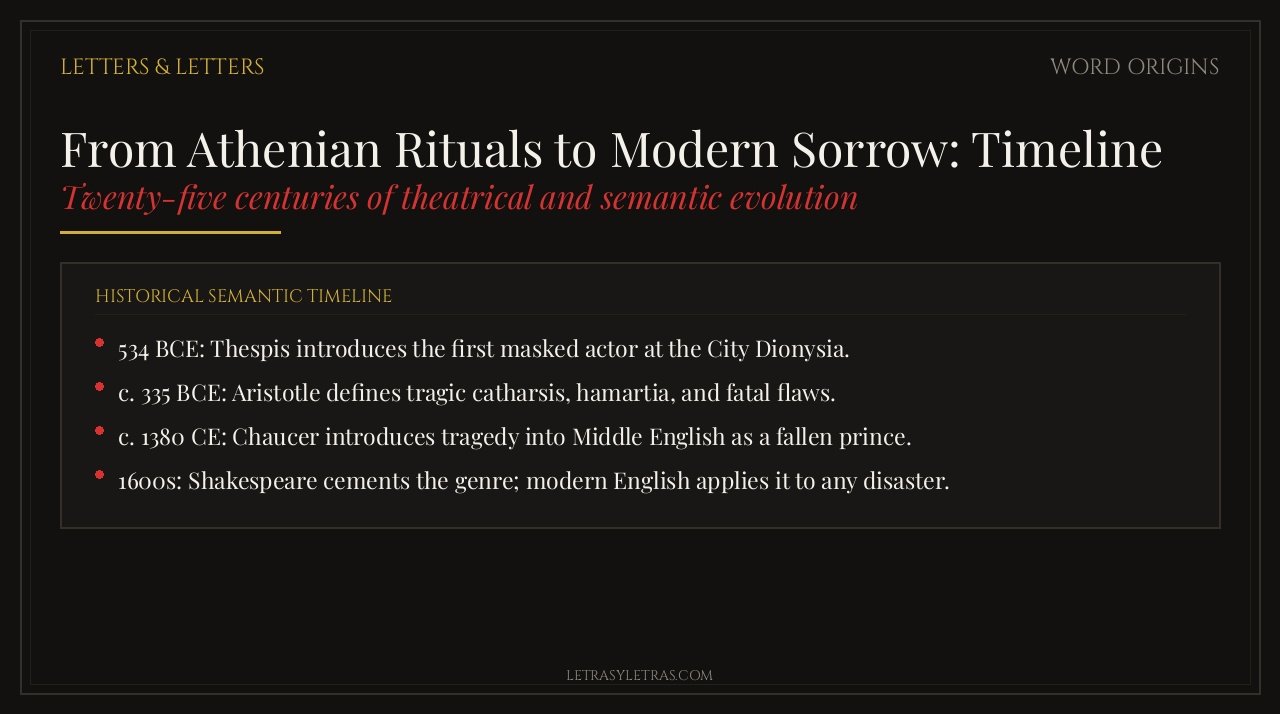
The evolutionary timeline tracing tragedy across twenty-five centuries of cultural history.
The Roman Transmission: Seneca’s Dark Spectacle
When the Roman Republic conquered Greece in the second century BCE, it eagerly adopted Greek theatrical forms. Roman writers translated Greek tragedies into Latin as tragoedia.
The most influential Roman tragedian was the Stoic statesman Seneca the Younger. Writing during the reign of Emperor Nero, Seneca crafted violent, psychological dramas.
Seneca filled plays like Medea and Thyestes with ghosts, gruesome revenge, and bloody curses. Unlike Athenian playwrights who kept violence offstage, Seneca placed horror in plain sight.
Seneca’s blood-soaked Latin tragedies survived the Middle Ages in monastic manuscripts. His macabre style directly inspired Renaissance playwrights in England and France.
Like our study of the origin of the word villain, Latin literary traditions reshaped the genre. The term became darker and more punitive.
From Chaucer to Shakespeare: Entering the English Language
The word tragedy entered Middle English during the late fourteenth century through Old French tragedie and Latin tragoedia. Poet Geoffrey Chaucer introduced the term in his literary works.
In The Monk’s Tale, Chaucer defined tragedy simply. It was a story of someone falling from high prosperity into ruin.
During the Elizabethan era, William Shakespeare and Christopher Marlowe elevated English tragedy to global heights. Masterpieces like Hamlet, Macbeth, and King Lear captured complex human psychology.
Shakespearean drama retained Aristotle’s emphasis on fatal character flaws. Elizabethan playwrights expanded the word’s cultural footprint far beyond royal courts.
The Online Etymology Dictionary records this shift. By the 1600s, English speakers used tragedy for any calamitous personal event.
Chronological Timeline of the Word Tragedy
To grasp the complete evolution of the word, we can trace key historical milestones. The table below outlines twenty-five centuries of linguistic transformation.
| Historical Era | Key Figure / Source | Dominant Meaning |
|---|---|---|
| c. 534 BCE | Thespis at the Athenian City Dionysia | A choral hymn with a solo masked actor competing for a prize goat. |
| c. 450 BCE | Aeschylus, Sophocles, and Euripides | Civic theatrical drama exploring fate, divine law, and royal suffering. |
| c. 335 BCE | Aristotle’s Poetics | Philosophical dramatic art producing catharsis through pity and fear. |
| c. 1380 CE | Geoffrey Chaucer’s The Monk’s Tale | A moral narrative showing a great ruler cast down from prosperity. |
| 1600s to Present | Shakespeare and Modern Journalism | A serious dramatic artwork, or any disastrous and heartbreaking real-world event. |
The Scapegoat Connection: Sacred Animal Symbolism
The goat’s connection to suffering and religious purification extends beyond ancient Athens. Across Mediterranean cultures, goats symbolized community atonement.
Like our analysis of the origin of the word scapegoat, ancient rituals used animal symbolism. Communities placed guilt onto a goat driven into the desert.
In Athenian drama, the tragic hero performs a similar spiritual function. Oedipus takes the pollution of Thebes upon his own shoulders and blinds himself to save his city.
The tragic hero is, in a symbolic sense, the community’s sacrificial goat. Spectators watch the hero suffer so that the social order can heal.
As scholars note in Oxford Reference classical companion entries, sacred sacrifice and dramatic poetry shared common psychological roots. The goat was the vessel for communal catharsis.
Modern Usage and the Loss of Meaning
In contemporary usage, the word tragedy is frequently applied to random misfortunes. We label plane crashes, industrial accidents, and sudden illnesses as tragedies.
Literary critics point out that random disasters are not true tragedies in the classical sense. An earthquake is a heartbreaking catastrophe, but it lacks tragic structure.
A classical tragedy requires choice, agency, and moral conflict. The protagonist must make a fateful decision that seals their destiny.
Remembering the ancient Greek root restores appreciation for the word’s depth. It reminds us that human beings have spent thousands of years gathering in theaters to confront mortality.
What began as a rustic goat song in Attica remains humanity’s most profound mirror. Through dramatic art, we find meaning in our deepest grief.
Frequently Asked Questions
Why is tragedy called goat song?
The word joins Greek tragos, meaning he-goat, and oide, meaning song. Early choral poets competed for a prize goat, performed in goatskins, or sang during animal sacrifices to Dionysus.
Who was the first tragic actor in history?
Thespis of Icaria is considered the first actor. At the 534 BCE Athenian festival, he stepped away from the chorus. He spoke lines as an individual masked character.
What did Aristotle consider the purpose of tragedy?
Aristotle argued that tragedy produces catharsis, an emotional cleansing of pity and fear. Spectators watch characters suffer from fatal flaws and leave the theater emotionally restored.
When did tragedy start meaning a sad real-world event?
During the early seventeenth century, English writers began applying the theatrical term to real-world calamities. By Shakespeare’s era, any catastrophic misfortune was described as a tragedy.
What is the difference between catastrophe and tragedy?
A catastrophe is a sudden, disastrous event caused by external forces. Tragic drama involves a protagonist whose personal choices and flaws contribute directly to their downfall.
Alan Sledge is the lead writer at letrasyletras.com. He uncovers the authentic histories behind our favorite words and sayings.


Alan Sledge is the writer and founder behind Letters & Letters. A lifelong lover of words, Alan has always been drawn to the small mysteries hidden in everyday language, why we say what we say, where our favorite sayings came from and the quotes that manage to put feelings into words better than we ever could ourselves.