
Have you ever wondered about the origin of the phrase golden handshake? It sounds like a warm gesture of business goodwill. The reality is far more transactional and pragmatic.
In the fast corporate world, firing a top executive is rarely simple. Senior leaders possess sensitive corporate secrets and legal influence. An angry departure can trigger stock drops and lengthy court battles.
To prevent public warfare, corporate boards developed a lucrative solution. They offered departing executives massive, guaranteed severance checks in exchange for quiet resignations. That high-stakes payout became known as a golden handshake.
Quick Answer: Origin of the Phrase Golden Handshake
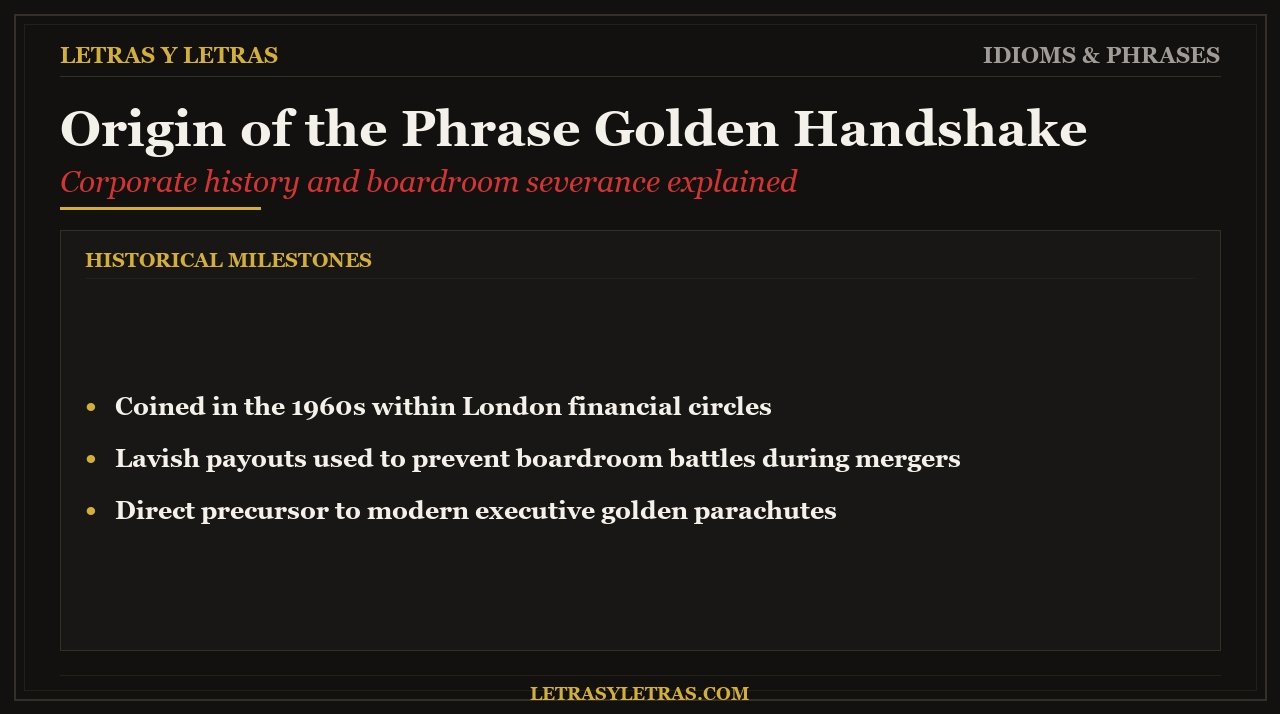
The origin of the phrase golden handshake dates to the mid-1960s in the City of London financial district. During a massive wave of corporate mergers, industrial conglomerates sought ways to remove redundant boardroom directors without public litigation or hostile proxy battles. The company offered departing senior executives substantial, tax-sheltered financial compensation in exchange for signing non-disclosure agreements and stepping down immediately. British financial newspapers first recorded the expression around 1960. Today, the idiom describes any lucrative severance package or contractual buyout paid to a high-ranking employee upon termination or early retirement.
Key Takeaways
- Coined in the mid-1960s within British financial and corporate legal circles.
- Created to buy the quiet resignation of senior executives during corporate mergers.
- Preceded related business idioms like golden parachute and golden handcuffs.
- Reflects the ancient economic custom of offering financial settlements to avoid conflict.
- Remains a central topic in modern executive compensation and corporate governance debates.
The 1960s London Financial District and Corporate Consolidations
Postwar Britain experienced massive industrial consolidation during the late 1950s and 1960s. Manufacturing firms, brewing companies, and financial institutions merged to survive international competition.
These consolidations created a significant administrative dilemma. Two merging corporations rarely needed two chairmen, two managing directors, or two finance chiefs. Senior boardroom seats were suddenly redundant.
Corporate boards could not simply terminate these directors like factory workers. Directors held contractual entitlements, company shares, and deep institutional knowledge. Firing them publicly invited hostile resistance and proxy wars.
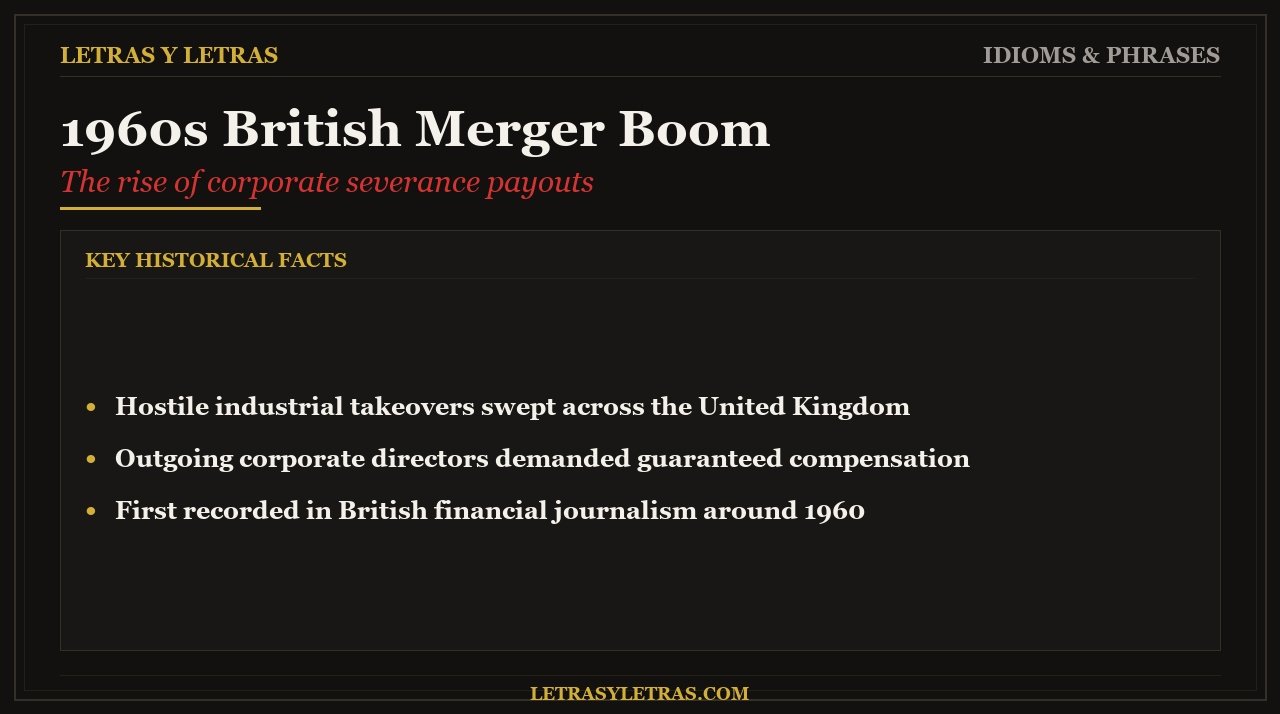
The City of London developed an elegant financial mechanism to solve this impasse. Rather than initiating a messy legal dispute, the board offered a lavish lump-sum payment.
This payment served several strategic purposes. It satisfied contractual obligations and ensured immediate cooperation. Most importantly, it bought total executive silence.
The director signed a mutual separation agreement. He surrendered his voting seat and praised his colleagues in the press. In return, he walked away with substantial financial security.
Journalists covering the London Stock Exchange quickly noted this pattern. They observed that every major corporate acquisition concluded with several senior men departing quietly.
By 1960, financial reporters began referring to these lucrative payouts ironically. They called the transaction a golden handshake. The term combined the physical ritual of parting with the immense value of gold.
Earliest Written Records and Literary Evolution
Linguistic researchers trace the earliest documented print appearances to British newspapers in the early 1960s. The phrase captured public curiosity immediately.
In 1960, the London publication *The Times* discussed corporate compensation disputes. Reporters used the phrase in quotation marks, indicating that it was novel financial slang.
Within three years, the expression shed its quotation marks. It became standard vocabulary in British business reporting and political debates.
The Oxford English Dictionary cites early 1960s industrial reports as the milestone where the idiom solidified. This expression quickly crossed the Atlantic to American corporate culture.
Wall Street embraced the phrase during the conglomerate merger wave of the late 1960s. American corporations adopted identical payout structures for ousted executives.
The phrase resonated because of its balance of politeness and cynicism. A handshake represents mutual respect and peaceful parting. The adjective golden exposes the sheer monetary scale of the transaction.
This combination made it a favorite metaphor for cartoonists and satirists. It exposed how wealth insulated elite corporate managers from the harsh realities of unemployment.
If factory workers lost their jobs to automation, they received minimal severance. When chief executives lost boardroom struggles, they received life-altering fortunes.
The linguistic contrast cemented the phrase permanently into the English lexicon of english idioms and meanings.
| Time Period | Setting and Context | Historical Development |
|---|---|---|
| Late 1950s | City of London | Postwar corporate mergers create redundant boardroom seats and leadership conflicts. |
| 1960 to 1962 | British Financial Press | First recorded appearances of the phrase in quotation marks in financial journalism. |
| Late 1960s | Wall Street, United States | American corporate acquisitions adopt the payout model and popularize the idiom globally. |
| 1980s | Global Financial Markets | Gives rise to derivative corporate idioms including golden parachute and golden handcuffs. |
The Metaphorical Family: Handshake, Parachute, and Handcuffs
The success of the golden handshake idiom inspired financial lawyers to coin related colorful metaphors. Over the subsequent decades, an entire family of golden corporate idioms emerged.
Studying these distinctions helps clarify modern business reporting and executive contracts. Each term addresses a different stage of the corporate employment relationship.
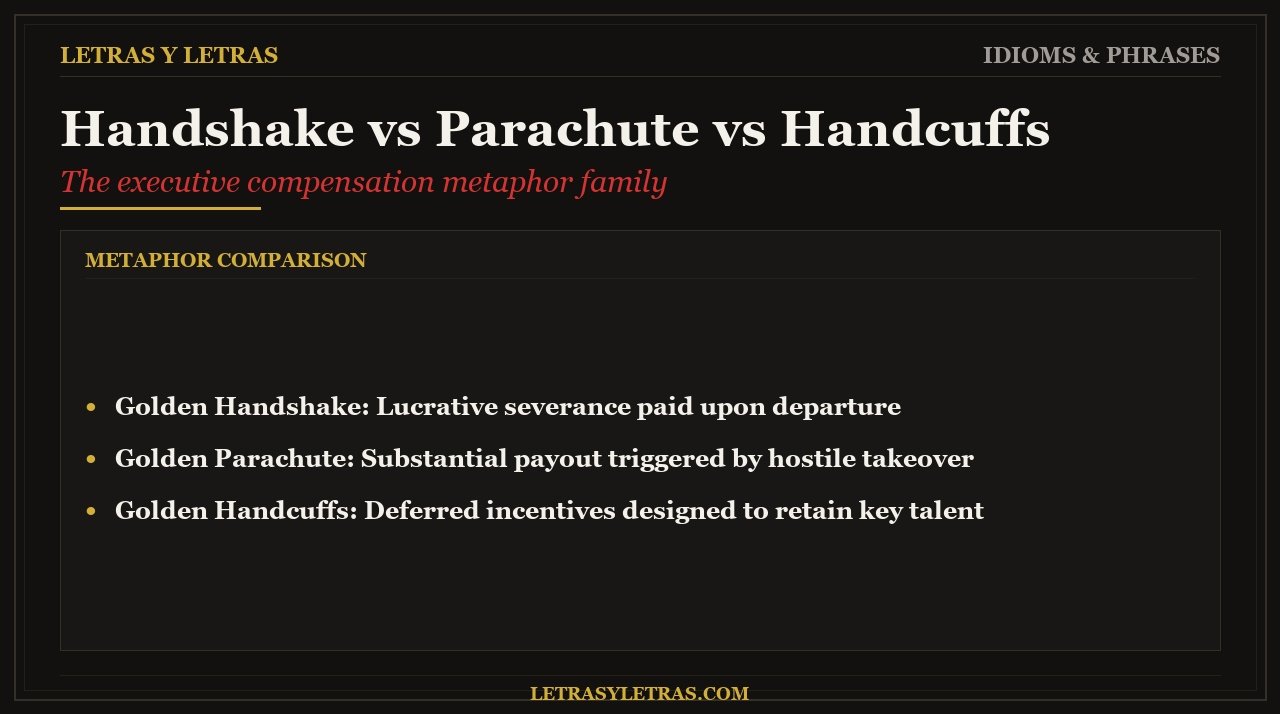
The original golden handshake is an exit payout agreed upon at departure. It is negotiated when the board decides an executive must leave.
In the late 1970s and 1980s, corporate raiders began launching hostile takeovers across American industry. Executives needed advance protection before raiders attacked.
Lawyers drafted employment clauses guaranteeing massive compensation if the company was acquired against management’s wishes. This upfront insurance policy was dubbed a golden parachute.
The image was vivid and unmistakable. If thrown from the corporate aircraft, his parachute opened safely onto a pile of money.
Soon after, human resource consultants developed another golden metaphor. They needed strategies to prevent brilliant executives from leaving for competitors.
They devised delayed bonuses, vesting stock options, and retention bonuses that matured over many years. If an executive quit early, he forfeited those riches.
Financial commentators called these deferred compensation packages golden handcuffs. They bound the executive to his desk with chains made of pure wealth.
Together, these three phrases form an expressive linguistic trio. They describe how modern corporate capitalism uses capital to manage human loyalty and boardroom conflict.
Like origin of the phrase burning bridges, these metaphors turn strategic tactics into unforgettable everyday imagery.
Ancient Precedents: The Roman Viaticum and Feudal Severance
While the specific idiom belongs to the twentieth century, the concept of paying leaders to depart peacefully is ancient. History reveals many historical parallels to the modern golden handshake.
In ancient Rome, military commanders recognized the danger of retired soldiers and political rivals lingering near power. Emperor Augustus established the military treasury in 6 AD.
Roman legionaries who completed twenty years of honorable service received a substantial cash grant called a praemia militiae. This payment ensured veterans bought rural farms rather than joining rebellions in Rome.
Similarly, outgoing Roman provincial magistrates received travel allowances called the viaticum. While ostensibly meant for travel expenses, these funds functioned as handsome departure settlements.
During the Middle Ages, feudal monarchs routinely used golden settlements to remove rival dukes and pretenders to the crown. A rebellious baron was often granted distant estates and gold pensions.
The monarch understood that purchasing peace was cheaper than fighting a prolonged civil war. In turn, the baron agreed to retreat into private luxury rather than mobilize his knights.
The 1960s British corporate directors were acting on the exact same psychological impulse. When powerful individuals face forced retirement, generous compensation disarms hostility.
By studying these historical patterns, we recognize that business idioms rarely invent entirely new behaviors. They simply dress ancient human negotiation in contemporary corporate attire.
Corporate Governance Debates and Modern Controversy
In corporate governance, the golden handshake evolved into a subject of fierce public controversy.
During the late twentieth century, executive compensation packages exploded in size. Payouts that once numbered in tens of thousands of pounds expanded into tens of millions of dollars.
Shareholder advocacy groups began questioning the ethics of these enormous payouts. Critics pointed out a troubling paradox known as paying for failure.
If a chief executive drove a company into severe losses, the board often fired him to protect the brand. Under his contract, however, termination entitled him to an immense severance settlement.
The executive walked away with generational wealth while retail investors suffered devastating losses. Employees faced mass layoffs while the departed leader received lavish accolades and cash.
This public outrage prompted regulatory reforms across major economies. In the United Kingdom and the United States, regulators introduced shareholder votes on executive pay.
Corporations now face strict disclosure rules regarding severance terms. Modern contracts frequently include clawback provisions allowing boards to reclaim severance funds if fraud or misconduct emerges.
Despite these regulatory hurdles, the golden handshake remains a standard fixture of executive recruitment. Top corporate talent routinely demands guaranteed severance before accepting high-stress leadership roles.
The phrase has also expanded far beyond the executive suite into everyday vernacular. People now use it humorously to describe any generous bonus received upon leaving an organization or project.
Frequently Asked Questions
What is the difference between a golden handshake and a golden parachute?
A golden handshake is a negotiated severance payment agreed upon when an employee leaves a company. A golden parachute is a pre-negotiated clause written into an executive contract that guarantees compensation specifically if the company is acquired in a hostile takeover.
Who coined the phrase golden handshake?
The phrase was coined by British financial journalists in the early 1960s covering corporate mergers in the City of London. Reporters used the expression to describe substantial lump-sum payouts given to redundant boardroom directors.
Are golden handshakes legal in modern corporate governance?
Yes, golden handshakes are entirely legal contractual agreements between employers and employees. However, public corporations must disclose these compensation packages to regulatory authorities and shareholders under modern corporate governance laws.
Why do companies pay golden handshakes to underperforming executives?
Companies provide these payouts to avoid costly litigation, enforce non-disclosure agreements, and protect corporate brand reputation. Paying a quick severance is often cheaper and less disruptive than enduring a public legal battle with a former leader.
What does the phrase golden handcuffs mean?
Golden handcuffs refer to financial incentives such as unvested stock options or deferred bonuses designed to keep an employee from quitting. If the employee departs before the specified time period, they forfeit the accumulated wealth.
Alan Sledge is the founder and lead writer at letrasyletras.com, dedicated to uncovering the true etymological histories behind our favorite words and phrases.


Alan Sledge is the writer and founder behind Letters & Letters. A lifelong lover of words, Alan has always been drawn to the small mysteries hidden in everyday language, why we say what we say, where our favorite sayings came from and the quotes that manage to put feelings into words better than we ever could ourselves.

Alan Sledge
Alan Sledge is the founder and lead researcher behind Letters & Letters. A lifelong student of linguistic history, he cross-references every word origin, idiom, and quote against primary archival manuscripts, the Oxford English Corpus, and 18th-century print lexicons.