
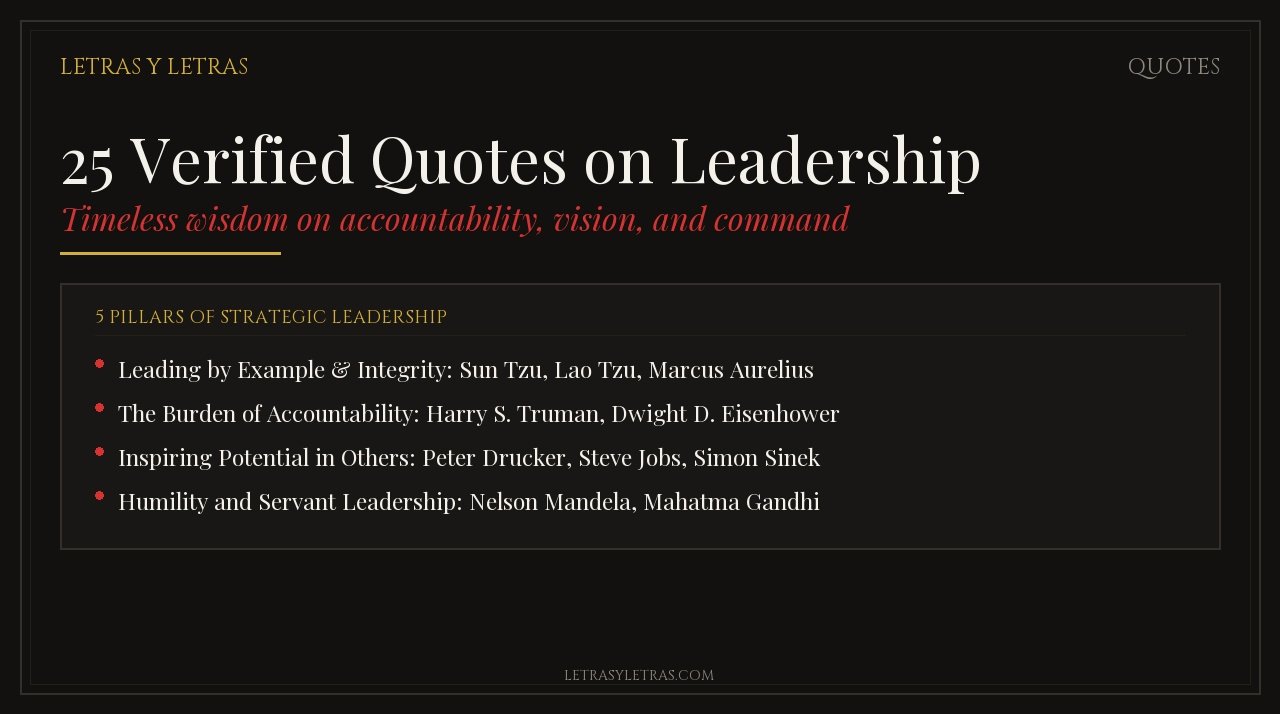
Real leadership is rarely about loud commands or formal authority. The most respected leaders throughout history led through moral example, discipline, and profound accountability.
In times of crisis and uncertainty, people look for steady guidance. Words spoken by seasoned leaders provide timeless clarity across generations. They remind us that true influence is earned through service.
If you are guiding a team, building a career, or seeking personal discipline, historical wisdom offers an enduring compass. Here is a curated collection of 25 verified quotes on leadership from history’s most consequential thinkers.
Quick Answer: What Defines True Leadership?
True leadership is the capacity to translate vision into reality while maintaining unwavering personal accountability and humility. Across classical philosophy, military strategy, and modern organizational management, authentic leaders do not merely command obedience. They cultivate psychological safety, shoulder personal responsibility for failures, and give credit to their teams for successes. From ancient Stoic emperors like Marcus Aurelius to modern thinkers like Peter Drucker, the defining hallmark of great leadership is leading by personal example rather than coercion.
Key Takeaways
- Authentic leadership prioritizes personal accountability over formal status or corporate privilege.
- Historical thinkers consistently emphasize leading by silent example rather than aggressive rhetoric.
- Great leaders absorb blame during difficult setbacks and pass praise to their followers.
- Humility and active listening remain the bedrock of long-term organizational trust.
- Decisive action requires balancing intellectual preparation with rapid, courageous execution.
Pillar 1: Leading by Example and Moral Integrity
A leader whose actions contradict his principles cannot command lasting loyalty. Followers study how their leaders behave under stress far more closely than what they say in speeches.
1. “A leader is best when people barely know he exists, when his work is done, his aim fulfilled, they will say: we did it ourselves.” – Lao Tzu
The ancient Taoist philosopher understood the power of humble facilitation. Master leaders build independence within their teams rather than dependence on ego.
2. “Waste no more time arguing about what a good man should be. Be one.” – Marcus Aurelius
In his personal journals, the Roman emperor reminded himself that philosophy is proven through conduct. Leadership begins with personal self-governance before directing others.
3. “Example is not the main thing in influencing others. It is the only thing.” – Albert Schweitzer
The Nobel laureate recognized that human beings mimic behavior naturally. If you expect discipline and punctuality, you must embody those standards yourself daily.
4. “The supreme quality for leadership is unquestionably integrity. Without it, no real success is possible.” – Dwight D. Eisenhower
As Supreme Allied Commander during World War II, Eisenhower knew that trust is the currency of command. Once followers doubt a leader’s honesty, tactical plans collapse.
5. “To lead people, walk behind them.” – Lao Tzu
Subtle guidance often achieves greater results than forceful pushing. Supportive leadership allows talented team members to discover their own capabilities safely.
Pillar 2: The Burden of Ultimate Responsibility
The defining test of leadership is how one responds when things go wrong. Weak leaders blame subordinates, while exceptional leaders accept complete responsibility for systemic failures.
6. “The buck stops here.” – Harry S. Truman
President Truman kept a famous wooden sign on his desk in the Oval Office. It served as an unyielding reminder that final accountability cannot be delegated away.
7. “A good leader takes a little more than his share of the blame, a little less than his share of the credit.” – Arnold H. Glasow
Generosity in success and courage in failure create unbreakable loyalty. Teams perform with bold initiative when they know their leader shields them from unfair fallout.
8. “Leadership is the art of giving people a platform for spreading ideas that work.” – Seth Godin
Modern organizations thrive when leaders remove bureaucratic obstacles. Leadership is about clearing paths rather than building corporate tollbooths.
9. “You gain strength, courage, and confidence by every experience in which you really stop to look fear in the face.” – Eleanor Roosevelt
The legendary First Lady championed human rights in the face of intense social resistance. Facing organizational adversity builds internal resilience that inspires everyone around you.
10. “A leader who does not hesitate before he sends his nation into battle is not fit to be a leader.” – Golda Meir
As Prime Minister of Israel, Meir understood the immense human cost of command. Genuine authority requires deep moral gravity and respect for human life.
| Leader / Thinker | Historical Era | Core Philosophy |
|---|---|---|
| Marcus Aurelius | Roman Empire (161-180 AD) | Stoic self-governance and moral duty before exercising civic authority. |
| Harry S. Truman | United States (1945-1953) | Absolute executive accountability without deflecting blame to subordinates. |
| Peter Drucker | Modern Management (1909-2005) | Defining institutional mission and empowering knowledge workers to excel. |
| Nelson Mandela | South Africa (1918-2013) | Reconciliation, humility, and leading from behind to foster unity. |
Pillar 3: Vision and Inspiring Collective Purpose
Managing daily tasks keeps an enterprise running, but leadership gives people a compelling reason to commit their energy. A clear vision transforms routine labor into shared mission.
11. “Management is doing things right; leadership is doing the right things.” – Peter Drucker
The father of modern management clearly separated administrative efficiency from strategic direction. Leaders focus on purpose and ethical alignment rather than mere activity.
12. “If your actions inspire others to dream more, learn more, do more and become more, you are a leader.” – John Quincy Adams
True influence is measured by how much growth you spark in others. Elevating the capabilities of your peers is the highest calling of leadership.
13. “People do not buy what you do; they buy why you do it.” – Simon Sinek
In his seminal work on inspirational leadership, Sinek observed that human beings rally around core convictions. Clear purpose attracts dedicated collaborators organically.
14. “The greatest leader is not necessarily the one who does the greatest things. He is the one that gets the people to do the greatest things.” – Ronald Reagan
A leader’s primary achievement is unleashing potential in his team. When people feel capable and trusted, extraordinary breakthroughs happen.
15. “It doesn’t make sense to hire smart people and tell them what to do; we hire smart people so they can tell us what to do.” – Steve Jobs
The Apple co-founder recognized that micromanagement suffocates creative genius. Exceptional leaders provide clear objectives and grant autonomy to subject experts.
Pillar 4: Humility and Servant Leadership
Arrogance is the downfall of many gifted commanders. When a leader believes he is above scrutiny, organizational blind spots multiply rapidly.
16. “It is better to lead from behind and to put others in front, especially when you celebrate victory when nice things occur. You take the front line when there is danger.” – Nelson Mandela
After enduring twenty-seven years of imprisonment, Mandela united a divided nation through sheer humility. He stepped forward during crises and pushed others forward during triumphs.
17. “The servant-leader is servant first. It begins with the natural feeling that one wants to serve.” – Robert K. Greenleaf
Greenleaf founded the modern servant leadership movement in 1970. He argued that authority should be evaluated by how those served grow healthier and wiser.
18. “I suppose leadership at one time meant muscles; but today it means getting along with people.” – Mahatma Gandhi
Gandhi dismantled a global empire without firing a single weapon. Moral persuasion and emotional connection will always outlast brute physical force.
19. “Before you are a leader, success is all about growing yourself. When you become a leader, success is all about growing others.” – Jack Welch
A fundamental psychological shift occurs when one moves into leadership. Your personal scorecard ceases to matter; the collective performance of your team becomes your only metric.
20. “True leadership lies in guiding others to success, in ensuring that everyone is performing at their best, doing the work they are pledged to do and doing it well.” – Bill Owens
Leadership is fundamentally an enabling profession. When your team succeeds, the entire organization moves forward in harmony.
Like our companion guide on quotes on courage, humility requires mastering internal ego before guiding external projects.
Pillar 5: Decisive Action in Crisis
Deliberation is vital, but prolonged hesitation paralyzes teams. When emergency strikes, leaders must make timely choices with incomplete information and stand behind them firmly.
21. “Courage is what it takes to stand up and speak; courage is also what it takes to sit down and listen.” – Winston Churchill
The British wartime leader understood that listening requires immense restraint. Great commanders actively solicit opposing viewpoints before making irrevocable decisions.
22. “In any moment of decision, the best thing you can do is the right thing, the next best thing is the wrong thing, and the worst thing you can do is nothing.” – Theodore Roosevelt
Roosevelt championed the strenuous life and decisive action. In competitive environments, total inaction is invariably more dangerous than a calculated mistake.
23. “A leader is a dealer in hope.” – Napoleon Bonaparte
Even in the depths of winter campaigns, Napoleon maintained an aura of unshakeable confidence. When circumstances look bleak, a leader’s emotional poise sustains morale.
24. “Do what you can, with what you have, where you are.” – Theodore Roosevelt
Resource constraints are an inevitable reality of every project. Exceptional leaders reject excuses and find creative ways to advance with current assets.
25. “You do not lead by hitting people over the head; that’s assault, not leadership.” – Dwight D. Eisenhower
Eisenhower frequently used this humorous analogy to warn young officers against tyranny. Lasting commitment comes from respectful persuasion rather than aggressive intimidation.
You can explore more wisdom in our directory of famous quotes and quotations.
Debunking Famous Misattributed Leadership Quotes
The internet frequently circulates inspiring quotes with erroneous historical attributions. As lovers of etymology and language history, we must separate verified records from internet folklore.
One popular quote often attributed to Winston Churchill reads: “Success is not final, failure is not fatal: it is the courage to continue that counts.”
Churchill historians have searched his complete speeches and writings and found zero record of this statement. The phrase actually originated in a 1938 beer advertisement and was later popularized in motivational books.
Another widespread quotation attributed to Niccolo Machiavelli states: “A leader must be feared rather than loved, if he cannot be both.”
While Machiavelli explored this theme in *The Prince*, the exact modern phrasing is an oversimplified paraphrase. Machiavelli added a vital caveat that modern readers often overlook.
He emphasized that a ruler must avoid inspiring hatred at all costs. Being feared for strict justice was acceptable, but cruelty that fostered contempt guaranteed a ruler’s rapid overthrow.
Verifying historical sources protects us from shallow corporate clichés. Genuine leadership wisdom requires studying the exact historical context in which these words were forged.
Frequently Asked Questions
What is the single most important quality of a great leader?
Historical evidence consistently points to integrity and personal example as the most critical leadership qualities. Without demonstrated honesty and ethical consistency, followers will not trust a leader during moments of severe crisis.
What is the difference between a manager and a leader?
A manager focuses on organizational processes, budgeting, task allocation, and operational efficiency. A leader focuses on setting vision, inspiring people, establishing psychological safety, and fostering long-term cultural growth.
Who coined the phrase servant leadership?
The term servant leadership was coined by Robert K. Greenleaf in his 1970 essay titled *The Servant as Leader*. Greenleaf proposed that the primary role of authority is serving the growth and well-being of followers.
Why is humility considered essential for modern leadership?
Humility allows leaders to listen to contradictory evidence, admit errors early, and hire people who are more skilled than themselves. Arrogant leaders create echo chambers that blind them to evolving market threats.
Did Winston Churchill really say success is not final?
No, there is no documented record of Winston Churchill ever speaking or writing those words. The famous quote originated in early twentieth-century print advertising before being mistakenly attributed to Churchill in subsequent decades.
Alan Sledge is the founder and lead writer at letrasyletras.com, dedicated to uncovering the true etymological histories behind our favorite words and phrases.


Alan Sledge is the writer and founder behind Letters & Letters. A lifelong lover of words, Alan has always been drawn to the small mysteries hidden in everyday language, why we say what we say, where our favorite sayings came from and the quotes that manage to put feelings into words better than we ever could ourselves.

Alan Sledge
Alan Sledge is the founder and lead researcher behind Letters & Letters. A lifelong student of linguistic history, he cross-references every word origin, idiom, and quote against primary archival manuscripts, the Oxford English Corpus, and 18th-century print lexicons.