
Every language maintains expressions that describe human defeat with vivid physical drama. Among our most enduring sayings, few conjure such instant imagery as biting the dust.
Most modern listeners associate the phrase with cowboy shootouts on dusty frontier trails. Others hear Freddie Mercury singing the driving bass rhythm of Queen’s 1980 rock anthem.
Yet this dramatic idiom did not begin in Hollywood westerns or recording studios. Its roots reach back nearly three thousand years to ancient Greek spear combat.
Quick Answer: Where Did the Phrase Bite the Dust Originate?
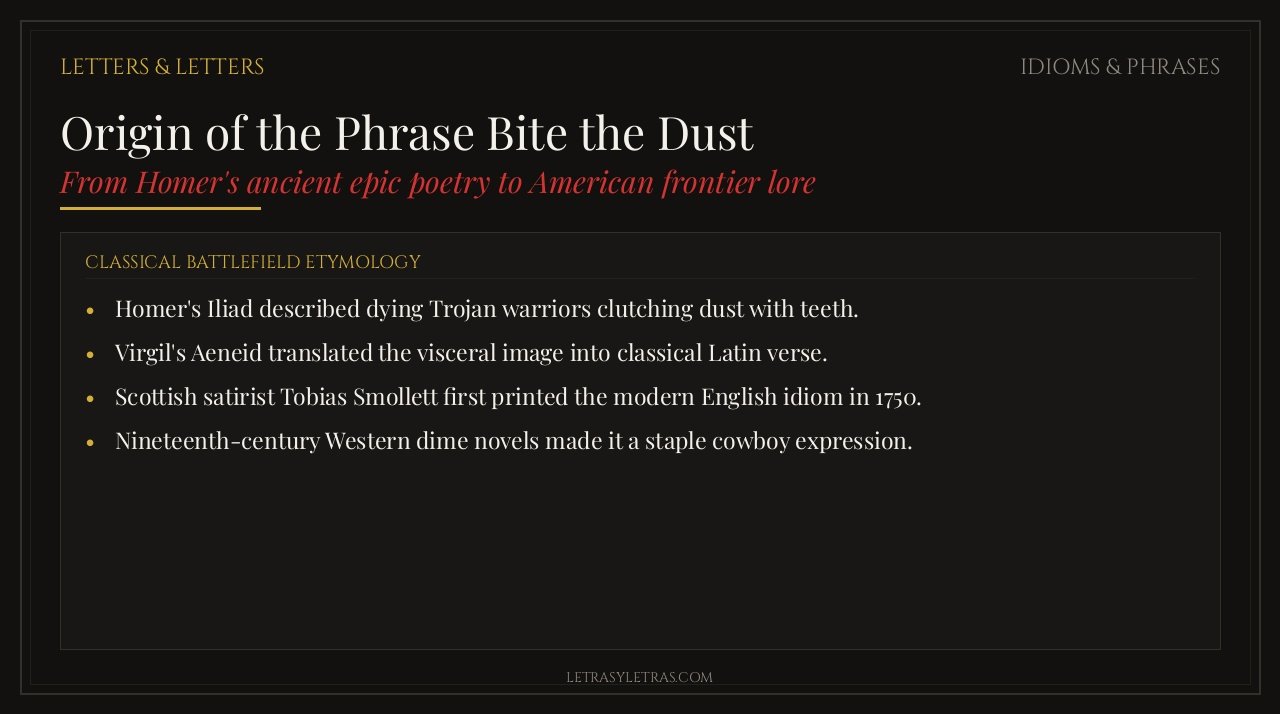
The phrase bite the dust originated in ancient Greek and Latin epic poetry describing slain warriors collapsing face down in battle. Scottish satirist Tobias Smollett first printed the exact English phrase in his 1750 translation of Gil Blas. American Western dime novels popularized the expression during the nineteenth century before Queen made it a global rock anthem in 1980.
Key Takeaways: The Historical Path of Bite the Dust
- Homeric Origin: Homer’s Iliad (c. 750 BCE) described dying Trojan warriors clutching dirt with their teeth during fatal spasms.
- Latin Heritage: Virgil’s Aeneid translated the image into Latin as humum semel ore momordit to convey heroic death.
- First English Print: Scottish author Tobias Smollett published the exact modern wording in his 1750 translation of Gil Blas.
- Frontier Fiction: Victorian dime novels and Hollywood cinema shifted the phrase from bronze spears to cowboy revolver duels.
- Universal Modern Idiom: Today, the saying describes mechanical breakdowns, corporate failures, and sports losses alongside physical death.
The Visceral Bronze Age: Homer’s Dying Warriors
The earliest known ancestor of our idiom appears in Homer’s epic poem the Iliad. Composed around the eighth century BCE, the work chronicles the brutal siege of Troy.
Homer possessed an unflinching eye for the physical realities of bronze spear warfare. When bronze weapon tips pierced bronze armor, men collapsed abruptly into dry soil.
To capture this sudden agony, Homer used the Greek phrase odax helon en koniesi. Literally translated, the phrase means seizing the dust between one’s teeth.
In Book Two of the Iliad, King Agamemnon prays for total military victory before advancing his army. He asks Zeus to grant that his enemies fall headlong and grip the dust with their teeth.
Classical scholars preserved these lines in the Tufts University Perseus Digital Library collection. Homer repeated this gripping line throughout multiple battle scenes across the Trojan plain.
The Greek poet did not intend this description as decorative literary ornamentation. He was recording an accurate medical consequence of fatal trauma.
When a spear or bronze arrow severed nerve pathways, human muscles contracted violently. The dying soldier’s jaw clamped shut in painful muscular spasms.
Falling face forward into dry earth, the soldier’s clenched teeth bit deep into the dirt. Homer transformed that gruesome physical reality into an unforgettable combat motif.
Virgil and the Classical Latin Tradition
Seven centuries after Homer, the Roman poet Virgil sat down to compose Rome’s national epic, the Aeneid. Virgil revered Homeric tradition and deliberately mirrored Greek battle descriptions.
In Book Eleven of the epic, Virgil recounts the heroic death of the Etruscan warrior Herminius. Struck down by a fatal spear strike, Herminius crashes to the earth.
Virgil wrote that the falling soldier humum semel ore momordit. In English, that famous line translates as he bit the ground once dying.
By using the Latin verb mordere, meaning to bite, Virgil formalized the image for Roman readers. The expression came to symbolize the ultimate price of military glory.
Other Roman poets adopted similar phrasing when describing heroic defeats. Lucan and Ovid both employed variations of biting earth to dramatize tragic combat deaths.
For classical writers, biting the ground marked the stark divide between victory and defeat. The standing soldier breathed air; the fallen soldier swallowed soil.
Biblical Parallels: Licking the Dust
While Greco-Roman poets spoke of biting the dust, ancient Hebrew scriptures developed a related phrase. Biblical writers frequently described defeated foes as licking the dust.
In the King James Bible of 1611, Psalm 72:9 proclaims that enemies of the king bow down. Ancient verses warn that his adversaries lick the dust.
The prophet Micah used similar language when foretelling the downfall of pagan nations. He declared that foreign princes would lick dust like creeping serpents.
There is a meaningful difference between biting dust and licking dust. Licking dust represented deliberate voluntary groveling in front of an imperial conqueror.
Biting dust, by contrast, remained an involuntary physical reflex of sudden death. Both expressions reinforced the symbolic connection between dry dirt and total defeat.
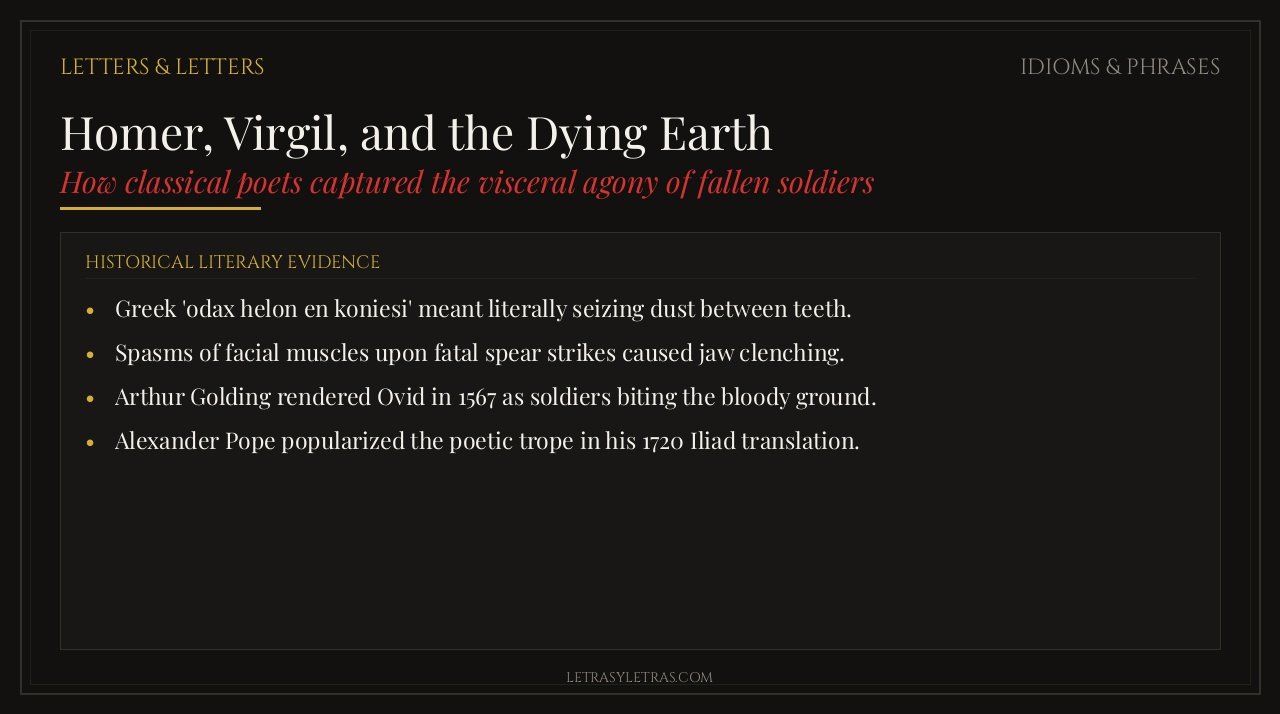
Classical literary evidence connecting ancient Greek epic poetry to the modern idiom.
Renaissance English Translators: Biting the Ground
During the sixteenth century, English scholars began translating classical Greek and Latin epics into early modern English. These humanists searched for English phrases that matched antique grandeur.
In 1567, poet Arthur Golding published his influential English translation of Ovid’s Metamorphoses. When describing fallen warriors, Golding wrote that soldiers bit the bloody ground.
A decade later in 1578, military chronicler Thomas Proctor recorded accounts of continental battles. Proctor described defeated infantrymen lying groveling and biting the dust.
When Alexander Pope published his famous translation of the Iliad in 1720, he wrestled with Homer’s Greek phrase. Pope selected high poetic diction to capture Agamemnon’s prayer.
Pope wrote that fierce adversaries would sink into death and bite the ground. Ground was the favored literary term in high British poetry for over a century.
According to the Online Etymology Dictionary entry for dust, English writers gradually substituted dust for ground. Dust carried stronger biblical overtones of human mortality and decay.
Tobias Smollett: The First Modern English Appearance
The transition from poetic translations to everyday English prose took place during the mid-eighteenth century. Scottish physician Tobias Smollett cemented the exact wording in print.
Smollett was a master of lively satirical prose. In 1748, he achieved widespread acclaim with his rowdy sea novel The Adventures of Roderick Random.
In 1750, Smollett released his English translation of Lesage’s French picaresque romance, Gil Blas of Santillane.
Book Four of the story, young adventurers encounter desperate highway robbers in a dark forest. A fierce firefight breaks out between travelers and bandits.
Smollett described the violent skirmish with sharp energy. He wrote: We made two of them bite the dust, and the others betake themselves to flight.
Readers can examine Smollett’s exact 1750 text in the digital Project Gutenberg edition of Gil Blas. This publication marks the earliest documented appearance of the exact modern phrase in published English prose.
Smollett used the expression with natural confidence. His casual phrasing suggests that British soldiers and sailors may already have used the phrase colloquially.
By putting the line into print, Smollett freed the phrase from academic poetry. He planted the expression firmly in the lively garden of popular adventure literature.
Nineteenth-Century Romantic Literature and Scott
Following Smollett’s publication, other British writers recognized the phrase’s dramatic power. Sir Walter Scott did more than anyone to spread historical idioms across nineteenth-century Britain.
In his 1819 medieval romance Ivanhoe, Scott depicted thunderous knightly jousts in muddy tournament grounds. Armored riders plunged headlong from saddles when struck by solid lances.
Scott wrote of courageous champions making haughty Norman knights bite the dust. Readers across Britain and the United States devoured Scott’s historical romances by the hundreds of thousands.
Victorian poets quickly adopted the expression into popular military ballads. Lord Byron used variations when memorializing fallen heroes of the Greek War of Independence.
By the mid-nineteenth century, biting the dust was a recognized standard English idiom. It appeared regularly in London newspapers, courtroom transcripts, and serialized magazine stories.

The three-thousand-year evolutionary timeline of the phrase bite the dust.
How the American Frontier Claimed the Saying
How did an ancient Greek battle phrase become indelibly linked to the American Wild West? The answer lies in the explosive popularity of nineteenth-century dime novels.
Following the American Civil War, publishers in New York churned out cheap adventure pamphlets. Authors like Ned Buntline wrote sensational stories of frontier marshals, outlaws, and cavalry scouts.
These pulp novels needed dramatic action verbs. When frontier sheriffs engaged train robbers in dusty boomtown streets, gunsmoke filled the dry desert air.
Outlaws shot from wooden saloon boardwalks tumbled face forward into untamed street dirt. Dime novelists adopted Smollett’s old phrase to describe these gunfight casualties.
Readers in eastern cities loved the visceral frontier imagery. The phrase appeared so often in Western pulp stories that readers assumed it originated in Texas or Arizona.
When Hollywood launched talking motion pictures in the late 1920s, Western cinema adopted this literary heritage. Screenwriters gave the line to tough lawmen played by John Wayne and Gary Cooper.
In hundreds of classic Western movies, outlaws bit the dust before the final credits rolled. Cinema cemented the illusion that the phrase was purely an American cowboy invention.
Queen and the Modern Pop Culture Anthem
By the late twentieth century, the phrase had settled into familiar colloquial English. Then, in the summer of 1980, British rock band Queen released their eighth studio album, The Game.
Bassist John Deacon composed a distinctive funk rhythm inspired by chic disco grooves. Singer Freddie Mercury delivered an aggressive, breathless vocal performance over the pounding drum loop.
The song was titled Another One Bites the Dust. Released as a worldwide single in August 1980, the track became a monumental international hit.
The single topped the United States Billboard Hot 100 for three consecutive weeks. It sold over seven million copies worldwide, becoming Queen’s best-selling single of all time.
The massive global reach of the record gave the antique idiom renewed life. A whole new generation of international music fans learned the phrase through Freddie Mercury’s vocals.
Sports arenas began playing the song whenever home teams scored decisive points against rivals. The idiom shifted effortlessly from military death into competitive sporting triumph.
Historical Evolution Timeline
| Era | Author & Context | Key Phrasing | Cultural Legacy |
|---|---|---|---|
| c. 750 BCE | Homer, The Iliad | Odax helon en koniesi | Recorded physical jaw spasms of slain Trojan soldiers. |
| c. 19 BCE | Virgil, The Aeneid | Humum semel ore momordit | Established the fallen warrior motif in Latin classical verse. |
| 1567 CE | Arthur Golding, Metamorphoses | Bite the bloody ground | Introduced the classical motif into early modern English literature. |
| 1750 CE | Tobias Smollett, Gil Blas | Made two of them bite the dust | First recorded appearance of modern wording in English prose. |
| 1870s to 1950s | American Western Fiction | Another outlaw bit the dust | Associated the phrase permanently with cowboys and frontier shootouts. |
| 1980 CE | Queen, The Game | Another One Bites the Dust | Transformed the ancient phrase into a global multi-platinum anthem. |
Debunking Common Folk Etymology Myths
Because the phrase evokes vivid imagery, several popular folk etymologies circulate widely online. Responsible language historians must address and dismantle these historical fictions.
The most frequent myth claims the expression began with nineteenth-century American cowboys. Proponents assert that riding bucking horses caused cowboys to hit the ground with open mouths.
While falling off a horse undoubtedly causes dirt ingestion, this folk explanation ignores documentary history. Smollett published the exact phrase in London nearly a century before American cowboy culture developed.
A second persistent myth links the phrase to battlefield surgery during the American Civil War. This theory claims wounded soldiers were given dirt to chew to silence screams during amputations.
This medical claim is completely false. Military surgeons used lead bullets, leather straps, or rum to assist suffering soldiers.
Nobody gave wounded men handfuls of dirt to chew before painful medical procedures. Clean soil was unavailable, and doctors understood that swallowing soil caused rapid infection.
A third myth attributes the saying to Native American surrender ceremonies. Historical records from Haudenosaunee and Plains tribes contain zero ceremonies involving eating dirt.
As documented in our research on the origin of the phrase bury the hatchet, authentic peace ceremonies involved burying weapons. They never involved ritualistic soil chewing.
The Semantic Shift: From Fatal Combat to Broken Toasters
Like many dramatic military phrases, biting the dust underwent significant semantic broadening over the centuries. Linguists call this process semantic weakening or generalization.
In ancient Greece and eighteenth-century Britain, the phrase carried lethal weight. If a warrior bit the dust, he had lost his life upon the battlefield.
During the twentieth century, English speakers began applying the phrase playfully to non-fatal failures. A student who failed a difficult university examination joked that they bit the dust.
Today, the idiom applies equally to inanimate machines and corporate ventures. When a kitchen blender stops running, family members remark that another appliance bit the dust.
When startup companies run out of capital, business reporters announce that another firm has bitten the dust. The violent mortality of Homer’s battlefield has softened into friendly conversational shorthand.
This semantic transition mirrors our findings on the origin of the phrase flash in the pan. Both expressions began in deadly gunpowder and spear warfare before settling into casual workplace vocabulary.
Why Dust Remains Humanity’s Ultimate Metaphor
Why has this particular phrase survived for nearly three millennia while other ancient expressions vanished? The explanation lies in humanity’s universal relationship with soil.
Across ancient cultures, dirt represented both human creation and human conclusion. The Book of Genesis reminds readers that from dust thou art, and unto dust shalt thou return.
Earth is the fundamental element that receives all organic life at death. To fall into dirt is to surrender the proud vertical posture that defines human consciousness.
When living beings stand upright, they assert independence from the earth below. As death arrives, gravity reclaims the body, returning flesh to dirt.
Biting the dust captures that tragic moment with total physical clarity. The mouth, which once spoke noble words and sang songs, now tastes only cold ground.
That stark contrast between human pride and earthy reality explains the phrase’s enduring resonance. Homer recognized it, Smollett appreciated it, and Queen set it to rhythm.
Frequently Asked Questions
What is the primary meaning of the phrase bite the dust?
The idiom bite the dust means to die, suffer total defeat, or stop functioning. English speakers apply it to fallen warriors, losing sports teams, failed business ventures, and broken household machines.
Did American cowboys invent the phrase bite the dust?
No, American cowboys did not invent the expression. Homer described fallen warriors in ancient Greece. Scottish novelist Tobias Smollett published the exact English phrase in 1750.
What is the difference between bite the dust and kick the bucket?
Both expressions serve as informal idioms for dying. Bite the dust applies to machines and defeats. By contrast, kick the bucket refers solely to human death.
Did Homer use the exact English words bite the dust?
No, Homer composed his poetry in ancient Greek. His exact phrase was odax helon en koniesi, which translates directly as seizing the dust between the teeth.
Who wrote the Queen song Another One Bites the Dust?
Queen bassist John Deacon composed the music and lyrics for Another One Bites the Dust. The multi-platinum track appeared on the band’s 1980 studio album titled The Game.
Alan Sledge is the lead writer at letrasyletras.com. He uncovers the authentic histories behind our favorite words and sayings.


Alan Sledge is the writer and founder behind Letters & Letters. A lifelong lover of words, Alan has always been drawn to the small mysteries hidden in everyday language, why we say what we say, where our favorite sayings came from and the quotes that manage to put feelings into words better than we ever could ourselves.