
When you hear the word handicap today, your thoughts likely turn to golf scorecards or designated parking spaces. You might think of physical limitations or athletic leveling systems.
Few people pause to consider the strange compound itself. What could a human hand and an ordinary cap possibly have to do with competitive disadvantages? The origin of the word handicap hides one of the most surprising histories in the English language.
As an essayist exploring word histories at Alan Sledge, I love unearthing forgotten customs. The true story does not begin in clinics or hospitals. It began inside smoke-filled seventeenth-century London taverns as a rowdy drinking game.
Quick Answer: What Is the Origin of the Word Handicap?
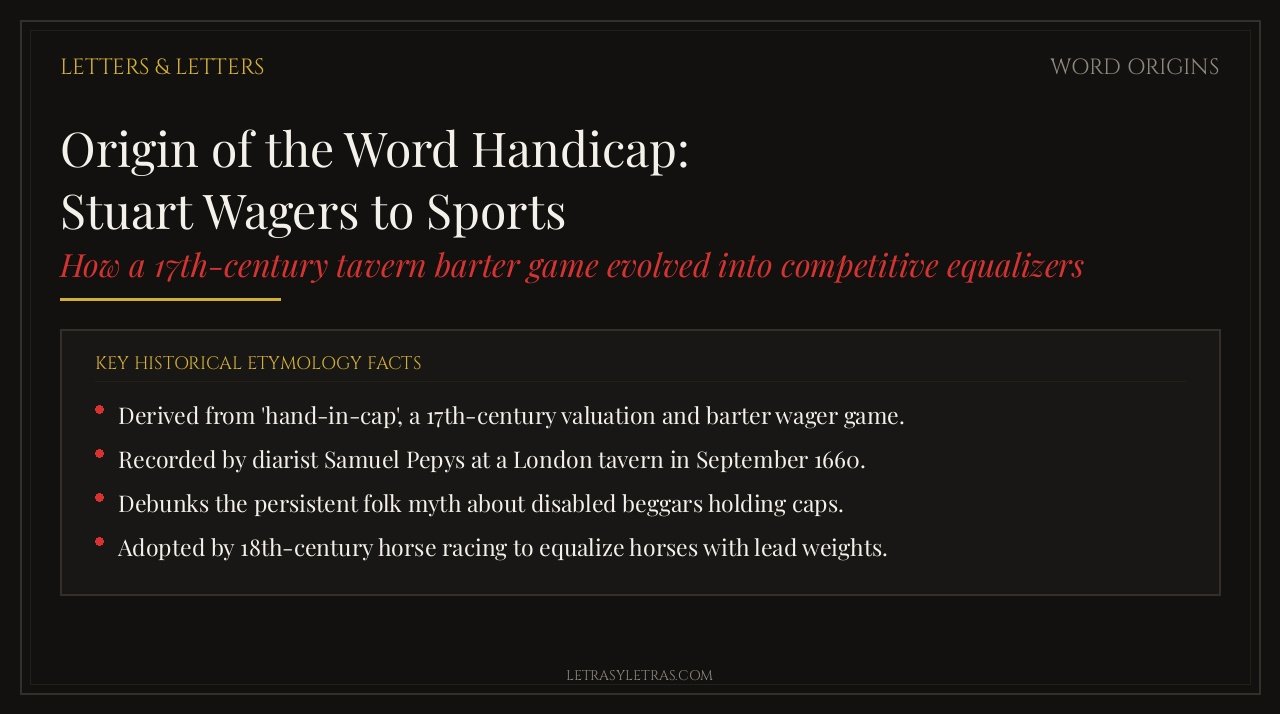
The word handicap originated in seventeenth-century England from an old valuation wager game called hand in cap. Two traders appointed an impartial umpire to appraise two items of unequal value. Both players placed forfeit money into a cap and drew out their hands to signal agreement. By the mid-eighteenth century, horse racing adopted the term to describe extra weights placed on faster horses to equalize competition. Only during the early twentieth century did the term shift from athletic leveling to physical disabilities.
Key Takeaways
- Originated in seventeenth-century England from a barter game called ‘hand in cap’.
- Diarist Samuel Pepys recorded the earliest written account of the tavern game in 1660.
- Debunks the popular urban legend about disabled war veterans begging with caps in hand.
- Eighteenth-century horse racing used handicap weights to equalize winning chances.
- Expanded into golf and sports before medical texts applied the word to disabilities around 1915.
The Persistent Myth: Beggars and Caps in Hand
Before examining the authentic historical records, we must confront a widespread folk tale. Many popular websites still repeat a fictional story about King Henry VII and disabled veterans.
According to this urban legend, sixteenth-century soldiers injured in foreign wars had no government pensions. The crown allegedly granted these disabled soldiers official licenses to beg on London streets. In this telling, the impoverished veterans stood on street corners holding their caps in hand.
The story claims that passersby dropped coins into the caps, creating the word handicap. It sounds tidy and sympathetic. Yet professional lexicographers and historians confirm that this tale is complete fiction.
The Oxford English Dictionary and researchers at Douglas Harper’s Online Etymology Dictionary have firmly debunked this myth. No royal charter ever licensed veterans to beg under that name.
The idiom cap in hand does exist in English as a gesture of humility. Servants removed their hats before noblemen to show respect. However, that humble phrase shares zero linguistic connection with the noun handicap.
The True 1660 Origin: The Tavern Game of Hand in Cap
The authentic history begins in Stuart-era England during the mid-seventeenth century. English tavern patrons loved games of chance, bartering, and friendly wagers.
Two men frequently wanted to exchange possessions of unequal worth. One man might offer an old riding horse, while the other offered a velvet hunting jacket. Because the articles had different values, direct bartering was difficult.
To settle the deal equitably, the traders played a game called hand in cap. They appointed a neutral third party to serve as an impartial umpire. The umpire inspected both items carefully.
The umpire determined how much money the owner of the lesser item needed to add to make the trade equitable. This balancing sum was known in old English commerce as the boot.
Next, all three participants placed an agreed amount of forfeit money into a cap. Both traders then placed their hands into their pockets. An umpire announced the exact cash valuation to the room.
Both traders reached closed fists into the cap. At an agreed signal, both men pulled their hands out simultaneously to reveal their decision.
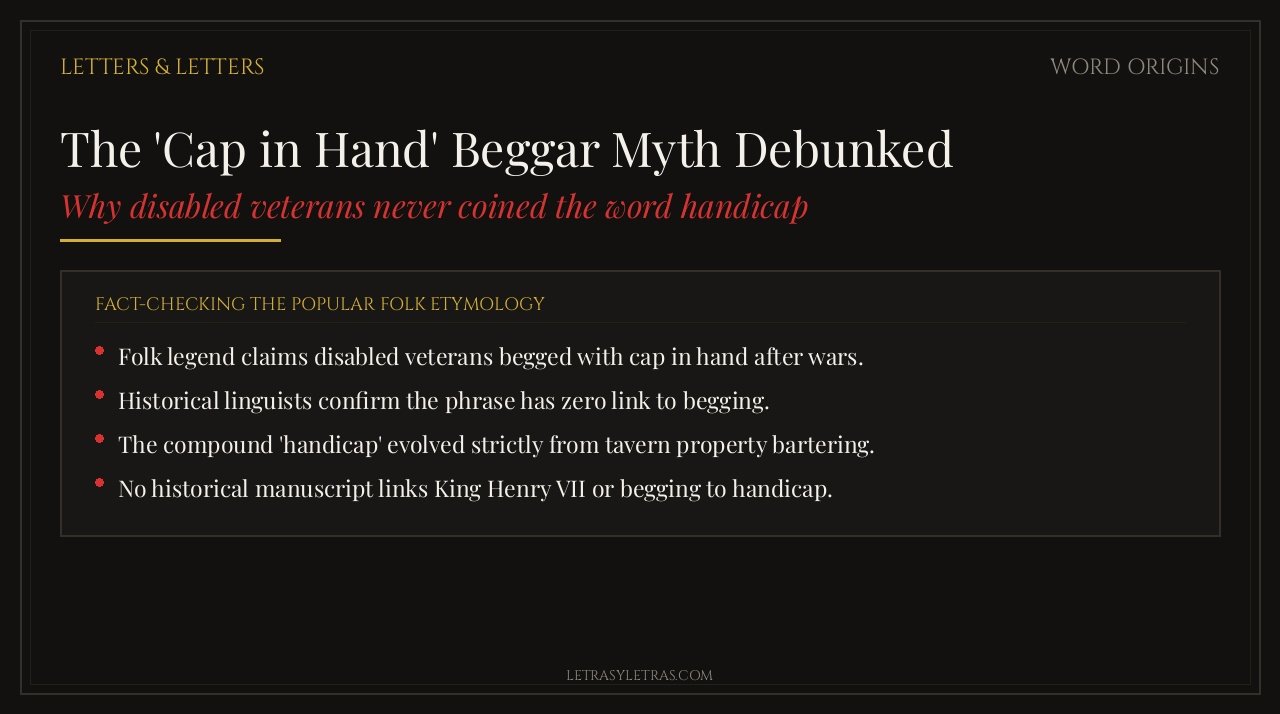
Historical fact-checking confirms that the word handicap originated in tavern bartering, not begging.
How the Hand in Cap Wager Worked
The rules governing the closed hands were clever and suspenseful. If a trader’s hand came out holding coins, it meant he accepted the umpire’s valuation.
If a hand emerged completely empty, it meant the trader rejected the trade. The outcome depended on mutual consent between both men.
When both players agreed to the trade, the exchange was finalized immediately. The owner of the cheaper item paid the designated cash boot to the other man. In addition, the umpire received the forfeit money in the cap as his fee.
What happened if both men withdrew empty hands? The trade was canceled immediately. Because neither man wanted the deal, the umpire kept the forfeit pool for his trouble.
The drama peaked when one man agreed while the other man refused. In that tense situation, the trade was cancelled.
The man who had accepted the valuation won all the forfeit money in the cap. Meanwhile, the stubborn refuser lost his stake.
This penalty discouraged unreasonable stubbornness. It forced men to think carefully before rejecting a fair valuation. The game became known simply as hand in cap, which spoken English quickly slurred into handicap.
Samuel Pepys and the Mitre Tavern in 1660
We possess direct historical proof of this game thanks to the famous diarist Samuel Pepys. On September 18, 1660, Pepys spent an evening socializing in central London.
Pepys recorded the gathering in his personal journal. The diary entry is now archived through The Diary of Samuel Pepys online records. His entry provides the earliest known written record of the game.
Pepys wrote that he went to the Mitre Tavern in Wood Street with several companions. While drinking wine, the patrons fell to handycapp, a sport that he had never seen before.
The diarist noted that he found the game entertaining and lively. Gentlemen used the game to swap horses, pocket watches, and walking canes. It provided a lively way to spend an evening while avoiding hostile arguments over value.
Over the following decades, the spelling solidified into handicap. Like our study of the origin of the word tragedy, an earthy social ritual gained lasting cultural power. The tavern game laid the foundation for modern competition.
The 18th Century Shift: Horse Racing and Equalizer Weights
For nearly a century, handicap remained strictly a valuation game between two traders. That narrow definition changed drastically during the middle of the eighteenth century.
English thoroughbred horse racing was growing into a major national spectator sport. Wealthy aristocrats bred powerful horses and wagered massive fortunes on race outcomes.
However, early racing faced a serious commercial problem. A handful of champion horses dominated every single contest. Slower horses had zero chance of winning, which killed betting interest and spectator attendance.
Around 1754, racing officials at Newmarket devised a brilliant mathematical solution. They borrowed the core principle of the old hand in cap game. Officials decided to equalize the chances of unequal competitors.
An official handicapper inspected every horse entered in the race. The handicapper assigned extra physical weight to the faster, superior animals. Jockeys carried small lead bars inside their saddle cloths, known as handicap plates.
A champion stallion might carry ten extra pounds of lead, while an unproven filly ran light. The theoretical goal was magnificent. If the handicapper calculated the weights correctly, every horse would cross the finish line in a dead heat.
| Time Period | Historical Context | Meaning of Handicap |
|---|---|---|
| Mid-1600s | Stuart-era English taverns and markets | A valuation wager game where players drew hands from a cap to exchange unequal items. |
| 1660 | Samuel Pepys Diary at the Mitre Tavern | Earliest written documentation of ‘handycapp’ as a gentleman’s tavern sport. |
| 1754 | English Thoroughbred Racing Calendars | Added weight penalties assigned to superior horses to equalize competitive winning odds. |
| Late 1800s | Victorian athletic clubs, golf, and yachting | A scoring adjustment given to players of different abilities to create a fair match. |
| Early 1900s | Medical, educational, and civic literature | Semantic shift referring to physical, sensory, or developmental disabilities. |
| Modern Era | Contemporary legal and civil rights standards | Sports scoring device; largely replaced by ‘disability’ in human social contexts. |
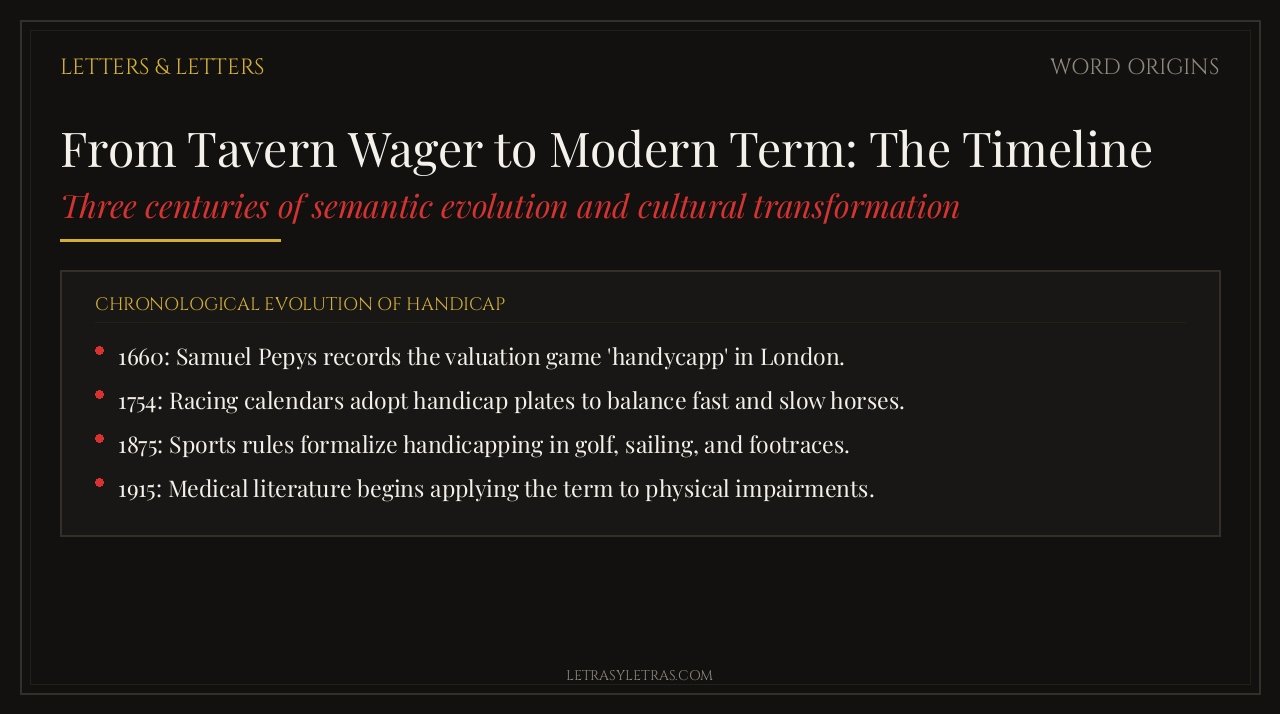
The three-century evolutionary timeline tracing the semantic history of handicap.
The Evolution from Racecourse to Sports Equality
The horse racing innovation was a sensational triumph. Crowds packed racecourses to watch handicap races, where unpredictable finishes replaced boring runaway victories.
Notice the critical semantic shift that occurred here. In the tavern game, handicap referred to the forfeit pool and the agreement process. On the racecourse, handicap began to mean the actual burden assigned to the favorite.
The extra lead in the saddle was the handicap. It was a calculated burden designed to produce competitive fairness. During the nineteenth century, other sports quickly adopted the concept.
Victorian gentlemen applied handicaps to competitive footraces, rowing regattas, and sailing matches. Fast runners started several yards behind the starting line, while novice runners received head starts.
Nowhere did the term find a more permanent home than on the golf course. By the late 1800s, British golf clubs developed mathematical handicaps based on average past scores.
A skilled scratch golfer gave strokes to an amateur companion. The handicap allowed players of vastly different abilities to compete on equal terms. In athletics, possessing a handicap was never viewed as an insult.
The 20th Century Shift: From Sports to Physical Disability
Throughout the nineteenth century, handicap remained firmly rooted in sports and games. People recognized it as an artificial burden imposed to level a contest.
Gradually, writers began using the word as a general metaphor for any life disadvantage. A merchant might note that lack of capital was a severe handicap in business. Similarly, a politician might describe a lack of formal education as a handicap.
Then, around the turn of the twentieth century, the word made a dramatic leap into medicine and education. Philanthropic organizations began using the phrase handicapped children to describe youngsters with physical impairments.
By 1915, clinical publications frequently used the term. Society viewed physical disability through the lens of a sporting race. People conceptualized an impairment as an extra burden carried in the race of life.
Federal legislation and school boards adopted the terminology widely. During the mid-twentieth century, phrases like physically handicapped became standard across Western governance and public signage.
The old tavern wager had traveled a staggering distance. A seventeenth-century game involving hats and coins now defined medical diagnoses and civic accessibility laws.
Modern Perspectives: Why Language Has Evolved
In recent decades, our relationship with the word handicap has shifted once again. Language is never static, as our study of the origin of the word barbarian proves.
Disability advocates and linguistic scholars have pointed out the problematic nature of the term when applied to human beings. In sports, a handicap is an artificial penalty assigned by an external authority to slow someone down.
Applying that metaphor to people implies that individuals with disabilities are inherently burdened or diminished competitors. Today, international civil rights organizations strongly prefer person-first language, such as person with a disability.
Legal statutes have followed this cultural shift. The United States replaced older legislative terms with the Americans with Disabilities Act.
Britain enacted the Equality Act with similar modern definitions. In modern English, handicap has returned largely to its sporting roots.
We still calculate golf handicaps and handicap horse races. We recognize the word’s origins in communal fairness, even as we retire it from descriptions of human dignity.
Connecting Words: The Rich Web of English Sayings
The history of handicap reminds us that language is deeply connected to daily life. Words rarely spring from academic committee rooms. They emerge from taverns, sports fields, religious rituals, and crowded markets.
Consider how many everyday sayings share similar origins in games and contests. Our collection of english idioms and meanings reveals countless sporting expressions that now guide business and conversation.
Phrases that seem modern often conceal centuries of human experience. When we explore our treasury of famous quotes and quotations, we see writers wrestling with these evolving meanings.
Knowing where a word comes from changes how you speak it. The next time you see a handicap placard or check a sports score, you will picture a seventeenth-century London tavern. You will see hands reaching into a wool cap, balancing property with coins and laughter.
Frequently Asked Questions
Did the word handicap come from beggars holding caps in hand?
No, historical linguists confirm that this popular story is an urban legend. The phrase cap in hand was an ancient gesture of subservience, but it has zero etymological connection to handicap. Instead, the word developed strictly from a seventeenth-century tavern barter game.
What was the original 17th-century game called hand in cap?
Hand in cap was a valuation and wager game used to exchange goods of unequal value. An umpire determined the price difference between two items, and players put forfeit money into a cap. Closed hands drawn from the cap revealed if players accepted or rejected the deal.
How did horse racing change the meaning of handicap?
In the mid-eighteenth century, racing officials adopted the term to create competitive races between horses of unequal speed. The handicapper assigned extra lead weights to faster horses so every competitor had an equal theoretical chance to win.
When did handicap start referring to physical disabilities?
The word transitioned from sports to physical and cognitive impairments in the early twentieth century, around 1915. Educational and medical institutions conceptualized disability as an extra burden carried in the race of life.
Why is the word handicap discouraged in modern disability language?
Modern disability advocates prefer terms like disabled person or person with a disability. In sports, a handicap is an artificial penalty assigned to slow someone down. Using it for human beings mistakenly frames disability as an inherent flaw rather than a natural aspect of human diversity.
Alan Sledge is the founder and lead writer at letrasyletras.com, dedicated to uncovering the true etymological histories behind our favorite words and phrases.


Alan Sledge is the writer and founder behind Letters & Letters. A lifelong lover of words, Alan has always been drawn to the small mysteries hidden in everyday language, why we say what we say, where our favorite sayings came from and the quotes that manage to put feelings into words better than we ever could ourselves.